
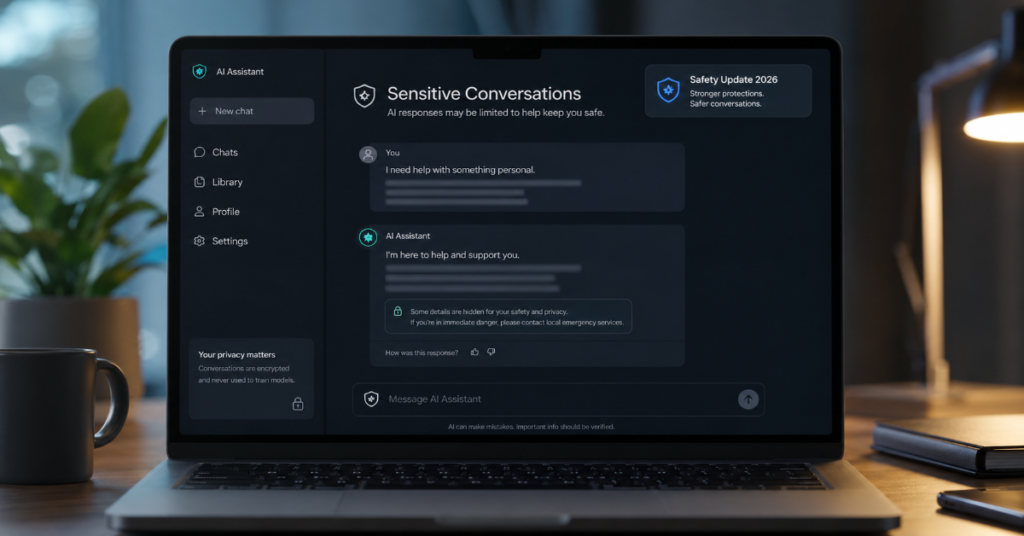
ChatGPT safety update released on May 14, 2026 represents the most significant advancement in how conversational AI systems handle sensitive and high-risk interactions since the deployment of safe completion systems in 2023. OpenAI’s new system enables ChatGPT to recognise that a request appearing ordinary or innocent on its own may carry a very different meaning when viewed alongside earlier messages in the same or previous conversations showing signs of distress, harmful intent, or escalating risk. The system introduces safety summaries — short, factual notes about earlier safety-relevant context that may matter in rare, high-risk situations — and cross-conversation safety tracking that allows ChatGPT to connect warning signs across separate sessions when they only become concerning in combination. The results from internal evaluations are substantial: in long single-conversation scenarios, safe-response performance improved by 50% in suicide and self-harm cases and by 16% in harm-to-others cases. On GPT-5.5 Instant, the current default ChatGPT model deployed across 900 million weekly users, safe-response performance improved by 52% in harm-to-others cases and by 39% in suicide and self-harm cases. These are not marginal improvements — they represent a step-change in the ability of an AI system to handle the rarest but most consequential category of interactions that users have with it.
How Safety Summaries Work — The Technical Architecture
The safety summary system is built on a layered architecture that deliberately separates safety reasoning from general conversation capability. OpenAI trained a dedicated model specifically for safety reasoning tasks — separate from the general ChatGPT model — whose sole function is to analyse conversations and generate narrowly scoped, factual notes about safety-relevant context. These summaries are short — a few sentences at most — and are generated only when the safety model detects signals of serious concern. They capture factual context, not interpretations or predictions: information like a user describing a specific situation, expressing intent, or making requests that combine to suggest elevated risk.
Critically, the safety summaries are time-limited and purpose-scoped. They are not stored as long-term memory, are not used for general personalization of ChatGPT responses, and are not accessible for any purpose other than informing safety-relevant responses when a later request triggers concern. The design choice to keep summaries entirely separate from ChatGPT’s memory and personalization systems reflects a deliberate ethical architecture: the same data that makes ChatGPT more personalized and useful across everyday conversations is not what drives safety responses. Safety reasoning runs on a separate track, with separate purpose and separate storage limits. According to the latest 2026 documentation reviewed from OpenAI’s official safety announcement and the EdTech Innovation Hub coverage, the safety summaries were evaluated across 4,000 assessments and scored 4.93 out of 5 for safety relevance and 4.34 out of 5 for factuality — indicating high reliability in accurately characterising the safety context they are meant to capture.
“Risk is not always clear from a single message. They may emerge gradually, through subtle shifts in context, intent, or behavior over time. And in sensitive conversations, this context can matter as much as a single message.” — Declan Grabb, Safety, OpenAI, and clinical mental health provider, LinkedIn statement, May 14, 2026
ChatGPT Safety Update — Performance Improvements by Scenario
| Scenario Type | Test Context | Safe Response Improvement | Model Tested |
| Suicide and self-harm | Long single conversation | +50% safe response rate | Previous default model |
| Harm to others | Long single conversation | +16% safe response rate | Previous default model |
| Harm to others | GPT-5.5 Instant (current default) | +52% safe response rate | GPT-5.5 Instant |
| Suicide and self-harm | GPT-5.5 Instant (current default) | +39% safe response rate | GPT-5.5 Instant |
| Cross-conversation risk (multi-session) | Risk signals across separate sessions | New capability — not present before | GPT-5.5 Instant |
| Ordinary conversations | Benign everyday interactions | No degradation in helpfulness | All models tested |
The Cross-Conversation Architecture — A Genuinely New Capability
The cross-conversation component of the safety update is the most technically novel element and the one that raises the most governance questions. The system recognises that some safety risks emerge across separate conversations — that a subtle sign of harmful intent in one session may only become concerning in combination with a related request in a subsequent session that would appear entirely benign when viewed in isolation. To address this, OpenAI developed the safety summary system that can retain limited, narrowly scoped notes about safety-relevant prior context and use them to inform how ChatGPT interprets later requests.
The governance architecture is designed to address the obvious concern: that cross-session data retention for any purpose creates privacy exposure. OpenAI has implemented three specific constraints on the system. First, the safety summaries are created only by the dedicated safety model, not by ChatGPT itself, and only when the safety model detects signals meeting a threshold of serious concern. Second, the summaries are kept for a limited time — they are not permanent records that accumulate indefinitely. Third, the summaries are used only when a current request triggers safety concern and are not accessible to ChatGPT for any other purpose. These constraints are real design choices, not marketing language. They create a meaningful distinction between safety-motivated cross-session awareness and general-purpose surveillance of user conversations. Whether those constraints are sufficient for the populations most likely to interact with ChatGPT in high-risk situations — people in mental health crisis, domestic violence situations, or other acute risk scenarios — is a question that the EdTech Innovation Hub and other organisations working in regulated AI are continuing to evaluate.
“These updates help ChatGPT better recognize patterns of potentially harmful intent both within and across conversations. When concerning signals emerge gradually, the model is better able to identify the pattern and respond more safely.” — OpenAI official safety update announcement, May 14, 2026
The Mental Health Expert Collaboration — Two Years of Clinical Input
The ChatGPT safety update is described by OpenAI as building on more than two years of collaboration with mental health and safety experts. The Global Physicians Network that contributed to the system includes psychiatrists, psychologists, and specialists in forensic psychology, suicide prevention, and self-harm — clinical professionals whose expertise in how risk presents and evolves in real-world conversations is the foundation of the training data and policy decisions that underpin the system. According to OpenAI’s official announcement, these experts helped inform when safety summaries should be created, how much prior context is relevant, and how long the model should consider that context when responding.
The clinical input is not incidental to the system’s design — it is constitutive. OpenAI’s five-step process for developing mental health safety capabilities begins with defining the problem (mapping different types of potential harm), measuring it (using evaluations, real-world conversation data, and user research), validating the approach with external experts, mitigating the risks through post-training and product interventions, and continuing to measure and iterate. The published metrics — 50% improvement in suicide and self-harm scenarios, 52% improvement in harm-to-others cases on GPT-5.5 Instant — reflect a system that has been evaluated against real-world clinical standards rather than solely against automated benchmarks. OpenAI states that the work currently focuses on self-harm and harm-to-others scenarios and may be extended to other high-risk areas including biology and cyber safety with appropriate safeguards.
| Safety System Component | Technical Implementation | Privacy Constraint | Clinical Validation |
| Safety summaries | Separate dedicated safety model generates short factual notes | Time-limited — not long-term memory; purpose-scoped only | 4.93/5 safety relevance; 4.34/5 factuality (4,000 evaluations) |
| Cross-conversation tracking | Safety model retains limited safety context across sessions | Used only when current request triggers concern; not for personalization | Clinical expert input on threshold criteria and context scope |
| Context-aware risk recognition | ChatGPT trained to interpret requests in light of prior safety context | Safety track separate from personalization track | Expert-defined taxonomies of harmful conversation patterns |
| Multi-model routing | Sensitive conversations re-routed to safer model variants | No change to user-facing model selection | Mental health expert validation of routing criteria |
| Ordinary conversation protection | System designed to escalate only when harm signals present | No impact on helpfulness in benign interactions confirmed in testing | Validated against everyday conversation benchmarks |
“This is hard, ongoing work. No system will be perfect. But helping AI better recognize when context matters is an important step toward building systems that are useful in everyday moments and take additional care in the moments that matter most.” — Declan Grabb, Safety, OpenAI, May 14, 2026
Key Takeaways
• OpenAI’s May 14, 2026 ChatGPT safety update introduces safety summaries — short, factual, time-limited notes generated by a dedicated safety model — that allow ChatGPT to carry awareness of safety-relevant context from earlier conversations into later interactions.
• Safe response performance improved by 50% in suicide and self-harm scenarios and 16% in harm-to-others cases in long single-conversation evaluations. On GPT-5.5 Instant (the current default model for 900 million weekly users), the improvements were 52% in harm-to-others and 39% in suicide and self-harm cases.
• The cross-conversation capability is new — it allows ChatGPT to connect warning signs across separate sessions when risk only becomes apparent in combination. The system is designed to do this only when a current request triggers safety concern, not as general surveillance.
• Safety summaries are generated exclusively by a separate dedicated safety model, kept for a limited time, scoped narrowly to factual safety context, and not used for general personalisation — a deliberate architectural separation from ChatGPT’s memory and personalisation systems.
• The system was developed with input from psychiatrists, psychologists, and specialists in forensic psychology, suicide prevention, and self-harm through OpenAI’s Global Physicians Network, reflecting more than two years of clinical collaboration.
• OpenAI plans to extend similar safety summary approaches to other high-risk domains including biology and cyber safety, with appropriate safeguards — signalling that the cross-conversation risk architecture may become a general safety infrastructure across ChatGPT’s most sensitive use cases.
Conclusion
OpenAI’s cross-conversation safety update is the most substantive advance in consumer AI safety architecture since safe completion systems were first deployed. The 50% improvement in suicide and self-harm safe responses and 52% improvement in harm-to-others cases on GPT-5.5 Instant are not trivial numbers — they represent a meaningful reduction in the probability that ChatGPT will respond unhelpfully or dangerously in the rarest but most consequential category of interactions that users have with it. The architectural choices — a separate dedicated safety model, time-limited summaries, purpose-scoped cross-session awareness — reflect a serious attempt to balance safety improvement against the privacy and surveillance risks that cross-conversation data retention creates. The clinical validation by the Global Physicians Network grounds the system in real-world expertise rather than solely in automated evaluation metrics. The outstanding question — whether the system’s constraints are sufficient for the populations most likely to experience these interactions in the highest-risk contexts — will be answered over time as the system scales across ChatGPT’s 900 million weekly users and clinical organisations are able to evaluate its real-world performance independently.
Frequently Asked Questions
What is a ChatGPT safety summary?
A safety summary is a short, factual note about earlier safety-relevant context from a user’s conversation history. It is generated by a separate dedicated safety model (not ChatGPT itself) only when safety signals of serious concern are detected. Summaries are time-limited, purpose-scoped (used only when a current request triggers safety concern), and not accessible to ChatGPT for personalisation or other purposes.
How much did ChatGPT’s safety response improve?
In internal evaluations, safe-response performance improved by 50% in suicide and self-harm scenarios and 16% in harm-to-others cases in long single-conversation tests. On GPT-5.5 Instant (the current default ChatGPT model), the same updates improved performance by 52% in harm-to-others cases and 39% in suicide and self-harm cases.
Does ChatGPT now track users across conversations for safety?
In a narrow, constrained way for safety purposes only. Safety summaries can carry limited context from one conversation to another when a current request triggers serious concern. These summaries are time-limited, generated only by the dedicated safety model (not ChatGPT), not used for personalization, and scoped to factual safety context only. The system is specifically designed to be separated from ChatGPT’s general memory and personalization infrastructure.
Who developed the mental health guidelines for this system?
OpenAI worked with its Global Physicians Network, including psychiatrists, psychologists, and specialists in forensic psychology, suicide prevention, and self-harm, over more than two years. These experts helped define when safety summaries should be created, what context is relevant, how long context should be retained, and how ChatGPT should respond — grounding the system in clinical real-world expertise.
Does the safety update affect normal ChatGPT conversations?
No. OpenAI tested the updates against everyday conversation benchmarks and confirmed that the safety improvements do not degrade helpfulness in ordinary interactions. The system is specifically designed to escalate caution only when harm signals emerge — not to treat all conversations with heightened restriction. The safety model runs separately from ChatGPT’s ordinary response generation.
References
OpenAI. (2026, May 14). Helping ChatGPT better recognize context in sensitive conversations. https://openai.com/index/chatgpt-recognize-context-in-sensitive-conversations/
OpenAI. (2026). Strengthening ChatGPT’s responses in sensitive conversations. https://openai.com/index/strengthening-chatgpt-responses-in-sensitive-conversations/
EdTech Innovation Hub. (2026, May 18). OpenAI updates ChatGPT safety for high-risk conversations. https://www.edtechinnovationhub.com/news/openai-updates-chatgpt-safety-systems-to-track-risk-across-sensitive-conversations
StartupHub.ai. (2026, May 14). ChatGPT gets smarter on sensitive chats. https://www.startuphub.ai/ai-news/artificial-intelligence/2026/chatgpt-gets-smarter-on-sensitive-chats
ResultSense. (2026, May 15). OpenAI improves ChatGPT safe-response rate for sensitive chats. https://www.resultsense.com/news/2026-05-15-openai-chatgpt-sensitive-conversations-safety/
Releasebot. (2026, May). OpenAI release notes May 2026. https://releasebot.io/updates/openai
Grabb, D. (2026, May 14). [LinkedIn post on ChatGPT safety update]. OpenAI Safety Team. LinkedIn.
