
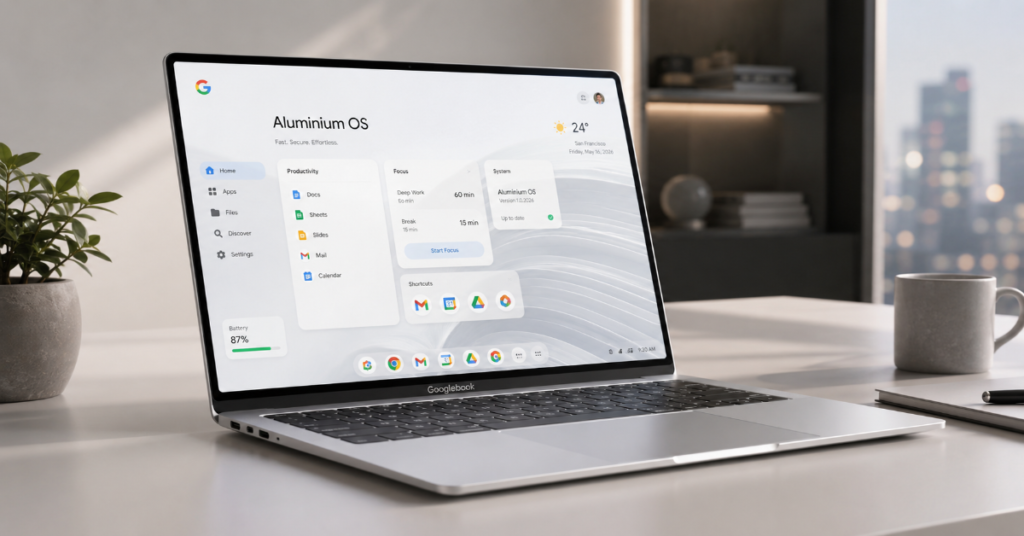
Google Aluminium OS and the Googlebook laptop category represent the most significant platform launch in Google’s hardware and software history since the original Chromebook in 2011, and they are arriving this fall. Aluminium OS is Google’s unification of Android and ChromeOS into a single AI-first operating system that has been in development for at least three years under the codename Aluminium. At the Android Show on May 12, 2026, Google confirmed Googlebooks — a new premium laptop category powered by Aluminium OS — with hardware from Acer, ASUS, Dell, HP, and Lenovo arriving this fall, alongside Google’s own hardware. The timing is calculated: Aluminium OS launches while Apple’s iOS 26 and MacBook AI features are being finalised for WWDC in June, while Microsoft’s Windows AI PC strategy is maturing but fragmented, and while consumer demand for AI-native computing experiences is higher than at any prior point in the history of the PC industry. Google’s structural advantage in this moment is unique: Android powers 3 billion active devices, Chrome commands 68% of global browser market share, Google Workspace runs in the background of hundreds of millions of professional workflows, and Gemini Intelligence is the AI layer that connects all of them. No other operating system vendor can embed AI this deeply across this many existing touchpoints from day one.
What Aluminium OS Actually Is — The Technical Foundation
Aluminium OS is not ChromeOS with Android apps — the current Chromebook model that has existed since 2016. It is a ground-up architectural unification in which Android provides the hardware abstraction layer, driver ecosystem, and app compatibility, while a new desktop shell provides the interface, productivity features, and developer tools required for a laptop-class computing experience. According to a leaked 16-minute hands-on video and screenshots reported by Android Authority before the Android Show, Aluminium OS features an Android-style desktop with a bottom app dock, virtual desktops, compact Quick Settings and notifications, and a Link to iOS app for cross-platform continuity with iPhone. The official name has not been confirmed — Google stated the codename will not be the final product name and an official name is expected later in 2026, after I/O.
The Gemini Intelligence integration is the defining architectural difference between Aluminium OS and previous Google laptop platforms. Gemini Intelligence in Aluminium OS operates at the OS level — not as an app or a sidebar, but as a layer that understands what is on the screen, can move across applications, and can take multi-step actions to complete tasks that would normally require a user to jump between multiple apps. The Gemini Intelligence specification reported before I/O requires devices with 12GB of RAM minimum and a qualified flagship SoC — a hardware requirement that positions Googlebook as a premium product rather than the budget-accessible Chromebook market that ChromeOS has historically served. This is a strategic shift: Google is moving up-market for Aluminium OS, targeting the MacBook and Windows premium AI PC segment rather than the education and budget enterprise market that Chromebooks currently dominate.
“We’re transitioning from an operating system to an intelligence system.” — Sameer Samat, Head of Android Ecosystem, Google, announcing Aluminium OS strategy, May 12, 2026
Googlebook vs MacBook vs Windows AI PC — Platform Comparison
| Feature | Googlebook (Aluminium OS) | MacBook (macOS / Apple Intelligence) | Windows AI PC (Windows 11) |
| AI OS layer | Gemini Intelligence — native, deep, OS-level | Apple Intelligence — integrated, privacy-first, on-device | Microsoft Copilot — improving, less native |
| AI model quality | Gemini 2.5 Pro / new I/O model | Apple Intelligence (GPT-4o via ChatGPT where needed) | GPT-5.5 via Copilot (Microsoft/OpenAI partnership) |
| App ecosystem | Android apps (Google Play), Progressive Web Apps, Linux via container | macOS native apps, iOS/iPadOS apps, Catalyst | Win32, UWP, WSL2 Linux, Android apps (limited) |
| Phone integration | Deep Android integration — phone streaming, sync | Handoff, Continuity — iPhone seamless | Phone Link — improving but limited |
| Privacy architecture | Google account integration — cloud processing default | On-device processing default — Private Compute Core | Microsoft account — cloud and on-device mixed |
| Target price tier | Premium — $12GB RAM minimum SoC requirement | Premium — MacBook Air starts $1,099 | Budget to premium — wide range |
| Browser | Chrome with Gemini — deeply integrated | Safari — limited AI; Chrome available | Edge with Copilot; all browsers available |
| Hardware partners | Acer, ASUS, Dell, HP, Lenovo + Google | Apple only | All major PC OEMs |
| Launch timing | Fall 2026 | Current — continuous updates | Current — AI PCs expanding |
The OEM Strategy — Why Dell, HP, and Lenovo Signal Mass Market Ambition
The announcement that Dell, HP, and Lenovo are Googlebook launch partners — alongside the previously announced Acer and ASUS — completes a hardware strategy that covers essentially the entire premium PC OEM landscape outside of Apple. Dell is the dominant business laptop vendor for enterprise IT procurement. HP is the largest laptop OEM globally by unit volume. Lenovo is the largest PC company in the world by unit volume and has a strong presence in both enterprise and consumer markets. Adding all three as Googlebook launch partners means that Aluminium OS is not launching as a niche Google experiment — it is launching as the operating system that every major PC vendor is prepared to build hardware for. This is categorically different from the Chromebook launch in 2011, where only Acer and Samsung were initial hardware partners and enterprise adoption took years to materialise.
The competitive signal to Microsoft is direct. Windows AI PCs have faced a challenge that the Googlebook strategy explicitly addresses: fragmentation. Different Windows PC OEMs implement AI features differently, through different hardware configurations, with different Copilot integrations and different NPU capabilities. A user buying a Dell Windows AI PC and a user buying an HP Windows AI PC may have materially different AI experiences despite running the same operating system. Googlebook hardware partners are building to Google’s Aluminium OS specification — a minimum 12GB RAM, qualified flagship SoC, Gemini Intelligence from the OS level, phone streaming, and the full Googlebook feature set. The user experience is defined by Google, not by the OEM. This is Apple’s model applied to Android — and it is a model that Google has never successfully executed in the laptop category before.
“Googlebook is a new category of laptops designed for Gemini Intelligence and perfectly in sync with your Android phone.” — Google, The Android Show: I/O Edition, May 12, 2026
The Migration Challenge — Will Users Leave macOS and Windows?
The Googlebook strategy faces a structural challenge that Google’s operating system efforts in the laptop category have always faced: switching costs. A user who has spent three years building a macOS workflow — iCloud integration, macOS-native apps, Apple Continuity features, App Store purchase history — faces real friction switching to Googlebook, even if the AI capabilities are superior. A corporate IT department that has standardised on Windows for Active Directory, Microsoft 365, and enterprise software that runs exclusively on Windows is not switching to Aluminium OS regardless of Gemini Intelligence’s quality. The education market, where Chromebooks have achieved genuine dominance (Chromebooks represent more than 60% of K-12 education computing in the US), may be the most natural upgrade path — Aluminium OS on Googlebook would be a natural successor for students whose first computer was a Chromebook.
Google’s answer to the migration challenge is the Link to iOS app — a direct bridge to the iPhone ecosystem that signals Google understands many premium laptop buyers are also iPhone users. The Link to iOS feature, announced at the Android Show, allows Googlebook users to access iPhone notifications, messages, and some apps from the laptop, similar to how Apple’s Continuity features allow MacBook and iPhone to work seamlessly together. If Googlebook can provide a comparable iPhone integration experience to MacBook, it removes one of the most significant barriers to switching for the large segment of iPhone users who currently buy MacBooks primarily for the device continuity rather than for macOS itself. Android Authority separately reported that Google confirmed Googlebook will support wireless iPhone-to-Android transfer — further reducing the friction of adopting the Google ecosystem.
Key Takeaways
• Aluminium OS is Google’s unified Android-ChromeOS operating system confirmed for fall 2026 launch on Googlebook laptops from Acer, ASUS, Dell, HP, Lenovo, and Google — the most complete PC OEM launch coalition Google has ever assembled for a laptop platform.
• Aluminium OS integrates Gemini Intelligence at the OS level — not as an app or sidebar, but as a layer that moves across applications, understands screen context, and completes multi-step tasks. Hardware minimum: 12GB RAM and a qualified flagship SoC, positioning Googlebook as a premium product.
• The Googlebook category competes directly with MacBook and Windows AI PCs in the premium laptop segment — a strategic shift from ChromeOS’s budget and education market positioning to the premium segment where Apple dominates and Microsoft is building AI PC presence.
• A leaked 16-minute hands-on video showed an Android-style desktop with bottom app dock, virtual desktops, compact Quick Settings, and a Link to iOS app for iPhone continuity — addressing the switching barrier for iPhone users who currently buy MacBooks for Apple Continuity features.
• The premium OEM coalition (Dell, HP, Lenovo in addition to Acer and ASUS) signals that Aluminium OS is being positioned as a mass-market platform with defined hardware specifications, unlike the fragmented Windows AI PC market where different OEMs implement AI features differently.
• Google has not confirmed the official Aluminium OS product name — the final name is expected after I/O 2026. The Gemini Intelligence hardware requirement of 12GB RAM minimum excludes most existing Chromebooks from compatibility, meaning Googlebook is a new hardware category, not a Chromebook upgrade path.
Conclusion
Aluminium OS and Googlebook represent Google’s most serious attempt to compete in the premium laptop market since the Pixelbook — and arguably the most technically credible attempt any non-Apple company has made to build an AI-first operating system from the ground up rather than grafting AI features onto an existing platform. The OEM coalition is real and comprehensive. The AI integration is deeper than any competing platform has delivered in production. The iPhone continuity features address the most critical switching barrier for the premium consumer market. The challenges are equally real: premium laptop switchers have the highest switching costs of any computing segment, enterprise IT standardisation on Windows creates structural lock-in that Gemini Intelligence alone cannot overcome, and the education Chromebook market that Aluminium OS would naturally inherit does not overlap with the premium consumer and professional segments where the growth opportunity is largest. Whether Aluminium OS succeeds depends less on whether it is technically excellent — the leaked previews and confirmed hardware partnerships suggest it is — and more on whether Google can sustain the marketing, developer support, and enterprise sales investment required to make premium PC buyers consider a third ecosystem alongside macOS and Windows for the first time in decades.
Frequently Asked Questions
What is Google Aluminium OS?
Aluminium OS is Google’s new unified operating system that merges Android and ChromeOS into a single AI-first platform. It integrates Gemini Intelligence at the OS level, supports Android apps from Google Play, progressive web apps, and Linux via container, and runs on Googlebook laptops from Acer, ASUS, Dell, HP, Lenovo, and Google. It is launching fall 2026. The official product name has not been confirmed.
What is a Googlebook?
Googlebook is the new premium laptop category built on Aluminium OS, announced at The Android Show on May 12, 2026. The first Googlebooks arrive fall 2026 from Acer, ASUS, Dell, HP, and Lenovo with Gemini Intelligence, Android app support, phone app streaming, and features including Magic Pointer and Create My Widget. Hardware minimum: 12GB RAM and a qualified flagship SoC.
Does Aluminium OS work with iPhones?
Yes — Google confirmed a Link to iOS app that allows Googlebook users to access iPhone notifications, messages, and some apps from the laptop. Google also announced a wireless iPhone-to-Android transfer tool. These features directly address the switching barrier for iPhone users who currently choose MacBook for Apple Continuity features.
How does Googlebook compete with MacBook?
Googlebook targets the premium laptop market that MacBook currently dominates. Its key advantages are Gemini Intelligence at OS level (deeper than Apple Intelligence in current MacBook), Android app ecosystem, Google Workspace native integration, and cross-device sync with Android phones. MacBook’s advantages remain strong developer app ecosystem, Apple Silicon performance, tighter privacy architecture, and Continuity with iPhone for Apple product users.
Will existing Chromebooks get Aluminium OS?
The Gemini Intelligence hardware requirement of 12GB RAM minimum means most existing Chromebooks will not be compatible with the full Aluminium OS Googlebook experience. Google has not confirmed a migration path for existing Chromebook users. Aluminium OS on Googlebook is a new premium hardware category, not an upgrade to the existing budget Chromebook product line.
References
Google. (2026, May 12). The Android Show: I/O Edition 2026. https://blog.google/products-and-platforms/platforms/android/android-show-io-edition-2026/
Android Authority. (2026, May 12). What to expect from Google I/O 2026: Gemini upgrades, Android features, Aluminium OS, and more. https://www.androidauthority.com/what-to-expect-from-google-io-2026-3664979/
Beebom Gadgets. (2026, May 18). What we’re expecting from Google I/O 2026 keynote on May 19. https://gadgets.beebom.com/guides/what-to-expect-at-google-io-2026
Let’s Data Science. (2026). Google debuts Gemini-focused updates at I/O 2026. https://letsdatascience.com/news/google-debuts-gemini-focused-updates-at-io-2026-4be4fde6
Android Central. (2026, May 19). Google I/O 2026 live blog — Android 17, Android XR glasses, Gemini AI news. https://www.androidcentral.com/phones/live/google-i-o-2026-live-blog-android-17-android-xr-glasses-and-all-the-gemini-ai-news
CNBC. (2026, May 12). Google races to put Gemini at the center of Android before Apple’s AI reboot. https://www.cnbc.com/2026/05/12/google-races-put-gemini-at-center-of-android-before-apples-ai-reboot.html
TradingKey. (2026). Will Google I/O 2026 launch Gemini 4.0? https://www.tradingkey.com/analysis/stocks/us-stocks/261894049-google-io-2026-alphabe-gemini-tradingkey
