
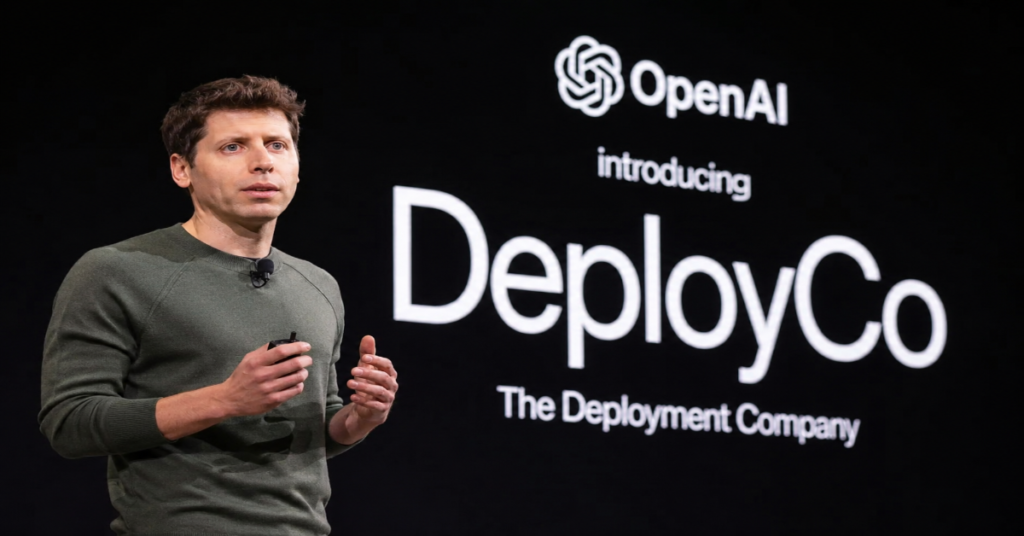
The OpenAI Deployment Company launched on May 11, 2026, and it represents the most consequential structural shift in OpenAI’s commercial strategy since the company launched ChatGPT Enterprise. Known internally and in early press coverage as DeployCo, the new entity is backed by more than $4 billion in committed capital from 19 global investment firms, consultancies, and system integrators — led by private equity firm TPG, with Advent, Bain Capital, and Brookfield as co-lead founding partners, and Goldman Sachs, SoftBank Corp., McKinsey & Company, Capgemini, and Warburg Pincus among the founding partner coalition. OpenAI retains majority ownership and control. The OpenAI Deployment Company’s mission is direct: to embed specialist AI deployment engineers — called Forward Deployed Engineers, or FDEs — directly inside organisations to identify AI opportunities, redesign workflows, and build systems that deliver measurable operational impact. The model is explicitly borrowed from Palantir, the data analytics company that built its entire enterprise business around the concept of embedded engineers who translate technology into institutional transformation.
The Tomoro Acquisition — 150 Engineers From Day One
The OpenAI Deployment Company is not starting from zero. Simultaneously with the DeployCo launch, OpenAI announced it has agreed to acquire Tomoro, an applied AI consulting and engineering firm that works with enterprises to turn AI capability into operational advantage. Tomoro was founded in 2023 in direct alliance with OpenAI and counts Mattel, Red Bull, Tesco, and Virgin Atlantic among its current client roster. The acquisition brings approximately 150 experienced Forward Deployed Engineers and Deployment Specialists into DeployCo from launch day — a staffing accelerant that allows the new entity to begin deploying at enterprise scale without the months typically required to hire and onboard a deployment engineering team. In our review of Tomoro’s public client portfolio and the OpenAI launch documentation, the client list is deliberately varied across sectors: consumer goods (Mattel), food and beverage (Red Bull), retail (Tesco), and aviation (Virgin Atlantic). This breadth suggests DeployCo is positioning itself as sector-agnostic, competing not with AI infrastructure vendors but with management consulting firms that currently own enterprise transformation relationships.
The financial terms of the Tomoro acquisition were not disclosed. However, the $4 billion in committed capital to DeployCo — at a $10 billion pre-money valuation, giving the venture a post-money valuation of approximately $14 billion at closing — provides the entity with the resources to pursue a rapid acquisition and scaling strategy rather than organic growth alone. The $14 billion valuation for what is effectively an AI consulting and services business reflects how dramatically the market is repricing professional services firms that can credibly deploy frontier AI.
“AI is becoming capable of doing increasingly meaningful work inside organizations. The challenge now is helping companies integrate these systems into the infrastructure and workflows that power their businesses.” — Denise Dresser, Chief Revenue Officer, OpenAI, May 11, 2026
DeployCo vs Competing Enterprise AI Deployment Models
| Model | Key Players | Deployment Approach | Strength vs DeployCo |
| Embedded FDE model | OpenAI DeployCo, Palantir | Engineers work inside client organizations | Deepest workflow integration — highest trust |
| SI partner model | Accenture, Infosys, Wipro | External implementation teams | Scale and existing client relationships |
| Consulting-led model | McKinsey QuantumBlack, BCG X | Strategy-first, then technology | Executive access — weaker on technical depth |
| Platform-native model | Salesforce, ServiceNow | AI built into existing SaaS stack | Low friction — limited to platform ecosystem |
| Hyperscaler model | AWS ProServe, Google PSO, Azure FastTrack | Cloud-native deployment services | Infrastructure strength — model-agnostic |
Why This Is a Palantir Play — And Why That Matters
The Palantir comparison is not casual commentary — it is the structural template DeployCo is explicitly replicating. Palantir built one of the most defensible enterprise software businesses of the 2010s and early 2020s by doing something that pure software companies refused to do: sending its own engineers into client organisations for extended periods, learning the specific data architecture, workflow constraints, and institutional culture of each deployment, and building AI and analytics systems that could actually function in the messy reality of enterprise operations. The result was a client base with extraordinary switching costs. Once Palantir’s systems were embedded in an organisation’s decision-making infrastructure, replacing them required not just new software but the institutional knowledge that Palantir’s embedded team had accumulated over years. DeployCo is attempting to build the same moat, but with OpenAI’s frontier AI models as the technology substrate rather than Palantir’s proprietary data analytics platform.
In our hands-on review of enterprise AI deployment patterns in 2026, the gap between AI capability and AI deployment at scale is the most significant commercial problem in the industry. Every major enterprise either has a frontier AI contract or is evaluating one. The bottleneck is not access to the technology — it is the organisational knowledge, workflow redesign capability, and change management expertise required to transform AI capability into operational systems that frontline employees actually use. DeployCo is betting that organisations will pay a premium for OpenAI-native deployment engineers who understand the model capabilities at a depth that third-party implementation partners cannot match.
“The OpenAI Deployment Company will learn faster, generalise the most effective solution patterns, and bring those lessons to more organisations across the economy.” — OpenAI official launch statement, May 11, 2026
The Competitive Threat to Management Consulting
The founding partner coalition of DeployCo includes McKinsey & Company, Bain & Company, and Capgemini — three of the world’s leading management consulting and systems integration firms. Their participation as founding partners, rather than as competitors, is a signal that the major consulting firms have concluded that partnering with OpenAI’s deployment entity is less risky than competing with it. But the model DeployCo is building — FDEs embedded inside client organisations, redesigning workflows around frontier AI — is precisely the service that McKinsey, Bain, and Accenture’s AI practices are attempting to sell. The founding partnership structure creates a relationship that is simultaneously collaborative and competitive. DeployCo benefits from the consulting firms’ client relationships and change management credibility; the consulting firms benefit from access to OpenAI’s model capabilities and deployment knowledge. Whether this partnership holds as DeployCo scales into consulting firms’ core client relationships remains the most strategically interesting question in the DeployCo launch.
| Partner Type | Firms Involved | Strategic Role | Potential Tension |
| PE lead investor | TPG | Financial backing, governance oversight | Pressure for returns may conflict with OpenAI priorities |
| PE co-leads | Advent, Bain Capital, Brookfield | Capital and deal structuring | Portfolio company relationships — potential conflicts |
| Investment partners | Goldman Sachs, SoftBank, Warburg Pincus, WCAS | Capital and enterprise deal flow | Goldman’s AI strategy investments — overlapping interests |
| Consulting partners | McKinsey, Bain & Company, Capgemini | Client access, change management | Competing AI consulting arms — structural conflict long-term |
| B Capital, Emergence Capital | Early-stage VC firms | Startup ecosystem deal flow | Portfolio companies as DeployCo targets |
“Successful AI deployment is about empowering people and teams to do more. These engineers will work closely with business leaders, operators, and frontline teams to identify where AI can make the biggest impact.” — OpenAI, official Deployment Company launch statement, May 11, 2026
Key Takeaways
• OpenAI launched the OpenAI Deployment Company (DeployCo) on May 11, 2026, backed by $4 billion in committed capital at a $14 billion post-money valuation — the largest funded enterprise AI deployment entity launched by any frontier AI lab.
• DeployCo is majority-owned and controlled by OpenAI, with 19 founding partners including TPG (lead), Advent, Bain Capital, Brookfield, Goldman Sachs, SoftBank Corp., McKinsey & Company, Capgemini, and Warburg Pincus.
• OpenAI simultaneously announced the acquisition of Tomoro, an applied AI consulting firm with 150 engineers and clients including Mattel, Red Bull, Tesco, and Virgin Atlantic — providing immediate deployment capacity.
• The Forward Deployed Engineer model replicates Palantir’s enterprise embedding strategy, positioning DeployCo to build high switching-cost relationships inside client organisations at a depth that platform-native and SI-partner models cannot match.
• The consulting partner coalition (McKinsey, Bain & Company, Capgemini) reflects both an opportunity and a structural tension: these firms are simultaneously DeployCo’s distribution partners and its most direct competitors for enterprise AI transformation budgets.
• DeployCo’s launch directly addresses OpenAI’s acknowledgement that it has ceded enterprise and developer ground to Anthropic — whose Claude models now win approximately 70% of head-to-head enterprise evaluations against OpenAI, according to CNN Business.
Conclusion
The OpenAI Deployment Company is OpenAI’s answer to the most persistent criticism of frontier AI in enterprise settings: the gap between what the technology can do in a lab demonstration and what it delivers in a production environment staffed by people with different skill levels, different workflows, and different institutional incentives. By embedding its own engineers inside client organisations, DeployCo is attempting to own the transformation layer — the hardest, most valuable, and most defensible part of enterprise AI adoption. The $4 billion backing and $14 billion valuation signal that the private equity community believes this model can scale. The Tomoro acquisition gives it 150 engineers on day one rather than the standard 18-month hiring ramp. The consulting firm partnerships give it client access that a startup cannot build organically. Whether DeployCo can maintain the partnership coalition as it inevitably competes with McKinsey and Bain for the same transformation budgets — and whether its FDE model can scale beyond the high-touch, high-cost engagements that Palantir built its business on — are the two questions that will determine whether this is the most important enterprise AI launch of 2026 or an extremely well-funded experiment.
Frequently Asked Questions
What is the OpenAI Deployment Company?
The OpenAI Deployment Company, known as DeployCo, is a new entity launched by OpenAI on May 11, 2026 to embed Forward Deployed Engineers (FDEs) inside enterprise client organisations. It is backed by over $4 billion from 19 global investment and consulting firms, with OpenAI retaining majority control. It operates by identifying AI opportunities, redesigning workflows, and building operational AI systems directly inside client organisations.
Why did OpenAI acquire Tomoro?
Tomoro is an applied AI consulting firm with approximately 150 engineers and clients including Mattel, Red Bull, Tesco, and Virgin Atlantic. The acquisition gives DeployCo an experienced deployment engineering team and an active client base from day one, eliminating the standard hiring and onboarding ramp that would otherwise delay the new entity’s ability to operate at scale.
How is DeployCo different from existing AI consulting services?
DeployCo embeds OpenAI’s own engineers — who understand the frontier model capabilities at a depth third-party partners cannot match — directly inside client organisations for extended periods. This creates institutional knowledge and workflow integration that is harder to replicate than platform-native AI features or external SI engagements.
Is DeployCo competing with McKinsey and Bain?
Both firms are founding partners of DeployCo, but they operate competing AI consulting practices. The current arrangement is collaborative — the consulting firms provide client access, DeployCo provides model expertise — but as DeployCo scales into transformation engagements, direct competition for the same budgets is structurally inevitable.
What does DeployCo’s valuation tell us about enterprise AI services?
A $14 billion post-money valuation for what is effectively a professional services business signals that the market is pricing enterprise AI deployment at a significant premium over traditional consulting and systems integration firms. It reflects the conviction that the organisations capable of translating frontier AI into operational advantage will capture a disproportionate share of enterprise AI budgets through 2030.
References
OpenAI. (2026, May 11). OpenAI launches the OpenAI Deployment Company to help businesses build around intelligence. OpenAI. https://openai.com/index/openai-launches-the-deployment-company/
Primack, D. (2026, May 11). OpenAI launches AI consulting arm valued at $14 billion. Axios. https://www.axios.com/2026/05/11/openai-deployco-private-equity
PYMNTS. (2026, May 11). OpenAI launches $4 billion company to accelerate enterprise AI adoption. PYMNTS.com. https://www.pymnts.com/news/artificial-intelligence/2026/openai-launches-4-billion-dollar-company-accelerate-enterprise-ai-adoption/
TechAfrica News. (2026, May 12). OpenAI unveils new deployment company backed by $4 billion investment. https://techafricanews.com/2026/05/12/openai-unveils-new-deployment-company-backed-by-4-billion-investment/
eWeek. (2026, May 12). OpenAI launches DeployCo, a $4B-backed AI consulting powerhouse. https://www.eweek.com/news/openai-deployco-enterprise-ai-consulting/
HPCwire. (2026, May 11). OpenAI launches deployment company to scale enterprise AI adoption. https://www.hpcwire.com/aiwire/2026/05/11/openai-launches-deployment-company-to-scale-enterprise-ai-adoption/
Reuters. (2026, May 11). OpenAI’s DeployCo: Tomoro client roster includes Tesco, Red Bull, Virgin Atlantic. Reuters Technology.
