
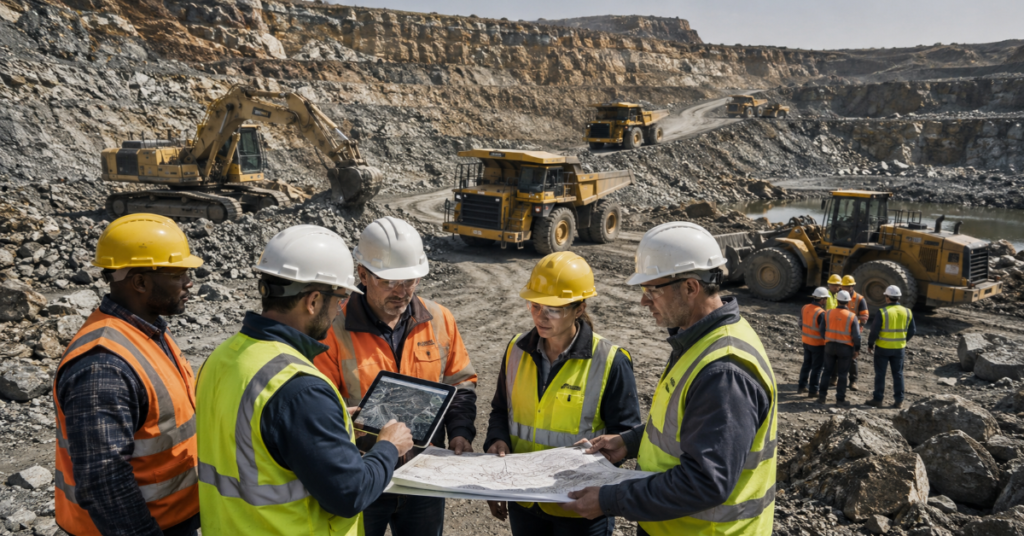
Maschinenring mining refers to the idea of applying the Maschinenring cooperative model to mining, quarrying and extraction work. Instead of every operator owning a complete fleet of machines, labor teams and specialist services, participants coordinate access to shared equipment, crews and operational support. The concept comes from the agricultural machinery-ring system, where farmers pool resources to reduce costs and improve access to modern equipment.
The term needs careful handling. Maschinenring is a real cooperative service model with deep roots in agriculture, especially in Germany and Austria. The first machinery ring was founded in Buchhofen, Bavaria in 1958, according to Maschinenring’s own historical material. Today, Maschinenring organizations support farmers through machinery coordination, labor services, forestry, winter work and related rural services.
But “Maschinenring mining” is newer and less established. In some cases, it may simply refer to a Maschinenring office located in Mining, Austria, because Mining is also a place name. In an industrial context, however, the phrase usually means a cooperative operating model for extraction work. That distinction matters because one meaning is geographic while the other is strategic.
The useful question is not whether the term is already mature. It is whether the model solves a real problem. Mining and quarrying are capital-heavy businesses. Excavators, haul trucks, crushers, drills, loaders, survey tools and skilled operators are expensive. Many smaller sites do not use every machine at full capacity every week. A machinery-sharing structure could turn that idle capacity into a managed network.
What Maschinenring Mining Actually Means
Maschinenring mining is best defined as a cooperative or coordinated resource-sharing system for mining and quarry operations. Members could share:
- Excavators, loaders, drills, crushers and haulage equipment
- Skilled operators, mechanics, surveyors and safety personnel
- Maintenance capacity, spare parts access and inspection routines
- Site services such as road clearing, dewatering, vegetation control or winter operations
- Digital scheduling, compliance documentation and utilization tracking
The model does not require every participant to become part-owner of every asset. It can work through membership fees, hourly usage charges, fleet pools, service contracts or a hybrid structure. The central idea is coordination. A member who owns a crusher but uses it only part of the month could make it available to another approved operator. A quarry that needs a specialist drilling crew for a short campaign could access one without hiring full-time staff.
This resembles equipment rental, but with a stronger member-based logic. A rental company sells access to assets. A machinery ring coordinates mutual benefit between members, often with local knowledge, trust relationships and service discipline. That trust layer is what makes the model interesting.
For readers comparing operational models, Perplexity AI Magazine’s article on performance analytics in 2026 is relevant because cooperative mining would depend heavily on utilization data, downtime records and productivity benchmarks.
Why the Agricultural Maschinenring Model Matters
The original Maschinenring model emerged because small and mid-sized farms faced a practical mismatch. Modern machinery improved productivity, but owning every machine individually was inefficient. A farmer might need a specialized machine only a few days per season. Sharing created access without forcing each farm to carry the full capital burden.
A GIZ paper on machinery rings describes them as a self-help concept built around machinery access, entrepreneurial training and local cooperation. The approach has also been used in international development projects, including efforts to support smallholder farmers in Kenya.
That agricultural logic transfers surprisingly well to parts of mining. Many extraction businesses are not global mining giants. They are local quarry operators, aggregates suppliers, contractors, small mineral producers or seasonal extraction sites. Their equipment needs fluctuate by contract, weather, permit timing, geology and demand.
The mining industry already understands asset sharing indirectly through rental, subcontracting and contract mining. Maschinenring mining would formalize the cooperative layer. It could create a structured network where members share not just machines but also operational knowledge, safety routines and trained labor.
Maschinenring Mining vs Traditional Equipment Models
| Model | How It Works | Main Advantage | Main Weakness | Best Fit |
| Full ownership | One operator buys and controls all assets | Maximum control and availability | High capital cost and idle-machine risk | Large sites with steady production |
| Equipment rental | Assets leased from commercial rental firms | Flexible access without ownership | Less member control and possible availability limits | Short-term projects and overflow demand |
| Contract mining | A contractor runs part or all of the operation | Outsourced expertise and fleet capacity | Lower direct control and contract dependency | Complex sites needing specialist execution |
| Maschinenring mining | Members coordinate shared machines, labor and services | Lower capital pressure with local cooperation | Governance, liability and scheduling complexity | Small and mid-sized operators with uneven demand |
The key difference is incentive design. Full ownership rewards control. Rental rewards flexibility. Contract mining rewards outsourcing. Maschinenring mining rewards network efficiency.
The Cost Logic Behind Shared Mining Resources
The strongest economic argument is utilization. Mining equipment produces value when it works safely and productively. It destroys value when it sits idle, breaks down or is used below capacity. The Global Mining Guidelines Group has emphasized the importance of benchmarking fleet utilization, availability and operational delays across trucks, shovels and crushers.
A cooperative mining ring could track the same metrics across members:
| Operational Factor | Why It Matters | Cooperative Advantage |
| Fleet utilization | Measures how much productive time equipment actually delivers | Idle machines can be scheduled across multiple sites |
| Availability | Shows whether equipment is mechanically ready for work | Shared maintenance standards improve reliability |
| Operator capacity | Skilled labor shortages delay production | Members can access trained crews when demand spikes |
| Capital expenditure | Heavy machinery requires large upfront investment | Smaller operators reduce ownership burden |
| Downtime risk | Breakdowns disrupt extraction schedules | Backup assets may be available within the ring |
| Compliance documentation | Safety and inspection records protect operators | Centralized systems reduce paperwork gaps |
The broader market already points in this direction. Grand View Research estimated the global mining equipment rental market at USD 106.79 billion in 2024, projected to reach USD 144.49 billion by 2030 with a 5.2% compound annual growth rate from 2025 to 2030. That does not prove Maschinenring mining will scale, but it shows demand for asset-light equipment access is real.
Practical Use Cases for Maschinenring Mining
The model makes the most sense where demand is uneven and assets are expensive.
Small quarry networks
Local aggregate producers often serve roadwork, construction, concrete and infrastructure demand. Work may surge during construction seasons and slow during bad weather. A shared equipment pool could help these operators access mobile crushers, loaders or screening equipment without each site buying a full fleet.
Specialty drilling and blasting support
Drilling crews, blasting engineers and safety supervisors are expensive to retain full time. A cooperative network could coordinate qualified teams across sites, subject to strict legal and safety requirements.
Maintenance and emergency backup
Breakdowns are costly. A cooperative ring could maintain a list of available mechanics, replacement machines and emergency parts. This would not eliminate downtime, but it could reduce the length of stoppages.
Rehabilitation and environmental work
Site restoration, drainage work, vegetation management and access road maintenance are recurring needs. Maschinenring organizations already provide land, forestry and rural services in agricultural settings. Similar coordination could support mining rehabilitation work, especially after extraction phases end.
Strategic Implications for Small and Mid-Sized Operators
For smaller operators, Maschinenring mining could change the economics of participation. A business that cannot justify buying a high-cost machine may still access one through a ring. A contractor with idle capacity can monetize it. A community of operators can build local resilience instead of relying entirely on distant rental fleets.
This does not mean ownership disappears. Core assets at high-volume sites will still be owned directly. The cooperative model is more likely to support edge capacity, specialist equipment, backup services and seasonal peaks.
The strategic benefit is optionality. Operators gain more ways to match equipment supply with real work. That flexibility matters in a mining sector facing cost pressure, productivity challenges and rising capital needs. McKinsey has argued that mining companies need both stronger cost productivity and capital productivity to create superior value.
The same logic applies below the level of global majors. Capital discipline is not only a boardroom issue. It is also a quarry-yard issue.
Risks and Trade-Offs
The model has real weaknesses.
First, safety liability is harder when multiple members use the same machines. Who is responsible if an excavator is poorly maintained, an operator is undertrained or a site procedure is ignored? The answer must be written into contracts, insurance policies and operating rules before work begins.
Second, scheduling can become political. If three members need the same loader during the same week, the ring needs a fair allocation system. Without transparent rules, cooperation turns into conflict.
Third, quality control is uneven unless standards are enforced. Mining is not casual equipment sharing. Machines must meet inspection requirements. Operators must be certified where required. Maintenance records must be complete. Site-specific hazards must be briefed before work starts.
Fourth, regulatory exposure varies by jurisdiction. A machinery-sharing arrangement in Austria, Germany, the United States or Australia would face different labor, safety, environmental and insurance rules. Any serious deployment needs legal review before operations begin.
Finally, the model may not fit large, continuous mining operations. A major open-pit mine running 24/7 cannot depend on a community schedule for critical production assets. Maschinenring mining is more plausible for smaller extraction sites, support services and regional contractor networks.
Real-World Impact: Why This Idea Is Appearing Now
Three forces make the concept timely.
The first is capital pressure. Mining equipment is expensive, and the sector faces rising demand for critical minerals, aggregates and infrastructure inputs. McKinsey estimated in 2024 that mining would need USD 5.4 trillion in capital expenditure from 2024 to 2030 to meet future demand.
The second is productivity pressure. Mining has struggled with productivity improvement compared with other sectors. Reports discussing McKinsey’s 2025 mining analysis noted that mining productivity has declined over the long term while sectors such as manufacturing and agriculture improved.
The third is data maturity. Equipment-sharing only works when members know where assets are, who used them, what condition they are in and whether they generated value. Telematics, fleet software, maintenance logs and digital scheduling make cooperative coordination more realistic than it was two decades ago.
This is where the model connects to wider operational technology trends. Perplexity AI Magazine’s coverage of AI-powered global intelligence platforms shows how data dashboards are moving from elite institutions into smaller commercial settings. A mining ring would need a simpler version of that same logic: shared visibility, risk scoring and practical decision support.
Three Original Insights Often Missed
1. The model is less about ownership and more about trusted dispatch
Most articles focus on shared machines. The real bottleneck is dispatch governance. A cooperative ring needs rules for priority, emergency access, operator qualification, machine return condition and dispute resolution. Without that, shared ownership becomes shared frustration.
2. Insurance may decide the model faster than technology
The technology exists. Scheduling software, telematics and equipment tracking are not the hard part. The harder part is insuring machines across sites with different risk profiles. A quarry with stable haul roads is not the same risk as a remote extraction site after heavy rain. Insurers may require tiered pricing, approved operators and documented inspections.
3. The best early market may be quarrying, not deep mining
Deep mining has higher hazard complexity and stricter operational dependencies. Quarrying, aggregates, rehabilitation work and contractor support are more realistic entry points. These environments still require discipline, but the cooperative model can be tested without disrupting a high-intensity mine plan.
The Future of Maschinenring Mining in 2027
By 2027, Maschinenring mining is unlikely to become a universal industry label. The more realistic future is selective adoption under different names: cooperative fleet networks, regional equipment pools, shared contractor platforms or mining service rings.
The strongest growth path would be in regions with many small quarry operators, strong cooperative traditions and high equipment costs. Austria, Germany and parts of Europe already understand the machinery-ring concept in agriculture. Australia, Canada and the United States have large equipment-rental markets and mature contractor ecosystems, but the cooperative cultural layer may be weaker.
Technology will help. Fleet telematics, digital maintenance logs, operator credential systems and utilization dashboards can make sharing safer and more accountable. Regulatory pressure may also support the model where environmental rehabilitation, emissions reduction and capital efficiency become more important.
Still, the concept should not be oversold. It will not replace major mining fleets. It will not solve permitting delays or commodity-price volatility. Its likely value is narrower but practical: helping smaller operators access better equipment, reduce idle capacity and professionalize shared services.
Key Takeaways
- Maschinenring mining adapts a proven agricultural cooperation model to extraction work, but the mining version remains emerging rather than officially standardized.
- The model is strongest where equipment demand is uneven, capital budgets are tight and local trust networks already exist.
- Shared machinery is only one layer. Labor, maintenance, compliance, emergency backup and rehabilitation services may be equally important.
- Safety, insurance and liability rules will decide whether the model can operate beyond theory.
- Quarrying and aggregates are more likely early adopters than large continuous mining operations.
- Digital utilization tracking is essential because cooperative equipment sharing fails without accurate scheduling and condition records.
- The term can also be confused with Mining, Austria, so writers and operators should clarify context.
Conclusion
Maschinenring mining is a useful idea because it addresses a real operational problem: expensive assets are often underused while smaller operators struggle to access modern equipment and skilled labor. The agricultural Maschinenring model shows that cooperative resource sharing can work when local trust, clear rules and service discipline exist.
The mining version, however, needs more than enthusiasm. It needs contracts, insurance, safety systems, utilization data and transparent governance. Without those, the model becomes informal borrowing under a professional name.
Its strongest future is probably not inside large-scale global mining operations. It is in regional quarrying, aggregates, contractor services, maintenance support and rehabilitation work. Used carefully, Maschinenring mining could become a practical middle path between full ownership and commercial rental. Used loosely, it risks becoming another vague business phrase. The difference will be execution.
FAQ
What is Maschinenring mining?
Maschinenring mining is the application of the machinery-ring cooperative model to mining or quarry operations. It means sharing equipment, labor and services across approved members to reduce idle capacity and lower operating costs.
Is Maschinenring mining an official industry standard?
No. The Maschinenring organization is well documented in agriculture, but Maschinenring mining appears to be a newer interpretive term rather than a formal global mining standard.
How is Maschinenring mining different from equipment rental?
Equipment rental is usually a commercial supplier-customer relationship. Maschinenring mining would be member-based, with shared coordination, local trust, common rules and potentially mutual access to machines, labor and services.
Could this work for large mining companies?
Only in limited areas. Large mines usually need direct control over critical production fleets. The model is more realistic for support equipment, local contractors, quarry networks, rehabilitation work and specialist services.
What are the biggest risks?
The biggest risks are safety liability, unclear insurance coverage, scheduling disputes, uneven maintenance standards and weak governance. These must be solved before machines or crews are shared.
Why does the term sometimes cause confusion?
Mining is also a place name in Austria. So “Maschinenring Mining” may refer to a Maschinenring office in Mining, Austria rather than mining as an extraction industry.
What data would a cooperative mining ring need?
It would need asset availability, utilization rates, maintenance logs, operator credentials, site risk records, fuel usage, downtime reports and billing data. Without reliable records, shared equipment becomes difficult to manage.
Methodology
This article was developed from the supplied editorial brief and keyword instructions for Perplexityaimagazine.com. The analysis was validated against Maschinenring’s own historical and service materials, GIZ documentation on machinery rings, mining productivity commentary, fleet-utilization guidance and mining equipment rental market data. The article treats Maschinenring mining as an emerging concept rather than an established formal mining standard. No firsthand site testing or practitioner interviews were conducted for this draft, so a human editor should verify all claims, references and internal links before publication.
References
Bundesverband der Maschinenringe. (n.d.). Machinery rings are the backbone of domestic agriculture. Maschinenring.
Deutsche Gesellschaft für Internationale Zusammenarbeit. (2023). Machinery rings as a self-help concept. GIZ.
Global Mining Guidelines Group. (2024, July 10). Benchmarking fleet utilization and productivity. GMG.
Grand View Research. (2025). Mining equipment rental market size, share & trends analysis report. Grand View Research.
Maschinenring Österreich. (n.d.). Maschinenring services and organization. Maschinenring.
McKinsey & Company. (2024, November 12). Mining the future: McKinsey at IMARC 2024. McKinsey & Company.
McKinsey & Company. (2025, October 29). Productivity is not enough: How the mining industry can create superior value. McKinsey & Company.
