
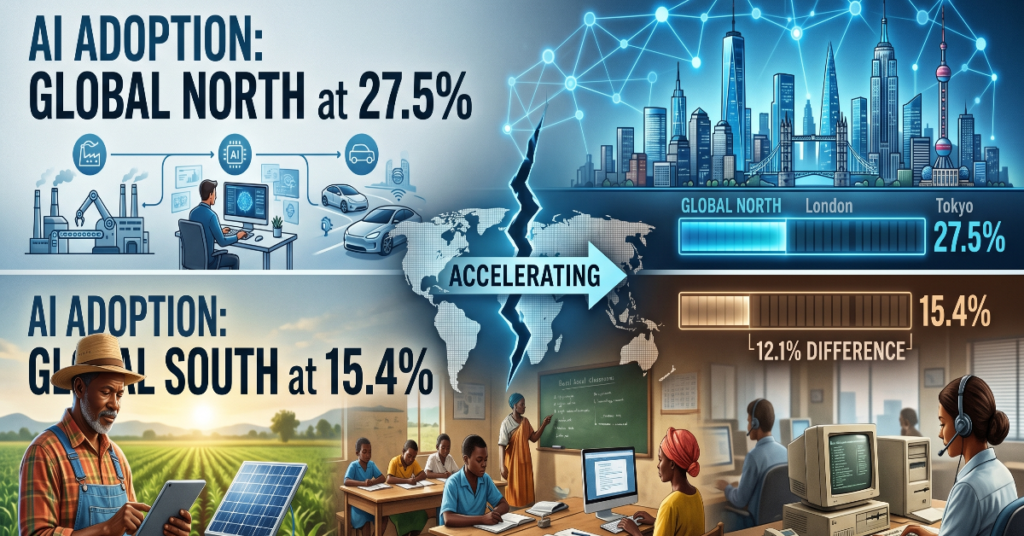
The gap between AI adoption rates in the Global North and the Global South is widening faster than AI diffusion data predicted a year ago, according to Microsoft’s Q1 2026 Global AI Diffusion Report published this week. The North now sits at 27.5% of working-age population using generative AI — up 2.8 percentage points from the second half of 2025. The South has reached 15.4% — a smaller 1.3 point gain. The 12.1 percentage point gap between the two regions is up from 9.8 points at the start of 2025 and represents the fastest rate of divergence since measurement began.
What Is Driving the Gap
Infrastructure remains the primary barrier. Access to reliable high-speed internet, computing hardware, and electricity grid stability are prerequisites for meaningful AI use that remain unevenly distributed across the Global South. Language model performance in low-resource languages — those with limited training data — has historically lagged English, French, and Mandarin, creating an additional usage barrier for populations whose primary language is not well-represented in frontier model training sets.
The rapid rise of Asian adoption — twelve of the fifteen fastest-growing AI economies are in Asia — demonstrates that the divide is not simply North vs. South but more specifically between economies with established digital infrastructure and those without it, regardless of hemisphere. Thailand, Vietnam, and South Korea are all growing faster than several European nations in AI adoption, driven by strong mobile internet penetration and aggressive local AI deployments.
The DeepSeek Effect
One counterforce to the widening gap has been the emergence of open-weight Chinese AI models, particularly DeepSeek, which have lowered the cost of AI access substantially in regions where frontier US model pricing is prohibitive. Microsoft’s previous AI diffusion report noted that DeepSeek’s spread has been most rapid across Africa — a trend that raises questions about whose AI standards and values will shape the next billion AI users. As Microsoft’s report noted, ‘the next billion AI users may emerge not from traditional tech hubs but from the Global South’ — but AI adoption gap Global North South 2026 models they use, on whose infrastructure, will determine the geopolitical and economic character of that expansion.
