
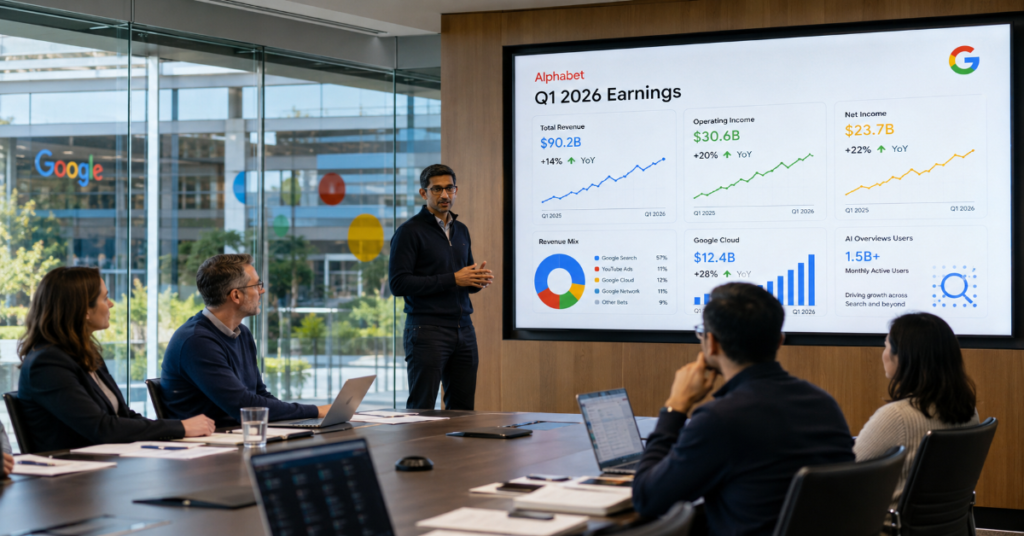
Alphabet Google Q1 2026 earnings report, published April 30, delivered numbers that left Wall Street analysts scrambling to revise their models upward. Total revenue reached $109.9 billion, up 22% year-over-year. Net income hit $62.6 billion, up 81% year-over-year. Earnings per share came in at $5.11 — against a consensus estimate of $2.63. At least six Wall Street firms raised their price targets within 24 hours of the release, and Alphabet stock jumped 34% across April to record its best monthly performance since October 2004, the year of its IPO.
The results erased the last traces of the 2025 narrative in which Google was portrayed as the AI era’s first major corporate casualty. That story is now finished.
The Cloud Number That Changed Everything
Google Cloud revenue reached $20.03 billion in Q1 2026 — a 63% year-over-year increase that was dramatically ahead of Street consensus near 47%. It was the first quarter in which Google Cloud crossed the $20 billion threshold. Cloud operating income more than doubled. The contracted backlog nearly doubled sequentially to $462 billion, with over half expected to convert to revenue within the next 24 months.
The backlog figure is particularly significant because it represents committed future revenue — not speculative pipeline. A $462 billion backlog at current conversion rates provides multi-year revenue visibility that reduces investor uncertainty about whether the current growth rates are sustainable. Mizuho analysts wrote after the results that consensus estimates ‘still significantly underestimate Google Cloud revenue and operating income over the next two years.’
Susquehanna lifted its price target to $460 from $400. Canaccord moved to $450 from $415. TD Cowen raised to $450 from $375, calling the Cloud number a ‘monster AI inflection point.’ JPMorgan, which named the stock its ‘top overall pick’ in all of tech, highlighted the ‘standout quarter’ and accelerating growth trajectory.
Search, TPUs, and the Full Stack
Beyond Cloud, Search revenue grew 19% year-over-year. Net profit margin expanded from 32.8% at the end of 2025 to 37.9% in Q1 2026. The company’s total debt-to-equity ratio remains 0.19 — conservative for a company committing $180 to $190 billion in capital expenditure for the full year 2026, up from $91.4 billion in 2025.
Alphabet’s Tensor Processing Units — custom AI chips co-developed with Broadcom and increasingly used by third parties including Anthropic and OpenAI — are projected to generate approximately $3 billion in TPU-related infrastructure revenue in 2026 and $25 billion in 2027, according to Citizens analyst Andrew Boone. That trajectory, if realised, would make Google’s chip business a meaningful revenue category in its own right within 18 months.
The Capex Question
The single number that gives investors pause is the $180 to $190 billion capital expenditure guidance — more than double the $91.4 billion spent in 2025. Roughly 60% goes to servers and 40% to data centres and networking. This level of spending will push depreciation costs significantly higher and compress free cash flow throughout 2026. Barclays analysts noted that infrastructure costs are already weighing on overall profitability and will continue to do so.
Google CEO Sundar Pichai’s explanation on the earnings call — that AI is ‘lighting up every part of the business’ and that the company is seeing ‘tremendous’ demand for its AI tools and custom chips — provides the strategic rationale. Whether the capital deployment produces returns commensurate with its scale is the defining investment question for Alphabet in the second half of 2026. Google I/O, kicking off within two weeks, will be Wall Street’s next opportunity to assess whether the AI stack narrative is backed by product momentum.
