
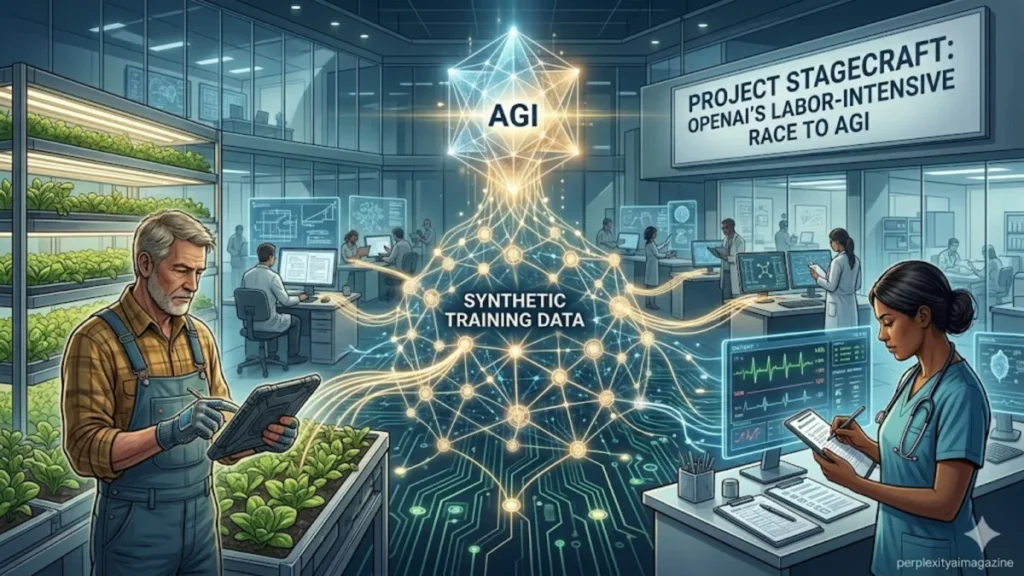
OpenAI is reportedly using thousands of freelancers via a project called Stagecraft, run through the data-labeling firm Handshake AI, to train ChatGPT on real-world skilled jobs including farming and medicine. This initiative, revealed through internal documents in late March 2026, marks a strategic pivot away from scraping generic internet data toward the cultivation of highly specialized, “farmed” data. By hiring between 3,000 and 4,000 contractors at rates ranging from $50 to $500 per hour, the Stagecraft project seeks to map economically relevant human activities that remain largely undocumented in public datasets. These freelancers are not tech workers; they are practitioners—farmers, animal husbandmen, nurses, and aviation experts—tasked with simulating the granular decision-making processes of their respective trades.
The objective of Stagecraft is to imbue Large Language Models (LLMs) with “professional intuition.” While ChatGPT can easily recite a textbook definition of crop rotation, it often struggles with the messy, multi-variable troubleshooting required on a 500-acre farm in the midst of a blight. Through Stagecraft, contractors develop detailed personas and digital prompts that mimic actual workflows, such as reviewing complex medical literature or managing nutrient scheduling for a drought-stricken orchard. As of early April 2026, the project remains a critical, if controversial, pillar of OpenAI’s development pipeline, even as reports of payment disputes and ethical concerns from participants suggest that the human infrastructure of AI is as fragile as the algorithms are robust.
Simulating the Soil: The Agricultural Frontier
Within the silos of Project Stagecraft, farming has emerged as a primary focus for AI fine-tuning. Freelancers in the program do not just describe farming; they inhabit it digitally. They are tasked with creating personas like experienced agronomists or veteran ranchers managing daily operations. These simulations go beyond simple question-and-answer pairs. A contractor might spend hours drafting a scenario where they must interpret a specific soil test report and then troubleshoot an irrigation failure while simultaneously planning a budget for livestock feed. This high-fidelity data allows ChatGPT to grasp the “niche occupations” that have traditionally been a blind spot for AI, which has largely been trained on the digital detritus of social media and news sites.
The process is rigorous. Once a freelancer submits a simulation, it undergoes a tiered review system. Two separate industry experts at Handshake AI vet the content for technical accuracy before it reaches OpenAI for a final ethical and contextual audit. This ensures that the resulting “synthetic data” is not just plausible, but authoritative. For agriculture, this means the AI must learn the specificities of sustainable practices, the nuances of different soil types, and the economic constraints of regional farming. By capturing these intellectual tasks, OpenAI is essentially building a digital map of human expertise that could, in theory, be deployed as an autonomous agricultural advisor.
The Architecture of “Farmed” Expertise
The move toward “farmed data”—a term used by industry insiders to describe human-crafted synthetic datasets—is a response to the “data wall.” Researchers estimate that the pool of high-quality public text will be exhausted within the next few years. To continue scaling, AI must learn from the private, unrecorded expertise of the physical world. Project Stagecraft is the blueprint for this new economy of data. Unlike traditional “clickwork” platforms like Amazon Mechanical Turk, Handshake AI recruits for deep domain expertise. A pilot or a nurse is paid hundreds of dollars an hour because their “persona” is more valuable than any amount of scraped text.
| Component | Project Stagecraft | Traditional Data Labeling |
| Worker Profile | Specialized Professionals (Farmers, Nurses) | Generalist Gig Workers |
| Hourly Rate | $50 – $500 | $1 – $15 |
| Output Type | Workflow Simulations & Personas | Classification & Tagging |
| Review Process | Triple-blind expert audit | Single-pass consensus |
| Focus | Economic & Intellectual Activity | Visual & Linguistic Recognition |
“The irony of Stagecraft is that we are essentially training our own replacements,” noted one contractor who worked on livestock management simulations. This sentiment reflects a growing tension within the project: the contractors are building the very tool that could automate their professional advice. However, OpenAI maintains that this data is necessary to make AI safe and helpful in specialized contexts, preventing the “hallucinations” that occur when a model guesses at technical information it was never formally taught.
The Risks of Recursive Intelligence
Despite the high stakes and high pay, the reliance on farmed data carries significant systemic risks, the most prominent of which is “model collapse.” This occurs when an AI is trained recursively on data generated by humans who are themselves mimicking AI-style prompts, or when the dataset lacks the chaotic diversity of truly organic human experience. In the context of farming, if the pool of experts is limited to a specific geographic region—such as the American Midwest—the AI may develop a bias that makes its advice dangerous for small-scale farmers in diverse climates or developing nations.
Furthermore, bias amplification is a constant threat. If a small group of highly-paid freelancers embeds their personal preferences or regional biases into the “expert” personas they create, the resulting model will treat those biases as objective truths. There is also the issue of quality degradation; as rare patterns of real-world failure vanish from the training set, the AI becomes overconfident in its idealized simulations. For sectors like nursing or aviation, where the “edge case” is a matter of life and death, the lack of real-world “messiness” in synthetic data could lead to catastrophic failures in the model’s logic.
Ethical Boundaries and the Future of Work
The revelation of Project Stagecraft has sparked a broader debate about the ethics of “harvesting” human skill. While OpenAI focuses on the “intellectual tasks” to map economically relevant activities, the privacy implications are vast. Freelancers often use real-world operational data from their farms or clinics to make their simulations realistic, raising questions about whether trade secrets or geolocated information are being unwittingly ingested into OpenAI’s models. There is a legal gray area regarding the liability of an AI providing flawed agricultural or medical advice that was originally derived from a specific, anonymized freelancer’s input.
| Training Technique | Description | Role in Stagecraft |
| Self-Instruct | LLM generates its own prompts | Used to scale initial expert ideas |
| Data Augmentation | Rephrasing queries for diversity | Ensures the model understands synonyms |
| Distillation | Large model teaches a smaller one | Final step for mobile/edge AI deployment |
| Persona Mapping | Experts craft deep professional roles | The core mission of Project Stagecraft |
“We aren’t just labeling images anymore; we are digitizing the human experience of work,” says Dr. Emily Bender, a linguist and AI critic. As Stagecraft continues into 2026, the project serves as a stark reminder that behind the “magic” of AI lies a massive, invisible infrastructure of human labor. The success of the next generation of ChatGPT depends not on better chips, but on whether OpenAI can successfully “farm” enough human wisdom before the specialists realize they are handing over the keys to their professions.
Takeaways from Project Stagecraft
- Specialized Workforce: OpenAI is employing 3,000–4,000 experts to create high-fidelity task simulations for niche fields like farming.
- Economic Value: Contractors earn between $50 and $500 per hour, reflecting the high value of “expert” data over generic internet text.
- Persona Development: Freelancers create detailed professional personas to help AI understand real-world workflows and professional nuances.
- Rigorous Vetting: Simulations undergo a three-stage review process involving Handshake AI domain experts and OpenAI staff.
- Model Collapse Risk: Recursive training on “farmed” or synthetic data could lead to a loss of diversity and accuracy in AI outputs.
- Agricultural Focus: Significant resources are dedicated to planning, pest management, and soil analysis to make AI a viable farm advisor.
- Ethical Irony: Experts are being paid high rates to potentially automate the very skills they have spent decades perfecting.
Conclusion
Project Stagecraft represents the closing of the circle in the development of artificial intelligence. If the first phase of AI was characterized by the unfettered harvesting of the public internet, this second phase is defined by the meticulous, paid cultivation of the private mind. By hiring farmers, nurses, and pilots to simulate their lives, OpenAI is attempting to build a model of the world that is as deep as it is broad. However, the reliance on Handshake AI to manage this “ghost workforce” highlights the persistent gaps in the AI dream: the looming threat of data scarcity, the risks of model collapse, and the profound ethical questions regarding the automation of human expertise. As the project moves forward, it will serve as a bellwether for the future of work. Whether these experts are the pioneers of a new collaborative era or the last generation of humans to hold a professional monopoly remains to be seen. In the fields of Stagecraft, the harvest is intelligence, but the seeds are still unmistakably human.
READ: academic integrity ai news: Universities Redesign Trust and Assessment
Frequently Asked Questions
What is the difference between Stagecraft and traditional data labeling?
Traditional data labeling usually involves simple tasks like identifying stop signs in photos. Project Stagecraft requires deep professional expertise to create complex, multi-turn simulations of actual jobs, such as managing a farm or analyzing medical literature.
Why is OpenAI focusing on farming?
Farming is a high-stakes, economically vital industry with vast amounts of “unstructured” data that isn’t easily found online. Training AI on agriculture allows it to become a more useful tool for food security, sustainability, and automated advisory services.
What is “model collapse” in this context?
Model collapse happens when an AI is trained on too much “synthetic” or human-mimicked data, causing it to lose its ability to handle rare, real-world situations. It eventually starts repeating its own mistakes and losing the “messy” variety of actual human life.
Do freelancers need to know how to code for Stagecraft?
No. The project specifically seeks practitioners—real farmers, pilots, and nurses—who can describe their daily workflows and professional decisions. Handshake AI manages the technical side of integrating that knowledge into the AI.
How much do Stagecraft contractors get paid?
Reports indicate rates range from $50 to $500 per hour, depending on the rarity and depth of the expert’s knowledge. This is significantly higher than the standard gig-economy rates for AI training.
References
- Business Insider. (2026, March 27). Inside Stagecraft: OpenAI’s secret plan to hire the world’s experts. Retrieved from https://www.businessinsider.com/openai-stagecraft-handshake-ai-experts-farming-nursing-2026-3
- OpenAI. (2025). The importance of high-quality human feedback in model alignment. OpenAI Research. Retrieved from https://openai.com/research/alignment-human-feedback
- Handshake AI. (2026). Expert-in-the-loop: Our methodology for professional data synthesis. Retrieved from https://www.handshake.ai/methodology
- Bender, E. M., & Gebru, T. (2021). On the dangers of stochastic parrots: Can language models be too big?. Proceedings of the 2021 ACM Conference on Fairness, Accountability, and Transparency.
- Shumailov, I., et al. (2023). The curse of recursion: Training on generated data makes models forget. arXiv preprint arXiv:2305.17493. Retrieved from https://arxiv.org/abs/2305.17493
