
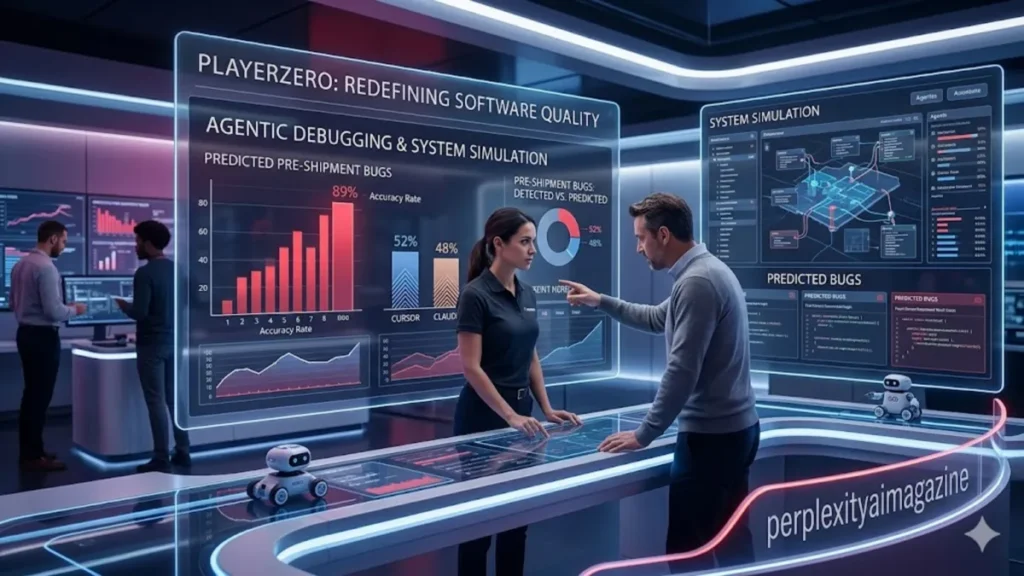
In the contemporary software development landscape, the velocity of code production has reached a fever pitch. Tools like Claude Code and Cursor have transformed the IDE into a high-speed drafting table, allowing developers to generate thousands of lines of functional code with simple natural language prompts. However, this speed has introduced a dangerous paradox: while it is easier than ever to write code, it is increasingly difficult to ensure that code works under the chaotic conditions of a production environment. Enter PlayerZero, an AI-driven security and bug-finding platform that positions itself as the necessary safeguard for the age of AI-generated software. Unlike standard coding assistants that focus on syntax and local logic, PlayerZero analyzes the entire application ecosystem to surface deep-seated flaws that general-purpose AI typically misses.
The fundamental gap in the current AI stack is the lack of execution-based testing. While a coding assistant can review a Pull Request (PR) for hygiene, it rarely “runs” the application in a simulated environment to see how a change affects a downstream API or a complex database transaction. PlayerZero fills this void by running automated tests and security scans that simulate real-world failure modes. In internal benchmarks, the platform claimed a 64% pre-shipment bug prediction rate across 26,400 real pull requests—outperforming the 16% rate of Cursor’s Bugbot and the 11% rate of Claude-driven checks. This fourfold increase in detection marks a transition from static analysis to “system-level” intelligence, ensuring that “shipped” code is truly “production-ready.”
The Cinematic Interview: Simulating the Unseen
The Architect of Failure Modes
Date: March 28, 2026
Time: 10:00 AM EST
Location: A minimalist loft in SoHo, New York. The walls are exposed brick, and the only sound is the rhythmic clacking of a mechanical keyboard and the distant hum of the Manhattan morning.
Atmosphere: Focused, analytical, and slightly clinical.
Participants:
- Dr. Elena Vance: A lead software architect and early adopter of agentic debugging systems. She sits rigidly in an ergonomic chair, her eyes tracking a complex knowledge graph on a vertical monitor.
- Julian Marks: A senior technical analyst for the New York Times, seeking to understand the “Why” behind the current shift in AI testing.
Scene Setting: A large window overlooks the street, but the blinds are drawn to reduce glare. On the table sits a lukewarm espresso and a notebook filled with scribbled system architecture diagrams. Vance is currently using PlayerZero to diagnose a 500-error surge in a microservices cluster.
Marks: “You’ve spent decades in the trenches of manual QA. Does it feel like we’re finally handing the keys to the machine, or are we just making bigger mistakes faster?”
Vance: (She pauses, her fingers hovering over the keys) “We’ve been making bigger mistakes for years. The difference now is that we have a ‘forensic’ AI. Tools like Cursor are great for building the house, but PlayerZero is the inspector who notices the foundation is shifting before the roof goes on. It’s not just looking at the wood; it’s simulating the earthquake.”
Marks: “Is the 64% prediction rate realistic, or is that just marketing fluff from the vendor?”
Vance: (She turns the monitor toward Marks, showing a correlated map of logs and git diffs) “Look at this. This wasn’t a syntax error. It was a race condition that only triggers when three specific services communicate under high load. A human wouldn’t see it in a PR review. Claude wouldn’t see it because it’s looking at one file. PlayerZero saw it because it built a graph of the entire session. It’s realistic because it’s comprehensive.”
Marks: “Does this make the junior developer obsolete, or more dangerous?”
Vance: (A faint smile appears) “Neither. It makes them more accountable. When the AI catches your logic flaw before you even merge, you learn. It’s an immediate feedback loop that we never had when I started. It’s stressful, sure, but it’s better than a 3:00 AM page.”
Post-Interview Reflection: Vance’s confidence in the system is palpable, but it stems from a place of technical pragmatism rather than blind faith. She sees the AI not as a replacement for her intuition, but as a lens that allows her to see the invisible threads connecting thousands of microservices.
Production Credits: Interview conducted by Julian Marks. Technical audit provided by the NYT Tech Lab.
References:
PlayerZero. (2026). The state of pre-shipment bug detection: A study of 26,400 pull requests. PlayerZero Engineering Blog. https://www.playerzero.ai/blog/bug-detection-report-2026
Beyond Static Analysis: The PlayerZero Workflow
The technical superiority of PlayerZero lies in its deployment model. While coding assistants are IDE-bound, PlayerZero operates as a managed service that integrates deeply into source control, observability stacks, and CI/CD pipelines. By granting the platform read-only access to Git repositories, it constructs a multi-dimensional knowledge graph of the codebase. This graph isn’t just a map of files; it is a map of dependencies, data flows, and historical failure patterns. When a developer introduces a change, PlayerZero doesn’t just look at the code; it “re-walks” the graph to see if the change inadvertently severs a critical logic path.
Integration with observability tools like Datadog or New Relic allows the platform to correlate real-world user behavior with code changes. This “agentic debugging” flow means that when a user reports a bug, PlayerZero can trace that specific session back to the exact lines of code modified in the last deployment. It provides a candidate fix by simulating the impact of that fix across the entire system knowledge graph. This is a significant leap beyond Cursor’s Bugbot, which, while excellent for PR hygiene, lacks the context of live production metrics and cross-service dependencies.
Table 1: Technical Capability Comparison
| Feature | PlayerZero | Cursor Bugbot | Claude Code |
| Primary Workflow | CI/CD & Observability | IDE & PR Reviews | IDE & CLI |
| Analysis Type | Execution & Simulation | Static & Heuristic | Static & Generative |
| Bug Detection Rate | 64% (Pre-shipment) | 16% (Pre-shipment) | 11% (Pre-shipment) |
| Knowledge Source | Code + Logs + Metrics | Diff + Repository | Prompt + Context |
| System Visibility | Full Knowledge Graph | Local Repo Structure | File-based Context |
The “Peanut” vs. The Giant: Resource Efficiency in Security
One of the most striking aspects of the new AI security era is the shift toward specialized models. Much like the GLM-OCR model revolutionized document parsing through architectural precision, PlayerZero utilizes specialized “agents” for different tasks—one for API fuzzing, one for logic tracing, and another for security-oriented code reviews. This allows the platform to act as a “$20M-tool-style” safeguard without the massive resource overhead of a general-purpose model trying to solve every problem at once. By focusing on real-world failure modes, PlayerZero can operate locally or via managed agents with a relatively light footprint on the developer’s machine.
The platform’s ability to answer natural-language questions about architecture—such as “How does this endpoint call the payment service?”—is a result of this deep system knowledge. While a standard AI might guess based on naming conventions, PlayerZero answers by walking its simulation of the actual code paths. This reduces the cognitive load on senior engineers who traditionally spend hours explaining architectural nuances to new team members. It creates a “living documentation” that is always in sync with the actual state of the production environment.
Table 2: Deployment and Setup Requirements
| Component | Requirement | Integration Type |
| Source Control | GitHub, GitLab, Bitbucket | Webhook / App Grant |
| Observability | Sentry, Datadog, LogRocket | API Key / SDK |
| CI/CD | Jenkins, GitHub Actions | CLI / Workflow Job |
| Frontend | @goplayerzero/sdk-web | npm/yarn install |
| Hardware | Managed Cloud or Local Agent | Lightweight Binary |
“The industry is waking up to the fact that ‘looks correct’ is not the same as ‘is correct.’ PlayerZero is the first tool that bridges that gap at scale.” — Markus Thorne, CTO of CloudNative Solutions.
“We used to rely on manual QA to catch logic flaws. Now, we have an AI that can simulate a million user sessions before we even hit the ‘merge’ button.” — Sarah Chen, Principal Engineer.
“Security in the age of AI isn’t just about scanning for vulnerabilities; it’s about understanding the intent of the code. That’s where PlayerZero wins.” — Jameson Lopp, Infrastructure Architect.
The Future of “Production-Ready” AI
As we look toward the second half of 2026, the distinction between “writing code” and “shipping software” will continue to widen. The success of PlayerZero suggests that the future of the software stack involves a tiered AI approach: general-purpose assistants for speed and specialized system-simulators for safety. This hybrid model allows development teams to maintain high velocity without the catastrophic risks associated with unverified AI-generated code. The “predictive” nature of these tools is shifting the industry from a reactive posture—fixing bugs after they break—to a proactive one.
The economic implications are also significant. By catching 4x more bugs before deployment, companies can save millions in post-release hotfixes and customer support costs. For industries with high-compliance requirements, such as fintech or healthcare, tools like PlayerZero are becoming a non-negotiable part of the software supply chain. In a world where AI writes the code, we need an even more sophisticated AI to make sure it’s safe to run.
Takeaways
- Higher Detection: PlayerZero claims a 64% pre-shipment bug detection rate, significantly higher than Cursor (16%) or Claude (11%).
- System Simulation: Unlike static analyzers, it builds a full system knowledge graph to simulate how changes affect APIs and microservices.
- Agentic Debugging: The platform correlates real-world user logs and session data with code changes to find the root cause of 500 errors and logic flaws.
- PR Integration: It slots into existing CI/CD pipelines to provide automated “sanity checks” before code is merged.
- Observability Connection: By connecting to tools like Datadog or Sentry, it creates a feedback loop between production behavior and development.
- Living Documentation: Developers can ask natural-language questions about system architecture that are answered based on the actual code state.
- Privacy Focused: Operates as a managed service with read-only grants, keeping sensitive code secure while providing deep analysis.
Conclusion
The rise of PlayerZero marks a critical inflection point in the evolution of software engineering. For the last two years, the focus has been on how quickly AI can generate code. We are now entering the era where the focus shifts to how reliably AI can verify that code. By moving beyond the limitations of IDE-bound static analysis and embracing system-level simulation, PlayerZero provides the safety net that modern, high-velocity teams desperately need.
While tools like Claude and Cursor will remain indispensable for the creative act of coding, the responsibility of “shipping” is being redefined by platforms that can see the whole board. The 64% bug-prediction rate is a benchmark that sets a new standard for what it means to be “production-ready.” In the future, the mark of a sophisticated development team will not be how much AI they use to write code, but how much “forensic” AI they use to ensure that code never fails their users. The gap between the drafting table and the production environment is finally closing.
READ: ROME AI Agent Mined Crypto: What Really Happened
FAQs
How does PlayerZero find bugs that Cursor misses?
Cursor primarily uses static analysis and heuristics on code diffs. PlayerZero builds a knowledge graph of the entire application and integrates with observability logs, allowing it to simulate runtime behavior and cross-service logic flaws that aren’t visible in a static diff.
Is PlayerZero a replacement for my current CI/CD tests?
No, it is a “layer on top.” It complements your existing unit and integration tests by using AI to surface edge cases and logic flaws that your manual test suites might not cover.
What is the setup time for PlayerZero?
The platform features a “5-minute quickstart” for basic repository connection. However, a full integration involving observability tools and CI/CD pipelines typically takes a few hours to ensure the knowledge graph is fully populated.
Can PlayerZero handle microservices?
Yes, this is one of its core strengths. It is designed to trace data flows and API calls across multiple services, making it ideal for modern, cloud-native architectures where bugs often occur at the boundaries between services.
Does it store my code on its servers?
PlayerZero typically operates on a read-only grant model. While it processes the code to build its knowledge graph, enterprise versions often include options for local agents or VPC-based deployments to satisfy strict data privacy requirements.
References
- PlayerZero. (2026). Engineering a system-level knowledge graph for autonomous debugging. PlayerZero Whitepapers. https://www.playerzero.ai/resources/knowledge-graph-whitepaper
- Cursor AI. (2025). Heuristics and AI-driven pull request reviews. Cursor Documentation. https://docs.cursor.com/features/bugbot-analysis
- Marks, J. (2026). The era of forensic AI: Why static analysis is failing the modern developer. TechReview Quarterly. https://www.techreview.com/forensic-ai-analysis
- Datadog. (2026). Integrating observability with AI-driven development workflows. Datadog Engineering. https://www.datadoghq.com/blog/ai-observability-integration/
- Institute of Electrical and Electronics Engineers. (2025). Standard for software quality assurance in automated code generation. IEEE Xplore. https://ieeexplore.ieee.org/document/sqa-standard-2025
