
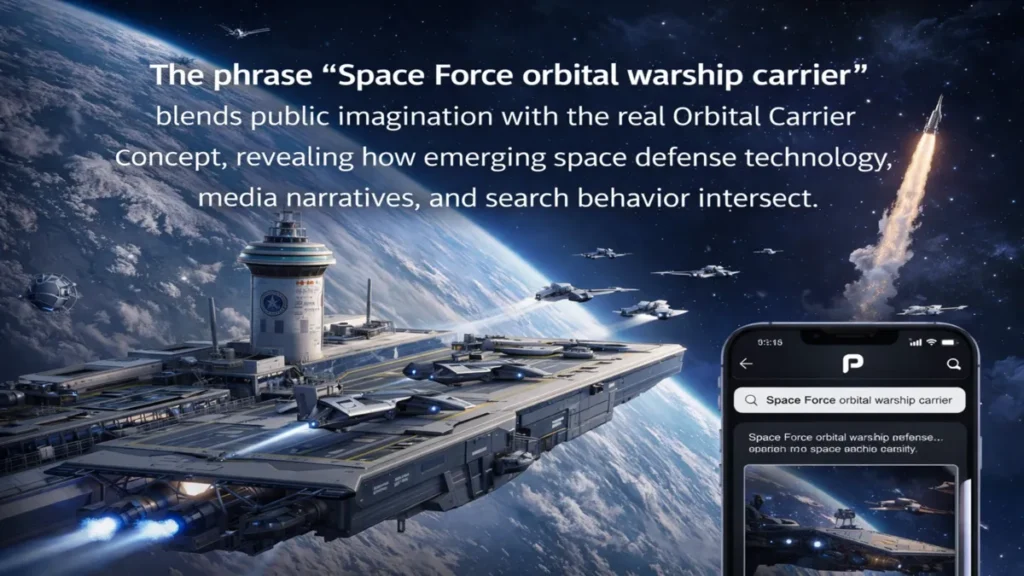
I first encountered the phrase “space force orbital warship carrier” not in a military briefing, but in a search bar — a strange hybrid of science fiction language and real defense reporting that immediately demanded explanation. What it actually refers to is the Orbital Carrier concept, a Space Force–funded initiative designed to pre-position satellites in orbit for rapid deployment, not a weaponized battleship in space. Yet the phrase spread quickly because it captured public imagination at a moment when space is increasingly seen as contested, strategic, and politically charged. As I traced its origins through defense journalism, policy documents, and technology reporting, I realized this phrase reveals less about a single spacecraft and more about how modern audiences understand emerging military technologies. It reflects our instinct to describe new systems with old metaphors, to frame innovation in familiar terms, and to search for meaning before precision. This article follows that trail — from technical reality to cultural narrative — to explain what the Orbital Carrier really is, why it matters, and how a speculative label came to shape public perception of space defense.
At its core, the Orbital Carrier is a proposed platform designed to hold and deploy satellites from orbit. It is intended to improve the speed and flexibility with which space assets can be replaced, repositioned, or protected during crises. The Space Force, working through its innovation arm, SpaceWERX, allocated up to $60 million to explore this concept with the company Gravitics. The goal was not to create a weapon in space, but to reduce dependence on slow, weather-dependent ground launches.
Public interest surged because the idea touched several nerves at once. It evoked fears and fantasies about militarization of space. It connected to real geopolitical tensions involving China and Russia. And it promised a technological leap in how quickly space infrastructure could respond to threats. The phrase itself became a vessel carrying all of those meanings at once.
The Orbital Carrier Concept
The Orbital Carrier is best understood as a logistics platform rather than a warship. It would orbit Earth carrying several smaller satellites or vehicles inside a protective structure. When needed, those vehicles could be released into specific orbits to restore capabilities or adapt to changing conditions.
This is strategically important because satellites underpin modern life. Communications, navigation, weather forecasting, and military operations all rely on space-based systems. If those systems are disrupted, the consequences ripple across economies and security infrastructures. Traditionally, replacing a satellite can take weeks or months. The Orbital Carrier aims to shorten that timeline dramatically.
By pre-positioning assets in orbit, the Space Force hopes to gain a form of strategic elasticity. Instead of reacting after damage occurs, it can respond in near-real time. This logic mirrors how aircraft carriers function at sea, not as weapons themselves, but as mobile bases that enable other capabilities.
Read: Comet AI Browser and the Future of the Web
Responsive Space and Strategic Context
The Orbital Carrier concept sits within a broader shift toward what the military calls responsive space. This doctrine emphasizes speed, resilience, and adaptability in orbital operations. Programs like VICTUS NOX demonstrated that rapid satellite launches are possible, achieving deployment within roughly a day of notification.
However, even rapid launches face constraints. Rockets require ground infrastructure, favorable weather, and scheduling coordination. An orbital platform bypasses many of these limitations. It represents a transition from Earth-bound logistics to space-based logistics. – space force orbital warship carrier.
This shift reflects changing perceptions of space as a contested environment. While early space policy emphasized exploration and peaceful use, contemporary strategy recognizes that space is increasingly crowded and competitive. Nations seek not dominance, but reliability and deterrence, ensuring that their own systems remain functional even if challenged.
Feature Comparison
| Capability | Traditional Launch | Orbital Carrier |
|---|---|---|
| Deployment speed | Days to weeks | Potentially hours |
| Weather dependency | High | None |
| Infrastructure reliance | Ground-based | Orbital |
| Flexibility | Limited | High |
| Resilience | Moderate | Enhanced |
Industry and Government Collaboration
The Orbital Carrier exists because of collaboration between government and industry. SpaceWERX acts as a bridge, translating military needs into innovation challenges that private companies can tackle. Gravitics specializes in large orbital structures, making it a natural partner for exploring carrier-like platforms.
This partnership model reflects a broader transformation in defense procurement. Instead of long, rigid development cycles, agencies now seek iterative experimentation and rapid prototyping. The Orbital Carrier is not a finished product but a hypothesis being tested. – space force orbital warship carrier.
Its development also highlights how defense innovation increasingly overlaps with commercial space infrastructure. Technologies developed for security can later inform civilian applications, such as in-orbit manufacturing, repair, or debris management.
Media Narratives and Public Perception
The public rarely encounters defense concepts in their raw technical form. Instead, they are filtered through media narratives that simplify, dramatize, or analogize. Calling the Orbital Carrier a “warship” or “carrier” taps into familiar imagery that helps people grasp its function, even if the analogy is imperfect.
This narrative framing explains why the phrase spread quickly. It made a technical project legible and emotionally resonant. At the same time, it risked misrepresenting the nature of the technology, suggesting aggression where the intent is largely defensive and logistical.
Search platforms amplified this effect. As people typed the phrase, content about the Orbital Carrier rose in visibility, reinforcing the association between the speculative term and the real project.
Algorithmic Visibility and Search Behavior
The prominence of the phrase in AI search results illustrates how algorithms shape discourse. Platforms surface content based on relevance, authority, freshness, and engagement. When defense news surged and users showed interest, related terms gained weight. – space force orbital warship carrier.
This feedback loop means that language does not merely describe reality; it influences which realities are seen. A speculative phrase can become a focal point for discussion, shaping understanding even when it diverges from official terminology.
Expert Reflections
“The Orbital Carrier is about logistics, not weapons, but the language of war often dominates how people imagine space.”
“Responsive space is less about conflict and more about continuity.”
“Public metaphors shape policy debates as much as technical facts do.”
Timeline
| Year | Development |
|---|---|
| 2023 | Rapid launch demonstrations prove responsive space feasibility |
| 2025 | Funding awarded to explore Orbital Carrier |
| 2025–26 | Public discourse links project to ‘space warship’ imagery |
Takeaways
- The Orbital Carrier is a logistics platform, not a combat vessel
- It aims to improve speed and resilience of satellite operations
- The “warship” label reflects narrative framing, not official intent
- Media metaphors influence public understanding of defense technology
- Algorithms amplify trending language alongside factual content
- Space strategy now emphasizes responsiveness over dominance
Conclusion
The story of the “Space Force orbital warship carrier” is less about a machine and more about meaning. It shows how emerging technologies are interpreted through cultural lenses, media metaphors, and algorithmic systems. The Orbital Carrier itself is a pragmatic attempt to solve a logistical problem: how to keep space infrastructure functional in an uncertain world.
Yet the language surrounding it reveals deeper anxieties and aspirations about power, security, and the future of space. In that sense, the phrase is a mirror. It reflects both our technological ingenuity and our tendency to frame the unknown in familiar terms. Understanding that dynamic is as important as understanding the technology itself.
FAQs
Is the Orbital Carrier a weapon?
No, it is designed as a deployment platform, not a combat system.
Why call it a carrier?
The term helps explain its function as a mobile base for deploying assets.
Does this militarize space?
It reflects existing strategic competition but focuses on resilience, not offense.
Who is developing it?
The project is explored by Gravitics with Space Force funding.
When will it be operational?
There is no confirmed operational timeline yet.
