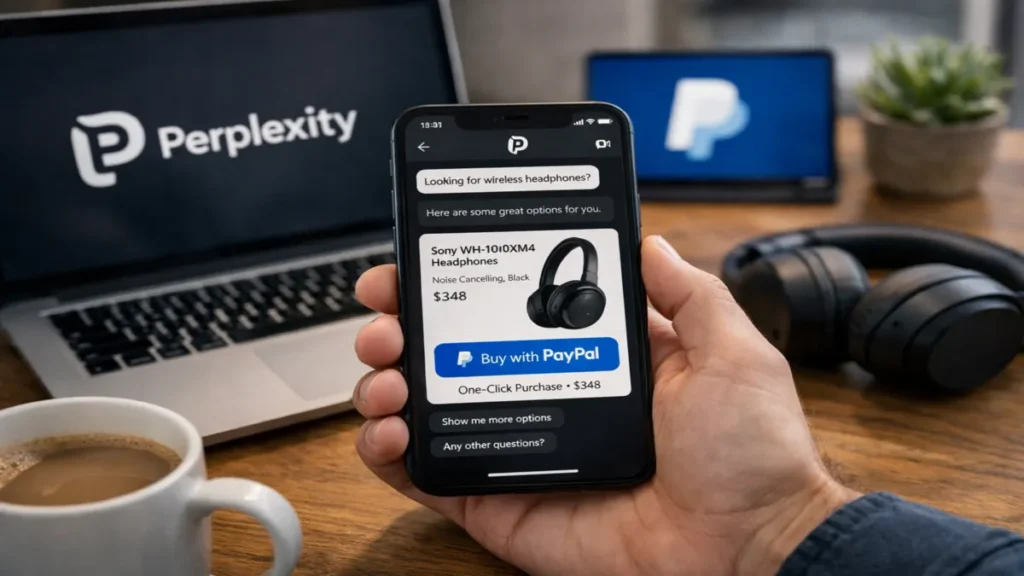
When Perplexity AI introduced in-chat shopping with PayPal in 2025, it signaled a subtle but important change in how people move from information to action online. Search had long been about finding answers and links, while shopping lived on separate websites and apps. The partnership collapsed that distance. A user could ask a question, receive product recommendations, and complete a purchase without leaving the conversation.
For users, this meant less friction and fewer steps. For Perplexity, it meant extending the role of AI from guide to intermediary. For PayPal, it meant placing its payment infrastructure at the moment of intent, when a user is most ready to act. Together, they created what came to be described as agentic commerce, where software agents help not only find information but execute transactions.
This shift matters because it changes the architecture of the web experience itself. Instead of jumping between tabs, apps, and forms, users remain inside a single conversational space. That space becomes not just a window onto the internet, but a place where decisions are made and money moves. The Perplexity–PayPal integration therefore represents more than a feature update. It is an early example of how AI systems may become central marketplaces, shaping both what people see and what they buy.
The Partnership and Its Intent
The collaboration between Perplexity and PayPal was designed to merge two complementary strengths. Perplexity brings natural language understanding, recommendation, and synthesis. PayPal brings identity, trust, fraud protection, and global payment rails. By combining them, the companies aimed to reduce friction in e-commerce and increase conversion by keeping users in a single flow.
This was not about replacing merchants or becoming a retailer. Merchants remain responsible for fulfillment, returns, and customer service. Perplexity acts as the discovery and decision layer, while PayPal acts as the transaction layer. The user experiences it as a single interaction, but structurally it remains a partnership between three parties.
The initial rollout focused on the United States, where PayPal and Venmo have large user bases and regulatory clarity. The integration allowed users on Perplexity Pro to see product cards, compare options, and then choose “Pay with PayPal” or “Pay with Venmo” to complete checkout instantly.
Read: Perpl and Perplexity AI: Inside a Tiny Search Signal
What “Instant Buy” Changed
Before this integration, shopping through search meant bouncing between platforms. Users would search, click, read, add to cart, create accounts, and then pay. Each step added friction and abandonment risk.
Instant Buy removed most of that friction. It allowed a user to go from intent to transaction in one place. The conversational context carries through the process, so the AI understands what the user wants, why they want it, and what constraints matter, such as price or delivery time.
This turns the search interface into a commerce interface. The difference is not just convenience, but control. The AI shapes which options are shown, how they are framed, and in what order they appear. This raises questions about neutrality, fairness, and transparency that echo earlier debates about search ranking and advertising.
Subscription and Billing Boundaries
The PayPal integration did not extend to everything on Perplexity. Subscriptions to Perplexity Pro still require credit or debit card payments processed through Stripe. PayPal cannot be used to start or renew a Pro subscription.
There were promotional exceptions. In 2025, some PayPal and Venmo users were offered free or discounted Pro access through limited campaigns. These were time-bound and did not convert into ongoing billing relationships. This distinction is important because it shows that payments for commerce and payments for subscriptions remain structurally separate inside the platform.
The result is a hybrid model. Shopping is conversational and payment-integrated. Subscriptions remain traditional and account-based.
Feature Comparison
| Dimension | Traditional E-Commerce | Perplexity + PayPal |
|---|---|---|
| Discovery | Search engines, browsing | Conversational AI |
| Checkout | Merchant website | In-chat PayPal/Venmo |
| Payment trust | Varies by merchant | PayPal identity and protection |
| User flow | Multiple sites and tabs | Single conversational interface |
| Merchant role | Full funnel owner | Fulfillment and service owner |
User Experience in Practice
From the user’s perspective, the experience feels unusually smooth. You ask for recommendations, the AI shows you options, you refine your request, and then you pay. There is no sense of “going somewhere else.” The payment step feels like part of the conversation, not a separate ritual.
This can feel empowering, but also disorienting. Users must trust that the AI’s recommendations are not biased toward particular merchants, that prices are accurate, and that the payment layer is secure. PayPal’s presence helps with trust, but the recommendation layer remains opaque.
For some users, this opacity is a concern. For others, it is simply invisible infrastructure.
Impact on Merchants
For merchants, the integration offers a new acquisition channel. Instead of relying solely on search rankings or ads, they can appear inside AI-mediated conversations. This could increase conversion by capturing users at the moment of intent.
However, it also shifts power. Merchants become one option among many curated by an algorithm. Their brand visibility depends not only on SEO and ads, but on how well their data feeds integrate with Perplexity and how the AI chooses to surface them.
This mirrors earlier shifts in platform power, from standalone websites to app stores to social feeds. AI now becomes another gatekeeper.
Expert Reflections
“Agentic commerce collapses the funnel. Discovery and transaction become one moment, not two.”
“The risk is that recommendation algorithms gain enormous influence over consumer choice.”
“Trust will depend on transparency, not just convenience.”
Timeline
| Year | Development |
|---|---|
| 2025 | Launch of in-chat checkout with PayPal |
| 2025 | Limited PayPal and Venmo promotions for Pro |
| 2026 | Ongoing U.S. availability, cautious global expansion |
Takeaways
- Perplexity and PayPal merged conversational discovery with instant checkout
- Shopping happens inside chat, not on separate websites
- Pro subscriptions still require traditional card billing
- Merchants gain a new channel but lose some control over presentation
- The model concentrates power in AI recommendation systems
- Convenience and transparency must be balanced carefully
Conclusion
The Perplexity–PayPal integration is an early glimpse into a future where AI is not just a guide to the web, but a place where economic activity happens. It reduces friction, increases speed, and feels intuitively aligned with how people think and speak. At the same time, it centralizes influence over what is seen, recommended, and bought.
This dual nature makes it both exciting and unsettling. It promises a more humane interface to commerce, but also a more mediated one. As conversational agents become marketplaces, the questions once asked of search engines will return in new forms. Who decides what we see. Who benefits from our attention. And who controls the flow of value inside systems that increasingly feel like the internet itself.
FAQs
What is Instant Buy?
It is Perplexity’s in-chat shopping feature powered by PayPal and Venmo.
Can I pay for Pro with PayPal?
No, Pro subscriptions still require credit or debit cards.
Where is this available?
Primarily in the United States.
Do merchants still handle fulfillment?
Yes, merchants remain responsible for shipping and service.
Is this the future of shopping?
It is an early model that shows how AI and commerce may converge.