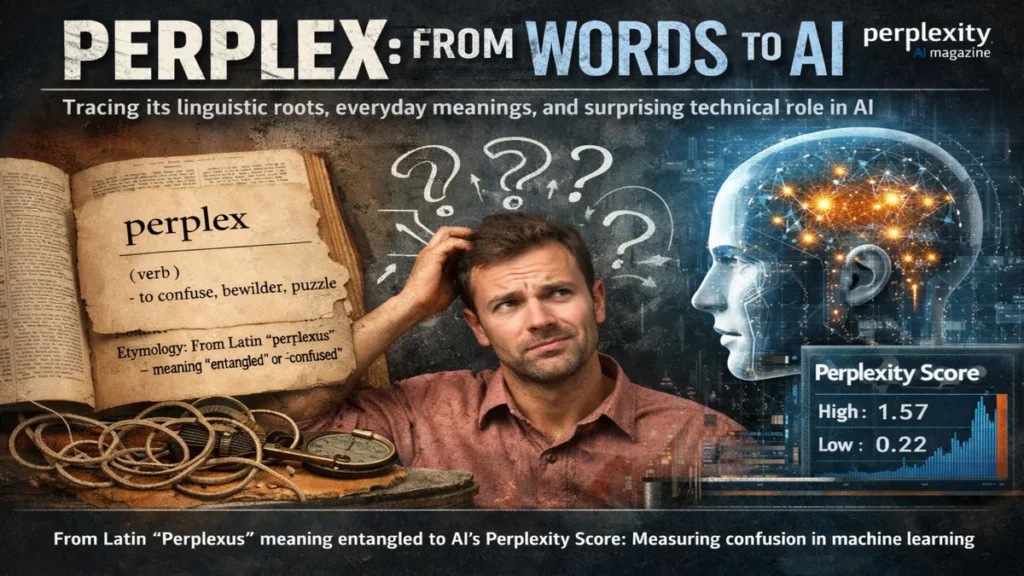
I define perplex as the experience of mental entanglement — the moment when something becomes difficult to understand because it is complex, ambiguous, or internally contradictory. When people search for “define perplex,” they are usually not just looking for a dictionary entry, but for clarity about this state itself: how it differs from simple confusion, how it feels, and how it functions in language, thought, and even technology. What fascinates me about the word is that it spans centuries and disciplines, from its Latin roots meaning “interwoven,” to its everyday use in describing human bewilderment, and finally to its modern technical role in artificial intelligence, where “perplexity” has become a formal measure of uncertainty. – define perplex.
Yet the word carries more weight than its casual usage suggests. Perplex is not just a feeling; it is a historical, linguistic, psychological, and now even computational concept. It comes from the Latin perplexus, meaning tangled, twisted, or interwoven — a metaphor that still resonates today when we say we feel “perplexed.” Something has wrapped around our thinking in a way that resists easy untying.
In modern culture, perplex appears in literature, education, philosophy, and increasingly in artificial intelligence, where perplexity — its noun form — is used as a statistical measure of uncertainty in language models. The word thus spans human emotion and machine evaluation, subjective experience and mathematical abstraction.
This article follows that journey. It traces how “perplex” evolved from a description of tangled rope to tangled thought, how its meanings differ from neighboring concepts like confusion and bewilderment, how writers and thinkers have used it to describe the human condition, and how engineers now use it to quantify how uncertain a machine is about language. In doing so, it shows how one small word connects deeply human experiences with the technical systems that increasingly shape modern life. – define perplex.
The Linguistic Origins of “Perplex”
The word perplex originates from the Latin perplexus, meaning entangled, twisted together, or interwoven. The prefix per- implied thoroughness or intensity, while plexus meant braided or folded. The original sense was physical: something literally knotted or crossed in a complicated way.
As the word moved through Old French into Middle English, its meaning shifted from physical entanglement to mental entanglement. Instead of threads being tangled, thoughts became tangled. This metaphorical extension is common in language: we speak of “knotty problems,” “twisted logic,” or “unraveling” an argument.
By the 16th and 17th centuries, perplex was firmly established in English as a verb meaning to confuse or puzzle, and perplexity as the noun describing that state. The evolution reflects a deep human tendency to describe mental states using physical imagery. Confusion feels like something is wrapped around our thoughts, blocking a straight path. – define perplex.
This history matters because it reveals that perplexity is not merely about ignorance. It is about obstruction. A person may have information and still feel perplexed if that information is too dense, contradictory, or poorly structured.
Read: perplexed definition, Meaning, and Usage Explained
Defining “Perplex” in Everyday Use
In modern usage, to perplex is to cause someone difficulty in understanding. It does not imply stupidity or lack of intelligence; in fact, people are often perplexed precisely because something is sophisticated, subtle, or layered.
For example, a riddle can perplex a child and an adult alike. A legal contract can perplex a well-educated person if it is written in overly technical language. A novel with unreliable narrators can perplex even experienced readers.
Perplex differs from simple confusion in tone and implication. Confusion often suggests disorder or chaos, while perplexity suggests structured complexity that resists easy interpretation. Bewilderment adds emotional intensity, often implying surprise or disorientation. Bafflement suggests being blocked or stopped.
Thus, to be perplexed is not just to be lost, but to be caught in a web of meaning that is too dense to immediately penetrate.
The Relationship Between Perplex and Perplexity
Grammatically, perplex is a verb, while perplexity is a noun. The verb describes the action; the noun describes the resulting state.
One can say, “The instructions perplexed me,” referring to the cause. One can also say, “I stared at the instructions in perplexity,” referring to the internal condition.
This distinction mirrors many verb–noun pairs in English: confuse/confusion, astonish/astonishment, irritate/irritation. But perplexity has an added nuance: it can also describe the thing itself that causes confusion, not just the feeling.
For example, “The city’s bureaucracy is a perplexity” frames the system itself as tangled and difficult.
Table: Linguistic Forms of “Perplex”
| Form | Part of Speech | Meaning | Example |
|---|---|---|---|
| perplex | verb | to confuse or puzzle | “The question perplexed her.” |
| perplexed | adjective | feeling confused | “He looked perplexed.” |
| perplexing | adjective | causing confusion | “It was a perplexing problem.” |
| perplexity | noun | state of confusion or complexity | “She felt great perplexity.” |
Perplex in Literature and Philosophy
Writers have long used perplexity to describe moments of moral, emotional, or intellectual crisis. Characters become perplexed when their assumptions collapse or when the world no longer fits their expectations.
In philosophical writing, perplexity often marks the beginning of inquiry. Socrates famously induced perplexity — aporia — in his students by questioning their assumptions until they realized they did not understand what they thought they understood. This confusion was not failure but a doorway to deeper insight.
Thus, perplexity can be productive. It can signal that a person is thinking seriously, encountering complexity, and reaching the limits of simple answers. – define perplex.
The Psychological Experience of Perplexity
Psychologically, perplexity arises when cognitive frameworks fail to integrate new information smoothly. It is a mismatch between expectation and perception.
This mismatch triggers attention and analysis. The brain pauses, reassesses, and attempts to build a new model of understanding. In this way, perplexity is not merely discomfort; it is part of learning.
Educational research shows that moderate perplexity can enhance engagement and memory, as learners work to resolve uncertainty. Too little perplexity leads to boredom; too much leads to frustration.
Thus, perplexity is a dynamic state that balances between curiosity and overload.
The Technical Meaning of Perplexity in AI
In machine learning and information theory, perplexity is a numerical measure of how uncertain a model is about predicting the next element in a sequence, typically words in language.
Lower perplexity means the model is more confident and better at prediction. Higher perplexity means it is more surprised by the data. – define perplex.
This technical usage preserves the metaphorical core of the word. A model with high perplexity is, in a sense, confused. A model with low perplexity is less entangled in uncertainty.
Perplexity thus becomes a bridge between human intuition and mathematical formalism.
Table: Human vs Technical Perplexity
| Domain | Meaning | Purpose |
|---|---|---|
| Language | State of confusion | Describe experience |
| Psychology | Cognitive mismatch | Trigger learning |
| Literature | Emotional or moral tension | Deepen narrative |
| AI | Statistical uncertainty | Evaluate models |
Expert Perspectives
A linguist might say that perplexity reflects how language encodes mental states through physical metaphors.
A cognitive scientist might argue that perplexity is a key driver of learning and adaptation.
An AI researcher might note that perplexity offers a quantitative window into how well machines model human language.
Takeaways
- Perplex means to confuse by making understanding difficult.
- It originates from a Latin word meaning tangled or interwoven.
- Perplexity is the resulting state or condition of confusion.
- The word spans emotional, philosophical, and technical domains.
- Moderate perplexity supports learning and inquiry.
- In AI, perplexity measures predictive uncertainty.
Conclusion
Perplex is a small word with a long reach. It captures a universal human experience — the moment when understanding falters and thought becomes tangled. Yet it also now belongs to the language of machines, where perplexity becomes a number rather than a feeling.
This dual life of the word reflects a broader truth about the modern world. Our emotional and cognitive concepts increasingly intersect with technical systems that model, measure, and simulate them. In tracing the meaning of perplex, we trace a line from ancient metaphors of tangled threads to algorithms predicting the next word in a sentence. – define perplex.
To be perplexed, then, is not merely to be confused. It is to stand at the edge of what one knows, facing complexity. It is uncomfortable, but also fertile. It is the beginning of thought.
FAQs
What does “perplex” mean?
It means to confuse or puzzle someone by making understanding difficult.
Is perplex always negative?
No, it can be a sign of deep thinking or learning.
What is perplexity in AI?
It is a metric measuring uncertainty in language model predictions.
How is perplex different from confuse?
Perplex implies structured complexity rather than disorder.
Where does the word come from?
From Latin perplexus, meaning tangled or interwoven.