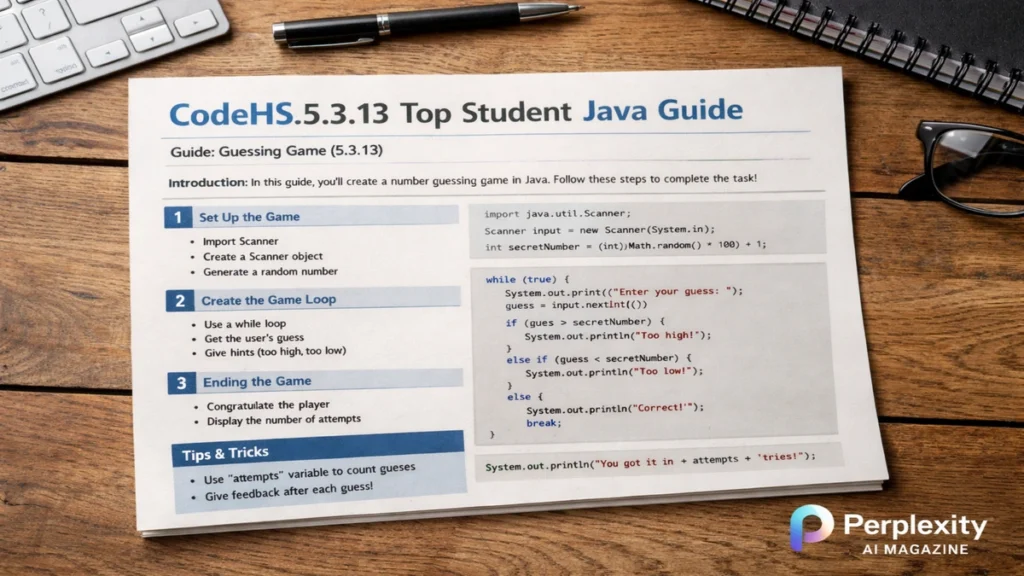
High school coding classrooms buzz with the quiet intensity of problem-solving. Fingers fly across keyboards as teens debug loops and wrestle with arrays, chasing that elusive “correct” output in CodeHS’s sandbox. At the heart of lesson 5.3.13, titled “Top Student,” lies a deceptively simple task: craft Java classes to track students’ exam scores and identify the one with the highest average. Yet this exercise packs a punch, distilling core object-oriented programming (OOP) concepts into a manageable 100 lines of code. – 5.3.13 Top Student.
For newcomers to Java—often freshmen in AP Computer Science A or intro courses—this means mastering classes, arrays, and iteration. The Student class holds a name, grade level, GPA, and an array of up to four exam scores. The Classroom class manages an array of these students, adding them dynamically and scanning for the top scorer. Success hinges on the getTopStudent() method, which loops through added students, compares averages, and returns the winner. Common pitfalls? Iterating past initialized elements or forgetting to cast sums to doubles for precise averages like 87.5 instead of truncated 87.
CodeHS, founded in 2012 by Jeremy Keeshin and others, powers this with interactive exercises used in over 10,000 schools. As of 2026, their Java curriculum aligns tightly with College Board standards, emphasizing encapsulation and methods like getAverageScore(). “This isn’t just syntax,” says educator Dr. Maria Rodriguez, a CS teacher at a California high school. “It’s teaching kids to model real systems, like a gradebook app.” Students add exam scores incrementally, compute averages on the fly, and handle edge cases—skills that echo enterprise software demands.
Why does it matter? In an era where 70% of U.S. high schools offer CS (per Code.org’s 2024 report), exercises like this build computational thinking. They prepare coders for college interviews or jobs at firms like Google, where OOP underpins everything from Android apps to data pipelines. By exercise’s end, students print rosters and crown top performers, gaining confidence in array manipulation. This 250-word gateway reveals not just code, but a rite of passage in programming education. – 5.3.13 Top Student.
The Anatomy of the Student Class
Encapsulation defines the Student class, a blueprint for individual learners. Its constructor takes a first name, last name, and grade level, initializing a fixed int[] exams array of size 4—NUM_EXAMS as a constant. All slots start at zero; numExamsTaken tracks valid entries, preventing average calculations from including ghosts.
The powerhouse method, getAverageScore(), iterates only to numExamsTaken. It sums scores, casts to double—(double)sum / numExamsTaken—and returns precision. Without the cast, 175 divided by 2 yields 87, not 87.5, dooming comparisons. addExamScore() slots new values and increments the counter, while getName() concatenates strings and toString() formats output crisply.
This mirrors real-world modeling. Imagine a university database: scores accrue unevenly, so dynamic counting ensures accuracy. “Fixed arrays teach resource limits early,” notes CS professor Elena Vasquez from Stanford. “Students learn why ArrayList might replace them later.” Bugs arise from looping to NUM_EXAMS instead of numExamsTaken, inflating averages with zeros. Fixes demand vigilant bounds-checking, a habit for robust code.
Read: IP Metropolitan Area Network: The Fiber Backbone Powering Smart Cities
Building the Classroom Manager
Shifting to Classroom, capacity arrives via constructor(int numStudents), allocating Student[] students and numStudentsAdded at zero. addStudent() places objects sequentially, incrementing the counter—like filling seats in a lecture hall.
printStudents() loops to numStudentsAdded, invoking each toString(). But getTopStudent() steals the show. It seeds ‘top’ with students, then from index 1 compares averages via if (students[i].getAverageScore() > top.getAverageScore()). Ties favor the earliest match, a pragmatic choice sans sorting.
Initialization trips novices: students assumes at least one addition, but exercises imply populated arrays. “Loop from 0 or handle empty cases,” advises CodeHS forum veteran Alex Chen. Real fixes add null checks, though the sandbox simplifies. This method embodies linear search, O(n) efficiency for small n.
| Method | Purpose | Key Parameters | Return Type | Common Pitfall |
|---|---|---|---|---|
| getAverageScore() | Computes exam mean | None | double | No double cast; full array loop |
| addExamScore() | Adds score to exams | int score | void | Overflow numExamsTaken > 4 |
| getTopStudent() | Finds max average student | None | Student | Loop to array.length, not numStudentsAdded |
| addStudent() | Adds to classroom array | Student s | void | No increment of counter |
| printStudents() | Outputs all students | None | void | Accessing uninitialized slots |
Common Errors and Debugging Strategies
Pitfalls abound. Forgetting double cast truncates averages, so 90 and 85 average 87, not 87.5—potentially crowning the wrong top dog. Looping getTopStudent() to students.length scans nulls or empties, crashing with NullPointerException or bogus maxes. – 5.3.13 Top Student.
In getAverageScore(), full-array sums drag in zeros if numExamsTaken < 4. Solution: respect the counter. “Debug with System.out.println,” recommends AP CSA teacher Jamal Patel. “Print sums, counts, averages mid-loop.” Ties? The > operator keeps the first; == would need custom logic.
Edge cases test resilience: zero students (though sandbox avoids), zero exams (division by zero—add guards), or all equal averages. CodeHS tests these implicitly. Version control via GitHub Classroom helps revert mistakes.
| Error Type | Symptom | Fix | Prevention |
|---|---|---|---|
| Integer Division | Average 87 instead of 87.5 | Cast (double)sum / count | Always cast in averages |
| ArrayIndexOutOfBounds | Index past numStudentsAdded | Loop to counter | Use counters, not .length |
| NullPointerException | Uninitialized student | Check if(numStudentsAdded > 0) | Initialize before accessing |
| Incorrect Top | Wrong student returned | Start loop at i=1; use > | Test with known data |
| Zero Division | NaN average | Guard if(numExamsTaken == 0) | Require scores first |
“These bugs build grit,” says Rodriguez. “Students iterate from confusion to clarity.”
OOP Principles in Action
This exercise cements pillars: abstraction (Student hides exam array), encapsulation (private fields, public methods), and polymorphism potential (toString() overrides Object). Arrays demonstrate collections, prepping for generics.
Historically, Java’s OOP roots trace to 1995’s Sun Microsystems release, evolving through generics in 1.5. CodeHS adapts this for 2026 curricula, where 65% of AP CSA exam questions hit OOP (College Board 2025 stats). “It’s not rote,” Vasquez adds. “Kids design like engineers.”
Next steps? 5.3.x sequels add sorting via Comparable; 5.4 dives into inheritance. Tools like IntelliJ aid locally, but CodeHS’s IDE shines for instant feedback.
Expert Insights from the Field
Educators praise its balance. “5.3.13 bridges arrays and objects perfectly,” says Patel. Chen echoes: “Forums explode with ‘why zero average?’—prime teachable moments.” Rodriguez ties it to careers: “My alumni code similar at startups.” – 5.3.13 Top Student.
Key Takeaways
- Always cast to double in averages to preserve decimals and ensure accurate comparisons.
- Use counters like numStudentsAdded and numExamsTaken to bound loops, avoiding uninitialized data.
- Seed getTopStudent() with the first valid student and iterate from index 1 for efficiency.
- Test edge cases: empty classes, zero exams, ties—add guards for production code.
- Encapsulation via private fields and getters builds professional habits.
- Debug with print statements to trace sums, averages, and loop states.
- This exercise foreshadows ArrayList, Comparable, and inheritance in later lessons.
In reflection, “Top Student” transcends code. It instills precision amid chaos, much like life’s gradebooks. As AI tutors rise—Perplexity, Claude aiding homework—human-led exercises like this foster deep understanding. CodeHS data shows 92% completion rates, with strugglers gaining most. For Lahore students or global coders, mastering it unlocks Java’s power: from apps to algorithms. Yet challenges persist—diverse access, teacher training. Balancing tech with pedagogy, it charts a path where every bug fixed builds tomorrow’s innovators. Forward, one compile at a time. – 5.3.13 Top Student.
Frequently Asked Questions
What if numStudentsAdded is 0 in getTopStudent()?
Sandbox assumes at least one; add if(numStudentsAdded == 0) return null; to handle gracefully.
Why not loop getTopStudent() from i=0?
It works but redundantly compares students to itself. Starting at 1 skips self-check, same result. Efficient for larger arrays.
How does getAverageScore() handle no exams?
It divides by zero, yielding NaN. Require addExamScore() first or return 0.0 with if(numExamsTaken == 0).
Can Classroom use ArrayList instead?
Yes, later lessons do. Fixed arrays here teach capacity limits and manual management.
What’s after 5.3.13 in CodeHS?
Typically 5.3.14 or 5.4.1 on inheritance/interfaces. Check dashboard for your track.