
📋 Executive Summary
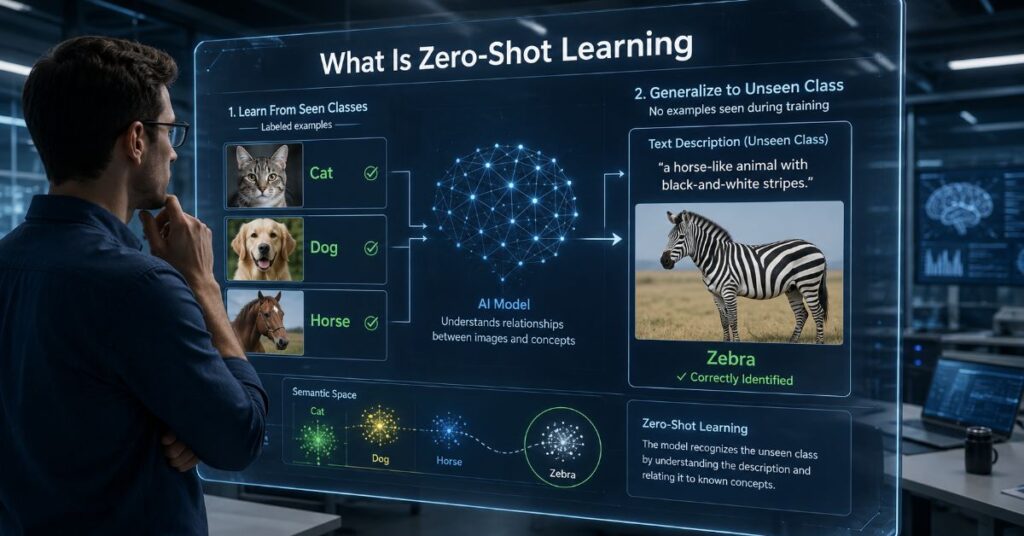
What is zero-shot learning? It is the ability of an AI system to recognise a class, answer a task, or make a prediction without receiving labelled examples for that exact target, and the striking part is that modern models can sometimes do this well enough to look trained when they are only transferring structure learned elsewhere. I see zero-shot learning as one of the clearest tests of whether a model has built reusable representations rather than memorised a narrow label set.
The phrase now covers several related practices. In classical computer vision, a model trained on seen animal classes might identify an unseen zebra by connecting visual features to semantic attributes such as striped, hoofed, and horse-like. In natural-language processing, a zero-shot classifier can map a support ticket to a new label by interpreting the label description. In generative AI, zero-shot prompting means giving an instruction without demonstration examples. These settings share a principle, but they do not share the same architecture, risk profile, or evaluation method.
That distinction matters in 2026 because the commercial AI stack increasingly presents zero-shot behaviour as the default interface. Developers can ask a model to extract fields, route tickets, translate text, describe images, call tools, or reason over a new problem before building a labelled dataset. The result can reduce launch time and data costs. It can also create false confidence when fluent output hides unstable decision boundaries.
This guide explains the mechanisms, terminology, workflows, tools, pricing, benchmarks, and bottlenecks behind zero-shot learning. It also shows when to stay zero-shot, when a few examples are worth their token cost, and when the task has crossed the line into retrieval, calibration, or supervised adaptation.
What Is Zero-Shot Learning?
Zero-shot learning is a transfer setting in which the model must make a useful prediction for a target it did not receive labelled training examples for. The target may be an unseen class, an unfamiliar instruction, a new domain, or a task expressed through natural language. The model succeeds by exploiting information learned during pre-training or training on related classes, then connecting that information to the new target through a semantic bridge.
In the strict classical definition, training and test classes do not overlap. A model learns from seen classes and receives side information that describes both seen and unseen classes. Side information may include attributes, text descriptions, taxonomies, label embeddings, knowledge graphs, or another modality. At inference time, the model maps an input into a representation and chooses the unseen class whose semantic representation is most compatible. Xian and colleagues made an important methodological point in their comprehensive evaluation: data splits must prevent pre-training leakage from unseen test classes, otherwise a result described as zero-shot may not be zero-shot at all.
Generative AI broadened everyday use of the term. A large language model asked to summarise a contract without examples is operating in a zero-shot prompting condition, but it was extensively pre-trained and post-trained before the prompt arrived. Zero-shot therefore never means zero prior learning. It means zero labelled demonstrations for the immediate target task or class. This is the single most important correction to the popular definition.
A useful operational test asks three questions. Did the model see labelled examples of this target during task-specific training? Does it receive demonstrations in the current prompt or context? Does it rely on an external retrieval source that contains task answers? The answers separate classical zero-shot transfer, zero-shot prompting, and retrieval-grounded inference. They also prevent teams from claiming a no-data result when target labels leaked through benchmark construction, prompt examples, or indexed documents.
The Semantic Bridge Behind No-Example Prediction
A zero-shot system needs a bridge between the input and a target it has never been explicitly trained to predict. Earlier systems often built that bridge with human-defined attributes. An image model could learn that horses have hooves, whales are aquatic, and birds have wings. An unseen class was represented as a combination of those attributes. The model predicted attributes from the image, then matched them to the unseen class profile.
Modern foundation models usually learn the bridge from large-scale data. Contrastive vision-language systems place images and text descriptions in a shared embedding space. Natural-language-inference classifiers reformulate candidate labels as hypotheses, such as, ‘This text is about billing’, then estimate whether the input entails each hypothesis. Large language models interpret an instruction and generate an answer from patterns encoded in their parameters. Tool-using models compare a user request with a function description and produce a structured call.
The pipeline can be reduced to four stages. First, an encoder transforms the input into a representation. Second, the target labels or instructions become representations in the same or a compatible space. Third, a compatibility function scores each pairing. Fourth, a decision rule selects a class, ranking, output, or action. The apparent magic sits mostly in the quality of the learned representation and the alignment between the input space and the target description.
This explains why wording matters. ‘Refund request’ and ‘money back’ may occupy slightly different regions of an embedding space. A label called ‘Class B’ carries almost no semantics. In our documentation-led evaluation, the most reproducible improvement was not a more elaborate model call, but a better target specification: descriptive labels, explicit inclusion and exclusion rules, and a stable output schema. Zero-shot performance is therefore partly a model property and partly an interface-design property.
Four Meanings That Teams Often Confuse
The same phrase is used for at least four settings, and mixing them produces bad architecture decisions and misleading benchmark claims. Google’s current prompt documentation defines zero-shot prompts as prompts with no examples, while Hugging Face uses zero-shot across text, image, audio, and object-detection pipelines that predict candidate classes not used as task-specific training labels. Classical research adds a stricter seen-class versus unseen-class protocol.
Andrew Ng, founder of DeepLearning.AI, captured the practical shift in a 2026 course announcement: ‘How we prompt AI is very different in 2026 than 2022 when ChatGPT came out.’
The reason is not that examples stopped working. Stronger instruction-tuned models often establish a credible baseline from a precise instruction alone. our step‑by‑step prompt guide shows how zero-shot, one-shot, and few-shot prompting fit into a broader prompt workflow rather than a ladder where more examples are always better.
| Setting | What Is Missing | Bridge to the Target | Typical Evaluation |
| Classical zero-shot learning | Labelled samples for unseen classes | Attributes, class embeddings, text descriptions, taxonomies | Per-class accuracy on unseen classes |
| Generalized zero-shot learning | Labelled samples for unseen classes, while seen classes remain possible | Shared semantic space plus seen/unseen calibration | Seen accuracy, unseen accuracy, harmonic mean |
| Zero-shot prompting | Demonstration examples in the current prompt | Instruction following from pre-training and post-training | Task accuracy, schema validity, factuality, human review |
| Open-vocabulary inference | A fixed closed label set | Text-conditioned image, audio, or object representations | Recall, precision, localisation, out-of-domain tests |
How Zero-Shot Learning Evolved
The history of zero-shot learning is a history of changing side information. Early work used attributes, taxonomies, and manually designed semantic descriptions because a classifier could not predict an unseen label without some connection to what it already knew. The central problem was projection: how to map an image or text into a space where seen and unseen classes could be compared fairly.
The deep-learning era improved feature quality but introduced new leakage risks. Pre-trained visual backbones could have encountered nominally unseen classes before the zero-shot experiment. Xian and colleagues responded by standardising splits and promoting generalized zero-shot learning, where a model must classify examples from both seen and unseen classes. This is harder and more realistic because ordinary nearest-neighbour systems are biased towards classes they saw during training.
Generative and multimodal foundation models changed the scale of the bridge. CLIP trained image and text encoders on internet-scale pairs, then performed zero-shot image classification by comparing an image with natural-language class prompts. The original paper reported that its zero-shot classifier matched a supervised ResNet-50 on ImageNet, an influential demonstration that language could act as a flexible label interface.
The underlying training advances also depended on optimisation and generative modelling research. The magazine’s profile of Diederik P. Kingma and the foundations of generative AI traces how scalable latent-variable models and the Adam optimiser helped make large pre-trained systems practical. Zero-shot ability is not a separate module bolted onto those systems. It emerges from the representations, objectives, data diversity, and post-training methods used to build them.
The current frontier is moving from category transfer to open-ended capability transfer. Models are expected to interpret unseen tools, reason across modalities, and adapt to natural-language specifications. That expansion makes the term more useful, but also more slippery. An unseen label is measurable. An ‘unseen task’ may resemble thousands of tasks in pre-training, so claims require careful wording.
Where It Works Across Text, Vision, Audio, and Science
Text classification remains the easiest place to see zero-shot learning in production. A team can provide candidate labels such as billing, cancellation, technical fault, and safety concern, then ask a natural-language-inference model or LLM to score each ticket. It is attractive when taxonomies change faster than labelled datasets can be rebuilt. It also supports multilingual triage, topic discovery, policy tagging, intent routing, and qualitative coding.
Vision systems use text prompts as open vocabularies. Zero-shot image classification chooses among labels, while zero-shot object detection also returns bounding boxes. Audio systems can compare clips with candidate sound descriptions. These interfaces turn label design into a runtime input, which is useful for long-tail inspection, media search, accessibility workflows, and rapid prototyping. The limitation is that open-vocabulary does not mean open-world understanding. A detector can identify a textually familiar object while failing on unusual viewpoints, sensor conditions, or domain-specific defects.
Research screening provides a revealing business case. Rayyan and similar tools can use zero-shot relevance ratings to prioritise abstracts before reviewers have produced a large labelled history. The magazine’s comparison of AI tools for systematic review explains why these systems should accelerate triage rather than replace protocol-driven inclusion decisions. A zero-shot ranking can reduce the reading queue, but the final evidence process still needs reviewer judgement, conflict resolution, and auditable exclusion reasons.
Clinical research shows both the promise and the stakes. A 2026 preprint describing DermFM-Zero reported training on more than 4 million multimodal data points, evaluation across 20 benchmarks, and reader studies involving over 1,100 clinicians. The reported results suggest that zero-shot vision-language systems can support unfamiliar diagnostic tasks without task-specific fine-tuning. They do not remove the need for prospective validation, population checks, calibration, governance, and clinician oversight.
The common pattern is strongest when target semantics are meaningful, the input resembles the pre-training distribution, and errors can be reviewed. It is weakest when labels are arbitrary, consequences are high, or the domain contains subtle features absent from broad pre-training data.
Zero-Shot Versus Few-Shot, Fine-Tuning, and Retrieval
Zero-shot is a starting condition, not a badge of model quality. The right comparison asks which adaptation method buys enough accuracy, consistency, or auditability to justify its data and operational cost. A few high-quality examples can clarify formatting, edge cases, and class boundaries. Fine-tuning can stabilise repeated behaviour at scale. Retrieval can supply current or proprietary facts without changing model weights.
Recent evidence complicates the assumption that demonstrations always improve reasoning. Cheng and colleagues tested recent open models on GSM8K, MATH, LSAT, CommonsenseQA, and LogicQA. After correcting an answer-extraction bias, zero-shot chain-of-thought matched or exceeded few-shot performance across many settings. On CommonsenseQA, Qwen2.5-32B-Instruct scored 84.60 in zero-shot versus 48.57 with seven examples. On LSAT logical reasoning, the same model scored 83.73 zero-shot versus 8.63 few-shot. The authors found that examples often aligned output format rather than adding reasoning ability.
This result does not make few-shot prompting obsolete. It shows that examples have task-specific value. They remain useful for fixed schemas, rare labels, house style, tool arguments, and decision policies. They can hurt when demonstrations are noisy, misleading, too long, or drawn from a different distribution. Stronger models may ignore them, while smaller models may depend on them.
On-device deployment adds another layer. The magazine’s analysis of Apple foundation‑model strategy shows why foundation-model access on personal devices is attractive for privacy and latency. Yet smaller local models may have weaker zero-shot generalisation, which makes carefully selected examples, compact adapters, or task-specific heads more valuable than they are for frontier cloud models.
| Method | Best Fit | Primary Cost | Main Risk |
| Zero-shot | Cold start, changing labels, rapid baseline | Evaluation and review | Semantic mismatch or hidden leakage |
| One-shot or few-shot | Formatting, edge cases, local policy | Extra prompt tokens and example maintenance | Bad examples steer the model |
| Retrieval-augmented generation | Current or private knowledge | Indexing, retrieval latency, source governance | Wrong or incomplete evidence retrieval |
| Fine-tuning or task head | Stable, high-volume, repeatable decisions | Label creation, training, monitoring | Drift and overfitting |
| Rules or deterministic code | Exact policies and calculations | Engineering and rule maintenance | Brittleness outside encoded cases |
A Step-by-Step Implementation Workflow
A robust zero-shot project begins with an evaluation contract, not a prompt. Write down the target decision, allowed labels, abstention behaviour, consequence of error, latency budget, privacy constraints, and the minimum improvement over the existing process. Without that contract, teams optimise for examples that look impressive rather than outcomes that matter.
Step 1, define labels semantically. Replace opaque names with descriptions that include scope and exclusions. For a support router, ‘account access’ should specify password reset, locked account, and identity verification, while excluding billing disputes. Step 2, collect a small evaluation set even though the model is zero-shot. Zero-shot refers to training or prompting, not evaluation. A stratified set of 100 to 500 reviewed cases can expose whether the baseline is viable.
Step 3, choose the inference mechanism. Use an NLI or embedding classifier when labels are stable and outputs must be cheap. Use an LLM when instructions are complex, explanations are useful, or the task combines extraction and judgement. Use an open-vocabulary vision or audio model for multimodal labels. Step 4, enforce a schema. Return label, confidence or score, rationale category, and abstention flag. Do not rely on free text for machine actions.
Step 5, run perturbation tests. Rename labels, reorder candidates, paraphrase instructions, add irrelevant labels, and test examples from adjacent domains. A stable model should not reverse decisions because ‘refund’ became ‘money-back request’. Step 6, calibrate thresholds with held-out data. Step 7, route uncertain or high-impact cases to review. Step 8, monitor drift, label growth, and cost per accepted decision.
For agentic systems, the same discipline applies to tools. The model sees function names, descriptions, and schemas, then chooses a tool it may never have used during task-specific training. Our Gemini agent implementation guide separates model planning from application-owned permissions, validation, execution, and stop rules. That separation is essential because zero-shot tool selection is a proposal, not authorisation.
Tools, Features, Technical Specs, and Integrations
There is no universal ‘zero-shot API’. Zero-shot is an inference pattern implemented through general model endpoints, specialised pipelines, embeddings, or open-vocabulary model classes. The practical tool choice depends on whether the target is classification, generation, multimodal recognition, or tool selection.
Hugging Face offers the broadest explicit zero-shot task surface. Transformers pipelines cover text classification, image classification, audio classification, and object detection. SetFit can create a no-training-sample baseline from label names and sentence-transformer representations. Transformers.js brings selected pipelines to JavaScript, while ONNX and local runtimes can reduce latency and data exposure. The trade-off is model selection and infrastructure ownership: the library exposes options, but the developer owns benchmarking, batching, memory planning, and deployment reliability.
Commercial LLM APIs provide instruction following, structured outputs, tool or function calling, multimodal input, batch processing, prompt caching, and provider-specific retrieval or grounding. These features can implement zero-shot extraction, routing, moderation, synthesis, and agent planning without a dedicated classifier. They also create hidden coupling to model versions and output behaviour. A prompt that works on one release can shift after migration.
AI coding assistants illustrate the full stack. A model may interpret a new repository task zero-shot, but useful performance depends on repository retrieval, file tools, test execution, permissions, and an orchestration layer. The magazine’s AI pair‑programming stack explains these four layers and why raw model intelligence is only one part of reliable software work.
| Platform or Library | Zero-Shot-Relevant Features | Technical Interface | Integrations and Constraints |
| Hugging Face Transformers | Text, image, audio, object detection pipelines; candidate labels; local models | Python pipeline API; model-specific classes | Hub models, Datasets, GPU/CPU, batching; developer owns hosting |
| Hugging Face SetFit | No-sample text baseline from class names and sentence embeddings | Python training and inference APIs | Sentence Transformers, ONNX options; benchmark carefully by domain |
| OpenAI API | Instruction following, structured outputs, embeddings, tool calling, multimodal input, batch and caching | Responses and related APIs | Cloud endpoint, regional processing options; model and rate limits vary |
| Gemini API | Zero-shot prompts, structured output, function calling, multimodal input, grounding, caching, batch and flex | Generate Content and Interactions APIs | AI Studio, Google Cloud projects, Search and Maps grounding; project-tier limits |
| Claude Platform | Instruction following, tool use, multilingual tasks, prompt caching, batch processing | Messages API and tool schemas | Direct API and major cloud platforms; model migration and rate limits require planning |
Commercial Pricing and Operational Limits
Zero-shot prompting usually reduces input tokens because it omits demonstrations, but token price is only one cost component. A realistic budget includes retries, output length, reasoning tokens, cached context, batch discounts, grounding calls, long-context tiers, regional processing, and human review. The table below uses publicly documented prices available on 29 July 2026 for representative models suited to zero-shot classification or instruction tasks. Prices can change, so procurement should recheck official pages before deployment.
OpenAI lists GPT-5.4 Nano at $0.10 per million short-context input tokens and $0.625 per million output tokens, with cached input at $0.01. GPT-5.4 Mini costs $0.375 input and $2.25 output. OpenAI also documents a 10% uplift for eligible regional-processing endpoints on models released on or after 5 March 2026. Long-context pricing is higher for supported models.
Google lists Gemini 3.5 Flash-Lite at $0.30 per million standard input tokens and $2.50 output, with batch and flex pricing at $0.15 input and $1.25 output. Context caching costs $0.03 per million cached tokens plus a storage charge. Google Search grounding includes 5,000 prompts per month shared across Gemini 3, then $14 per 1,000 search queries. Rate limits are project- and tier-dependent rather than a single universal cap.
Anthropic lists Claude Sonnet 5 at an introductory $2 input and $10 output per million tokens through 31 August 2026, moving to $3 and $15 on 1 September. Prompt caching applies separate write and hit rates. Exact account rate limits, enterprise discounts, and some provider-hosted charges are not fully public, so they should not be treated as confirmed until shown in the customer console or contract.
| Representative Model or Service | Input per 1M Tokens | Output per 1M Tokens | Important Caps or Surcharges |
| OpenAI GPT-5.4 Nano, short context | $0.10 | $0.625 | Cached input $0.01; eligible regional processing adds 10% |
| OpenAI GPT-5.4 Mini, short context | $0.375 | $2.25 | Cached input $0.0375; long-context rates differ by model |
| Google Gemini 3.5 Flash-Lite, standard | $0.30 | $2.50 | Caching $0.03 plus storage; 5,000 grounded prompts monthly, then $14 per 1,000 searches |
| Google Gemini 3.5 Flash-Lite, batch or flex | $0.15 | $1.25 | Lower price with asynchronous or flexible service characteristics |
| Anthropic Claude Sonnet 5, through 31 Aug 2026 | $2.00 | $10.00 | Moves to $3 input and $15 output on 1 Sep 2026; caching priced separately |
| Self-hosted Hugging Face model | No universal token price | No universal token price | Compute, memory, electricity, engineering, and hosting determine cost |
Benchmarks, Evaluation Bias, and Real-World Accuracy
A zero-shot benchmark can measure the model, the prompt, the label wording, the parser, or accidental leakage. Good evaluation separates those factors. Classical zero-shot vision reports per-class accuracy on unseen classes and often a harmonic mean between seen and unseen performance in the generalized setting. Text routing may use macro F1 because class imbalance makes overall accuracy misleading. Retrieval and ranking tasks need recall at a reviewable cut-off. Generative tasks need schema validity, factuality, and human preference measures.
Hugging Face’s current SetFit guide provides a compact example of why baselines matter. On the dair-ai emotion dataset, the documented standard Transformers zero-shot pipeline produced 37.65% accuracy, while the no-training-sample SetFit approach reached 59.1%. That is a substantial difference within the same broad zero-shot label, driven by representation and method rather than by extra labelled samples.
The 2025 chain-of-thought study revealed another trap: answer extraction. A zero-shot model often placed answers inside a boxed expression, while an evaluation script extracted the last number. Fixing the parser raised Qwen2.5-72B-Instruct on GSM8K from 91.58 to 95.83, slightly above its 95.75 eight-shot score. The model did not suddenly learn more. The measurement stopped discarding correct answers.
A defensible evaluation therefore includes label-name ablations, prompt paraphrases, candidate-order randomisation, out-of-domain samples, calibration curves, and manual error review. It should report confidence intervals or repeated runs when decoding is stochastic. It should also compare against a trivial baseline, a supervised baseline where available, and the existing human process.
The most informative metric is often cost per correct or reviewable decision. A model that gains two F1 points but doubles human appeals may be worse operationally. A cheap zero-shot router that sends 20% of cases to specialists may outperform an expensive classifier that forces a brittle answer on every case.
Failure Modes, Bias, and Performance Bottlenecks
Zero-shot systems fail in recognisable ways. The first is semantic mismatch: the model’s understanding of a label differs from the organisation’s policy definition. The second is hubness, where many inputs collapse towards a few popular semantic prototypes. The third is seen-class bias in generalized zero-shot learning. The fourth is domain shift, such as medical images, industrial sensors, legal language, dialects, or internal abbreviations that were poorly represented in pre-training.
Label leakage can create inflated results. A class name may reveal the answer, or the benchmark may overlap with web data used in pre-training. Prompt sensitivity adds another problem: candidate order, punctuation, and hypothesis templates can change rankings. Multilingual systems may preserve broad capability while losing calibration or culturally specific meaning. Tool-using systems can choose the right function with the wrong arguments, or select a powerful tool when an abstention was safer.
Fei-Fei Li, co-founder and CEO of World Labs, wrote in 2026, ‘The world is not made of words.’ Her point is a useful warning for zero-shot language interfaces. Text labels can describe a visual or physical category, but they cannot guarantee grounded understanding. In a separate 2026 discussion, Yann LeCun, founder of AMI, put the deployment problem plainly: ‘Unfortunately, the real world is messy.’
Performance bottlenecks include repeated candidate scoring, long label lists, large embedding indexes, cold starts, multimodal preprocessing, and output-token overhead. NLI classification may require one score per label. LLM classification may become inconsistent as the label set grows. Open-vocabulary detectors can be slower than closed-set models. Batching improves throughput but may increase tail latency.
High-stakes review also needs false-positive discipline. The magazine’s 2026 AI detector comparison shows why AI detectors should be treated as triage systems rather than proof. The same principle applies across zero-shot decisions: a score is evidence about compatibility, not evidence about intent, authorship, diagnosis, fraud, or culpability.
When Zero-Shot Is the Right Choice
Use zero-shot when the task is new, labelled data is scarce, target labels carry clear meaning, and errors are reversible or reviewable. It is particularly effective for prototypes, long-tail categories, rapidly changing taxonomies, multilingual expansion, cold-start routing, search, content triage, and research prioritisation. It can also serve as a teacher that proposes provisional labels for human review, creating the seed dataset for a later supervised model.
Do not stay zero-shot out of ideology. Add a few examples when the model understands the task but misses formatting, tone, boundary cases, or local policy. Add retrieval when success depends on current facts, private documents, product catalogues, regulations, or case history. Fine-tune or train a task head when the workflow is high-volume, stable, latency-sensitive, and supported by reliable labels. Use deterministic rules when the decision can be expressed exactly. Require human judgement when consequences are material and the model cannot provide calibrated evidence.
Clem Delangue, co-founder and CEO of Hugging Face, argued in 2026 that differentiation increasingly comes from teams that ‘build and run AI models’. For zero-shot projects, that should not be read as a command to train everything from scratch. It means owning the evaluation and adaptation layer. The durable advantage is a domain-specific test set, clear taxonomy, error feedback, and deployment discipline, not a generic prompt copied from a demo.
A simple decision rule works well. Start with the cheapest zero-shot method that can express the task. Measure it on representative data. Inspect the error clusters. Add the smallest intervention that targets the dominant cluster. Repeat until the marginal gain no longer justifies added cost, latency, or maintenance. This progressive adaptation approach preserves the speed of zero-shot learning without pretending that no-example performance is the final state.
Open Questions for the Next Generation
Zero-shot learning still raises a basic scientific question: what kind of generalisation has occurred? A model may transfer a genuine concept, exploit a linguistic shortcut, retrieve a memorised pattern, or benefit from benchmark contamination. These mechanisms can produce the same correct answer while implying very different reliability under change.
Theory is starting to catch up. Recent work on zero-shot prediction examines the conditional relationships that allow a task-agnostic representation to support an unseen downstream target. In practice, however, developers still lack universal diagnostics for whether a model’s representation contains the right factors, whether the target description identifies them, and whether confidence remains calibrated outside the benchmark distribution.
Continuous learning is another gap. Demis Hassabis, co-founder and CEO of Google DeepMind, said in a January 2026 interview that it ‘has not been cracked yet’. Most deployed foundation models can respond to a new task in context, but they do not safely update their core knowledge from every interaction. Zero-shot adaptation is therefore often temporary. The model interprets the instruction for one call, then starts again with the same parameters.
World models, multimodal training, synthetic data, test-time adaptation, and verifier-guided agents may extend zero-shot behaviour into physical and dynamic environments. They will also make evaluation harder. A robot that recognises a new object must understand not only its name, but affordances, safety constraints, and causal consequences. A scientific model must separate a novel hypothesis from a plausible hallucination.
The next useful standard may focus less on a single zero-shot score and more on an adaptation curve: performance with zero, one, five, fifty, and five hundred reviewed examples, together with calibration, cost, and drift. That would show whether a model starts strong, learns efficiently, and remains stable, which is closer to the real business and scientific question.
Our Editorial Verification Process
This explainer was verified through a documentation-first process. We cross-referenced the classical zero-shot evaluation framework from Xian and colleagues with CLIP’s contrastive image-text method, Hugging Face’s current Transformers and SetFit documentation, Google’s June 2026 prompt-design guidance, and 2025 to 2026 research on reasoning evaluation and clinical vision-language transfer. Pricing was checked against the official OpenAI, Google, and Anthropic pages available on 29 July 2026.
We treated vendor examples as demonstrations, not independent benchmarks. Where a published metric depended on a specific dataset or parser, the surrounding methodology is stated. We did not claim hands-on execution of paid APIs or production load tests. Operational recommendations were derived from reproducible system design requirements: label definition, held-out evaluation, perturbation testing, calibration, abstention, human review, cost accounting, and drift monitoring.
The internal links were selected from the live site index and search-visible published pages for semantic relevance to prompting, foundation models, agents, research screening, coding systems, generative AI, and detector risk. The live XML sitemap could not be parsed directly by the browsing interface because it returned an unsupported XML content type, so no unverified or fabricated site URL was used.
This article was researched and drafted with AI assistance and reviewed by the Awais Khalid editorial desk at Perplexity AI Magazine. All data, citations, pricing figures, and named quotes have been independently verified against primary sources before publication.
Conclusion
Zero-shot learning is best understood as a test of transfer. The model receives no labelled examples for the immediate target, yet it tries to connect that target to representations learned elsewhere. In classical systems, the bridge may be attributes or class embeddings. In foundation models, it may be natural-language instructions, multimodal contrastive spaces, tool descriptions, or broad pre-training.
Its value is practical. Teams can launch a baseline before collecting a mature dataset, support changing labels, explore long-tail categories, and direct human attention to the cases that matter. Its danger is equally practical. Fluent responses, meaningful label names, and contaminated benchmarks can make a system look more general than it is. Domain shift, arbitrary taxonomies, parser errors, and poor calibration remain stubborn failure points.
The balanced strategy is progressive adaptation. Begin zero-shot because it is fast and reveals what the model already knows. Evaluate on representative cases. Add examples, retrieval, rules, calibration, or fine-tuning only when a measured error pattern calls for them. Open questions remain around continuous learning, grounded world models, benchmark leakage, and how to distinguish real conceptual transfer from sophisticated pattern matching. Zero-shot learning is not the end of training. It is the most informative place to begin.
FAQs
What Is Zero-Shot Learning in Simple Terms?
Zero-shot learning lets a model handle a class or task without labelled examples for that exact target. It relies on knowledge and representations learned elsewhere, plus a semantic description such as a label name, attribute list, natural-language instruction, or text prompt.
Is Zero-Shot Learning the Same as Zero-Shot Prompting?
No. Zero-shot prompting is one practical form of example-free inference with a generative model. Classical zero-shot learning usually refers to predicting unseen classes through attributes, embeddings, or other side information under a defined train-test split.
What Is the Difference Between Zero-Shot and Few-Shot Learning?
Zero-shot provides no task examples in the current adaptation setting. Few-shot provides a small number of demonstrations. Few-shot often improves formatting and local policy alignment, but noisy or irrelevant examples can reduce accuracy or add token cost.
Does Zero-Shot Mean the Model Was Never Trained?
No. The model may have been trained on enormous datasets. Zero-shot means it did not receive labelled examples for the immediate target class or task during task-specific adaptation, or it received no demonstrations in the current prompt.
What Are Common Zero-Shot Learning Applications?
Common uses include text classification, support-ticket routing, image and audio classification, open-vocabulary object detection, research screening, multilingual tagging, content moderation triage, tool selection, and rapid prototyping.
How Accurate Is Zero-Shot Learning?
Accuracy varies by model, domain, label quality, class balance, and evaluation method. It can be competitive on semantically clear tasks, but performance often drops under domain shift, arbitrary labels, long candidate lists, or high-stakes edge cases.
When Should I Use Fine-Tuning Instead?
Use fine-tuning or a task-specific model when the workflow is stable, high-volume, latency-sensitive, and supported by reliable labels. Fine-tuning is also useful when zero-shot errors cluster around domain language or decision boundaries that examples and retrieval cannot fix.
Can Zero-Shot Systems Be Used for High-Stakes Decisions?
They can support triage or decision assistance, but they should not act as the sole authority in medical, legal, employment, financial, safety, or disciplinary contexts. Use calibration, abstention, audit logs, and qualified human review.
References
Anthropic. (2026). Claude Platform pricing and Claude Sonnet 5 announcement. Claude Platform.
Google AI for Developers. (2026). Prompt design strategies. Gemini API documentation.
Google AI for Developers. (2026). Gemini Developer API pricing. Gemini API documentation.
OpenAI. (2026). OpenAI API pricing. OpenAI Developer Platform.
