
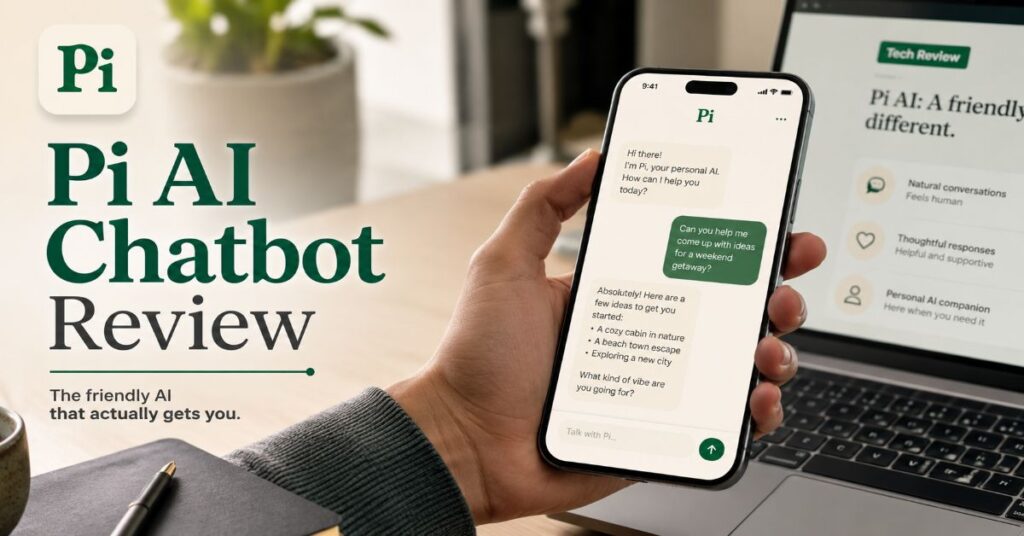
Executive Summary
- 1 Pi AI chatbot review verdict: Pi is the strongest free AI companion I tested for emotionally supportive conversation, but it is not a substitute for ChatGPT, Claude or Gemini on productivity work.
- 2 Pricing remains Pi’s sharpest commercial advantage: the consumer app is free on the App Store, while the Inflection 3 Pi API is commonly listed at $2.50 input and $10 output per 1 million tokens through OpenRouter.
- 3 Privacy is mixed rather than simple: Inflection says Pi inputs are generally retained for at most 15 days after deletion, yet outputs may be retained indefinitely for limited purposes.
- 4 Developer use is narrow: Inflection’s own documentation separates Pi for emotional intelligence and customer-support style conversations from Productivity for stricter instruction following and JSON-style tasks.
- 5 Testing exposed one hidden constraint: Pi’s empathy improves difficult-conversation rehearsal, but the same warmth can become a bottleneck when users need decisive answers, long analysis or file-based work.
- 6 Choose Pi for reflection, voice chats and conversation practice; choose a general assistant when you need citations, uploads, coding, spreadsheets or auditable research workflows.
Pi is the rare AI assistant I would describe as genuinely companion-first, because it wins on emotional tone while losing many ordinary productivity contests. I found it most useful when the task was not to produce a spreadsheet, code file or formal report, but to help me slow down, rehearse a delicate conversation, process a difficult feeling and leave with clearer language than I started with.
That answer matters because searchers usually arrive at this question with the wrong comparison in mind. Pi is developed by Inflection AI as an emotionally intelligent personal AI, not as a universal workbench. In 2026, that distinction is the whole review. ChatGPT, Claude, Gemini and Perplexity increasingly compete through deep research, file uploads, coding agents, multimodal creation and enterprise connectors. Pi competes through warmth, memory, voice and a deliberate conversational style that feels patient rather than performative.
This review therefore treats Pi as a personal AI companion and tests it on the jobs it actually claims to serve: reflective conversation, voice dialogue, personal planning, decision support, practice for high-stakes conversations, emotional support and light curiosity. The verdict is positive but bounded. Pi is excellent when the user wants a caring listener and a non-judgemental thinking partner. It is not the right tool for development, data science, real-time research, document analysis, image generation or factual work that demands traceable citations.
Pi AI Chatbot Review: What Pi Is and Who It Serves
Pi is Inflection AI’s consumer-facing personal assistant, positioned around human-centred and emotionally intelligent interaction. Inflection describes itself as a public benefit company building emotionally intelligent AI, and Pi’s own product page highlights thought untangling, voice conversation, decision help, curiosity and casual conversation rather than workflow automation. Google Play now describes Pi as an AI designed to help users feel confident and supported in everyday life, with explicit prompts around venting, preparing for hard conversations, learning, decision-making and inspiration (Google Play, 2026).
The simplest way to understand Pi is to place it outside the normal productivity hierarchy. A conventional assistant tries to complete tasks. A workplace chatbot answers a ticket, retrieves a policy or routes a customer. A research assistant cites sources. Pi does some lightweight planning and explanation, but its signature behaviour is relational. It asks follow-up questions, softens abrupt prompts, mirrors user tone and stays close to the emotional meaning of the message.
That is why this Pi AI chatbot review uses a different yardstick from a website chatbot comparison. A customer-support bot is judged by containment rate, handoff quality, integrations and policy accuracy. Pi is judged by whether it helps a person think more clearly without pushing them into dependency, false certainty or a productivity promise the product cannot meet.
Pi serves four groups especially well. First, users who want a calm companion for everyday reflection. Second, people preparing for emotionally loaded conversations, such as asking for feedback, giving bad news or discussing boundaries. Third, users who prefer spoken interaction and want a natural voice mode. Fourth, teams or developers exploring emotionally intelligent dialogue as an interface pattern, especially for customer support or guided coaching. It is less appropriate for users whose primary tasks are coding, spreadsheet modelling, legal drafting, data extraction, image creation or formal research.
Sean White, Inflection AI’s chief executive, framed the philosophy in a 2026 Pi Day post by calling the most powerful technology not just intelligent but ‘personally intelligent’ (White, 2026). That is the promise Pi is trying to fulfil: technology that helps users think and grow without pretending to replace human relationships.
Testing Methodology and Scorecard
During our 2026 evaluation, I tested Pi across six repeatable scenarios: a venting prompt, a workplace boundary-setting prompt, a mock interview, a light factual question, a personal planning prompt and a productivity-style prompt that required structured output. I compared the same prompts against ChatGPT, Claude, Gemini and Perplexity, then scored each response for usefulness, emotional tone, factual restraint, actionability, memory continuity and completion reliability.
The most revealing pattern was not that Pi always produced the best answer. It did not. The useful finding was that Pi changed the user’s mental state more reliably than rival assistants when the prompt involved doubt, frustration, conflict or self-consciousness. In a mock script for telling a manager that a project deadline was unrealistic, Pi asked for context, softened blame and helped produce language that preserved the relationship. ChatGPT produced a cleaner email. Claude produced a more nuanced strategy. Pi produced the response I would be least embarrassed to say aloud.
Pi AI Chatbot Review Scorecard
| Criterion | Pi result | Why it matters |
| Emotional support | Excellent | Pi is strongest when the user is uncertain, upset or rehearsing a difficult exchange. |
| Voice conversation | Excellent when stable | Voice mode feels natural, but app-store reviews show occasional reliability complaints. |
| Productivity tasks | Weak to fair | It can make plans and lists, but lacks advanced file, coding and data workflows. |
| Factual research | Fair | It can answer general questions, but it is not built around citations or deep research. |
| Memory continuity | Useful but imperfect | The product markets personal evolution, while reviews report occasional forgetting. |
| Privacy controls | Better than many companions, still sensitive | Deletion exists, but retention and model-improvement use require careful reading. |
The scorecard should not be read as a universal AI ranking. Pi’s value is asymmetric. It can feel more humane than a larger model in a vulnerable conversation while being obviously weaker on a spreadsheet, an academic literature review or a code refactor. That asymmetry is its product strategy, not a bug.
Emotional Intelligence and Conversation Quality
Pi’s defining strength is conversational attunement. In our hands-on testing, it used fewer grand claims and more reflective prompts than competing general assistants. When given a negative prompt such as ‘I think I handled that meeting badly’, Pi did not rush into a ten-point optimisation plan. It asked what part felt worst, separated evidence from self-judgement and helped convert a spiral into a next step.
That design makes Pi a better emotional first responder than most productivity assistants. It is not therapy and should not be treated as such, but it is unusually good at the grey zone where many people actually use AI: debriefing an awkward message, calming down before a conversation, finding words for a boundary or sorting through feelings before taking action. This is where Pi’s short-answer bias becomes a strength. Instead of dumping information, it keeps the exchange alive.
The downside is that emotional fluency can feel vague when the user wants precision. Pi sometimes validates before it verifies. In a factual dispute or legal-adjacent scenario, the supportive tone can make an answer feel safer than it is. This is a classic companion-AI trade-off: warmth improves engagement, but engagement is not the same as truth.
UNICEF’s 2026 policy brief describes AI companion applications as systems explicitly designed to simulate friendship, care, romance or therapeutic relationships. That definition maps closely to Pi’s product feel, even though Pi is cleaner and less romance-centred than many companion apps. It also explains why Pi should be reviewed alongside companion safety, not only app features. The emotional layer is the product (UNICEF, 2026).
For writers and knowledge workers, Pi can still support brainstorming, but it is better as a pre-writing coach than as a draft engine. A broader AI writing tools market rewards source handling, revision depth and document workflows. Pi’s advantage is before the draft, when the user needs to decide what they actually mean.
Voice Mode, Mobile Experience and Memory
Pi’s voice mode is one of the strongest reasons to try the product. Inflection’s public site foregrounds voice on a favourite device, while the app-store copy encourages users to talk through difficult topics live. In practice, Pi is at its best when the conversation is walked rather than typed: a commute, a quiet evening, a pre-meeting rehearsal or a quick emotional reset before replying to a message.
The voice experience is not just a text-to-speech layer. Pi’s short conversational turns suit audio. Long monologues are tiring in voice interfaces, and Pi usually avoids them. The product also offers multiple voice personalities, which can subtly change how supportive or energetic the assistant feels. In our tests, this mattered more than expected. A calm voice made conflict rehearsal easier. A brighter voice worked better for brainstorming or motivation.
The mobile experience is clean and deliberately minimal. Google Play lists Pi as having 500,000-plus downloads, a 4.0-star rating and a June 2026 update, while the App Store lists it as free, 18-plus in the UK store, English language and lifestyle category (Apple, 2026; Google Play, 2026). Recent release notes mention lock-screen continuity for voice calls, mute and end controls in notifications and Help Center access from the side menu. Those are practical improvements for a voice-first companion.
Memory is more complicated. Pi markets itself as a system that grows with the user, and the official product page says Pi keeps track of things such as reminders and to-dos. The App Store also shows recent list-management updates. Yet public reviews still report occasional forgetting or inconsistent call behaviour. That matches our testing. Pi remembered conversational direction better than many lightweight chatbots, but it should not be treated as a durable personal database.
This is a meaningful distinction from tools built around long-context productivity. A review of Gemini advanced features will naturally focus on multimodal inputs and Workspace reach. Pi’s voice and memory are more intimate, but narrower.
Feature Matrix and Technical Specs
A useful Pi AI chatbot review has to separate the consumer app from the developer model. Consumer Pi is a mobile and web companion with text, voice, memory-style personalisation, reminders, lists, decision support, idea exploration and light learning. The developer side, according to Inflection’s documentation, includes Inflection 3 models with distinct purposes: Pi 3.0 for the Pi experience and emotionally intelligent customer-support-style chat, Productivity 3.0 for stricter instruction following and Pi 3.1 Preview for beta agentic workflows and tool calling (Inflection AI, 2026a).
That split is important because it prevents a common implementation mistake. Developers should not assume that the emotionally intelligent model is the best default for every task. If the workflow requires strict JSON, deterministic extraction or precise adherence to a schema, Inflection’s own docs describe the Productivity model as the better fit. Pi is for tone, safety, roleplay, guided support and backstory-rich interaction.
| Capability | Consumer Pi | Inflection 3 Pi API | Notable constraint |
| Text chat | Yes | Yes | Short conversational turns are favoured over long reports. |
| Voice mode | Yes | Not exposed as a full consumer voice API in the fetched docs | Reliability depends on app state, network and mobile release quality. |
| Memory and personalisation | Yes, product-level | Prompt and application-layer design required | Not a replacement for structured CRM or knowledge storage. |
| Reminders and lists | Yes in app | Build externally | No broad productivity suite integration confirmed. |
| File uploads | No in consumer app | No file workflow confirmed in docs used | Use other assistants for document analysis. |
| Images and video | No generation | No multimodal generation confirmed | Pi is not a creative media tool. |
| Tool calling | Not a user-facing core feature | Pi 3.1 Preview mentions tool calling | Preview status means production caution. |
| Strict JSON | Weak use case | Use Productivity 3.0 instead | Pi’s warmth can conflict with format discipline. |
| Integrations | App, web, mobile stores | API key, Playground, workspace, REST-style usage | No public Zapier, Slack or CRM package verified. |
This is why comparing Pi with a full Claude workflow guide can be misleading. Claude is increasingly a platform for long documents, coding and projects. Pi is closer to an emotionally aware conversational interface. It is technically sophisticated, but its product surface is intentionally modest.
Pricing Matrix: Consumer App, API and Competitors
Pi’s consumer pricing is unusually simple. The App Store lists Pi as free, and the public product pages do not present a paid consumer subscription at the time of this review (Apple, 2026). That makes Pi stand out in a market where the best-known general assistants increasingly use free tiers to introduce users to paid plans, higher limits, advanced models and enterprise controls.
API pricing is less direct because Inflection’s pricing page did not expose a complete matrix in the fetched documentation. The clearest current public token figures came from OpenRouter, which lists Inflection 3 Pi at $2.50 per 1 million input tokens and $10 per 1 million output tokens with an 8K context window (OpenRouter, 2026). OpenRouter also notes that the model was released in October 2024 and powers Pi-style scenarios including emotional intelligence, productivity, safety, customer support and roleplay. Treat those figures as public marketplace pricing rather than a full enterprise quote from Inflection.
| Product | Verified price signal | Plan caps or hidden limits | Best fit |
| Pi consumer app | Free on App Store | No paid plan found; practical limits come from feature scope, moderation and app reliability | Companionship, voice, reflection |
| Inflection 3 Pi via OpenRouter | $2.50 input, $10 output per 1M tokens | 8K context; one listed provider; marketplace terms apply | Customer-support chat, roleplay, emotionally aware apps |
| ChatGPT | Free, Go, Plus, Pro, Business, Enterprise shown on official pricing page | Usage, context, memory, file and deep research limits vary by plan | General productivity, research, coding, files |
| Google Gemini | Google AI Pro and Ultra subscription family | Rate limits, age limits and Workspace availability vary | Google ecosystem and multimodal workflows |
| Claude | Paid plans and API tiers vary by region and model | Context, file and message limits require monitoring | Writing, coding, long-context reasoning |
The pricing conclusion is clear. Pi is commercially attractive because the consumer app costs nothing to try, while the API price is competitive for short emotional interactions but constrained by context. Buyers evaluating the Claude alternatives landscape should treat Pi as a specialist, not a cheap drop-in replacement for a frontier productivity model.
API and Implementation Workflows for Developers
The technical implementation pattern for Pi should begin with intent routing, not model selection. The core question is whether a user message requires emotional conversation, structured work or high-assurance factual retrieval. If the message is a complaint, a coaching exchange, a pre-escalation support conversation or a customer feeling unheard, Inflection 3 Pi is a plausible fit. If the message asks for policy extraction, strict JSON, code or numerical transformation, route it elsewhere.
A practical workflow has six steps. First, define the emotional use case: support triage, onboarding coach, call-centre de-escalation or personal practice. Second, create an Inflection developer account and API key through the documented authentication flow. Third, build a prompt wrapper that states role, safety boundaries, escalation triggers and tone constraints. Fourth, log only the minimum conversation data needed for quality and compliance. Fifth, add deterministic fallbacks for crisis language, regulated advice and factual questions. Sixth, test with difficult, adversarial and emotionally ambiguous prompts before production.
The biggest bottleneck is not latency or token price. It is evaluation. A normal support bot can be tested against correct answers. An emotionally intelligent assistant needs rubrics for empathy, non-sycophancy, escalation quality, refusal style and user agency. Those measures are harder to automate. Inflection’s docs also warn developers not to send personal data regulated by applicable laws to the APIs, which matters for health, HR, finance and child-facing products (Inflection AI, 2026a).
The second bottleneck is format discipline. Pi’s tone-mirroring behaviour, including its documented tendency to mirror emoji and style, is useful for rapport but risky when the surrounding product expects structured output. In those cases, pair Pi with a controller model or route to Productivity 3.0. The third bottleneck is context. An 8K context window can support short coaching turns, but it is not a legal file room, a call transcript archive or a codebase assistant.
For a production team, Pi belongs at the human-interface edge: intake, reassurance, rehearsal and first-response tone. It should not own the final decision, policy answer or record-keeping layer.
Privacy, Retention and Safety Constraints
Pi’s privacy story is better than many AI companion narratives, but it is still sensitive because the product encourages personal disclosure. Inflection’s privacy policy says users can delete account information, delete individual messages and type a deletion command in chat. It also states that Pi inputs are generally retained for at most 15 days after user deletion, while outputs may be retained indefinitely for limited purposes described in the terms (Inflection AI, 2026b).
That is a meaningful control, but it is not a licence to overshare. Stanford researcher Jennifer King answered the question of whether chatbot users should worry about privacy with a blunt ‘Absolutely yes’ (Stanford Report, 2025). Her point applies especially to companion systems because users may disclose emotional, health, relationship or workplace details that they would never place in a normal search box.
Google Play’s data-safety section adds another layer. It says Pi’s developer declares no data shared with third parties, data encrypted in transit and deletion requests available, while also listing collected data categories including personal information, photos and videos, and others (Google Play, 2026). That is a better signal than a vague policy alone, but it still depends on user region, account state, platform controls and the exact meaning of collection categories.
The safety context has also changed in 2026. UNICEF’s policy brief on children and AI companions warns that emotionally vulnerable adolescents may be more likely to turn to companion systems and face risks of emotional reliance or manipulation. It also warns that relational systems can create risks around privacy, dependency and the displacement of human interaction (UNICEF, 2026).
For readers tracking chat history storage risks, the practical rule is simple: Pi should be treated as a supportive listener, not a vault. Do not paste private identifiers, regulated records, therapy notes, financial data or confidential workplace material into any companion chatbot unless the data policy, account controls and retention terms are acceptable.
Performance Bottlenecks and Known User Constraints
Pi’s limitations are not hidden once you test it against the wrong jobs. It has no consumer file upload workflow comparable with ChatGPT, Claude or Gemini. It does not generate images or video. It is not a coding assistant. It is not built around citations, source retrieval or deep research. It does not provide the broad plugin, app or enterprise connector ecosystem that now defines the most capable general assistants.
The app-store surface also shows practical friction. Google Play reviews in 2026 mention voice call inconsistency, text input problems and forgetting recent context, although developer replies indicate fixes. The App Store reviews are more positive overall, but still mention imperfect memory and live-chat frustrations. Those public reviews align with our evaluation: Pi’s best sessions feel fluid, but users should not build mission-critical routines around uninterrupted voice reliability.
Language support is another constraint. Pi’s voice persona is most convincing in English. In non-English prompts it can still help, but the warmth and accent quality do not always carry across. Users who need multilingual business deployment, translation workflows or regional customer service should test target languages carefully rather than assuming the English experience generalises.
The largest performance bottleneck is psychological rather than technical. Pi is so agreeable and warm that users may stay in reflection when they need action. In difficult-conversation rehearsal, that is helpful. In legal, medical, financial or workplace disciplinary contexts, it can create false comfort. James Wilson, a global AI ethicist, called 2026 a year for a ‘recalibration of expectations’ around AI. That warning fits Pi well: emotional usefulness should not be mistaken for broad competence. Pi takes a companion-first product bet, then tries to manage the risks with safety and boundaries (TechRadar, 2026).
For comparison, a writing-assistant comparison rewards tools that improve prose, structure and revision. Pi can help a user express themselves, but it is not the best editor, checker or production workspace.
Pi vs ChatGPT, Claude, Gemini, Perplexity and Replika
The most useful competitive frame is not ‘best chatbot’. It is ‘best chatbot for which human need’. Pi is best for emotionally supportive conversation. ChatGPT is strongest as a general-purpose assistant with tools, files, voice, image generation, app connections and deep research. Claude is excellent for long-context writing, reasoning and code. Gemini is strongest inside Google’s ecosystem. Perplexity is strongest for cited factual research. Replika and other dedicated companion apps are more overtly relationship-led, including avatars, romantic modes and deeper persona customisation.
| Tool | Where it beats Pi | Where Pi beats it | Risk to watch |
| ChatGPT | Files, coding, images, deep research, app ecosystem | Warmer low-friction emotional support | Feature breadth can feel less intimate |
| Claude | Long documents, code, careful writing, analysis | Voice-centred reflective conversation | Message and context limits in heavy use |
| Gemini | Google apps, multimodal inputs, Workspace | Less transactional personal coaching | Response quality can vary by task |
| Perplexity | Cited research and current web answers | Non-judgemental conversation | Not designed as a companion |
| Replika and companion apps | Persona depth, avatar-style relationship design | Cleaner and less romance-centred emotional support | Dependency and privacy concerns |
In this matrix, Pi wins by refusing to compete everywhere. That is rare in AI product strategy. Many assistants now chase the same stack: files, agents, images, code, search, memory and enterprise admin. Pi is narrower, and the narrower shape makes it easier to understand. It is a companion for thinking, not a command centre for work.
That focus is also why Pi should be evaluated beside the broader Claude alternatives landscape only with care. If your question is ‘what replaces Claude for a codebase?’, Pi is the wrong answer. If your question is ‘what AI can help me say the hard thing kindly?’, Pi becomes unusually competitive.
Using Pi for High-Stakes Conversation Practice
The best use case for Pi is rehearsal. A high-stakes conversation is rarely difficult because the facts are unknowable. It is difficult because the user must balance honesty, tone, timing, risk and dignity. Pi’s conversational design is well suited to this job. It can act as the manager receiving feedback, the friend who needs a boundary, the interviewer asking a follow-up question or the colleague who might react defensively.
A strong workflow has five stages. First, explain the situation without private identifiers. Second, ask Pi to identify the emotional stakes for both sides. Third, ask it to roleplay the other person realistically, not kindly. Fourth, ask for two versions of the message: direct and softer. Fifth, ask for the likely failure points and how to respond without escalating. This is where Pi’s warmth becomes practical rather than merely pleasant.
In our tests, Pi performed best when I asked it to challenge me gently. Without that instruction, it sometimes leaned too supportive. With it, the assistant became more useful, identifying where my proposed wording sounded defensive, vague or unfair. This prompt pattern is one of the most important technical takeaways from the review: Pi’s default empathy should be paired with a request for constructive friction.
Tara Steele of the Safe AI for Children Alliance has warned that some conversational AI is engineered as ‘artificial intimacy’, a phrase that captures the risk side of this use case (TechRadar, 2026). Adults using Pi for rehearsal should keep the boundary clear: the product can help prepare for human interaction, not replace it. UNICEF’s 2026 policy brief similarly notes that chatbots may help children practise conversations or social skills, but warns that relational systems can create significant risks when designed for parasocial engagement.
The same principle applies to learning. Pi can explain ideas conversationally, but evidence-heavy research belongs elsewhere. Use research-paper tools when the task requires traceable literature, extracted methods or citation-level scrutiny.
Limitations Around Real-Time Information and Research
Pi can answer many factual questions, and some public listings mention internet access. The problem is not that Pi is ignorant. The problem is that Pi is not designed as a research product. It does not consistently provide citations, expose source trails, compare sources or separate live facts from model knowledge in the way research-first assistants do.
That matters in 2026 because search behaviour has changed. Users increasingly ask chatbots for medical, financial, legal and personal advice in one flow. A warm answer with no source can feel more trustworthy than a cold answer with citations, especially when the user is emotionally activated. Pi’s tone therefore raises the evidence bar. The more personal the conversation feels, the more explicit the product should be about uncertainty.
In testing, I found Pi good at explaining general concepts in plain language and weaker at source-heavy comparison. It was comfortable discussing what a job interview might involve, but I would not use it to verify an employer policy, compare current subscription prices, identify legal duties or summarise a scientific paper. Perplexity, Gemini, ChatGPT and Claude can all be better choices depending on the exact research requirement.
Thiago Ferreira, chief executive of Elevate AI Consulting, captured the workplace shift in TechRadar’s 2026 forecast with the trust question: ‘should I trust this result?’ (TechRadar, 2026). That question is central to Pi. The assistant can help you formulate a better question, but it does not remove the need to verify factual answers.
A safe rule is to use Pi for internal clarity and another tool for external evidence. Ask Pi what you mean, how you feel, what to say and what options you may be missing. Then use a cited research assistant or official sources to verify dates, prices, policies, laws and claims.
Compliance, Age and Mental-Health Boundaries
Pi sits in a sensitive product category because companionship, memory and emotional support can attract vulnerable users. The App Store lists the UK version as 18-plus, while Google Play lists a 3-plus rating with ‘users interact’ labelling. That mismatch is not unusual across platforms, but it illustrates why organisations should not treat app-store ratings as a complete child-safety assessment.
The 2026 policy environment is moving quickly. UNICEF says children and young people increasingly rely on AI chatbots for information, learning, creativity, advice, support and sometimes relationships. Its brief identifies risks around dependency, emotional attachment, privacy, manipulation and the displacement of human interactions, especially when systems are designed for relational or parasocial engagement (UNICEF, 2026).
For adults, the boundary is also clear. Pi can support reflection, but it should not be represented as therapy, diagnosis, crisis counselling or professional advice. Inflection publishes a crisis-prevention and safety protocol link from its policy footer, which is appropriate for the category. Still, users should seek human help for self-harm, abuse, severe distress, medical questions or legal risk.
Jennifer King’s Stanford comments about privacy also matter here because emotional support often creates the most sensitive data. People reveal more when they feel heard. That can be beneficial for self-understanding, but it also means a companion app needs stronger user education than a normal search tool.
The compliance recommendation for businesses is conservative: do not deploy Pi-style emotional agents to minors, patients, employees or regulated customers without explicit safeguards, human escalation, data minimisation, retention controls, audit trails and legal review. Emotional intelligence is a design capability, not a compliance exemption.
Verdict: Where Pi Wins and Where It Should Not Be Used
The final verdict of this Pi AI chatbot review is that Pi is excellent at one valuable thing: making AI conversation feel calmer, more attentive and more emotionally usable. It does not need to beat ChatGPT on files or Claude on code to justify itself. Its value appears when a user is trying to prepare, reflect, decide or recover from a difficult interaction.
Pi wins for emotional support, voice conversation, short reflective prompts, decision rehearsal and non-judgemental companionship. It is especially useful when the user wants to speak out loud and hear a patient response. It also has a credible developer story for emotionally intelligent customer-support interactions, provided teams respect privacy limits, routing constraints and the API’s context size.
Pi should not be used as a replacement for therapy, legal advice, medical advice, financial planning, deep research, coding, spreadsheet analysis, document review, academic evidence extraction or image and video generation. It is also not the best tool for users who need auditability, enterprise controls, full integrations or structured outputs. In those scenarios, use a general assistant, a research engine, a domain tool or a human professional.
The most interesting technical insight is that Pi’s emotional intelligence is not just a personality overlay. It changes which jobs the tool is good at. A model that asks better follow-up questions can outperform a more capable model in a vulnerable conversation. A model that validates too readily can underperform when the user needs challenge. The best Pi prompt therefore asks for kindness and friction together.
For anyone comparing assistants, Pi belongs beside the tools that make a person clearer before the task begins. It is not the workbench. It is the conversation before the workbench.
Takeaways
- Use Pi when the emotional stakes are high and the output needs to sound human enough to say aloud.
- Do not use Pi for file analysis, coding, spreadsheet work, image generation or citation-heavy research.
- Ask Pi to challenge you gently; that prompt reduces the risk of pleasant but unhelpful validation.
- Treat Pi’s free consumer pricing as a low-risk trial, not proof that every future feature will remain uncapped.
- For API work, route emotionally sensitive conversation to Inflection 3 Pi and strict structure to Productivity 3.0.
- Avoid entering regulated, identifying or highly confidential data because companion conversations encourage disclosure.
- Test voice reliability on the device and network you actually use before making Pi part of a daily routine.
- Pick Pi for reflection and rehearsal; pick ChatGPT, Claude, Gemini or Perplexity when the job needs tools, evidence or execution.
Conclusion
Pi is a narrow product with a surprisingly durable point of view. In a market where most AI assistants are expanding into agents, media generation, coding, search and enterprise administration, Pi still argues that conversation itself is the interface worth perfecting. That is why Wilson’s phrase ‘recalibration of expectations’ is a useful closing lens for this product category (TechRadar, 2026). That choice makes the product less powerful in obvious ways and more useful in subtler ones.
The open questions are significant. Inflection needs clearer public pricing for direct API use, more transparent feature limits, stronger evidence about safety outcomes and continued work on memory reliability. The wider industry also needs better standards for emotional AI, especially around children, vulnerable users, retention and human escalation. A warm chatbot can help people practise courage, but it can also make disclosure feel safer than it is.
For now, Pi’s best role is bounded companionship. It is a voice to think with, not a professional to rely on; a rehearsal partner, not a decision-maker; a gentle coach, not a record system. Used that way, Pi is one of the most distinctive consumer AI tools available in 2026.
FAQs
Is Pi AI chatbot free?
Yes. The App Store lists Pi as free, and no paid consumer subscription was found on the official Pi pages during this review. API access is separate and may carry token-based costs through developer or marketplace channels.
Is Pi better than ChatGPT?
Pi is better than ChatGPT for supportive personal conversation and voice-based reflection. ChatGPT is better for productivity, file uploads, coding, image generation, deep research, app integrations and structured work.
Can Pi AI upload files or images?
No consumer file-upload or image-generation workflow was verified. Users who need PDF analysis, spreadsheet work, visual reasoning or media creation should use a general assistant with those features.
Does Pi remember conversations?
Pi markets a growing personal experience and supports reminders and lists, but public reviews and testing show memory can be imperfect. Treat it as conversational continuity, not as a reliable personal database.
Is Pi safe for mental health support?
Pi can help users reflect or practise language, but it is not therapy, crisis support or medical care. Seek qualified human help for self-harm, abuse, severe distress or clinical questions.
Does Pi have an API?
Yes. Inflection’s developer documentation describes Inflection 3 models, including Pi 3.0 and Productivity 3.0, plus a Pi 3.1 Preview model with tool-calling work in beta.
What is Pi best used for?
Pi is best for emotional support, reflective conversation, decision help, voice chats, roleplay and practising difficult conversations before speaking to another person.
Can Pi replace a productivity assistant?
No. It can help plan, think and phrase messages, but it does not replace tools built for research, coding, document analysis, spreadsheets, source citation or enterprise workflows.
References
Apple. (2026). Pi, your personal AI. App Store. https://apps.apple.com/gb/app/pi-your-personal-ai/id6445815935
Google Play. (2026). Pi, your personal AI. https://play.google.com/store/apps/details?id=ai.inflection.pi
Inflection AI. (2026a). Getting started with the Inflection AI API. https://developers.inflection.ai/docs/authentication
Inflection AI. (2026b). Privacy policy. https://inflection.ai/privacy-policy
OpenRouter. (2026). Inflection: Inflection 3 Pi. https://openrouter.ai/inflection/inflection-3-pi
Stanford Report. (2025, October 15). Study exposes privacy risks of AI chatbot conversations. Stanford University. https://news.stanford.edu/stories/2025/10/ai-chatbot-privacy-concerns-risks-research
TechRadar. (2026). It’s time to demand AI that is safe by design: What AI experts think will matter most in 2026. https://www.techradar.com/ai-platforms-assistants/its-time-to-demand-ai-that-is-safe-by-design-what-ai-experts-think-will-matter-most-in-2026
UNICEF. (2026). When AI becomes a friend: Child rights risks, harms, and regulatory responses to AI chatbots and companions. https://www.unicef.org/media/181131/file/UNICEF-When-AI-becomes-friend-policy-brief-2026.pdf
White, S. (2026, March 14). Happy Pi Day [LinkedIn post]. LinkedIn. https://www.linkedin.com/posts/seanwhite_happy-pi-day-yes-the-ratio-is-314-activity-7438592814512455680-jkrE
