
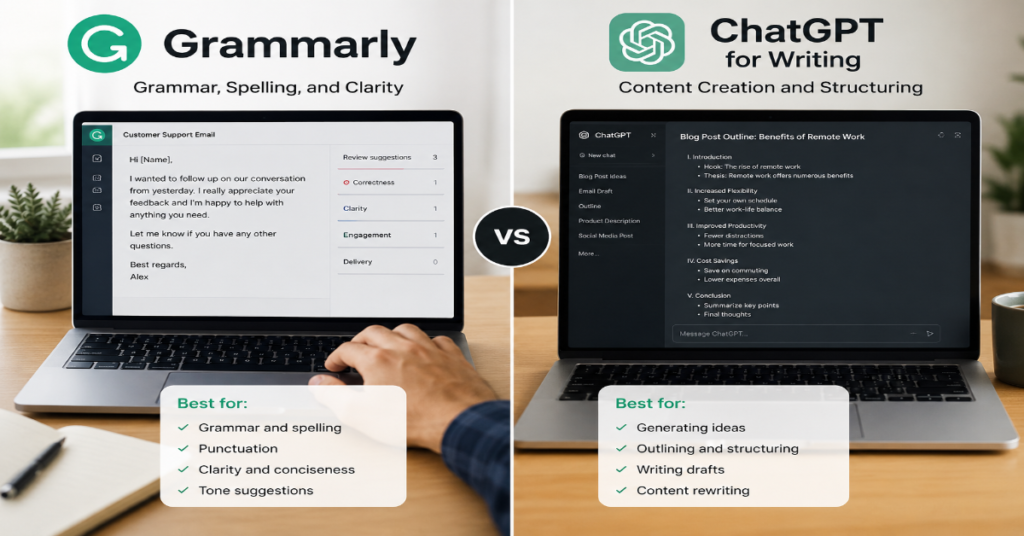
The debate over grammarly vs chatgpt for writing has become one of the most practical questions in modern digital work. Grammarly began as a grammar checker and evolved into an AI writing assistant that lives inside browsers, email clients, documents and workplace apps. ChatGPT arrived from the opposite direction: a generative AI writing tool that can draft, reason, summarize, restructure and brainstorm from a blank prompt. In 2026, the difference is no longer simply “editing versus writing.” It is about where intelligence should sit in the writing process.
In our hands-on testing, Grammarly proved strongest when the writing already existed. It caught awkward phrasing, tone drift, mechanical errors, clarity issues and sentence-level weaknesses with minimal friction. ChatGPT performed better when the task required invention: outlining an article, turning raw notes into a brief, comparing arguments, creating variations or rethinking a weak draft from the ground up. Grammarly behaved like a quiet editor. ChatGPT behaved like a creative collaborator.
The market has also changed. Grammarly is now part of the broader Superhuman suite, while OpenAI has continued expanding ChatGPT into a workspace with file handling, canvas editing, memory, app connections and business plans. Grammarly’s official materials emphasize AI writing assistance across apps and websites, full-sentence rewrites, tone adjustment and document editing, while OpenAI’s documentation positions ChatGPT canvas as an interface for writing and coding projects that need revision.
The best answer is not universal. For professional emails, Grammarly often wins. For strategic writing, ChatGPT often wins. For serious content teams, the strongest workflow is usually both.
Grammarly vs ChatGPT for Writing: The Core Difference
Grammarly is built around intervention at the point of composition. It watches the sentence as it appears, identifies potential problems and offers quick corrections. That makes it useful in fast-moving work environments where the writer cannot stop to engineer a prompt. If a sales manager is replying to a client, Grammarly can improve clarity and tone without requiring a separate conversation. Its strength is not theatrical creativity. Its strength is continuity. It follows the user into Gmail, Google Docs, Slack-like tools, forms and many browser-based editors.
ChatGPT is built around conversational generation. It does not merely correct text. It can ask what the audience needs, propose a structure, rewrite in several voices, summarize source material, create a comparison table, draft a script or challenge weak reasoning. This makes ChatGPT more powerful when the problem is conceptual rather than grammatical. According to OpenAI’s 2026 release notes, ChatGPT has continued adding writing-relevant capabilities, including better uploads, easier copying and more reliable long chats.
In short, grammarly vs chatgpt for writing is a workflow question. Grammarly improves what you are already writing. ChatGPT helps decide what should be written.
What Grammarly Does Better
Grammarly’s strongest advantage is low-friction editing. It operates in the background, which matters more than many comparison articles admit. Most business writing is not produced inside a blank AI chat window. It happens inside email threads, CRM notes, shared documents, application forms, support tickets and internal messaging tools. Grammarly’s ability to provide contextual suggestions where the text already lives reduces the switching cost that often weakens AI adoption.
According to Grammarly’s feature documentation, the product supports paragraph rewrites, proofreading, clarity improvements and tone suggestions. Its Pro plan also includes full-sentence rewrites, tone adjustment, brand support and generative AI prompts. In our hands-on testing, Grammarly was especially strong at catching small defects that writers overlook after staring at a draft for too long: repeated words, overlong sentences, uncertain punctuation, inconsistent formality and phrases that sound sharper than intended.
For executives, students and client-facing teams, this matters. A grammar checker that works instantly can prevent reputational damage before it leaves the outbox. ChatGPT can fix the same problems, but only after the writer asks.
What ChatGPT Does Better
ChatGPT is more capable when the page is empty or the assignment is ambiguous. It can turn vague instructions into outlines, extract themes from messy notes and generate multiple versions of an argument. That makes it more useful for writing tasks where the key challenge is not correctness but direction. A marketer writing a campaign brief may need headline angles, audience objections and a content structure before grammar matters. A researcher may need a literature summary before polishing sentences. A founder may need investor-email variants, each with a different level of urgency.
ChatGPT also performs better as a reasoning partner. It can explain why a paragraph fails, identify missing evidence, challenge an assumption or create a counterargument. OpenAI’s ChatGPT pricing page describes the free tier as offering limited access to GPT-5.5 Instant, uploads, memory, context, image generation, deep research and Codex, while paid plans expand the experience. That matters because writing in 2026 is increasingly multimodal and research-heavy.
The weakness is control. ChatGPT depends on prompt quality. Poor instructions can create generic prose, factual errors or overconfident claims. Grammarly’s edits are narrower but usually easier to audit.
Feature Comparison Table
| Category | Grammarly | ChatGPT | Practical Winner |
| Grammar correction | Real-time sentence-level suggestions | Strong when asked, but not always automatic | Grammarly |
| Blank-page drafting | Limited compared with full LLM workflows | Strong ideation, outlining and drafting | ChatGPT |
| Tone adjustment | Built into writing flow | Powerful with good prompting | Tie |
| Long-form restructuring | Useful for rewrites and clarity | Strong for reordering, expanding and reframing | ChatGPT |
| Browser and app presence | Designed for cross-app writing | Available in app, browser and integrations | Grammarly |
| Prompt flexibility | Less dependent on prompts | Highly dependent on prompt quality | Grammarly for ease, ChatGPT for power |
| Research synthesis | Limited compared with chatbot workflows | Strong when sources are supplied and checked | ChatGPT |
| Brand consistency | Available in Grammarly Pro and enterprise workflows | Possible through custom instructions and examples | Tie |
| Privacy controls | Enterprise security, trust and compliance materials | Data controls, business privacy and enterprise terms | Depends on plan |
| Best use case | Editing finished or near-finished writing | Creating, analyzing and transforming writing | Use both |
Accuracy: Grammar, Style and Factual Reliability
Accuracy has two meanings in this comparison. Grammarly is usually judged by linguistic accuracy: Did it catch the typo, improve the sentence and preserve the writer’s intended meaning? ChatGPT is judged by semantic accuracy: Did it produce a useful answer, avoid hallucination and maintain factual integrity? Those are not the same test.
In our hands-on testing, Grammarly was more dependable for surface-level correctness. It rarely needed a long instruction to identify sentence-level issues. However, it could sometimes push writing toward safe corporate smoothness, removing personality in favor of clarity. This is a known weakness of many content editing software tools. They can mistake deliberate style for a problem. Grammarly’s own positioning emphasizes mistake-free writing, tone visibility and rewrites, which confirms that its center of gravity remains editorial improvement rather than open-ended research.
ChatGPT was more impressive but riskier. It could transform a scattered draft into a coherent essay, but it could also invent specifics if the prompt invited unsupported claims. Stanford HAI’s 2026 AI Index notes that AI capability is advancing quickly while measurement and management are lagging behind, a useful warning for writers who treat generated prose as finished truth.
The Hidden Workflow Issue: Prompting Versus Auto-Correction
The most overlooked factor in grammarly vs chatgpt for writing is cognitive overhead. Grammarly asks little from the user. It detects, scores and suggests. ChatGPT requires framing. The writer must specify audience, tone, purpose, constraints, format and often source boundaries. This can produce better writing, but it also adds managerial work.
Ethan Mollick, a Wharton professor known for his work on AI adoption, has described ChatGPT-like systems as “a machine you are programming with words.” That sentence captures the practical difference. With ChatGPT, the writer becomes a prompt operator. With Grammarly, the writer remains inside the original writing surface and accepts or rejects interventions.
This difference becomes decisive in teams. Junior employees may use ChatGPT to generate polished but unsupported prose. Senior editors may spend extra time checking the logic. Grammarly, by contrast, usually makes smaller changes that are easier to review. Its ceiling is lower, but its failure mode is also narrower.
Grammarly’s 2026 Strategic Shift
Grammarly is no longer only Grammarly in the old sense. The company has been repositioned within the Superhuman suite, a broader AI productivity ecosystem that includes Superhuman Mail, Coda and Superhuman Go. The Verge reported that the shift followed Grammarly’s acquisitions of Coda and Superhuman Mail, with the Grammarly writing tool remaining part of a larger productivity platform.
This matters because Grammarly’s future is not merely better commas. It is contextual assistance across documents, email, knowledge bases and workflows. The company’s own Docs page describes an all-in-one AI document editor with AI agents that support writing at multiple stages. The deeper insight is that Grammarly is trying to become ambient AI for communication, while ChatGPT is becoming a central AI workspace.
Shishir Mehrotra, Superhuman’s CEO, explained the user impulse behind AI writing feedback in a 2026 Nieman Lab interview: “They go to ChatGPT and Claude and say, ‘What would Nilay think about my writing?’” The comment reveals Grammarly’s strategic anxiety and opportunity. Users want feedback, not just correction.
ChatGPT’s 2026 Writing Evolution
ChatGPT has moved far beyond a text box. OpenAI’s release notes show an expanding product with file uploads, app actions, long-chat reliability improvements and deeper workspace behavior. Its canvas feature is especially relevant to writers because it creates a dedicated editing environment for writing and coding projects that require revisions.
That changes the comparison. Earlier versions of ChatGPT were often used as a drafting engine: ask, copy, paste, edit elsewhere. In 2026, ChatGPT is closer to an interactive writing room. It can hold context, respond to selected passages, compare versions and help reshape an argument over several rounds. This is where ChatGPT begins to threaten traditional writing productivity tools.
Still, the experience is uneven. ChatGPT can be brilliant at macro-level revision and surprisingly weak at preserving exact house style unless given examples. It may over-explain, over-polish or flatten a distinctive voice. For publication teams, ChatGPT is best treated as a developmental editor, not a final proofreader.
Use-Case Benchmark Table
| Writing Task | Grammarly Performance | ChatGPT Performance | Best Workflow |
| Client email | Excellent for tone, grammar and brevity | Good for drafting difficult replies | Draft with ChatGPT, polish with Grammarly |
| Academic essay | Useful for clarity and grammar | Strong for outlining and argument review | Use ChatGPT for structure, Grammarly for final edit |
| SEO article | Good for readability and tone | Strong for briefs, outlines and section drafts | Use both with human fact-checking |
| Resume rewrite | Good for concision | Strong for role-specific positioning | ChatGPT first, Grammarly second |
| Social media captions | Good for tone checks | Strong for creative variations | ChatGPT first |
| Legal or compliance text | Useful for clarity only | Risky without expert review | Human expert first, Grammarly second |
| Internal memo | Strong for professionalism | Strong for structure and executive framing | Both |
| Fiction or personal essay | May over-smooth voice | Strong for ideation, risky for originality | Use selectively |
SEO Writing: Which Tool Helps More?
For SEO writing, ChatGPT has the broader toolkit. It can create outlines, search-intent maps, meta descriptions, title variants, FAQ clusters and content briefs. It can also compare a draft against a target audience or rewrite a section for a different funnel stage. That makes it useful for marketers who need more than grammar. However, ChatGPT should not be trusted blindly for current facts, search volume, competitor claims or citations unless the workflow includes verified sources.
Grammarly helps later in the SEO process. It improves readability, reduces confusing phrasing and keeps tone consistent. For content teams publishing at scale, this can be valuable. A page that is accurate but clumsy can underperform because readers leave early. A page that is smooth but unoriginal can also fail because it adds nothing. The ideal SEO workflow uses ChatGPT for strategic structure and Grammarly for editorial finish.
The information-gain opportunity is clear: ChatGPT can help identify angles competitors missed, but only human editors can decide whether those angles are true, useful and defensible.
Business Writing and Enterprise Workflows
Business writing rewards speed, consistency and risk reduction. In that environment, Grammarly’s real-time approach is hard to beat. Employees do not want to paste every email into a chatbot. They want the sentence they are already writing to become clearer before they send it. Grammarly’s Trust Center says its algorithms analyze text, writing behavior, usage data and other information to provide writing suggestions, insights and usage tips.
ChatGPT becomes more valuable when business writing requires synthesis. A manager preparing a quarterly update can ask ChatGPT to turn bullet points into a narrative, identify missing metrics and adjust tone for executives. It is also useful for role-playing difficult communication: layoffs, client complaints, performance reviews or investor updates. But those are higher-risk contexts. The draft must be reviewed by someone accountable for the outcome.
In practical editorial workflows, Grammarly is the daily communication layer. ChatGPT is the planning, drafting and reasoning layer. The winner depends on whether the writer is fixing a sentence or solving a communication problem.
Academic and Student Use
For students, grammarly vs chatgpt for writing raises a sharper ethical question. Grammarly can help students improve mechanics, clarity and tone without necessarily replacing their thinking. ChatGPT can explain concepts, suggest outlines and provide feedback, but it can also cross the line into ghostwriting if used carelessly.
Pew Research Center’s 2026 report found that more than half of U.S. teens had used chatbots for schoolwork, with information seeking and school help among the top uses. That makes prohibition unrealistic. The better question is how students use these tools. Grammarly is safer for final proofreading. ChatGPT is useful for tutoring, brainstorming and asking “what is weak in my argument?” It becomes problematic when the student submits generated work as original.
Educators should distinguish correction from composition. A grammar checker helps polish expression. A generative AI writing tool can produce the expression itself. That distinction should guide classroom policy.
Privacy and Data Handling
Privacy is one of the most important differences. Grammarly often operates across many apps and websites, which gives it broad contextual reach. Grammarly says users’ data is encrypted, private and secure, and points users to its Privacy Policy and Trust Center for details. Its security page also lists ISO/IEC 27701:2019 privacy information management certification.
OpenAI’s privacy policy says users can choose whether their content may be used to improve and train models, decide whether memory is used, export ChatGPT history and delete or archive chats. OpenAI’s enterprise privacy page adds that ChatGPT Business users control whether conversations are retained and that deleted or unsaved conversations are removed within 30 days unless legal obligations require retention.
The practical rule is simple: do not paste sensitive contracts, medical records, unreleased financials or confidential client information into any AI writing assistant without checking the exact plan, controls and organizational policy. Privacy depends less on brand reputation than on configuration.
Pricing and Value in 2026
Grammarly’s official support page lists Grammarly Pro at $30 per member per month, $60 per member per quarter or $144 per member per year, equal to $12 per member per month on the annual plan. Grammarly’s Pro page says the plan includes full-sentence rewrites, tone adjustment, brand support and 2,000 AI prompts, while the free plan includes mistake-free writing, tone visibility and 100 AI prompts.
ChatGPT’s pricing is broader because it spans free, Go, Plus, Pro, Business and Enterprise options. The official pricing page says the free plan includes limited access to GPT-5.5 Instant, limited messages and uploads, limited deep research, limited memory and limited context. OpenAI’s business pricing page says paid plans include Go, Plus, Business and Enterprise, with more powerful experiences depending on the tier.
The value decision is not only cost. Grammarly is worth paying for when writing happens constantly across apps. ChatGPT is worth paying for when writing requires research, synthesis, ideation or complex transformation.
Expert Views: What Industry Figures Reveal
Three industry signals matter in 2026. First, Grammarly’s own leadership now frames writing assistance as agentic and contextual rather than merely corrective. Mehrotra’s comments about users asking AI to simulate admired editors show that the market wants judgment, not just grammar.
Second, OpenAI’s leadership has acknowledged that writing quality is not automatically solved by model intelligence. A 2026 TechRadar report said Sam Altman admitted OpenAI “screwed up” writing quality in ChatGPT 5.2 and promised future versions would not neglect it. That is revealing. Better reasoning does not always mean better prose.
Third, Mollick’s observation that users are “programming with words” explains why ChatGPT rewards skilled operators. Grammarly hides complexity. ChatGPT exposes it. This is why casual users often prefer Grammarly for polish, while power users prefer ChatGPT for depth.
The expert consensus is not that one tool replaces the other. It is that writing has split into layers: correction, generation, reasoning, verification and voice preservation.
The Problem of Voice
Voice is the battleground both tools struggle with. Grammarly can make prose clearer, but it may also standardize it. ChatGPT can imitate a requested style, but it may produce a polished sameness unless given strong examples. Writers who care about identity should be cautious with both.
The 2026 controversy around Grammarly’s Expert Review feature sharpened this issue. Reports from The Verge and The Guardian said Grammarly disabled an AI feature that offered suggestions inspired by recognizable experts after criticism that it used real writers’ voices without permission. That episode points to a larger ethical challenge: writing style is not just decoration. It can be professional identity.
For working writers, the solution is to create a style guide and use both tools against it. Tell ChatGPT what must not change. Reject Grammarly suggestions that flatten rhythm. AI should protect clarity without laundering every sentence into the same corporate accent.
Which Tool Should Different Users Choose?
Freelance writers should use ChatGPT for outlines, pitch development and alternate structures, then Grammarly for final proofreading. Marketers should use ChatGPT for campaign ideation, audience mapping and SEO briefs, then Grammarly for consistency and readability. Students should use Grammarly for mechanics and ChatGPT for tutoring, not ghostwriting. Executives should use ChatGPT to pressure-test messages and Grammarly to polish final communication.
Non-native English writers may benefit from both. Grammarly offers immediate surface correction and tone support. ChatGPT can explain why a phrase sounds unnatural and propose alternatives. That explanatory layer is where ChatGPT becomes more educational.
Legal, medical, financial and compliance writers should be cautious. Grammarly can improve clarity but cannot validate legal meaning. ChatGPT can summarize or draft, but it can introduce unsupported claims. In high-stakes writing, neither tool replaces expert review. The more consequences a sentence carries, the more human accountability matters.
Should Writers Use Both Together?
Yes, for most serious writing workflows. The best sequence is not Grammarly or ChatGPT. It is ChatGPT, human judgment, Grammarly, final human review. ChatGPT helps produce options. The human selects direction. Grammarly tightens the chosen draft. The human restores nuance, checks facts and approves the final version.
In our hands-on testing, this combined workflow produced the strongest results. ChatGPT was best at making the draft more ambitious. Grammarly was best at making it cleaner. ChatGPT improved structure. Grammarly improved surface quality. ChatGPT sometimes added claims that needed verification. Grammarly sometimes suggested edits that reduced personality. The human editor remained essential.
The insider prediction for 2026 and beyond: the distinction between these tools will blur. Grammarly will become more agentic. ChatGPT will become more embedded. The winning products will not be those that generate the most words. They will be those that help writers preserve intent while reducing friction.
Takeaways
- Use Grammarly when your draft already exists and you need fast corrections, tone checks, clarity improvements or cleaner business communication.
- Use ChatGPT when you need ideas, outlines, rewrites, summaries, strategic framing or help solving the structure of a writing problem.
- For SEO content, use ChatGPT for briefs and information-gain angles, but verify all claims before publication.
- For confidential work, check privacy settings, business terms and data controls before uploading sensitive text.
- Do not accept every Grammarly suggestion. Some edits improve clarity but weaken voice.
- Do not publish ChatGPT output without human review. It can sound confident while being incomplete or wrong.
- The strongest professional workflow is ChatGPT for development, Grammarly for polish and a human editor for judgment.
Conclusion
The question of grammarly vs chatgpt for writing is not really about which tool is smarter. It is about where the writer needs help. Grammarly is the better companion for everyday correctness, tone control and low-friction editing across work surfaces. ChatGPT is the stronger partner for ideation, drafting, reasoning and large-scale transformation. One protects the sentence. The other expands the possible shape of the work.
In 2026, writers should resist the temptation to treat either tool as a replacement for judgment. Grammarly can make weak thinking sound smoother. ChatGPT can make uncertain claims sound authoritative. The future belongs to writers who know when to delegate and when to intervene. Used carefully, both tools can raise quality. Used lazily, both can produce fluent mediocrity. The best writing workflow is not automated. It is supervised, intentional and unmistakably human.
FAQs
Is Grammarly better than ChatGPT for writing?
Grammarly is better for real-time grammar correction, tone checks and polishing existing drafts. ChatGPT is better for brainstorming, outlining, rewriting and developing ideas. For most professional writers, the best choice is not one or the other. Use ChatGPT to shape the draft and Grammarly to refine it.
Can ChatGPT replace Grammarly?
ChatGPT can perform many grammar and editing tasks, but it does not replace Grammarly’s convenience across apps and websites. Grammarly works automatically while you write. ChatGPT requires prompts and manual review. If you write constantly in email, documents and browser forms, Grammarly remains more frictionless.
Which is better for professional emails, Grammarly or ChatGPT?
Grammarly is usually better for everyday professional emails because it catches tone, clarity and grammar issues in the writing window. ChatGPT is better for difficult emails that require strategy, empathy or careful framing, such as complaints, negotiations or executive updates.
Is Grammarly or ChatGPT better for students?
Grammarly is safer for proofreading and improving clarity. ChatGPT is useful for tutoring, explaining concepts and reviewing essay structure, but students should avoid submitting AI-generated work as their own. Schools should define acceptable use clearly.
Should writers use Grammarly and ChatGPT together?
Yes. A strong workflow is to use ChatGPT for ideas, outlines and major rewrites, then use Grammarly for grammar, tone and final polish. Human review should remain the last step, especially for factual, academic, legal or brand-sensitive work.
References
Grammarly. (2026). Grammarly: Free AI writing assistance. https://www.grammarly.com/
Grammarly. (2026). Grammarly Pro: The best plan for individuals & teams. https://www.grammarly.com/pro
Grammarly. (2026). How much does Grammarly Pro cost? Grammarly Support. https://support.grammarly.com/hc/en-us/articles/115000090011-How-much-does-Grammarly-Pro-cost
OpenAI. (2026). ChatGPT release notes. OpenAI Help Center. https://help.openai.com/en/articles/6825453-chatgpt-release-notes
OpenAI. (2026). What is the canvas feature in ChatGPT and how do I use it? OpenAI Help Center. https://help.openai.com/en/articles/9930697-what-is-the-canvas-feature-in-chatgpt-and-how-do-i-use-it
OpenAI. (2026). Privacy policy. https://openai.com/policies/row-privacy-policy/
Stanford Institute for Human-Centered Artificial Intelligence. (2026). The 2026 AI Index Report. https://hai.stanford.edu/ai-index/2026-ai-index-report
