
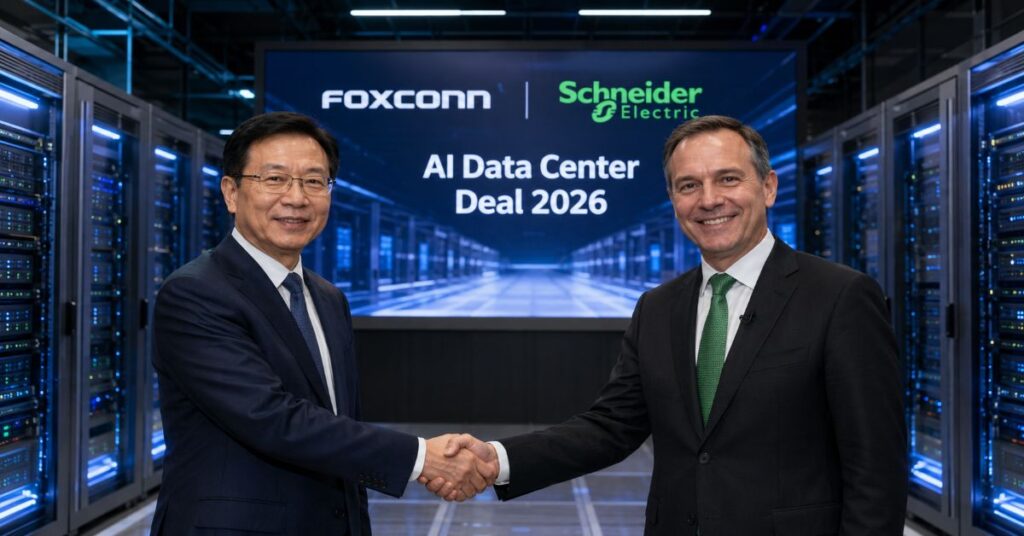
The company that builds most of the world’s iPhones just struck a deal to help build the power and cooling systems that keep AI data centers running. It is the clearest sign yet that Foxconn sees its future less in consumer electronics assembly and more in becoming the factory floor for the entire AI buildout.
Schneider Electric and Hon Hai Technology Group, the company better known as Foxconn, announced a strategic partnership on June 15 to co-develop and mass-produce integrated power, cooling, and energy-management hardware for next-generation AI data centers. The collaboration pairs Foxconn’s manufacturing scale and AI rack-integration expertise with Schneider Electric’s power distribution and thermal management systems, with production of the first jointly developed solutions scheduled to begin later this year.
The deal is a bet on standardization in an industry that has, until now, mostly built data centers as bespoke, site-by-site engineering projects — a process the two companies say is too slow for how fast AI compute demand is growing.
Key Developments
- Schneider Electric and Foxconn (Hon Hai Technology Group) announced a strategic partnership on June 15, 2026 to co-develop integrated AI data center infrastructure.
- The collaboration combines Foxconn’s manufacturing and AI rack-integration capacity with Schneider Electric’s power, cooling, and energy-management technology.
- Production of the first jointly developed, factory-assembled modular power and cooling “skids” is scheduled to begin later in 2026.
- Neither company disclosed financial terms, specific customers, or which regions will receive the first deployments.
What Happened
According to the companies’ joint announcement, the partnership centers on co-developing reference architectures for AI data center modules, with a specific focus on modular power and cooling skids — factory-assembled units that combine cooling and power systems before shipping, intended to arrive at a site ready for installation rather than requiring extensive custom field engineering. The companies also say they will explore closed-loop energy optimization and standardized design frameworks aimed at creating repeatable blueprints rather than one-off builds for each new facility.
Foxconn brings AI server manufacturing, rack integration, and global production scale — the company operates more than 240 campuses across 24 countries. Schneider Electric contributes power distribution, cooling technology, and digital energy-management platforms. No financial terms, specific anchor customers, or initial deployment regions were disclosed in the announcement; the companies described production of the first jointly engineered solutions as beginning “later this year.”
The Mechanism: Why Modular and Standardized, Not Custom
Most large data centers today are still built the way commercial real estate has always been built: a custom engineering project for each site, with power and cooling systems designed, procured, and installed individually to match local conditions, available grid capacity, and a specific operator’s technical requirements. That approach made sense when data centers were a slower-growing category of infrastructure. It does not scale well against the pace at which AI compute demand is currently expanding, where operators increasingly need to stand up gigawatt-class facilities in a matter of quarters rather than years.
The modular “skid” approach Foxconn and Schneider Electric are pursuing addresses that mismatch directly: by pre-engineering and factory-assembling power and cooling units to a standardized design, much of the complexity that normally gets resolved on-site during construction gets resolved once, in a factory, and then replicated. That shift mirrors a broader trend already underway elsewhere in AI infrastructure — prefabricated, repeatable building blocks replacing bespoke design — and it responds directly to the kind of data-center-driven electricity demand spike that has made power, not compute, the binding constraint for many operators. It is also where Schneider Electric’s technical credibility already runs deep: the company has collaborated with Nvidia since at least 2024 on reference designs for high-density liquid-cooled AI clusters, and discussed publicly, at the BloombergNEF Summit in January, data centers now operating at densities approaching 200 kilowatts per rack, roughly twenty times the current industry average.
The Backstory
Foxconn’s move into AI infrastructure hardware did not start with this deal. The company has captured roughly 40 percent of the global AI server market and has been deliberately diversifying beyond its traditional role as the world’s largest iPhone assembler for several years, leaning into AI infrastructure as a primary growth engine; the company’s 2025 revenue reached a record NT$8.1 trillion, or roughly $262 billion, with AI-related demand cited as the main driver.
That diversification has followed a consistent pattern: rather than building every capability internally, Foxconn has repeatedly partnered with, or taken equity stakes in, specialized infrastructure players. Reuters reported that Foxconn struck a similar strategic partnership with Taiwanese industrial motor maker TECO Electric & Machinery in July 2025, taking a 10 percent equity stake specifically to combine Foxconn’s server, cooling, and uninterruptible-power-supply expertise with TECO’s data center power infrastructure experience, explicitly targeting expansion beyond Taiwan and Asia into the US and Middle East. The Schneider Electric deal extends that same playbook to a far larger, more globally established energy-technology partner, and arrives alongside a separate Schneider Electric partnership announced around the same period as a strategic technology and industrial partner in SoftBank’s AI infrastructure investment in France — underscoring how central Schneider Electric has become to multiple, simultaneous AI buildout efforts this year.
The deal also lands in a year when data center power and cooling have become the binding constraint on AI growth more broadly than chip supply itself — a dynamic visible in Ferveret’s nuclear-reactor-cooled, fully waterless data center design out of MIT, and in the sheer scale of capital Nvidia alone has committed across the AI infrastructure supply chain this year. Foxconn and Schneider Electric’s answer to the same underlying pressure is less exotic but arguably more immediately scalable: standardize and mass-produce the power and cooling hardware itself, rather than reinvent the energy source feeding it.
Reactions
Foxconn chairman and chief executive Young Liu framed the deal around the pace of the industry rather than any single technical feature, saying “at the pace AI is evolving, the industry requires a new model for how infrastructure is designed, built, and delivered,” and that combining Foxconn’s manufacturing and AI system expertise with Schneider Electric’s energy management technology would help customers deploy AI infrastructure “more efficiently and sustainably.”
Schneider Electric chief executive Olivier Blum emphasized standardization specifically as the partnership’s core value, saying the companies are “developing reference architectures for AI data center modules that help reduce complexity, shorten deployment timelines, and improve energy performance from the start,” and positioning the collaboration as part of Schneider Electric’s broader role as “energy technology partners to an industry that is firmly entering the era of intelligence.”
The Dispute: Standardization’s Tradeoffs Remain Unaddressed
Neither company’s announcement engages with the central tension standardized, factory-built infrastructure has always carried: a repeatable blueprint optimizes for speed and cost predictability, but it inherently trades away the site-specific customization that has historically let data center operators adapt power and cooling design to local grid constraints, climate, and water availability — exactly the kind of local-condition sensitivity that has become a flashpoint elsewhere in the industry this year, as desert- and drought-region data center siting decisions draw scrutiny over water and grid impact. Whether a standardized Foxconn-Schneider Electric module can flex enough to satisfy operators in water-stressed regions as readily as those with abundant grid capacity is a question the announcement does not address.
There is also a basic information gap in the announcement itself: no financial terms, no named anchor customers, and no specific initial deployment regions were disclosed, which makes it difficult to assess the deal’s near-term commercial scale versus its longer-term strategic signaling. Press materials describe ambition — standardized blueprints, faster deployment, global reach — without yet providing the order-book or site-level specifics that would let outside observers gauge how quickly the partnership actually translates into deployed capacity rather than remaining a roadmap of intentions.
That ambiguity also extends to how the partnership will be priced and sold. Neither company has said whether the standardized modules will be offered as a joint product under a shared brand, sold separately by each company using shared reference designs, or licensed to third-party integrators who assemble the final data center themselves. That distinction matters commercially: a tightly bundled joint product gives both companies more control over margin and quality but narrows the customer base to operators willing to commit to a single integrated vendor relationship, while a more open reference-architecture approach could spread adoption faster but dilutes how much of the resulting revenue either company actually captures.
What Happens Next
Production of the first jointly developed hardware is set to begin later in 2026, which will be the clearest near-term signal of how quickly this partnership moves from announced blueprint to deployed product. Given that neither company named specific customers, the more telling indicator may be whether either party discloses early adopters or pilot deployment sites in the coming months — disclosures that would confirm whether hyperscalers and cloud operators are already lined up to use the standardized modules, or whether the companies are still building out the reference designs before pursuing customer commitments.
Why It Matters
This partnership formalizes a structural shift already underway in how AI infrastructure gets built: power and cooling, once treated as a downstream engineering problem solved separately at each site, are increasingly being designed and manufactured alongside the compute hardware itself, by companies whose core competency is manufacturing scale rather than civil engineering. If Foxconn and Schneider Electric succeed in making standardized, factory-built power and cooling modules a genuine industry default, it could meaningfully compress the timeline between an operator deciding to build AI capacity and that capacity actually coming online — a bottleneck that has, by most accounts, become at least as constraining to the AI industry’s growth this year as chip availability itself.
Sources
Schneider Electric / HPCwire (wire); Reuters; Data Centre Magazine; HPC Wire; InfoTechLead; Energy Digital.
