
At UnitedHealth Group’s headquarters outside Minneapolis, an AI now reads chart summaries aloud to home-health nurses as they drive between patient visits. It listens to millions of customer service calls to find recurring complaints. And in one active trial, an AI agent calls doctors’ offices directly to schedule patient appointments — a small but symbolically loaded detail in a company trying to convince a skeptical public that automation can fix, rather than worsen, America’s most frustrating health insurance experiences.
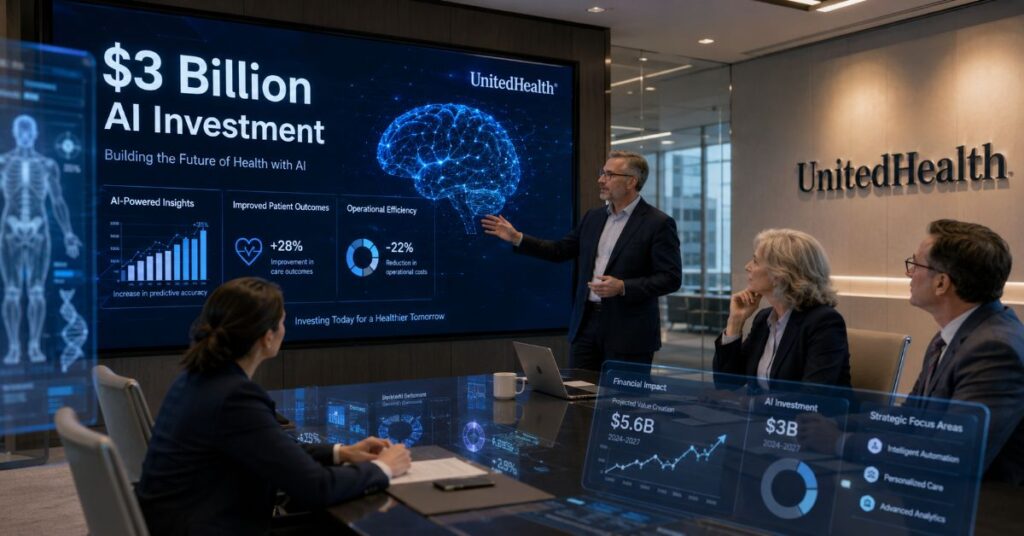
UnitedHealth Group plans to invest roughly $3 billion in artificial intelligence across 2026 and 2027, executives confirmed this week, with the company already claiming a 2-to-1 return on AI spending so far. The investment spans medical coding, customer service, fraud detection, clinical documentation, and prior authorization — the notoriously slow approval process insurers use to decide whether a treatment gets covered.
The rollout matters well beyond UnitedHealth’s own balance sheet. As the largest health insurer in the US, how aggressively it automates the machinery that decides whether care gets approved, delayed, or denied will likely set the pace the rest of the industry follows — for better or worse, depending on whom you ask.
Key Developments
- UnitedHealth plans to invest approximately $3 billion in AI across 2026 and 2027, with executives claiming a 2-to-1 return so far.
- One active trial uses AI agents to call doctors’ offices and schedule patient appointments; the company says 99% of its AI applications are administrative, not clinical — “we are not getting into diagnostic AI.”
- UnitedHealth has more than 1,000 AI use cases, 20,000 AI engineers, and 117 large language models available to staff, reviewed by an internal board including medical ethicists.
- The push comes as the company faces ongoing litigation over a subsidiary algorithm a federal inspector general found was linked to higher care-denial rates.
What Happened
According to Bloomberg’s reporting, UnitedHealth executives disclosed the $3 billion AI investment figure this week at an unusual event: the company invited reporters to its Minneapolis-area headquarters for a firsthand look at its AI work, a marked departure for a company that has historically limited press engagement. Sandeep Dadlani, chief executive of UnitedHealth’s Optum Insight technology division, said the company now has more than 1,000 AI use cases in production, 20,000 AI engineers, and 117 large language models available for staff to draw on.
One flagship example UnitedHealth points to is Optum Real, a system that lets medical providers check in real time whether a given service is covered — replacing what has traditionally been a slow back-and-forth of phone calls, faxes, and paperwork. The system has processed roughly a billion transactions since launching last year. The trial in which AI agents call doctors’ offices to schedule patient appointments is a separate, smaller pilot, not yet a company-wide deployment.
Dadlani said an internal review board including medical ethicists, clinicians, technologists, and privacy and legal experts vets every new AI use case before deployment, and that approximately 99 percent of the company’s AI applications are administrative rather than clinical. “We are not getting into diagnostic AI,” he said.
The Mechanism: Why Insurers Are Targeting Administrative Work First
UnitedHealth’s AI push is concentrated almost entirely on the unglamorous machinery of insurance administration, not clinical decision-making — and that is a deliberate, economically rational choice rather than caution alone. Insurers and medical providers together spend roughly $80 billion a year on administrative transactions, according to a June research note from Morgan Stanley analysts led by Erin Wright, who described the cost-savings potential as “clear, particularly for manual, data-intensive processes such as prior authorization.” Much of American healthcare’s back office still runs on phone calls, faxes, and paper — workflows that have been digitized in nearly every other major industry for a decade or more.
That gap is precisely what UnitedHealth is targeting: automating chart summarization for nurses, surfacing patterns in millions of customer-service calls, and giving providers real-time coverage answers instead of multi-day waits. None of it, on UnitedHealth’s own account, involves an AI system independently deciding whether a patient’s treatment gets approved — a distinction the company has been careful to draw publicly, given how much of the surrounding controversy concerns exactly that boundary.
The Backstory
UnitedHealth has put AI at the center of a broader turnaround strategy since the company’s profits collapsed last year, and the stakes for getting the bet right are unusually high: UnitedHealth shares have risen 21 percent in 2026, after slumping more than a third in 2025. Wall Street is expecting AI to materially boost earnings by cutting administrative expense, and UnitedHealth has said it expects almost $1 billion in operating-cost reductions this year, largely AI-driven — with the company also planning to sell AI products and services outward to other healthcare companies through Optum, turning internal automation into a second revenue line.
The company is also navigating a uniquely difficult trust environment for this kind of announcement. A Gallup survey last year found 69 percent of respondents had little or no trust in businesses to use AI responsibly, and health insurers face an especially steep version of that skepticism: about half of insured Americans report encountering care barriers like delays and denials, according to KFF polling, and most consider tactics like prior authorization a burden rather than a safeguard. A STAT News investigation published in April traced how deeply UnitedHealth has already woven AI into claims adjudication, fraud edits, and billing-code selection, work that touches tens of millions of Americans, finding that more than 80 percent of the company’s 22,000 software engineers now use AI to write code or build new agents. Public frustration with the broader US healthcare system intensified sharply after the December 2024 killing of UnitedHealthcare’s insurance chief Brian Thompson, and UnitedHealth and its rivals have since faced sustained pressure from Washington to roll back some prior-authorization requirements rather than expand them.
UnitedHealth is also already in active litigation over algorithmic care decisions. Plaintiffs in ongoing class-action cases allege the company and others relied on an algorithm — built by UnitedHealth subsidiary naviHealth — to limit coverage, including for post-acute care following hospital stays; UnitedHealth disputes the claims and says the algorithm is not used to make coverage decisions. A federal inspector general report found that companies using the algorithm had higher rates of denials, though those denials were almost always overturned when patients appealed — a track record that complicates UnitedHealth’s argument that the tool functions purely as a documentation aid rather than a de facto gatekeeper.
Reactions
Tim Noel, who succeeded Brian Thompson as head of UnitedHealth’s insurance division, framed the AI push around rebuilding credibility rather than simply cutting costs: “You have to gain trust, earn trust through your actions,” he said, adding that the changes will “take some time for that to actually be felt by people.”
Dadlani, for his part, emphasized the company’s internal governance and monitoring as the basis for public trust, describing real-time alerting that flags when an AI model’s behavior begins to drift, and saying the company has occasionally had to pull back specific models over unintended behavior. “We only approve using AI,” he said. “We never deny using AI” — a line aimed squarely at the fear that an algorithm might independently issue a coverage denial.
The Dispute: An Insurer’s Word Against Its Own Track Record
UnitedHealth’s central pitch — that AI is confined to administrative tasks and never independently denies care — runs directly against the company’s own recent regulatory history. The naviHealth litigation and the federal inspector general’s finding of elevated denial rates under algorithmic review predate this week’s announcement, and UnitedHealth’s public assurances that its current AI governance is fundamentally different are, for now, simply assurances rather than independently audited claims. The 2-to-1 return figure and the 99-percent-administrative breakdown are both UnitedHealth’s own self-reported numbers; no third party has yet verified either claim, and the company’s decision to open its doors to reporters this week reads as much as a trust-rebuilding exercise as a transparency one.
There is also a structural tension in UnitedHealth using Optum to both deploy these AI tools internally and sell them outward to other insurers and providers. If UnitedHealth’s administrative AI becomes the default infrastructure layer for a meaningful share of the US healthcare system’s claims and coverage workflows, the company’s commercial incentive to demonstrate strong AI-driven cost savings could, over time, sit uneasily next to its stated commitment to keep AI confined to a narrowly administrative, non-decisional role — particularly as the line between “flagging a claim that needs more documentation” and “influencing whether that claim ultimately gets paid” is not always a clean one in practice.
What Happens Next
UnitedHealth has not published a detailed public timeline for scaling the doctor-office-scheduling trial or its other administrative pilots beyond the broad 2026–2027 investment window, and the company’s claimed cost savings and return figures will be tested most directly against its upcoming quarterly results, where Wall Street will be looking for AI-driven margin improvement to materialize as promised. The naviHealth litigation also remains unresolved and will likely continue to shape how much latitude regulators and courts give insurers to deploy algorithmic tools anywhere near coverage decisions, regardless of how those tools are formally labeled.
Why It Matters
UnitedHealth is functionally running a live test of whether heavy AI investment can repair an insurer’s relationship with a public that, by its own cited research, mostly does not trust companies to use AI responsibly — and the company is betting that $3 billion and a carefully drawn administrative-only boundary will be enough to do it. That test matters for reasons beyond UnitedHealth’s own stock price: as enterprise boards and governance functions adopt AI tools of their own, and as broader research finds many large companies still struggling to convert AI investment into measurable financial return, UnitedHealth’s claimed 2-to-1 ROI — in one of the most heavily regulated, trust-sensitive industries in the country — is the kind of result every other healthcare and insurance executive watching this rollout will want independently verified before following suit.
Sources
Bloomberg (John Tozzi); STAT News; PYMNTS; Times West Virginian.
