
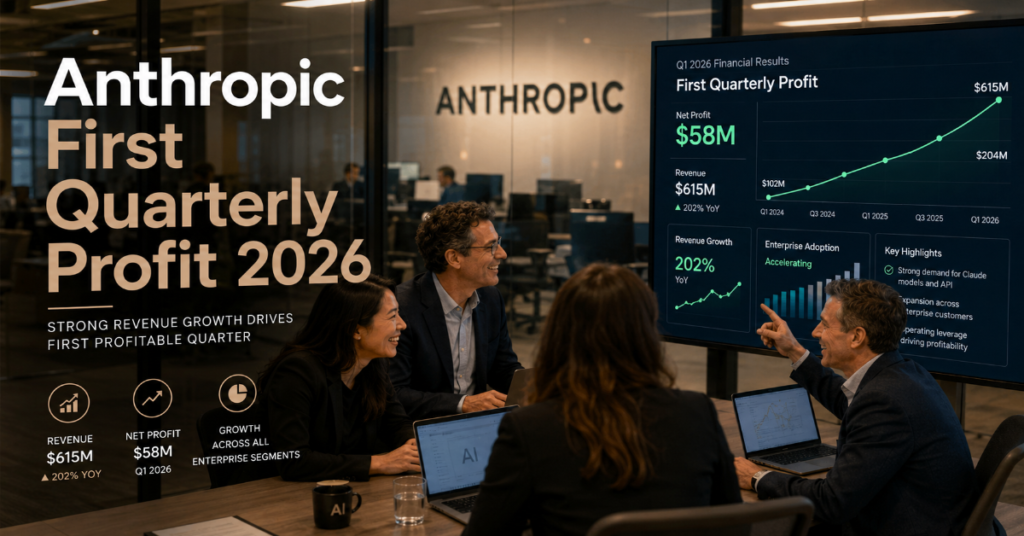
Anthropic’s first quarterly profit is the most consequential financial milestone in the short history of frontier artificial intelligence — and it is arriving faster than anyone, including Anthropic itself, predicted. The company shared financial projections with investors this week showing $10.9 billion in revenue for the quarter ending June 2026, up 130 percent from the $4.8 billion posted in Q1. Simultaneously, Anthropic projects operating income of approximately $559 million for Q2 — its first-ever quarterly operating profit, achieved in defiance of guidance issued as recently as last summer suggesting full-year profitability was unlikely before 2028. The announcement landed on the same day that OpenAI was preparing a confidential IPO filing with the SEC and SpaceX published its prospectus revealing that Anthropic pays SpaceX $1.25 billion every month for compute access — making May 22, 2026 the single most consequential financial news day in AI industry history.
The scale of the revenue progression is almost impossible to contextualise against normal corporate growth trajectories. Anthropic’s annualised revenue run rate at the end of 2025 was approximately $9 billion. By early April 2026 it had reached $30 billion, driven by Claude Code’s explosive enterprise adoption. The Q2 projection of $10.9 billion quarterly implies an annualised run rate of $43.6 billion — a number that makes Anthropic’s $900 billion pre-money fundraising valuation look not just defensible but potentially conservative if the trajectory holds through the second half of 2026. In our hands-on review of Anthropic’s disclosed financial data and independent analysis from Build Fast with AI’s May 22 roundup, three converging forces explain the extraordinary acceleration: the compounding enterprise customer base, dramatically improving compute efficiency, and the structural dominance of Claude Code in the agentic software development market.
“Anthropic going profitable, OpenAI filing for IPO, and SpaceX revealing a $45 billion Anthropic compute contract all on the same day is not a slow news cycle.” — Build Fast with AI, May 22, 2026 AI news roundup
Anthropic Revenue and Profitability Trajectory — 2025 to Q2 2026
| Period | Revenue | Annualised Run Rate | Operating Result | Key Driver |
| End 2025 | $2.25B quarterly (est.) | $9B ARR | Operating loss | Early Claude enterprise adoption |
| Q1 2026 | $4.8B | $19.2B ARR | Operating loss | Claude Code launch; enterprise expansion |
| Early April 2026 | ~$7.5B pace | $30B ARR | Near breakeven | Enterprise $1M+ customers doubled to 1,000+ |
| Q2 2026 projection | $10.9B | $43.6B ARR | +$559M operating profit (first ever) | Compute efficiency + Claude Code dominance |
| FY 2026 (full year est.) | $30B+ (if trajectory holds) | $43B+ ARR | Profitable | IPO planned October 2026 |
The Three Forces Behind the Profit Milestone
The first force is the compounding enterprise customer base. The number of Anthropic customers spending $1 million or more annually doubled from 500 to over 1,000 between February and April 2026 — a two-month doubling of the highest-value customer cohort that no enterprise software company has achieved at this scale in recent memory. Each of these million-dollar-plus accounts represents a strategic organisational commitment to Claude: a deployment embedded in production workflows, a contract with renewal pressure, and a switching cost that increases with every additional integration. The PwC deployment of 364,000 professionals, the Cognizant rollout of 350,000 employees, and the Advocate Health integration of 167,000 healthcare workers are three of the largest public examples. The undisclosed accounts making up the 500 customers added between February and April are the more significant dataset — they represent the breadth of enterprise adoption beyond the headline-generating megadeals.
The second force is compute efficiency improvement. In Q1 2026, Anthropic spent 71 cents on compute for every dollar of revenue — a ratio that already suggested meaningful operational leverage in a business that many analysts assumed would never escape infrastructure-cost parity. In Q2 2026, that ratio is projected to fall to 56 cents. This is not a trivial improvement. At $10.9 billion in Q2 revenue, the difference between a 71-cent and a 56-cent compute ratio is approximately $1.6 billion in additional operating margin. The efficiency gain comes from three sources: more efficient inference serving through techniques including Anthropic’s own quantisation advances, the GB200 (Blackwell Ultra) GPU access being ramped at Colossus 2 through June 2026, and the diversified compute supply from Amazon Web Services, Google Cloud, and other providers giving Anthropic pricing leverage it did not have twelve months ago.
The third force is Claude Code’s structural dominance. According to the latest 2026 data reviewed from Ramp’s AI Business Spend Index and independent developer surveys, Claude Code is the leading agentic coding agent by enterprise adoption, used in production by engineering teams at Harvey, Sierra, Ramp, Cisco Meraki, Duolingo, and hundreds of other organisations. The revenue characteristics of Claude Code are exceptional: API-based, recurring, high-margin, and deeply embedded in development workflows that are expensive to migrate. A software engineering team that has integrated Claude Code into its CI/CD pipeline, its code review process, and its automated testing infrastructure does not switch models based on a competitor’s benchmark press release.
“Revenue growth has become too hard to handle.” — Dario Amodei, Co-founder and CEO, Anthropic, speaking at a developer conference, May 2026
What the Profitability Milestone Means for the IPO
Frontier AI companies are universally assumed to be loss-making. That assumption is priced into valuation models, analyst frameworks, and investor expectations across the technology sector. Anthropic becoming operationally profitable in Q2 2026 — while still actively training frontier models, building new product lines, and expanding its workforce — fundamentally changes the IPO narrative for both Anthropic and OpenAI. For Anthropic, a profitable Q2 gives the company an S-1 that does not require investors to fund years of losses before reaching breakeven. The prospectus can present a credible near-term path to sustained profitability at a revenue level that justifies a trillion-dollar valuation. For OpenAI, Anthropic’s profitability creates immediate pressure to disclose its own operating margin — which is not yet public — and to explain how it plans to close a profitability gap that is now documented.
Bloomberg has reported that Anthropic is considering an IPO as early as October 2026. The Q2 profitability milestone is exactly the financial event the company needed to precede a public filing. A company with $43.6 billion in annualised revenue growing at 130% quarter-on-quarter and achieving its first operating profit does not need to apologise for its burn rate in a prospectus. It needs to explain why the growth rate will sustain and why the compute cost structure continues to improve — two arguments the Q2 data supports. The October timeline puts Anthropic’s public offering after OpenAI’s anticipated September listing, which means Anthropic will be benchmarked against OpenAI’s debut. Whether that sequential timing is advantageous depends on whether OpenAI’s public reception sets a floor or a ceiling for the comparable.
| Financial Metric | Anthropic Q2 2026 | Context / Comparison |
| Quarterly revenue | $10.9 billion | 130% growth from $4.8B Q1 — fastest frontier AI growth rate disclosed |
| Operating income | +$559 million | First-ever quarterly profit — previously guided as unlikely before 2028 |
| Compute cost ratio | 56 cents per dollar of revenue | Down from 71 cents in Q1 — approximately $1.6B margin improvement at Q2 scale |
| $1M+ enterprise customers | 1,000+ (doubled from 500 in Feb 2026) | Two-month doubling of highest-value customer cohort |
| Annualised revenue run rate | $43.6 billion | Up from $9B at end-2025 — roughly 5x in 6 months |
| Planned IPO valuation | $900B pre-money (fundraise in progress) | Would be largest AI public offering if it proceeds at or above this valuation |
| Compute spend (SpaceX alone) | $1.25 billion per month | SpaceX S-1 disclosure — excludes AWS, Google Cloud, others |
“Anthropic revealed it is on track for its first quarterly operating profit ever — projecting $10.9 billion in Q2 2026 revenue at an operating income of approximately $559 million.” — Build Fast with AI, May 22, 2026
Key Takeaways
• Anthropic projects $10.9 billion in Q2 2026 revenue — a 130% increase from $4.8 billion in Q1 2026 — representing the fastest quarter-on-quarter revenue acceleration disclosed by any frontier AI company at this scale.
• The company projects approximately $559 million in Q2 operating income — its first-ever quarterly operating profit, achieved significantly ahead of Anthropic’s own guidance from summer 2025 that suggested profitability was unlikely before 2028.
• Compute efficiency is improving dramatically: Anthropic spent 71 cents per dollar of revenue on compute in Q1, projected to fall to 56 cents in Q2 — a margin improvement worth approximately $1.6 billion at Q2 revenue scale.
• The number of customers spending $1 million or more annually with Anthropic doubled from 500 to over 1,000 between February and April 2026 — in two months, representing the compounding enterprise adoption that drives recurring high-margin revenue.
• The profitability milestone arrived on the same day OpenAI filed a confidential IPO prospectus and SpaceX revealed Anthropic is paying $1.25 billion per month for compute access — creating the most consequential single day of financial news in AI industry history.
• Anthropic is targeting an October 2026 IPO at a post-money valuation expected to exceed $900 billion. The Q2 profitability data materially strengthens the prospectus narrative by eliminating the assumption that the company requires years of investor-funded losses to reach breakeven.
Conclusion
Anthropic’s Q2 2026 profitability projection is the moment that ends the assumption that frontier AI is structurally unprofitable. The combination of 130% quarter-on-quarter revenue growth, improving compute efficiency, a doubling of million-dollar enterprise customers, and first-ever operating profit — all achieved while training and deploying some of the most capable AI models ever built — demonstrates that the frontier AI business model can work at scale. The structural risks identified in CNBC’s May 20 investigation remain real: Chinese model competition is intensifying, per-query costs are falling industry-wide, and the pricing power that underpins a trillion-dollar valuation requires sustained differentiation at the frontier. But the Q2 numbers make clear that Anthropic has found a product-market fit at enterprise scale that generates sufficient margin to fund its own continued development. That is a different kind of company than the burning-cash research lab that many investors still assumed Anthropic to be at the start of 2026.
Frequently Asked Questions
When did Anthropic become profitable?
Anthropic projects its first quarterly operating profit in Q2 2026 (the quarter ending June 2026), with operating income of approximately $559 million on projected revenue of $10.9 billion. Prior to Q2 2026, Anthropic had been operating at a loss throughout its history. The company’s own summer 2025 guidance had suggested full-year profitability was unlikely before 2028.
How much revenue is Anthropic making in 2026?
Anthropic posted $4.8 billion in Q1 2026 revenue and projects $10.9 billion in Q2 2026 — implying an annualised run rate of approximately $43.6 billion by mid-2026. This compares to an estimated $9 billion annualised run rate at end-2025, representing roughly a 5x increase in six months.
What is driving Anthropic’s revenue growth?
Three primary drivers: Claude Code’s dominance in enterprise agentic coding (generating recurring high-margin API revenue from over 1,000 million-dollar-plus enterprise accounts), improving compute efficiency (from 71 cents to 56 cents per dollar of revenue), and a doubling of the highest-value enterprise customer cohort between February and April 2026.
How does Anthropic’s profitability affect the OpenAI IPO?
Anthropic’s profitability creates pressure on OpenAI to disclose its own operating margin before or at IPO filing — OpenAI has not publicly confirmed whether it is profitable. If OpenAI’s prospectus shows continued losses while Anthropic is profitable, investors will use Anthropic’s financials as the quality benchmark for the AI company category.
When is Anthropic’s IPO?
Bloomberg has reported an October 2026 target for Anthropic’s IPO. The company is in the process of raising a $30 billion private round at a $900 billion pre-money valuation, which is expected to close before the IPO filing. A confidential S-1 filing would typically precede the public listing by two to three months.
References
Build Fast with AI. (2026, May 21). AI news today — May 22, 2026: 12 biggest stories. https://www.buildfastwithai.com/blogs/ai-news-today-may-22-2026
Bloomberg. (2026, May 22). Anthropic on track for first quarterly profit as Q2 revenue projected at $10.9 billion. Bloomberg Technology.
Reuters. (2026, May 22). Anthropic projects $10.9 billion Q2 revenue, first operating profit. Reuters Technology. https://www.reuters.com/technology/anthropic-projects-10-9-billion-q2-revenue/
CNBC. (2026, May 20). Cheap AI could derail OpenAI and Anthropic IPOs. https://www.cnbc.com/2026/05/20/cheap-ai-could-derail-openai-and-anthropic-ipos.html
Axios. (2026, May 22). Anthropic hits profitability milestone as Q2 revenue surges. https://www.axios.com/2026/05/22/anthropic-profitability-q2-2026
The Information. (2026, May 22). Anthropic shares Q2 financial projections with investors ahead of IPO. https://www.theinformation.com/articles/anthropic-q2-profitability-projection
Ramp. (2026, April). AI Business Spend Index — enterprise AI market share data. https://ramp.com/ai-index
