
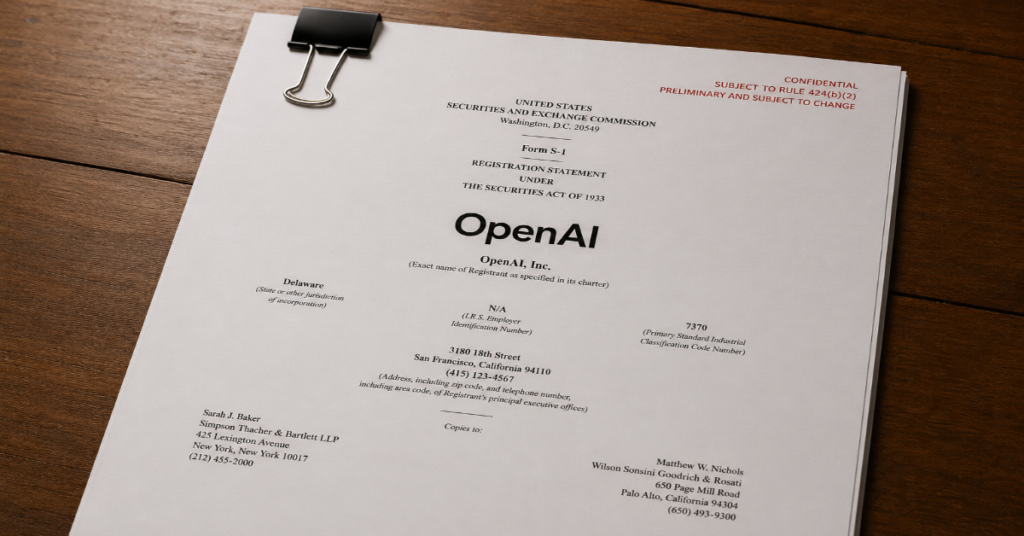
OpenAI’s confidential IPO filing landed at the Securities and Exchange Commission on May 22, 2026, according to simultaneous reporting from CNBC, Reuters, and Axios — bringing the most anticipated technology public offering since Facebook’s 2012 listing from rumour to legal process. Goldman Sachs and Morgan Stanley are serving as lead underwriters. A confidential S-1 filing allows a company to begin the mandatory SEC review process — the legal clock that governs when an IPO can proceed — without making its full financial details public until a subsequent public S-1 registration. Under the standard timetable, a company moves from confidential filing to public S-1 approximately two months after the confidential submission, then completes its roadshow and prices the offering approximately four to six weeks after that. A May 22 confidential filing points toward a public S-1 in late July or early August 2026, with a September listing as the primary target. At the company’s most recent private valuation of $852 billion — established in OpenAI’s March 2026 funding round — a public offering at or above that valuation would exceed Apple’s $39 billion IPO in 2018 adjusted for inflation and become the largest technology public offering in history by primary share value.
The Financial Case OpenAI Must Make
The confidential filing is a legal act, not a public disclosure — it triggers the SEC review process and the regulatory clock, not investor access to OpenAI’s financials. Those details will become public only in the public S-1, expected in late July. What is already known publicly sets the stage for that disclosure. OpenAI is generating approximately $25 billion in annualised recurring revenue as of May 2026, against an $852 billion valuation — an implied price-to-revenue multiple of approximately 34 times. For context, the broader enterprise software sector trades at roughly 8 to 12 times revenue; Microsoft trades at approximately 13 times. A 34x revenue multiple for OpenAI requires investors to believe one or more of the following: that revenue will compound at 50-plus percent annually for the next five or more years, that the business will eventually achieve operating margins above 30 percent, or that OpenAI will leverage its model and product distribution into market segments that are not yet generating revenue.
The complication is Anthropic. On the same day OpenAI filed its confidential S-1, Anthropic disclosed projections showing $10.9 billion in Q2 2026 revenue — implying a $43.6 billion annualised run rate — and its first-ever quarterly operating profit of $559 million. Anthropic is raising at a $900 billion pre-money valuation. On revenue multiple, Anthropic at $900 billion against $43.6 billion ARR implies approximately 20 times forward revenue — a more defensible multiple than OpenAI’s 34 times against $25 billion ARR. Investors who receive both S-1 prospectuses within weeks of each other will have a direct financial comparison. OpenAI must either demonstrate a revenue growth rate that justifies its premium multiple, or price the IPO below the private market valuation to attract institutional demand — a scenario that creates its own narrative challenges.
“A confidential filing today points toward a public S-1 in late July, with a September listing — making this the most significant technology IPO filing since Facebook in 2012.” — Build Fast with AI, May 22, 2026 AI news roundup
OpenAI IPO Process — Timeline and Key Milestones
| Milestone | Date | Description | Status |
| Private market valuation | March 2026 | $852 billion — SoftBank-led $40B round | Completed |
| Goldman Sachs / Morgan Stanley mandate | April-May 2026 | Lead underwriters selected for IPO process | Confirmed |
| Confidential S-1 filing | May 22, 2026 | SEC review clock starts — financials not yet public | Filed today |
| SEC review period | May-July 2026 | SEC comment letters and response cycle | In progress |
| Public S-1 registration | Late July 2026 (est.) | Full financial disclosure — revenue, margin, risk factors | Pending |
| Investor roadshow | August 2026 (est.) | CEO Sam Altman and CFO meet institutional investors | Pending |
| IPO pricing and listing | September 2026 (target) | First day of trading — NASDAQ or NYSE | Pending |
| Anthropic IPO (comparative) | October 2026 (target) | Will be benchmarked against OpenAI’s reception | Pending |
The Sam Altman Complexity — Personal Stakes and Corporate Structure
OpenAI’s IPO faces structural complexities that Facebook’s, Google’s, and Amazon’s offerings did not. The company was founded as a nonprofit, restructured into a capped-profit entity, and is in the process of a further restructuring into a standard for-profit Delaware corporation that is a prerequisite for the public listing. The restructuring was not completed at the time of the confidential filing — or at minimum, some of its provisions remain in legal negotiation. The nonprofit entity’s relationship to the new for-profit structure, the terms under which the original nonprofit mission is preserved or modified, and the equity stakes of the founding team are all elements that must be disclosed and resolved in the S-1.
Sam Altman’s personal equity stake is one of the most closely watched disclosures in anticipation of the public S-1. Altman has not held equity in OpenAI for most of the company’s history — a deliberate choice when OpenAI was a nonprofit where founder equity was inappropriate. In the restructuring to a for-profit entity, Altman is expected to receive an equity grant; the size of that grant and the structure of the vesting are material for investors assessing the CEO’s long-term incentive alignment. The Helion conflict-of-interest trial, in which Altman testified about his personal financial interests in energy companies that do business with OpenAI, has also created a disclosure requirement around related-party transactions that will be scrutinised by SEC reviewers during the comment period.
“Investors expect OpenAI to list on the public markets in September. Its rival Anthropic is also expected to list in 2026, around October. Both valuations could face pressure from cheaper, near-frontier Chinese AI models.” — CNBC, May 20, 2026, investigation into AI IPO valuation risks
What a September OpenAI IPO Would Mean for the Market
An OpenAI IPO at a $1 trillion valuation in September 2026 would be the defining event of the 2026 technology investment cycle — and it would set a market reference point that every subsequent AI investment is measured against. For institutional investors, the OpenAI prospectus will provide the first comprehensive public disclosure of a frontier AI company’s unit economics, growth trajectory, and capital requirements — data that currently exists only in private form, shared with selected investors under NDA. The public disclosure will either validate the private market valuations that have been assigned to frontier AI companies or force a re-rating of the entire category.
For the broader technology sector, an AI IPO at a trillion-dollar valuation — if it holds — provides the capital market signal that AI infrastructure investment is generating returns rather than consuming them. Pension funds, sovereign wealth funds, and retail investors who have been watching frontier AI from the outside finally get a liquid, publicly traded vehicle for exposure to the AI era’s most commercially successful company. The risk is that public market pricing discipline is more ruthless than private market pricing: public investors have real-time access to quarterly results, analyst coverage, and the ability to sell at any time. If OpenAI’s first public earnings report shows deceleration against the growth rate implied by the IPO valuation, the stock correction will be swift and large.
Key Takeaways
• OpenAI filed a confidential S-1 IPO prospectus with the SEC on May 22, 2026, targeting a September public listing. Goldman Sachs and Morgan Stanley are lead underwriters. A confidential filing starts the mandatory SEC review clock without making financial details public yet.
• A September listing at or above OpenAI’s March 2026 private market valuation of $852 billion would be the largest technology public offering in history by primary share value, exceeding Alibaba’s $25 billion 2014 IPO and Meta’s 2012 offering.
• The financial case OpenAI must make is challenging given Anthropic’s same-day disclosure: Anthropic has $43.6 billion ARR (vs OpenAI’s $25 billion), is approaching profitability (vs OpenAI’s undisclosed margin), and is raising at a $900 billion valuation with a lower implied revenue multiple.
• OpenAI’s corporate restructuring from nonprofit to for-profit Delaware corporation — a prerequisite for the IPO — may not be fully completed, creating potential disclosure complications in the S-1 around the nonprofit’s ongoing relationship to the new entity.
• Sam Altman’s equity stake, structured as part of the for-profit restructuring, and the related-party transaction disclosures arising from the Helion conflict-of-interest trial will be among the most closely scrutinised elements of the public S-1 when it is filed in late July.
• A public S-1 is expected in late July 2026. The investor roadshow is expected in August. September is the primary listing target on either NASDAQ or NYSE, with Anthropic’s October IPO to follow as the comparable offering.
Conclusion
OpenAI’s confidential SEC filing is the legal formalisation of a public listing that has been anticipated since the company’s March 2026 $852 billion funding round. The filing starts a process that is difficult to reverse without significant commercial and reputational cost — once a company is in SEC review, the default outcome is a public offering. The September timeline is aggressive: the SEC review process typically takes six to eight weeks in the first comment letter, with follow-up letters potentially extending the review. If SEC questions around the nonprofit restructuring or related-party transactions require substantive responses, the September target could slip to October or November. But the commercial incentive to list before year-end is powerful on all sides: Goldman Sachs and Morgan Stanley have placed IPO reputational stakes on the outcome, early investors are waiting for liquidity, and the employee equity holders whose compensation is largely in OpenAI shares need a public market. The confidential filing means the process has started. Whether it ends with the largest technology IPO in history depends on whether the public S-1’s financials are strong enough to justify the ambition.
Frequently Asked Questions
Did OpenAI file for an IPO?
Yes. OpenAI filed a confidential S-1 prospectus with the US Securities and Exchange Commission on May 22, 2026, according to CNBC, Reuters, and Axios. Goldman Sachs and Morgan Stanley are lead underwriters. A confidential filing starts the SEC review process without making financials public — the public S-1 is expected in late July 2026.
When will OpenAI IPO?
OpenAI is targeting a September 2026 public listing. Under the standard timeline from a May 22 confidential filing, the public S-1 would arrive in late July, followed by an investor roadshow in August and a September pricing and listing. Delays in the SEC review process could push the timeline to October or November.
What valuation is the OpenAI IPO targeting?
OpenAI’s most recent private market valuation was $852 billion, established in the March 2026 SoftBank-led funding round. The IPO could target a higher valuation — some analysts have cited a $1 trillion target — but the final IPO pricing will be set by the investor roadshow and book-building process, not by the company’s stated target.
Who are the OpenAI IPO underwriters?
Goldman Sachs and Morgan Stanley are the lead underwriters for OpenAI’s IPO. Both banks have extensive experience with large-cap technology public offerings. Additional co-underwriters have not been publicly confirmed.
How does the OpenAI IPO compare to Anthropic’s planned IPO?
Both OpenAI (September target) and Anthropic (October target) are expected to list in the second half of 2026. OpenAI is valued at $852 billion against $25 billion in ARR; Anthropic is raising at $900 billion against $43.6 billion in ARR. On revenue multiple, Anthropic’s implied valuation is more conservative. On brand recognition, OpenAI leads. The sequential timing means OpenAI’s public market reception will directly influence Anthropic’s IPO pricing.
References
CNBC. (2026, May 22). OpenAI to file confidential IPO paperwork with SEC as soon as Friday. https://www.cnbc.com/2026/05/22/openai-to-file-confidential-ipo-paperwork-with-sec-as-soon-as-friday.html
Reuters. (2026, May 22). OpenAI files confidential IPO prospectus with SEC. Reuters Technology. https://www.reuters.com/technology/openai-files-confidential-ipo-sec/
Axios. (2026, May 22). OpenAI files confidential S-1 with SEC ahead of September IPO. https://www.axios.com/2026/05/22/openai-ipo-sec-filing-confidential
Build Fast with AI. (2026, May 21). AI news today — May 22, 2026: 12 biggest stories. https://www.buildfastwithai.com/blogs/ai-news-today-may-22-2026
Wall Street Journal. (2026, April). OpenAI begins IPO preparations with Goldman Sachs and Morgan Stanley. https://www.wsj.com/articles/openai-ipo-goldman-sachs-morgan-stanley
CNBC. (2026, May 20). Cheap AI could derail OpenAI and Anthropic IPOs. https://www.cnbc.com/2026/05/20/cheap-ai-could-derail-openai-and-anthropic-ipos.html
SEC. (2026). Regulation S-K — IPO disclosure requirements for technology companies. https://www.sec.gov/division/corpfin
