
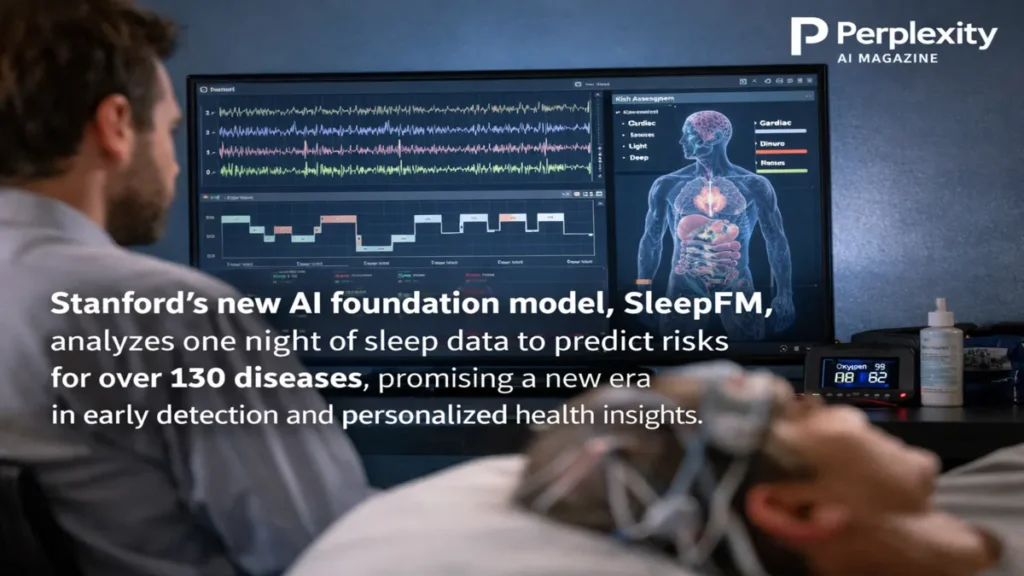
I used to think of sleep as something the body does when nothing else is happening — a kind of biological standby mode. That assumption quietly collapsed when I encountered SleepFM, a new artificial intelligence system from Stanford that can look at a single night of sleep and forecast a person’s risk for more than 130 diseases, from cancer to dementia to heart failure, often years before any clinical sign appears. What struck me was not only the model’s accuracy, but what it suggested about the body itself: that sleep is not passive rest, but an active physiological record of future health, written every night in rhythms we are only beginning to learn how to read. – stanford ai.
What makes this discovery extraordinary is not just its accuracy, but what it suggests about the human body itself. Sleep is not merely rest. It is a nightly diagnostic scan, a dense, living record of how the brain, heart, lungs, muscles, and nervous system are functioning together. SleepFM treats that record as a language — one written in electrical pulses, breathing rhythms, and subtle physiological shifts — and learns to read it.
The model was trained on 585,000 hours of clinical sleep studies from roughly 65,000 people between the ages of two and ninety-six. These recordings were paired with decades of electronic health records. The system learned which sleep patterns tended to precede which diseases, even when those diseases would not be diagnosed until ten or twenty years later.
The result is not a diagnostic oracle, but a risk map — a way to see probabilities that were previously invisible. It reframes sleep from something passive into something predictive. The night becomes not just a time of recovery, but a mirror that reflects the body’s future.
SleepFM does not promise certainty. It offers foresight. And in medicine, foresight is often the difference between prevention and crisis. – stanford ai.
Read: llm updates news 2026: Models, Trends, and Impact
The idea behind SleepFM
SleepFM is built on a simple but radical premise: that the body reveals its long-term health trajectory while it sleeps. During sleep, the nervous system cycles through carefully orchestrated states. The heart changes rhythm. Breathing slows and speeds. Muscles relax and twitch. The brain emits waves that reflect memory consolidation, emotional regulation, and metabolic maintenance.
All of this is already measured in a clinical sleep study called polysomnography. For decades, clinicians have used polysomnography primarily to diagnose sleep disorders such as insomnia, apnea, or narcolepsy. The data was rich, but its use was narrow.
The Stanford team treated that same data as a foundation for a much larger learning task. Instead of labeling sleep as “good” or “bad,” they asked: what long-term patterns does this data contain? What does sleep say about the future?
SleepFM is a foundation model, meaning it is trained first to understand the structure of sleep data itself before being fine-tuned for specific predictions. It does not begin with diseases. It begins with physiology.
The model divides sleep recordings into five-second segments and treats each segment like a word in a sentence. By learning how those segments relate to one another, it learns the grammar of sleep. It learns what is typical, what is unusual, and what patterns tend to recur across millions of hours of human nights. – stanford ai.
Only after learning this language does it get paired with medical outcomes.
How the model learns from sleep
SleepFM uses multimodal input. It does not rely on a single signal, but integrates many streams simultaneously.
It processes brain waves from EEG sensors, heart rhythms from ECG, breathing airflow and oxygen levels, muscle tone from EMG, and body movement. Each signal alone tells a limited story. Together, they tell a complex one.
The training method uses a technique called leave-one-out contrastive learning. The model learns to predict missing pieces of the data from the remaining pieces. If brain wave data is hidden, it predicts it from heart rhythm and breathing. If breathing is hidden, it predicts it from muscle tone and EEG. This forces the system to learn how the different systems of the body relate to each other.
In effect, it learns the internal coherence of human physiology during sleep.
Once trained, this internal representation can be reused for different tasks. Sleep staging, apnea detection, and disease risk forecasting all become different ways of reading the same underlying language.
This architecture allows the model to generalize across tasks without retraining from scratch. It is what enables SleepFM to move beyond sleep medicine into general health prediction. – stanford ai.
From patterns to predictions
After the foundational training, the researchers linked the sleep data to long-term health outcomes using electronic medical records spanning up to twenty-five years.
They examined more than one thousand disease categories and found 130 for which SleepFM achieved strong predictive performance, measured by a concordance index of 0.75 or higher. That means the model could correctly rank which of two people was more likely to develop a disease at least 75 percent of the time.
Some of the strongest predictions were:
Parkinson’s disease with a C-index of 0.89
Prostate cancer with a C-index of 0.89
Breast cancer with a C-index of 0.87
Dementia with a C-index of 0.85
All-cause mortality with a C-index of 0.84
Hypertensive heart disease with a C-index of 0.84
Heart attack with a C-index of 0.81
These are not trivial conditions. They are among the most feared and costly diseases in medicine. The idea that their risk could be inferred from sleep years in advance challenges existing assumptions about how early disease processes begin.
SleepFM does not detect tumors or plaques. It detects physiological drift — small changes in how systems coordinate that reflect underlying biological stress long before it becomes visible.
What sleep reveals about the body
Sleep is when the brain resets its neurotransmitters, when the heart and blood vessels recalibrate their tone, when immune activity reorganizes, and when hormones governing metabolism and repair are released.
If these processes are subtly impaired, sleep changes before symptoms appear. The brain’s slow waves may weaken. The heart’s variability may flatten. Breathing patterns may become more irregular. Muscle tone may shift.
These are not noticeable to a person. They are noticeable to a machine trained to see patterns across hundreds of thousands of nights. – stanford ai.
SleepFM essentially acts as a high-resolution stethoscope for the entire body, listening to systems talking to one another in the quietest hours.
Table: Signals and what they reflect
| Signal | System | What it reflects |
|---|---|---|
| EEG | Brain | Cognitive health, neurodegeneration risk |
| ECG | Heart | Cardiovascular stress and autonomic balance |
| Respiration | Lungs | Pulmonary function and metabolic demand |
| Oxygen saturation | Blood | Circulatory and respiratory efficiency |
| EMG | Muscles | Sleep fragmentation and neurological tone |
The model does not claim causation. Poor sleep does not cause Parkinson’s or cancer in this framework. Instead, early disease processes subtly alter sleep, and SleepFM learns to detect those alterations.
Medical implications
The most immediate implication of SleepFM is earlier risk awareness. For diseases where early intervention matters, this could be transformative.
A person flagged at elevated risk for heart disease could receive lifestyle counseling, closer monitoring, or preventive medications earlier. Someone flagged for neurodegenerative risk could be prioritized for cognitive screening or research trials. A person flagged for cancer risk could be guided toward earlier or more frequent screening.
This does not replace traditional medicine. It adds a new layer. – stanford ai.
It also introduces a shift from reactive care to predictive care. Instead of waiting for symptoms, clinicians could work with probabilities. – stanford ai.
Ethical and practical challenges
Predictive medicine raises ethical questions.
How should risk be communicated? How much uncertainty is acceptable? Who owns predictive data? Could insurers misuse it? Could it create anxiety without actionable benefit?
There is also the challenge of bias. The training data came from a specific clinical population. It may not reflect all ethnicities, socioeconomic groups, or global populations. A model trained on one demographic can mispredict in another. – stanford ai.
Before clinical deployment, SleepFM will require validation across diverse cohorts and regulatory evaluation. It must be shown not only to predict accurately, but to improve outcomes when used.
The model also requires clinical-grade sleep studies, not consumer wearable data. Whether simplified versions could work on smartwatch or home sensor data remains an open question. – stanford ai.
Table: Current status vs future possibilities
| Aspect | Today | Future potential |
|---|---|---|
| Data source | Clinical sleep labs | Home-based sensors |
| Use | Research | Preventive screening |
| Output | Risk scores | Personalized care pathways |
| Regulation | Not approved | Medical device evaluation |
Three expert perspectives
“Sleep is one of the few times when the body reveals its internal coordination without interference,” one sleep researcher noted. “It is like listening to an orchestra when no one is talking.”
A neurologist described the model as “a way to see neurodegeneration not as a sudden event, but as a slow drift that begins years earlier.” – stanford ai.
A cardiologist emphasized caution: “Prediction only matters if it leads to better care. Otherwise, it is just information without wisdom.”
Takeaways
- SleepFM treats sleep as a biological language that can be read by AI.
- It predicts risk for over 130 diseases from one night of sleep.
- It integrates brain, heart, breathing, and muscle signals.
- It forecasts years before symptoms appear.
- It enables a shift from reactive to preventive medicine.
- It raises ethical questions about risk, privacy, and equity.
- It is not yet a clinical tool, but a research breakthrough.
Conclusion
SleepFM reframes sleep from a passive necessity into an active signal of the body’s future. It suggests that long before disease becomes visible, it becomes legible. The body whispers before it screams, and sleep is where those whispers are most clear.
This does not mean we should fear our nights. It means we should respect them. The rhythms of sleep are not just restorative; they are informative. They carry the fingerprints of health and the early shadows of illness. – stanford ai
If developed responsibly, systems like SleepFM could become instruments of compassion — tools that help people avoid suffering rather than merely respond to it. They could guide medicine away from crisis and toward care.
In that sense, the future of medicine may begin each night when we close our eyes.
FAQs
What is SleepFM?
An AI foundation model that predicts long-term disease risk from sleep data.
Does it diagnose disease?
No, it estimates risk, not diagnosis.
How early can it predict?
Often many years before clinical symptoms appear.
Can it be used at home?
Not yet, it currently requires clinical sleep studies.
Is it available in hospitals?
No, it remains a research system pending validation and regulation.
