
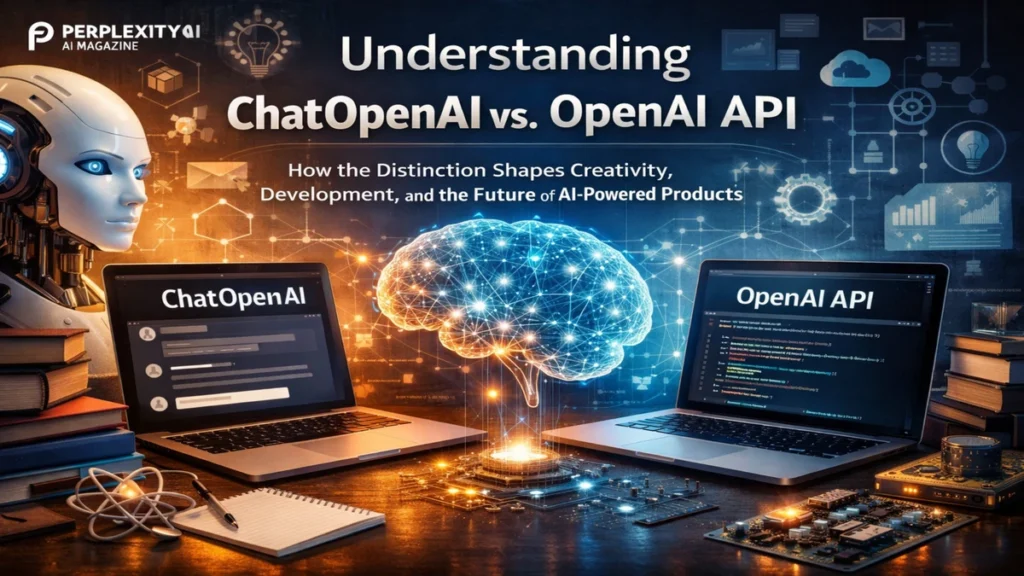
Chatopenai is one of the most searched and most misunderstood terms in the artificial intelligence ecosystem. I see people use it to mean ChatGPT, to mean OpenAI itself, and sometimes to mean the underlying models like GPT-4o, even though these are technically different layers of the same system. Understanding what ChatOpenAI actually refers to is no longer a semantic exercise. It determines how individuals experiment with AI, how companies build products, how data is handled, how costs scale, and how creativity and control are distributed between consumers and developers.
At its simplest, chatopenai refers to OpenAI’s chat-based interface, what most people know as ChatGPT, and the chat-optimized models behind it. It is the polished, consumer-facing layer of OpenAI’s technology: conversational, stateful, safety-filtered, and designed to feel like dialogue rather than software. The OpenAI API, by contrast, is the infrastructure layer. It exposes raw model access through code, allowing developers to build their own chatbots, agents, tools, and applications without inheriting the interface, memory model, or constraints of ChatGPT.
This distinction explains why ChatGPT feels friendly and immediate, while API integrations feel powerful but demanding. One is optimized for accessibility. The other is optimized for control. Both run on the same foundational intelligence, but they serve different human roles. As AI becomes embedded into products, workflows, and creative processes, the question is no longer which model is best, but which layer of AI you are actually interacting with.
Structural Layers of ChatOpenAI
Chatopenai exists to remove friction between humans and artificial intelligence. It wraps large language models in a conversational interface with built-in memory, safety moderation, sharing features, and UI-driven iteration. The user never sees tokens, system messages, or HTTP requests. They see a chat box.
The OpenAI API removes that layer entirely. Developers interact directly with models through code, controlling prompts, parameters, tools, streaming behavior, function calls, memory design, and data handling. This gives far more power, but far more responsibility. There is no interface, no memory unless built, and no guardrails unless implemented.
This separation mirrors earlier shifts in computing. ChatGPT is like a consumer operating system. The API is like a programming language. One lowers the barrier to entry. The other raises the ceiling of possibility.
Read: perplexity vs chatgpt vs Claude in 2026
ChatGPT as an Experimentation Environment
For non-technical users, chatopenai is an experimentation environment. Writers draft essays, marketers brainstorm campaigns, students ask questions, and designers test ideas. The interface encourages exploration rather than engineering, and that is why ChatGPT dominates public awareness. It is approachable.
For developers, the API is a construction environment. It allows AI to be embedded inside websites, apps, workflows, customer support systems, analytics pipelines, and internal tools. It is not about conversation. It is about integration.
This difference explains why ChatGPT feels complete while the API feels unfinished until something is built with it. One is a product. The other is a platform.
Perspectives on the Difference
“ChatGPT is a thinking surface,” says a product manager who builds AI tools for creative teams. “The API is a thinking engine. One invites play. The other invites architecture.”
A machine learning engineer describes the API differently. “The API is not smarter than ChatGPT. It’s freer. You decide what memory is, what tools exist, what the AI is allowed to do.”
A novelist who uses both tools draws another line. “I sketch in ChatGPT. I build systems with the API. But I write after they’ve helped me think.”
These perspectives show that the difference is not only technical but experiential.
Cost, Privacy, and Scale
This experiential gap becomes clear when cost, privacy, and scale are considered. ChatGPT offers flat pricing and OpenAI-managed data handling. The API offers pay-per-token pricing and user-managed logging, security, and compliance.
This makes ChatGPT ideal for individuals and small teams, while the API is designed for products and organizations that require scale, reliability, and integration.
The distinction matters legally as well. API users often control data retention, encryption, and compliance. ChatGPT users accept platform defaults. This is why enterprises frequently migrate from ChatGPT to APIs even if they begin experimentation inside the chat interface.
Creativity and Production
The distinction also shapes creativity. ChatGPT is optimized for long conversational arcs, tone imitation, and iterative refinement. It is where stories, scripts, and ideas grow organically. The API is optimized for consistency, automation, and integration into workflows. It is where ideas become products.
ChatGPT encourages exploration. The API enforces design.
This explains why ChatGPT outperforms research-oriented tools for creative writing, and why APIs outperform ChatGPT in production systems.
Comparative Overview
| Aspect | ChatGPT (ChatOpenAI) | OpenAI API | Perplexity |
|---|---|---|---|
| Primary Role | Conversational thinking | System integration | Live research |
| Technical Skill Needed | None | High | None |
| Customization | Limited | Extensive | None |
| Creative Strength | High | Medium | Low |
| Factual Freshness | Medium | Medium | High |
Layered Intelligence
The rise of chatopenai as a term reflects confusion about where intelligence lives. Is it in the model, the interface, or the platform. In practice, intelligence is layered. Models generate. Interfaces shape experience. Platforms shape scale.
ChatOpenAI is the face. The API is the skeleton. The model is the brain.
Understanding this prevents category errors such as expecting ChatGPT to behave like a backend or expecting an API to feel like a collaborator.
| Layer | Purpose | Example |
|---|---|---|
| Interface | Human interaction | ChatGPT |
| Platform | System integration | OpenAI API |
| Model | Language generation | GPT-4o |
| Retrieval | Verification | Perplexity |
Takeaways
- ChatOpenAI refers to ChatGPT and its chat-optimized models
- The OpenAI API exposes raw model access for developers
- ChatGPT is a product and the API is a platform
- Creativity thrives in ChatGPT while scalability thrives in APIs
- Perplexity complements both by focusing on research
- Understanding layers prevents misuse and frustration
Conclusion
Chatopenai is not a model, a company, or a platform. It is an experience, the way millions of people encounter artificial intelligence for the first time. The OpenAI API is not a competitor to that experience. It is its extension into the world of products, systems, and infrastructure. As AI becomes embedded into society, this distinction will grow more important. Those who understand it will design better tools, make better decisions, and build more responsibly. The future of AI is not about one system replacing all others. It is about layers of intelligence serving different human needs, from conversation, to creation, to construction.
FAQs
What is ChatOpenAI
It commonly refers to ChatGPT and OpenAI’s chat-optimized interface rather than the raw APIs.
Is ChatGPT the same as the OpenAI API
No, ChatGPT is a product and the API is a developer platform.
Why do developers prefer the API
It offers control, customization, scalability, and integration into products.
Why do creatives prefer ChatGPT
It supports long conversations, tone shaping, and iterative refinement.
Can teams move from ChatGPT to the API later
Yes, many prototype in ChatGPT and migrate to APIs for production.
