
- 💰 Dealroom records 28 London rounds above $100 million in 2026 worth $12 billion, with AI representing 42% of that large-round capital.
- 🚀 Nscale, Ineffable Intelligence, Wayve, ElevenLabs, PhysicsX and Synthesia define the mega-round story, but Beauhurst shows three AI companies captured 29% of all UK equity capital in H1.
- 📈 Commercial proof is clearest at ElevenLabs, which reported more than $500 million ARR by May, and Synthesia, where contracts above $100,000 tripled over 12 months.
- 💳 Pricing transparency divides the watchlist: Granola, ElevenLabs and Synthesia publish self-serve plans, while frontier compute, autonomy and industrial AI remain sales-led or contract-based.
- 🎯 The strongest 2026 watch signal is repeatable deployment, not valuation alone: regulatory timing, infrastructure cost, enterprise integration and customer concentration can matter more than headline funding.
London AI startups to watch 2026 are not simply the companies with the largest funding rounds. I would watch the firms that can turn London’s unusual mix of frontier research, enterprise buyers, engineering talent and government support into repeatable deployed products, because the capital now flowing into the market is exceptionally concentrated. Dealroom’s London profile, updated 18 August 2026, records 28 venture rounds above $100 million this year worth $12 billion, with AI accounting for 42% of that large-round capital. Yet Beauhurst’s H1 data shows just three AI companies absorbed 29% of all UK equity investment, a reminder that the headline boom describes a small group far better than it describes the typical startup.
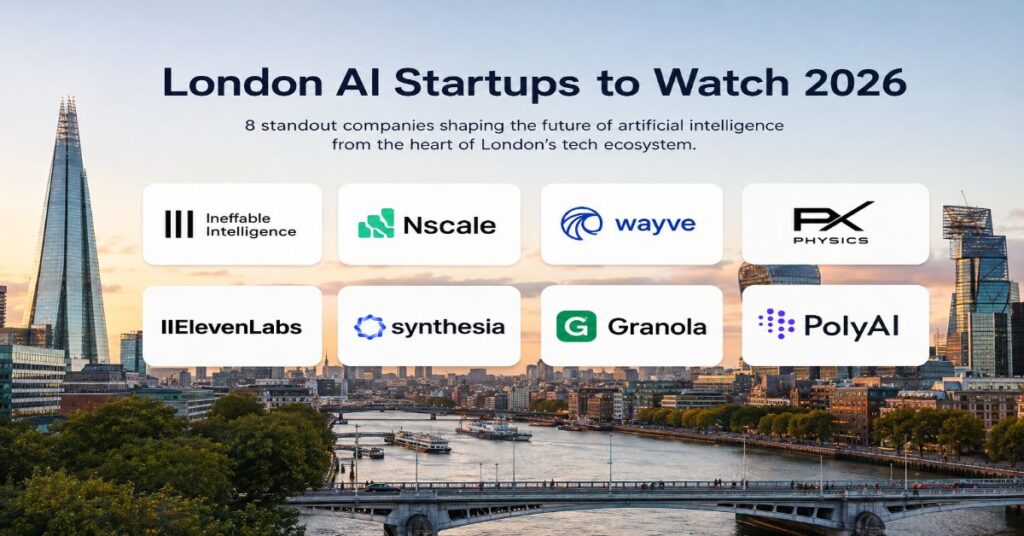
That tension is the organising idea for this watchlist. The eight companies below span frontier reinforcement learning, AI infrastructure, autonomous driving, industrial engineering, synthetic media, voice AI, meeting intelligence and enterprise dialog. They are not ranked by valuation, and inclusion is not a prediction that every company will win. Instead, I assessed 2026 financing, commercial traction, deployed technology, distribution, pricing visibility, customer evidence, regulatory exposure and the difficulty of the underlying technical problem.
The result is a London-first view of an ecosystem that is becoming more diverse even as funding becomes more concentrated. Some of these companies sell software today with transparent plan caps. Others are still building expensive infrastructure or research systems whose commercial economics remain private. That difference matters. A startup can be strategically important and still be years away from a conventional SaaS margin profile. Readers should therefore treat this list as a map of where technical and commercial pressure is accumulating, not as an investment recommendation.
Why London’s AI Market Looks Different in 2026
London’s 2026 AI story is a concentration story before it is a volume story. Dealroom lists $12 billion across 28 London rounds of at least $100 million, with AI representing 42% of the money in those large rounds. Nscale’s $2 billion Series C, Ineffable Intelligence’s $1.1 billion seed, ElevenLabs’ $500 million Series D, PhysicsX’s $300 million Series C and Synthesia’s $200 million Series E sit inside that total. Wayve adds a $1.2 billion Series D in transportation, even though its core technology is embodied AI. If the definition expands beyond Dealroom’s AI label, the amount of AI-related capital tied to London is larger still.
The national data explains why raw averages are misleading. Beauhurst says £14.4 billion was deployed across 2,799 UK equity deals in H1 2026 and that the average round reached a record £5.4 million. Three AI companies accounted for 29% of all equity capital in the half. Beauhurst’s later valuation analysis makes the distortion clearer: the average pre-money valuation for UK AI companies was £70.2 million, while the median was only £3.4 million. That roughly 20-fold gap means a small number of extreme financings are pulling the average away from the experience of the typical company.
London nevertheless has a genuine structural advantage. It combines research institutions, a large enterprise buyer base, deep professional services and financial services demand, and a dense founder network shaped by Google DeepMind and other major labs. The current researcher-to-founder pipeline helps explain why former lab leaders can assemble teams and capital quickly. Government support adds to that flywheel, with London Tech Week announcements in June tied to more than £6 billion of UK investment and around 8,000 jobs.
The constraint is cost. Frontier training, data centres, automotive validation and industrial simulation consume capital before predictable revenue appears. London’s advantage is that a small group can combine scientific talent, enterprise access and international capital at unusual scale.
London AI Startups to Watch 2026: Our Selection Logic
A watchlist is most useful when its inclusion rules are explicit. I included private companies headquartered in London or with a clear London operational centre, a defensible AI product or research thesis, and evidence of meaningful 2025-2026 financing, commercial adoption, technical deployment or strategic partnership. The list deliberately mixes startups and later-stage scale-ups because the search intent is about companies worth following through 2026, not only businesses below a particular age or valuation threshold.
Five signals carried the most weight. First was technical distinctiveness: a company needed more than a generic wrapper around a third-party model. Second was deployment evidence, such as production customers, infrastructure commitments, enterprise contracts or on-road testing. Third was economic evidence, including ARR, contract expansion or transparent pricing where available. Fourth was distribution: partnerships with automakers, cloud providers, enterprise systems or large corporate buyers. Fifth was constraint visibility. Companies with no meaningful risks are usually companies being described too superficially.
This framework produces a more balanced list than sorting by funding. Ineffable Intelligence has enormous research ambition but no public commercial pricing. Granola has far less capital but a much clearer per-seat product and an expanding workplace workflow. Wayve has stronger real-world generalisation evidence than most autonomy companies, yet its route to revenue depends on OEM and mobility partners plus regulatory approval. PhysicsX sells into industrial workflows where customer value can be high, but integrations and deployment cycles are more complex than self-serve software.
The snapshot below treats funding as execution capacity, while keeping each company’s main caveat visible.
| Company | 2026 Position | Capital / Valuation | Strongest Watch Signal | Main Caveat |
| Ineffable Intelligence | Frontier reinforcement learning | $1.1B seed; about $5.1B valuation reported by UCL | Vera Rubin-scale Google Cloud training cluster | No public product pricing or revenue signal |
| Nscale | AI cloud and infrastructure | $2B Series C; $14.6B valuation | Full-stack compute plus managed AI services | Capital intensity and utilisation risk |
| Wayve | Embodied AI for driving | $1.2B Series D; $8.6B post-money | Zero-shot driving in 500+ cities | Regulatory and OEM deployment timing |
| PhysicsX | Physics AI for engineering | $300M Series C; about $2.4B valuation | Simulation, DPM and engineering workflow stack | Long industrial validation and integration cycles |
| ElevenLabs | Voice and audio AI | $500M Series D; $11B valuation | $500M+ ARR reported by May 2026 | Model commoditisation and usage-cost complexity |
| Synthesia | Enterprise AI video | $200M Series E; $4B valuation | >$100K contracts tripled; NRR >140% | Best fit is enterprise communication, not every video use case |
| Granola | Meeting and company context | $125M Series C; $1.5B valuation | API, MCP and context-rich team workflows | Privacy, retention and platform competition |
| PolyAI | Enterprise voice agents | $86M Series D in Dec 2025; >$200M total funding | 2,000+ live deployments across 45 languages | Sales-led economics and fast-moving general voice models |
Frontier Learning and Compute: Ineffable Intelligence and Nscale
Ineffable Intelligence is the clearest example of London’s ability to finance research before there is a conventional product catalogue. Founded by David Silver, the former Google DeepMind reinforcement-learning leader associated with AlphaGo, the company raised a $1.1 billion seed round in 2026 and has been described by UCL and Google Cloud as a London-based effort to build systems that learn primarily from experience. The thesis is important because it shifts emphasis from pretraining on large static human-generated datasets towards reinforcement learning and continuous interaction.
Its infrastructure commitment is equally notable. Google Cloud says Ineffable will deploy one of the largest clusters of A5X systems powered by NVIDIA Vera Rubin NVL72 for its first generation of foundational models. Silver framed the dependency directly: “We evaluated the space and chose Google Cloud as the best fit for our reinforcement learning infrastructure.” The choice exposes the core trade-off: a potentially important learning paradigm paired with very high compute and talent costs before revenue is visible.
The magazine’s earlier coverage of Ineffable’s Google Cloud build provides useful infrastructure context. As of August 2026, the company does not publish a self-serve product, API tariff or enterprise plan, so any attempt to quote a commercial price would be speculative.
Nscale sits one layer lower in the stack and is easier to read commercially. Its $2 billion Series C in March 2026 valued the company at $14.6 billion, and its product strategy spans data centres, power, dedicated GPU infrastructure and a managed AI cloud. Nscale’s current service catalogue includes serverless or dedicated Inference Endpoints, Fine-Tuning, Prompt Workbench, Managed Slurm, Kubernetes Service, instances, compute, networking, storage, enterprise IAM, observability and OpenAI-compatible APIs. In July it acquired Anyscale, extending the story from raw infrastructure towards a fuller software platform.
London AI Startups to Watch 2026: The Frontier Pair
The pairing is strategically revealing. Ineffable needs tightly orchestrated compute for a new learning paradigm, while Nscale is building the physical and software layer that can support such workloads for many customers.
Nscale’s main bottleneck is capital intensity. Data-centre development, power procurement, accelerator supply and utilisation risk are fundamentally different from shipping a conventional SaaS product. Its public site directs buyers to sales for pricing and GPU reservations, so there is no stable public price card to compare with hyperscaler spot rates. The watch signal for 2026 is therefore capacity actually brought online, customer utilisation and the depth of platform adoption, not valuation in isolation.
Embodied and Industrial AI: Wayve and PhysicsX
Wayve and PhysicsX show a second London advantage: applying machine learning to expensive physical systems where software can unlock disproportionate economic value. Wayve’s $1.2 billion Series D, announced in February 2026, brought its post-money valuation to $8.6 billion, while Uber committed additional milestone-based capital within a broader $1.5 billion financing package. The company licenses an AI Driver to automakers rather than trying to own every vehicle, and its current roadmap spans L2+ hands-off supervised driving through L3 and L4 capability.
The technical claim worth watching is generalisation. Wayve says the same foundation model drove zero-shot in more than 500 cities across Europe, North America and Japan without city-specific fine-tuning. Its AI Driver runs on onboard compute and embedded sensors and does not depend on high-definition maps or location-specific engineering. Alex Kendall, co-founder and CEO, summarised the scaling thesis in Wayve’s February announcement: “Autonomy will not scale through city-by-city robotaxi deployments alone.” Its strategy is to make that autonomy layer repeatable across vehicles and markets.
The caveat is regulation and deployment timing. By late August 2026, reporting from the Financial Times and other UK outlets indicated that fully driverless London robotaxi launches were slipping because operators still needed critical approvals and TfL guidance. Wayve and Uber can continue testing with safety drivers, but a delayed transition to paid fully autonomous service changes the near-term commercial cadence. Technical and regulatory milestones therefore need separate tracking.
PhysicsX attacks a different physical-world bottleneck: the cost and speed of engineering simulation. Its $300 million Series C in June valued the company at about $2.4 billion. The platform combines Simulation Workbench for orchestrating simulation and experimental data, AI Workbench for developing and deploying Deep Physics Models, and Engineering Applications that expose models through operational workflows. The company documents uncertainty quantification, benchmarking, data lineage, 2D and 3D analysis, low-code and programmatic access, CAE integrations, multi-cloud deployment and support for hosted, customer-cloud and fully air-gapped environments.
Physics AI can compress design loops, but industrial buyers bring proprietary solvers, sensitive IP and long validation cycles. PhysicsX’s emphasis on uncertainty quantification and traceability is therefore central to whether engineers will trust faster model outputs.
London’s appetite for science-heavy AI is visible beyond this pair. The magazine’s coverage of Isomorphic Labs’ funding shows the same pattern in AI-designed drug development: unusually large rounds are flowing to companies where model capability must ultimately survive contact with physical reality.
Voice, Video and Enterprise Media: ElevenLabs and Synthesia
ElevenLabs and Synthesia are the watchlist’s strongest examples of London AI converting technical capability into clearly monetised enterprise products. ElevenLabs raised $500 million at an $11 billion valuation in February 2026. More important than the financing, the company said in May that it had passed $500 million in annual recurring revenue after ending 2025 at $350 million. That is unusually concrete commercial evidence across voice agents, customer support, sales, localisation and media creation.
The product surface is broad. ElevenCreative covers text to speech, speech to text, sound effects, voice design and cloning, music, dubbing, Studio and Productions. ElevenAgents adds workflow building, knowledge bases, multilingual voice agents and widgets. ElevenAPI exposes speech and audio models programmatically. The public plan structure is also unusually detailed: Free, Starter, Creator, Pro, Scale, Business and custom Enterprise tiers, with shared credits for creative products and separate call-minute economics for agents. Agent cost can still exceed the plan price because LLM usage and telephony may be separate, while burst pricing applies above concurrency limits.
Synthesia occupies the enterprise video and learning layer. It raised $200 million at a $4 billion valuation in January 2026, and by April said contracts above $100,000 had tripled over the prior 12 months while net revenue retention exceeded 140%. Its public product offers AI video generation, avatars, dubbing, translation, interactive video, API access, branded video pages and enterprise controls. The company says it is used by more than 90% of the Fortune 100, which is a much stronger distribution signal than social-media popularity.
Victor Riparbelli, Synthesia’s co-founder and CEO, described the product thesis in the January financing announcement: “AI video provides a better, more engaging way for organizations to communicate and learn.” In 2026 Synthesia is extending from generated video into agentic learning and role-play, aiming at measurable knowledge transfer rather than novelty alone.
For readers comparing creation platforms, our AI video editor comparison gives broader category context. Synthesia is strongest in repeatable organisational video, not every cinematic or consumer workflow. ElevenLabs faces rapidly improving native speech from foundation-model vendors. Both therefore need workflow depth, trust and distribution beyond raw generation quality.
Workplace Intelligence and Customer Dialog: Granola and PolyAI
Granola and PolyAI are less defined by mega-rounds than some companies above, but both are useful tests of whether London AI can own a repeated business workflow. Granola raised $125 million at a $1.5 billion valuation in March 2026. Its core meeting-notes product captures transcripts and lets users turn those conversations into company context, then search or chat across meetings. Business plans add unlimited notes and history, advanced models, API access, MCP integration and integrations with systems such as Attio, Notion, Slack, HubSpot, Affinity and Zapier.
The interesting part is not transcription itself, which is rapidly commoditising. Granola’s differentiation depends on whether accumulated meeting context can become a durable workflow layer. Its Spaces concept, API and MCP support point in that direction because meeting knowledge can flow into other tools instead of remaining a static note archive. That also increases privacy and governance pressure. Enterprise buyers need identity controls, retention policies, consent handling and clear boundaries around model training because meeting data often contains confidential strategy, customer information and personnel decisions.
PolyAI has been working on enterprise voice for longer and closed an $86 million Series D in December 2025, taking total funding above $200 million. The company said it had more than 100 enterprise customers and over 2,000 live deployments across 45 languages and more than 25 countries. In May 2026 it opened its Agentic Dialog Platform to a wider set of enterprise builders, offering three main surfaces: Agent Studio for visual building, an Agent Development Kit for Python, Git and CI/CD workflows, and REST APIs for programmatic control.
Its technical stack includes the proprietary Raven model, voice and chat, multi-provider text-to-speech and automatic speech recognition, RAG and connected knowledge, multi-step flows, analytics and integrations with contact-centre and enterprise platforms. The documentation lists systems such as Five9, NICE, Twilio, Genesys, Salesforce and ServiceNow, while the broader integration catalogue includes Microsoft 365, Zoom, Zendesk, Slack, HubSpot and other business tools. Nikola Mrkšić, co-founder and CEO, wrote when opening the platform in May: “Handling complex customer conversations at enterprise scale is a different challenge entirely.” That is the correct benchmark. The benchmark is reliable task resolution, not merely human-sounding voice.
Enterprise acceptance of AI inside decision workflows is moving beyond contact centres. The magazine’s report on Lloyds’ AI board bot illustrates how UK companies are experimenting with AI at governance level as well. Their key watch signal is whether they become embedded workflow infrastructure rather than replaceable point products.
Pricing, Plan Caps and Commercial Access
Pricing reveals which companies have already standardised a repeatable product and which still sell bespoke capacity or strategic deployments. Three companies on this list publish conventional self-serve tiers. ElevenLabs has the most complex matrix because creative generation, API usage and voice agents draw on different billing units. Synthesia is simpler, with video credits and minute limits. Granola uses per-seat SaaS pricing. PolyAI states that ongoing voice-agent usage is priced per minute but does not publish the general commercial minute rate on its own pricing page; a UK G-Cloud reseller schedule provides procurement-specific figures, which should not be assumed to equal every private contract.
The remaining four companies are sales-led. Nscale asks buyers to contact sales and reserve GPU capacity. PhysicsX does not post a public licence price for its enterprise engineering platform. Wayve licenses its AI Driver to automakers and fleet partners rather than selling a consumer subscription. Ineffable Intelligence has no public commercial product or tariff as of August 2026. Calling those prices “hidden” would overstate what is known. They are simply not publicly confirmed.
The table below therefore separates confirmed self-serve pricing from contract-led access instead of inventing comparable monthly fees.
| Vendor | Plan / Access | Current Public Price | Published Limits / Notes |
| ElevenLabs | Free | $0/mo | 10k creative credits; about 10 TTS minutes; 2 concurrent TTS requests. ElevenAgents: 15 included call minutes, 4 concurrent calls. |
| ElevenLabs | Starter | $6/mo | 30k credits; about 30 TTS minutes; 3 concurrent TTS. Agents: 75 minutes, 6 concurrent calls. |
| ElevenLabs | Creator | $22/mo; first month $11 | 121k credits; about 121 TTS minutes; 5 concurrent TTS. Agents: 275 minutes, 10 concurrent calls. |
| ElevenLabs | Pro | $99/mo | 600k credits; about 600 TTS minutes; 10 concurrent TTS. Agents: 1,238 minutes, 20 concurrent calls. |
| ElevenLabs | Scale | $299/mo | 1.8M credits; 3 seats; about 1,800 TTS minutes; 15 concurrent TTS. Agents: 3,738 minutes, 30 calls. |
| ElevenLabs | Business | $990/mo | 6M credits; 10 seats; about 6,000 TTS minutes; 25 concurrent TTS. Agents: 12,375 minutes, 40 calls. |
| ElevenLabs | Enterprise | Custom | Custom credits/seats, SSO, DPA/SLA terms, elevated concurrency. Agent LLM and telephony can be billed separately. |
| Synthesia | Basic | $0/mo | 1,200 credits/month; up to 10 video minutes; 9 avatars; 1 editor. |
| Synthesia | Starter | $29/mo or $264/year | 1,200 credits/month or 14,500/year; 10 video minutes; 125+ avatars; 1 editor + 3 guests. |
| Synthesia | Creator | $89/mo or $804/year | 3,600 credits/month or 44,000/year; 30 video minutes; 180+ avatars; API; 1 editor + 5 guests. |
| Synthesia | Enterprise | Custom | Unlimited video minutes; 240+ avatars; custom credits; SSO, SCORM, brand kits, collaboration; unlimited personal avatars subject to reasonable use. |
| Granola | Basic | $0/user/mo | AI meeting notes, limited meeting history, meeting chat, shared folders, templates and multi-language support. |
| Granola | Business | $14/user/mo | Unlimited notes/history, advanced models, API, MCP, Attio, Notion, Slack, HubSpot, Affinity and Zapier integrations. |
| Granola | Enterprise | $35/user/mo | Business features plus enterprise security/admin and SSO; other controls are documented in enterprise materials. |
| PolyAI | Enterprise voice | Sales-led per-minute pricing | Vendor page includes support, security, 99.9% SLA, monitoring and upgrades. Public vendor page does not state the general per-minute rate. |
| Nscale | AI cloud / GPU capacity | Contact sales | Trials and GPU reservations available; public pages do not provide a stable general price card. |
| PhysicsX | Engineering platform | Not publicly confirmed | Enterprise deployments; no public self-serve licence matrix found on current platform pages. |
| Wayve | AI Driver licensing | Not publicly confirmed | Licensed to automakers and mobility partners rather than sold as a consumer subscription. |
| Ineffable Intelligence | Frontier research | No public commercial tariff | No self-serve product, API price or enterprise plan publicly listed as of August 2026. |
Technical Stack, Integrations and Deployment Friction
The eight companies are easier to compare when the question changes from “what does the model do?” to “what must a customer integrate, operate or trust?” The differences are large. Nscale must manage GPU topology, networking, storage, scheduling, workload isolation and observability. PhysicsX must connect numerical simulation, engineering data and production workflows without losing lineage. Wayve must integrate sensors, onboard compute and vehicle controls under automotive safety requirements. ElevenLabs and PolyAI must keep real-time voice latency low while coordinating LLM, telephony, tool calls and enterprise systems.
Integration burden creates defensibility and bottlenecks. Nscale faces utilisation and data-residency constraints; PhysicsX needs trustworthy training data and validation; Wayve still needs homologation, OEM integration and local permission to operate.
For media and workplace tools, governance becomes the bottleneck. ElevenLabs needs authentication and consent controls; Synthesia needs content governance and identity controls; Granola expands the data boundary through API and MCP; PolyAI still needs escalation, observability and resilient backend integrations.
For founders building around these platforms, our AI tools for entrepreneurs guide is a useful reminder that a compelling demo and a production workflow are different things. The 2026 advantage belongs to companies that make the hard operational layer boring: deployment, permissions, monitoring, versioning, billing and failure recovery.
| Company | Core Technical Surface | Selected Integrations / Interfaces | Known Operational Constraint |
| Ineffable | Experience-based reinforcement learning; frontier model training | Google Cloud A5X; NVIDIA Vera Rubin NVL72 infrastructure | Large-scale compute orchestration; research outcome uncertainty |
| Nscale | Inference, fine-tuning, Prompt Workbench, Slurm, Kubernetes, instances, compute/network/storage | OpenAI-compatible APIs; enterprise IAM; managed environments | GPU capacity, power, topology and utilisation |
| Wayve | End-to-end AI Driver from L2+ through L3/L4 | Onboard compute, embedded sensors, OEM customisation | Automotive validation, approvals and fleet/OEM integration |
| PhysicsX | Simulation Workbench, AI Workbench, Deep Physics Models, Engineering Applications | CAE connectors, APIs, hosted/customer-cloud/air-gapped deployment | Training data quality, uncertainty, industrial validation |
| ElevenLabs | TTS, STT, voice cloning, dubbing, agents, API | Knowledge bases, widgets, telephony providers, external LLMs | Concurrency, separate LLM/telephony cost, consent controls |
| Synthesia | AI video, avatars, dubbing, translation, interactive video, role-play | API, SCORM, SSO, brand kits, learning workflows | Credit/minute limits, governance, creative fit |
| Granola | Meeting capture, notes, cross-meeting AI context | API, MCP, Attio, Notion, Slack, HubSpot, Affinity, Zapier | Sensitive meeting data, retention and permission boundaries |
| PolyAI | Raven LLM, Agent Studio, ADK, APIs, RAG, flows, voice/chat | Five9, NICE, Twilio, Genesys, Salesforce, ServiceNow and others | Latency, escalation, backend reliability, regulatory requirements |
What Funding Numbers Hide About Traction
Funding is execution capacity, not evidence of product-market fit. This distinction matters more in 2026 because the largest UK AI rounds distort the market’s headline statistics. Beauhurst’s H1 report shows that three AI companies captured 29% of all UK equity capital. Its August valuation analysis says the average UK AI pre-money valuation was £70.2 million while the median was £3.4 million. A reader who only sees the average might conclude that most AI startups are being valued at tens of millions before a round. The median tells a very different story.
Justin Tsui of Beauhurst Insights made the same point from the funding side after Q1: “AI mega-deals alone drove nearly half of Q1’s capital.” Nscale, Wayve and ElevenLabs together accounted for 49% of the quarter’s UK equity investment. That concentration makes mega-rounds a poor proxy for ecosystem health.
For this watchlist, commercial proof therefore receives separate weight. ElevenLabs’ reported $500 million-plus ARR gives investors and customers a revenue signal that a valuation cannot provide. Synthesia’s tripling of contracts above $100,000 and net revenue retention above 140% indicate expansion within larger accounts. PolyAI’s 2,000-plus live deployments and 100-plus enterprise customers show a production footprint. Granola’s per-seat pricing and named technology customers show a repeatable SaaS motion, even though public ARR is not disclosed.
Frontier and physical-world companies need different evidence. Ineffable’s Google Cloud commitment signals research deployment, Nscale needs utilised infrastructure, Wayve needs OEM deployment plus approval, and PhysicsX depends on production engineering outcomes that are often confidential.
A useful 2026 filter is therefore to ask three questions separately: How much capital has the company secured? What can it deploy today? What repeatable economic signal proves customers will keep paying? The strongest companies will improve all three, but they do not have to improve at the same speed.
London’s Structural Advantage and Its Constraints
London’s advantage comes from adjacency. Researchers can move between universities, Google DeepMind, startups and investors without leaving the city. Financial institutions, consultancies, media groups, retailers and global corporate headquarters offer early enterprise demand. Many also sell globally from day one, while government programmes and public investment institutions add capital and policy support.
This is visible in the 2026 pipeline. The UK government said London Tech Week announcements represented more than £6 billion of new investment and around 8,000 jobs, with PhysicsX’s $300 million round among the homegrown examples. City Hall has also described London as Europe’s largest concentration of AI startups and launched support for AI adoption among smaller businesses. That local buyer base can shorten the path from research to deployment.
But London’s constraints are equally concrete. Frontier AI still depends heavily on imported accelerators and globally competitive power infrastructure. Infrastructure companies need planning certainty, grid access and enormous financing. Autonomous systems face safety regulation and city-level transport policy. Enterprise AI vendors face the UK GDPR, the EU AI Act when selling into Europe, sector-specific rules and procurement processes that can stretch sales cycles.
There is also strategic dependence on US technology and capital. Ineffable chose Google Cloud for critical training infrastructure. Wayve’s investor and partner set includes Microsoft, NVIDIA, Uber and global automakers. Nscale’s stack is tied to leading accelerator vendors. Global interdependence is normal, but it makes “sovereign AI” more nuanced than a London headquarters.
The magazine’s coverage of BT and Anthropic’s security work captures another part of the UK enterprise picture: companies want advanced models, but they also want governance, cyber resilience and clear operational boundaries. London startups that can meet those procurement expectations may have a durable advantage over technically impressive competitors that cannot.
Risks That Could Change the Watchlist
A 2026 milestone is not permanent, and each company carries a distinct failure mode. Ineffable Intelligence faces scientific uncertainty because the timetable and commercial form of experience-based learning remain unknown. Nscale faces capital cost, power, accelerator supply, utilisation and hyperscaler competition as it converts funding into infrastructure.
Wayve’s near-term risk is that commercial deployment moves at the speed of regulation, not model improvement. London’s delayed robotaxi guidance in August is a practical warning, while OEM integration creates long lead times. PhysicsX must prove its surrogate models remain accurate across relevant design regimes and traceable enough for regulated engineering.
ElevenLabs and Synthesia face model commoditisation as foundation-model providers improve native speech and media. Their defence is workflow, governance, brand control and distribution. Granola must turn meeting context into durable organisational memory without unacceptable privacy risk. PolyAI must show that its dialog-specific stack produces better production outcomes than increasingly capable general-purpose voice agents.
Valuation can also become a constraint by raising the growth required for the next financing or exit. Beauhurst’s roughly 20-fold gap between average and median UK AI valuations shows two markets at once: a small group of high-conviction mega-bets and a much more ordinary long tail. These companies still have to earn the economics implied by their capital.
Three Signals I Would Track Through the Rest of 2026
The first signal is deployment conversion: how much capital becomes operating capacity, signed customers and live systems. For Nscale, that means usable GPU capacity; for Wayve, regulator-approved trials and OEM milestones; for PhysicsX, repeatable platform deployments beyond individual engineering projects.
The second is gross-margin discipline. ElevenLabs exposes detailed credit, minute and concurrency mechanics because inference has variable cost. Granola’s more agentic workflows can consume more model tokens, PolyAI charges voice usage per minute, and Nscale depends directly on infrastructure utilisation. Revenue quality matters as much as usage growth.
The third is product-layer durability. Customers need a reason to keep paying as underlying models become cheaper and better. Synthesia offers enterprise video workflow and governance; Granola offers accumulated context; PolyAI offers dialog tooling and contact-centre integration; Wayve offers vehicle-ready autonomy; PhysicsX combines physics-specific data, uncertainty and engineering workflow.
Three broader insights follow. London’s most consequential AI companies are increasingly infrastructure and workflow businesses rather than standalone chatbot vendors. Pricing transparency is itself a maturity signal because self-serve plans expose real constraints. Regulation and physical deployment can also become moats, since operating safely inside vehicles, industrial systems and enterprise processes may matter as much as benchmark performance.
Our Editorial Verification Process
This Expert Insights watchlist follows the editorial brief’s verification sequence. I attempted the Perplexity AI Magazine sitemap.xml, sitemap_index.xml and post-sitemap.xml endpoints first. They did not return parseable XML through the browsing layer, so no sitemap inventory was invented. The seven internal links were selected from live indexed Perplexity AI Magazine pages relevant to London AI talent, Ineffable Intelligence, UK enterprise adoption, founder tools and adjacent AI coverage. Each appears once in a body section.
External verification used Dealroom’s London ecosystem profile updated 18 August 2026, Beauhurst’s Q1 and H1 equity reports and valuation analysis, UK government announcements, and official 2026 releases or documentation from the companies covered. Current ElevenLabs, Synthesia, Granola, Nscale and PolyAI pricing pages were checked directly. Public prices are reported only where vendors publish them; sales-led products are labelled accordingly.
Technical claims were cross-checked against current platform or developer documentation for Nscale, PhysicsX, Wayve, PolyAI, ElevenLabs and Synthesia. No laboratory benchmark, vehicle test, model-training run or paid enterprise deployment was performed, so performance claims remain attributed to their original source rather than presented as independent test results.
This article was researched and drafted with AI assistance and reviewed by the Awais Khalid editorial desk at Perplexity AI Magazine. All data, citations, pricing figures, and named quotes have been independently verified against primary sources before publication.
The brief’s back-button and hidden-content checks require a live WordPress page. After publishing, the publisher should test browser Back navigation, audit WPCode snippets 3572 and 3605 if active, and inspect the rendered DOM for hidden-text patterns.
Conclusion
London’s 2026 AI market is powerful precisely because it is not one market. The same city is producing frontier reinforcement-learning research, sovereign-minded compute infrastructure, autonomy software, industrial physics models, synthetic media, workplace intelligence and enterprise dialog systems. That breadth makes London harder to reduce to a single “AI hub” narrative.
The eight companies here deserve attention for different reasons. Ineffable Intelligence and Nscale represent the frontier research and compute bet. Wayve and PhysicsX test whether AI can generalise into physical systems with demanding safety and engineering constraints. ElevenLabs and Synthesia show that London can build global AI products with measurable enterprise revenue. Granola and PolyAI show how narrower workflows can become strategically important when they accumulate context, integrations and operational trust.
The open question is whether 2026’s extraordinary capital concentration will translate into durable economics. Funding can buy compute, talent and time, but it cannot eliminate power constraints, regulation, procurement friction or model commoditisation. The next phase of the London AI story will be decided less by who announces the largest round and more by who turns technical advantage into repeatable deployment without losing cost control or customer trust.
FAQs
Which London AI startups are most important to watch in 2026?
Ineffable Intelligence, Nscale, Wayve, PhysicsX, ElevenLabs, Synthesia, Granola and PolyAI stand out because they combine meaningful 2025-2026 financing or traction with distinctive technology and clear London roots. They span frontier learning, compute, autonomy, industrial engineering, voice, video, workplace intelligence and enterprise dialog.
Why is London attracting so much AI investment in 2026?
London combines Google DeepMind-linked talent, leading universities, global enterprise buyers, venture capital, professional services and government support. Dealroom records $12 billion across 28 London rounds above $100 million in 2026, with AI accounting for 42% of that large-round capital.
Is London’s AI funding boom broad-based?
Not entirely. Beauhurst says three AI companies captured 29% of all UK equity capital in H1 2026. Its August analysis found an average UK AI pre-money valuation of £70.2 million but a median of £3.4 million, showing that mega-rounds heavily distort the average.
Which London AI startup has the clearest revenue traction?
Among the companies in this watchlist, ElevenLabs provides the clearest public revenue signal. It said in May 2026 that annual recurring revenue had exceeded $500 million. Synthesia also reports strong enterprise expansion, including a tripling of contracts above $100,000 over 12 months.
Which London AI companies publish public pricing?
ElevenLabs, Synthesia and Granola publish self-serve plan prices. PolyAI says its voice agents are priced per minute but keeps standard commercial rates sales-led. Nscale, PhysicsX, Wayve and Ineffable Intelligence do not publish a comparable general self-serve tariff as of August 2026.
What is the biggest risk for Wayve in 2026?
The largest near-term risk is deployment timing. Wayve has strong technical evidence for zero-shot driving across hundreds of cities, but fully driverless London robotaxi service still depends on regulatory approvals and TfL guidance. Technical capability and commercial permission can therefore move on different timelines.
Are these companies good investments?
This article is an editorial technology watchlist, not investment advice. Private-company valuations can change quickly, liquidity is limited, and several companies are capital-intensive or exposed to regulation. Readers should evaluate financial statements, ownership terms, market conditions and professional advice before making investment decisions.
What should founders learn from London’s leading AI startups?
The strongest lesson is that defensibility is moving beyond model access. These companies build around infrastructure, proprietary data, integrations, distribution, safety, workflow context and regulatory readiness. As foundation models become cheaper and more capable, durable operational advantages matter more.
References
- Beauhurst. (2026, August 5). The Deal H1 2026.
- Beauhurst. (2026, August 20). AI has repriced the entire venture market.
- Dealroom.co. (2026, August 18). London startup ecosystem profile.
- Department for Science, Innovation and Technology. (2026, June 12). Britain powers ahead on AI with billions of pounds of new investment and thousands of jobs secured as London Tech Week wraps up.
- Google Cloud. (2026, June 16). Ineffable Intelligence selects Google Cloud to power its superintelligence mission.
- Wayve. (2026, February 25). Wayve secures $1.5B to deploy its global autonomy platform.
- ElevenLabs. (2026, May 5). ElevenLabs crosses $500M ARR and welcomes new investors.
- Synthesia. (2026, January 26). Synthesia raises $200 million Series E at $4 billion valuation.
- PhysicsX. (2026, June 8). PhysicsX announces $300M Series C to accelerate Physics AI for industrial engineering.
