
📋 Executive Summary
I answer the question, What is a Foundation Model with a definition that sounds simple but carries a costly warning: it is a model trained on broad data at scale so that many products can adapt it, yet Stanford’s latest transparency index gives major developers an average score of only 40 out of 100. The reusable intelligence is increasingly capable, while the evidence needed to judge how it was built is becoming harder to obtain.
That tension matters because the phrase now covers far more than a large language model. A foundation model can learn patterns across text, images, audio, video, code, molecules, genomes, robots or simulated worlds. It may sit behind a chatbot, but it can also classify documents, generate designs, control tools, retrieve live information, support scientific research or coordinate an agentic workflow. The base model is only one layer. Production quality depends on the surrounding data, prompts, retrieval system, permissions, safety controls, monitoring and human review.
In this guide, I separate the model from the product built around it. I explain how pretraining creates a reusable statistical representation, where prompting and retrieval end and fine-tuning begins, why a million-token context window does not imply a million-token flat price, and how closed APIs differ from open-weight deployments. I also compare current OpenAI, Anthropic and Google pricing, examine integrations and hidden caps, and test the common belief that a larger general model is automatically the best choice. The result is a practical framework for editors, buyers, engineers and policy teams who need to decide whether a foundation model is the right substrate, which adaptation path is proportionate, and where a smaller specialised system may be safer, cheaper and more accurate.
What Is a Foundation Model? A Practical Definition
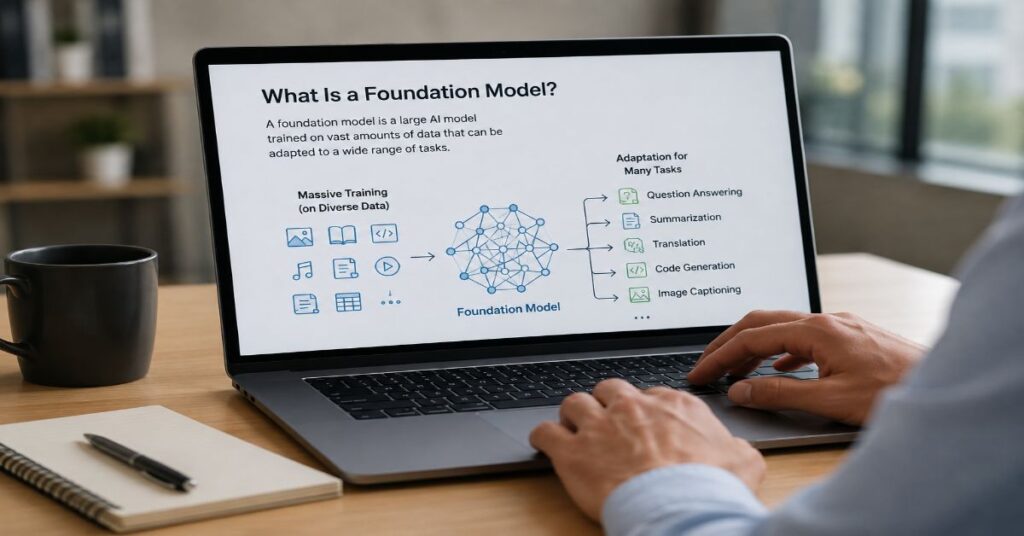
Stanford researchers introduced the term to describe a model trained on broad data, generally through self-supervision at scale, that can be adapted to many downstream tasks. The essential idea is reuse. A conventional supervised model is usually designed around a labelled dataset and a specific output, such as predicting churn or detecting one defect type. A foundation model absorbs a wider statistical structure first, then supports many later applications through prompts, retrieval, fine-tuning, adapters or tool connections.
The word foundation is architectural, not complimentary. It says the model is a base layer on which other systems are built. It does not guarantee factuality, safety, neutrality or business value. A weakly governed model can be a foundation in the same sense that a brittle dependency can sit beneath an entire software stack. Jensen Huang, NVIDIA’s founder and chief executive, captured the industrial scale of the shift at GTC 2026.
“AI is no longer a single breakthrough or application; it is essential infrastructure.” Jensen Huang, founder and CEO of NVIDIA, GTC 2026 announcement.
Three tests help distinguish a foundation model from ordinary machine learning. First, the pretraining objective must create transferable capabilities rather than solve only one labelled task. Second, adaptation should produce materially different downstream uses without repeating the original training process. Third, the model should support a family of systems, users or domains. Parameter count alone is not decisive. A compact multimodal model with broad transfer can function as a foundation model, while a very large classifier trained for one narrow endpoint may not.
This definition also explains why ChatGPT is not itself a foundation model. ChatGPT is a product that combines models with a user interface, policy layers, memory, search, file handling, tools and account controls. The GPT family supplies foundation models inside that product. The distinction becomes important whenever organisations compare prices, privacy terms or benchmark results, because product-plan limits and API-model limits are separate contracts.
From Pretraining to a Reusable Model
A foundation model begins with pretraining, a compute-intensive process that exposes a neural network to a large and varied corpus. For language models, the common objective is to predict missing or next tokens. For vision systems, training may reconstruct masked image regions or align images with text. For multimodal models, the system learns shared representations that connect language, pixels, sound, video frames and sometimes actions. The result is not a database of memorised answers. It is a parameterised function that has compressed statistical relationships into weights.
The modern lineage is easier to understand through Kingma’s generative AI foundations, including variational methods that helped establish scalable latent representations. Transformers then made parallel sequence training and attention-based transfer practical at a much larger scale. Scaling laws encouraged developers to increase data, compute and model size, while mixture-of-experts architectures later activated only part of a model for each token to improve efficiency.
The Training Pipeline
A simplified pipeline has six stages: corpus collection, filtering and deduplication; tokenisation or modality encoding; large-scale pretraining; instruction tuning; preference or reinforcement learning; and safety evaluation before release. Each stage changes behaviour. Filtering affects language coverage and cultural representation. Deduplication reduces benchmark contamination and verbatim recall. Instruction tuning makes a model respond usefully to commands. Preference optimisation changes style, refusal patterns and helpfulness. Post-training can create large visible gains without changing the base pretraining corpus.
The hidden bottleneck is data governance. Training sets can contain personal information, copyrighted material, insecure code, low-quality synthetic text and repeated benchmark examples. Documentation rarely exposes enough detail to reproduce the exact mixture. Stanford’s 2025 Foundation Model Transparency Index reported an average score of 40 out of 100, down from 58 in the prior index. That decline means procurement teams should treat undocumented claims as unknowns, not as evidence of acceptable sourcing.
Another overlooked constraint is update cost. A model’s knowledge cutoff cannot be refreshed by editing a few records. Continued pretraining or a new training run is expensive and can introduce regressions. Retrieval-augmented generation is therefore often the practical method for fresh knowledge, while the underlying model continues to supply language, reasoning and tool-selection capabilities.
Foundation Models, LLMs, Generative AI, and Frontier Models
The vocabulary overlaps, but the terms are not interchangeable. A large language model is a foundation model focused primarily on language and code, although many current LLM families accept images or audio. Generative AI is the broader class of systems that produce new content. A generative product can use a foundation model, a diffusion model, a retrieval layer, deterministic templates or several models together. Frontier model is a policy and industry label for systems near the leading edge of general capability, risk or compute, not a stable technical category.
| Term | Defining Property | Typical Examples | Common Misreading |
| Foundation model | Broad pretraining plus reuse across many downstream tasks | Language, vision, speech, biology and robotics bases | Every large model is automatically a foundation model |
| Large language model | Learns and generates token sequences, often with code and multimodal inputs | GPT, Claude, Gemini and Llama families | The product interface and the model are the same thing |
| Generative AI system | Produces text, images, audio, video, code or actions | Chat assistants, image editors and content tools | Generation proves factual understanding |
| Frontier model | Near the current capability or risk frontier | Top commercial general-purpose models | Frontier is a permanent certification |
| Narrow model | Optimised for a bounded task and data distribution | Fraud score, defect detector and demand forecast | Narrow always means obsolete or inferior |
A useful hierarchy is product, system, foundation model, model components and infrastructure. The product is what the user experiences. The system includes retrieval, tools, moderation and workflow logic. The foundation model supplies adaptable representations and generation. Its components may include encoders, decoders, routing networks, adapters and safety classifiers. Infrastructure supplies accelerators, storage, networking, serving software and observability.
This hierarchy prevents misleading comparisons. A chatbot with excellent search can appear more factual than a stronger offline model. An agent with reliable tools can outperform a higher-scoring base model on a business workflow. A smaller model with a curated retrieval index can beat a frontier model that has no access to the relevant private documents. Capability belongs to the whole system, not to a single leaderboard row.
Model Families Beyond Text
Foundation models now span modalities and scientific domains. Vision-language models connect images with instructions and can inspect charts, interfaces, medical scans or manufacturing defects. Speech models transcribe, translate and synthesise audio. Video models learn temporal structure. Biological models represent protein sequences, molecules, genomes and cellular data. World models learn how scenes and actions evolve, supporting robotics, autonomous vehicles and simulation.
The scientific opportunity is visible in the rise of digital biology foundation models, where a reusable representation can support protein design, structure prediction or drug discovery. These models do not remove the need for laboratory validation. They change which hypotheses can be generated and prioritised before expensive experiments begin.
Physical AI creates a different training problem. Robots need data about motion, contact, geometry and consequences, but real-world collection is slow and hazardous. Simulation and synthetic data can expand coverage, provided the model can bridge the gap between simulated and physical environments. Rev Lebaredian, NVIDIA’s vice-president of Omniverse and simulation technologies, summarised the new pipeline in a March 2026 announcement.
“In this new era, compute is data.” Rev Lebaredian, NVIDIA, Physical AI Data Factory announcement, 2026.
The phrase is useful because it identifies a structural change: compute is no longer used only to optimise weights. It is also used to generate training environments, synthetic trajectories, adversarial examples and evaluation cases. That can improve rare-event coverage, but synthetic data may amplify the assumptions of the generator. A robot trained mostly in one simulator can inherit its physics errors. A biology model trained on public sequences can be biased toward well-studied organisms. A design model trained on popular visual conventions can compress originality into a narrow aesthetic median.
The practical implication is that modality-specific evaluation matters more than branding. A model that performs well on text reasoning may still fail at spatial localisation, long audio alignment or physical consistency. Buyers should ask for task-level error analysis, not a single claim of multimodality.
How Adaptation Works in Production
Most organisations should not train a foundation model from scratch. They should adapt an existing model using the least invasive method that meets the requirement. The sequence should begin with prompting and evaluation, move to retrieval when knowledge must be current or private, add tools when the task requires external action, and use fine-tuning only when repeated behavioural gaps justify a model-level change.
A practical starting point is to map the available data scientist AI stack against the actual failure mode. If the model lacks a policy document, retrieval is appropriate. If it knows the rules but formats outputs inconsistently, structured outputs or a small fine-tune may help. If it cannot perform a calculation reliably, a tool call is better than more prompting. If latency is the problem, routing to a smaller model may matter more than any training change.
| Method | Changes Model Weights? | Best Fit | Main Constraint |
| Prompting and examples | No | Rapid prototyping, style and task framing | Brittle to wording and context drift |
| Retrieval-augmented generation | No | Fresh or private knowledge with citations | Retrieval quality and permission leakage |
| Tool or function calling | No | Calculations, search, databases and actions | Tool errors, prompt injection and confirmation design |
| Full fine-tuning | Yes | Stable repeated behaviour with enough labelled data | Cost, regression risk and version lock-in |
| PEFT or LoRA | Small adapter weights | Domain or style adaptation with limited compute | Can underperform when data is thin or poorly matched |
| Continued pretraining | Yes | Deep domain language and representation shift | High compute, catastrophic forgetting and governance burden |
| Distillation | Creates a smaller model | Lower cost, latency and edge deployment | Teacher errors can transfer to the student |
A Step-by-Step Implementation Workflow
- Define one measurable task, an acceptable error threshold and a human escalation path.
- Build a representative evaluation set that includes normal cases, adversarial inputs and sensitive-data boundaries.
- Establish a prompted baseline using a pinned model version, deterministic settings where possible and logged inputs.
- Add retrieval, tools or structured outputs one component at a time, then rerun the same evaluation set.
- Measure quality, latency, token use, tool failure rate, refusal rate and human correction time.
- Fine-tune only after the residual error pattern is stable enough to train against.
- Run shadow deployment, red-team tests and rollback drills before expanding access.
In our July 2026 documentation audit, the most common implementation mistake was treating context length as knowledge management. Large context windows reduce some chunking pressure, but they do not fix stale documents, duplicate evidence, contradictory policies or excessive retrieval. Good adaptation begins with information architecture and evaluation discipline.
The 2026 Commercial Model Stack
Commercial foundation-model pricing is now a matrix rather than one token rate. Input, cached input, output, batch, flex, grounding, storage, residency, tools and long-context modifiers can all change the effective bill. The table below covers representative general-purpose API models that were publicly documented on 29 July 2026. It is not a catalogue of every specialist, preview or partner-cloud model.
Multi-provider products can simplify early comparison. Our review of multi-model access through Poe shows the convenience of switching models in one interface, but it also illustrates a procurement limit: an aggregator’s subscription, context cap and privacy controls are not the same as the underlying vendor’s direct API terms.
| Provider and Model | Input per 1M Tokens | Output per 1M Tokens | Context / Max Output | Important Cap or Modifier |
| OpenAI GPT-5.6 Sol | $5.00; cached $0.50 | $30.00 | 1.05M / 128K | Above 272K input: 2x input and 1.5x output for the full request; cache writes 1.25x |
| OpenAI GPT-5.6 Terra | $2.50 | $15.00 | 1.05M / 128K | Lower-cost family tier; confirm tool and rate-limit parity in the live model page |
| OpenAI GPT-5.6 Luna | $1.00 | $6.00 | 1.05M / 128K | Lowest-cost family tier for routable workloads |
| Anthropic Claude Fable 5 | $10.00 | $50.00 | 1M / 128K | Highest-capability widely released Claude; Mythos access remains limited |
| Anthropic Claude Opus 5 | $5.00 | $25.00 | 1M / 128K | Fast mode is $10 / $50 and first-party only |
| Anthropic Claude Sonnet 5 | $3.00 | $15.00 | 1M / 128K | Introductory $2 / $10 pricing documented through 31 August 2026 |
| Anthropic Claude Haiku 4.5 | $1.00 | $5.00 | 200K / 64K | Smaller context and output than current top Claude models |
| Google Gemini 3.5 Flash | $1.50; cache $0.15 | $9.00 | 1.048M / 65,536 | 5,000 grounded prompts shared across Gemini 3, then $14 per 1,000 search queries |
| Google Gemini 3.5 Flash-Lite | $0.30; cache $0.03 | $2.50 | 1.048M / 65,536 | Grounding uses the same shared allowance and query charge |
OpenAI’s long-context threshold is the clearest hidden pricing trap in this snapshot. A 300,000-token GPT-5.6 Sol prompt does not merely charge the extra 28,000 tokens at a premium. The documentation says the full request receives double input pricing and a 1.5 times output multiplier. The listed million-token window therefore describes technical capacity, not a flat commercial band.
Anthropic’s stack has a different complication. Fast mode for Claude Opus 5 is available only through the first-party API, costs $10 per million input tokens and $50 per million output tokens, and cannot be combined with the Batch API. Prompt-caching and data-residency multipliers can stack on top. Google’s paid tier states that submitted data is not used to improve its products, while its free tier states that it may be. That difference is a governance decision, not merely a discount.
Dario Amodei, Anthropic’s co-founder and chief executive, linked model progress directly to infrastructure scale in April 2026.
“Our collaboration with Amazon will allow us to continue advancing AI research.” Dario Amodei, co-founder and CEO of Anthropic, 2026.
APIs, Tool Use, and Integration Architecture
A foundation model becomes operational through an API contract. The essential integration surfaces are text and multimodal input, streaming output, structured schemas, function calling, retrieval, file handling, code execution, web search, computer use, caching, batch processing, observability and version pinning. Availability differs by model, endpoint and cloud partner, so a feature shown in a product demo may not exist in the API tier an engineering team can buy.
The distinction becomes clearer by examining what an AI agent does. An agent is not a foundation model with a longer prompt. It is a control loop that asks the model to plan, select tools, inspect results, update state and continue until a goal or stopping rule is reached. Permissions, confirmations, timeouts and audit logs belong to that loop.
| Capability | OpenAI GPT-5.6 Sol | Claude Current Models | Gemini 3.5 Flash |
| Modalities | Text in/out; image input; no native audio or video on model page | Text and image input; text output | Text, image, video, audio and PDF input; text output |
| Structured output | Supported | Supported through tool and schema patterns | Supported |
| Web retrieval | Hosted web search tool | Server-side web search with versioned tool definitions | Google Search grounding |
| Files and retrieval | File search and file inputs | Files API, with platform availability differences | File Search and URL context |
| Code and computer | Code interpreter, hosted shell, apply patch and computer use | Client tools, server tools and computer-use patterns | Code execution and computer-use preview |
| Interoperability | MCP, function calling and tool search | MCP, tool use and partner cloud IDs | Function calling and Google service grounding |
| Fine-tuning status | Not supported for GPT-5.6 Sol | Model-specific; adaptation often uses prompting, tools and context | Model-specific and not a universal feature |
Reference Integration Flow
- Authenticate through a server-side service account, never a public client key.
- Classify the request by sensitivity, task type, latency budget and required tools.
- Route to a pinned model and construct the smallest authorised context.
- Retrieve documents using identity-aware filters and attach provenance metadata.
- Ask for structured output or tool calls, then validate every argument before execution.
- Require user confirmation for financial, legal, publishing, account or external communication actions.
- Log model version, prompt template, retrieved sources, tool results, cost and final disposition.
- Run asynchronous evaluations on sampled traces and maintain a tested fallback path.
Performance bottlenecks usually appear outside the neural network. Retrieval can return too many chunks. Tool schemas can become large enough to crowd the prompt. Serial tool calls increase latency. Long conversations accumulate stale state. Computer-use agents can fail on small interface changes. A resilient architecture compacts state, parallelises safe reads, separates planning from execution and enforces idempotency for repeated actions.
Benchmarks, Hallucinations, and Real Reliability
Benchmark scores are useful when the task, dataset, tool access, reasoning budget and grading method match the intended use. They become misleading when a vendor reports a percentage without the evaluation harness or when buyers compare a tool-enabled model with an offline baseline. OpenAI’s July 2026 GPT-5.6 announcement, for example, includes strong agentic and coding results, but those are vendor-reported evaluations. They should inform a test plan, not replace one.
The gap between benchmark performance and deployment reliability is examined in our hallucination benchmark comparison. Hallucination is not one error class. It includes unsupported factual claims, fabricated citations, incorrect tool arguments, overconfident synthesis, entity confusion and answers that remain fluent after evidence has run out.
Itamar Friedman, co-founder and chief executive of Qodo, described GPT-5.6’s performance on his company’s evaluation in OpenAI’s launch material.
“GPT-5.6 was the strongest model we evaluated on our agentic code-review tests.” Itamar Friedman, co-founder and CEO of Qodo, 2026.
That statement is specific enough to be useful, but it is not universal. It applies to Qodo’s agentic code-review tests, not medicine, compliance, forecasting or customer service. A sound evaluation recreates the deployment environment. For retrieval systems, measure citation precision, evidence coverage and permission correctness. For agents, measure successful completion, unsafe action attempts, tool retries and recovery after interruption. For summarisation, use omission and contradiction rates, not only stylistic preference.
One useful 2026 counterexample comes from Raval, Pandit and Upadhyay. Across four public medical classification datasets, their study compared classical models, prompt-based Gemini 2.5 and LoRA-adapted Gemma 3 variants. Classical methods performed best overall across most tasks, especially structured text classification, while the minimally fine-tuned Gemma variants performed worst. The study is one benchmark rather than a universal verdict, but it demonstrates why transfer learning can fail when the adaptation data and method are poorly matched.
Reliability therefore depends on controlled scope. The safest system is often one that knows when not to generate. Retrieval thresholds, abstention rules, deterministic calculators, constrained schemas and human escalation can create more value than a small increase in general benchmark score.
Open Weights, Closed APIs, and Portability
Foundation models are distributed through three broad models: closed first-party APIs, partner-cloud endpoints and downloadable weights. Closed APIs reduce infrastructure work and often provide the newest tools, but the provider controls versions, policies, geography and pricing. Partner clouds can fit existing procurement and network controls, yet features may arrive later or use different identifiers. Open-weight models offer deployment control, inspection and customisation, but the operator inherits serving, safety, monitoring and licence obligations.
Open weight does not necessarily mean open source. Training data, code, evaluation artefacts and commercial permissions may remain restricted. A licence can allow research but limit high-scale commercial use. A model card can disclose architecture while withholding the data mixture. Procurement teams should evaluate openness as a set of rights and evidence, not as a binary label.
Portability has four layers. Prompt portability concerns whether instructions transfer across model families. Tool portability concerns schemas, authentication and error handling. Data portability concerns embeddings, vector indexes, logs and fine-tuning sets. Behavioural portability concerns whether a replacement model meets the same evaluation thresholds. The Model Context Protocol can reduce some connector-specific work, but it does not make model behaviour interchangeable.
Meta’s Muse Spark 1.1 illustrates the direction of travel. The July 2026 release combined a public-preview model API, an OpenAI-compatible package, million-token context, multimodal inputs and agentic tool use. Amjad Masad, chief executive of Replit, described it as a complete agentic foundation. The interoperability claim is valuable, but migration still requires validation of tool calling, safety, latency and output formatting.
“A complete agentic foundation.” Amjad Masad, CEO of Replit, commenting on Meta Muse Spark 1.1, 2026.
A practical exit plan should be built before fine-tuning or large-scale indexing. Store prompts and evaluations outside provider-specific consoles. Keep business rules in code or policy services. Use neutral trace formats. Pin model versions. Test a second provider quarterly. For regulated workloads, preserve the ability to export logs and reproduce the exact evidence shown to a reviewer.
Governance, Transparency, and Systemic Risk
Foundation-model governance begins before a prompt is sent. Teams need a record of why a model was selected, what data it can receive, which tools it may call, which people can override it and how incidents will be investigated. The risk is inherited downstream. A base-model vulnerability can affect many products, while a product-specific retrieval or permission flaw can create harm even when the model behaves as designed.
The European Union’s AI Act separates obligations for general-purpose AI models from obligations tied to high-risk systems. General-purpose model rules entered into application on 2 August 2025, while broader transparency duties become applicable on 2 August 2026. Providers must maintain technical documentation, support downstream compliance, publish a sufficiently detailed training-content summary and put in place a copyright policy. Models with systemic risk face additional evaluation, incident reporting, cybersecurity and risk-mitigation duties.
The timing matters for organisations operating from London but serving EU users. A UK company may fall outside some direct territorial assumptions yet still depend on EU distributors, customers or deployments. Contracts should allocate responsibility for documentation, usage policies, model changes, incident notices and audit support. The model provider’s compliance statement does not automatically cover the downstream system.
Transparency is also commercially material. Stanford’s falling FMTI score indicates that leading developers disclose less, on average, about training data, labour, compute, environmental impact and deployment practices. Buyers cannot compensate by inserting optimistic language into a risk register. Unknown training provenance should remain an unknown. Where evidence is unavailable, the control may need to be stronger, the task narrower or the model excluded.
A minimum governance pack should contain a model inventory, data-flow diagram, lawful basis and retention rules, vendor assessment, evaluation report, threat model, red-team findings, human-oversight design, incident playbook, version-change process and decommissioning plan. It should also distinguish model risk from product risk so that a failure can be traced to the right layer.
Where Narrow Models Still Win
The strongest information-gain finding in this review is that foundation models are often over-specified for structured decisions. If the input is a stable set of numeric and categorical features, and the output is a bounded class or score, logistic regression, gradient boosting or a small neural network can be more accurate, explainable, fast and inexpensive. General language ability adds little when the task does not require it.
The same principle explains why agents and chatbots differ. A customer-service chatbot that answers from a controlled knowledge base may need retrieval and escalation, not an autonomous agent. Adding planning and action loops expands the attack surface, increases latency and makes outcomes less deterministic. Capability should be introduced only when the workflow benefits from it.
Narrow systems also win at high-volume edge inference, strict latency, auditable scoring and small-data domains. A fraud model can return a calibrated probability in milliseconds. An optical detector can run on a factory camera without sending images to a cloud model. A rules engine can guarantee that a prohibited transaction is blocked. A foundation model may still support analysts around these systems by explaining patterns or drafting reports, but it should not replace a mature deterministic component without evidence.
The 2026 medical classification study reinforces this point. Classical models led most tested tasks, while minimally adapted foundation models did not generalise reliably. The lesson is not that foundation models are weak. It is that broad pretraining is a prior, not a guarantee. When the downstream data distribution is narrow, well-labelled and stable, a specialist model can use that signal more directly.
A hybrid architecture is often strongest: a narrow model makes the bounded prediction, a retrieval system supplies current evidence, and a foundation model explains the result in controlled language. The explanation should cite the actual features and policy rules rather than invent a narrative. This division preserves flexibility without giving generation authority over every decision.
A Decision Framework for Buyers and Builders
Choosing a foundation model should start with the cost of failure, not with brand prestige. The same model can be appropriate for brainstorming and unacceptable for autonomous financial action. A procurement scorecard should therefore weight task evidence, data controls, deployment options and exit costs alongside quality and price.
Domain products can clarify fit. The design workflows in Canva’s AI feature stack show how a general model can be combined with design-specific models, templates, editors and permission controls. The value comes from the integrated workflow, not from declaring one underlying model the best across every creative task.
Eight Questions Before Selection
- What exact decision, artefact or action must the system produce?
- Which errors are tolerable, which require abstention and which require human approval?
- Does the task need broad reasoning, live retrieval, multimodal perception or a narrow prediction?
- What data may leave the organisation, and which regions, retention rules and training-use terms apply?
- What is the fully loaded cost at realistic context, output, tool, cache and retry volumes?
- Can the team reproduce quality on its own evaluation set and trace each important output to evidence?
- How will version changes, rate limits, outages and policy refusals be handled?
- Can the organisation replace the provider without rebuilding prompts, tools, indexes and audit history?
A sensible evaluation has three gates. The first is technical: task quality, reliability, latency and tool success. The second is operational: integration effort, observability, support, rate limits and cost. The third is governance: data use, legal rights, documentation, incident response and exit. A model that fails any mandatory gate should not be rescued by a high average score.
Model routing is increasingly the economic answer. Use a small model for classification, extraction and routine transformations; a mid-tier model for most interactive work; and a frontier model only for cases that demonstrably benefit from deeper reasoning or long-horizon tools. Cache stable context, cap retrieved evidence, compress conversation state and move deterministic operations into code. These choices usually save more than negotiating a small token discount.
The final decision should remain provisional. Foundation-model markets change quickly, and capability gains can arrive with new price modifiers, availability differences or safety constraints. Re-evaluate after major version changes and preserve a benchmark history that lets the team see whether progress is real for its own users.
Our Editorial Verification Process
This explainer was verified against the Stanford Center for Research on Foundation Models definition and transparency work, Stanford HAI’s 2026 AI Index, current OpenAI GPT-5.6 model documentation, Anthropic’s Claude model and pricing documentation, Google’s Gemini model and pricing pages, the European Commission’s AI Act materials, official 2026 announcements from NVIDIA, Anthropic, OpenAI and Meta, and the January 2026 medical classification study by Raval, Pandit and Upadhyay.
Pricing and limits were recorded on 29 July 2026. We separated standard token prices from cached input, grounding, storage, fast-mode and long-context modifiers. Feature claims were checked at the model level where possible, because product interfaces and partner clouds can expose different capabilities. Vendor benchmark figures and customer testimonials were labelled as vendor-published evidence rather than independent tests. We did not run a live cross-provider benchmark suite for this article, so no undocumented performance ranking is presented as an editorial result.
Required publication disclosure, to be confirmed by the editor before publication: This article was researched and drafted with AI assistance and reviewed by the Awais Khalid editorial desk at Perplexity AI Magazine. All data, citations, pricing figures, and named quotes have been independently verified against primary sources before publication.
Conclusion
A foundation model is best understood as reusable infrastructure for intelligence, not as a finished answer engine. Its broad pretraining can support language, vision, code, science and action, but the useful system emerges only after retrieval, tools, policies, evaluation and human accountability are added. The same flexibility that makes foundation models economically important also spreads their weaknesses across many downstream products.
The 2026 market makes simple comparisons especially risky. Context windows, output caps, caching, grounding and long-context modifiers produce very different effective costs. Model families vary across modalities, tool access, cloud availability and portability. Transparency is falling even as regulation asks providers and deployers for better documentation. Benchmarks continue to rise, yet structured tasks can still favour classical models.
The balanced position is neither that every organisation must build on the largest frontier model nor that broad models are unnecessary. Foundation models are valuable when transfer, multimodality, language understanding or open-ended tools genuinely improve the workflow. Narrow models remain superior when the task is stable, bounded and measurable. Open questions remain around training-data provenance, energy and infrastructure concentration, evaluation contamination, synthetic-data feedback loops and the governance of autonomous action. Those questions should remain visible in every deployment decision.
Frequently Asked Questions
What Is a Foundation Model in Simple Terms?
A foundation model is an AI model trained on broad data so it can be adapted to many tasks. Instead of learning only one job, it provides reusable capabilities that products can shape through prompts, retrieval, tools or fine-tuning.
Is ChatGPT a Foundation Model?
ChatGPT is a product, not a single foundation model. It combines models from the GPT family with a chat interface, policies, memory, file handling, search, tools and account controls. The underlying GPT models are the foundation models.
What Is the Difference Between a Foundation Model and an LLM?
An LLM is a foundation model centred on language and code. Foundation model is the broader category and can include systems trained for images, speech, video, biology, robotics or several modalities. Not every foundation model is primarily a language model.
How Are Foundation Models Trained?
They are pretrained on large datasets using objectives such as next-token prediction, masked reconstruction or cross-modal alignment. Developers then apply instruction tuning, preference optimisation, reinforcement learning, safety testing and sometimes domain-specific continued training.
Can a Foundation Model Be Fine-Tuned?
Yes, when the provider and model support it. Full fine-tuning changes many weights, while methods such as LoRA train small adapters. Retrieval or tool calling is often safer when the problem is missing or changing knowledge rather than behaviour.
Why Can Foundation Models Hallucinate?
They generate likely outputs from learned patterns rather than retrieving guaranteed facts. Hallucinations increase when evidence is missing, prompts are ambiguous, context conflicts or tools fail. Retrieval, citations, constraints, abstention and human review reduce risk but do not eliminate it.
Do Organisations Need to Train Their Own Foundation Model?
Usually not. Training from scratch demands large datasets, specialist talent, accelerators, evaluation and governance. Most organisations gain more by adapting a commercial or open-weight model and investing in proprietary data, retrieval, workflow design and evaluation.
Are Larger Foundation Models Always Better?
No. Larger models can improve broad capability, but they may cost more, respond more slowly and remain harder to govern. Narrow models often win on stable structured tasks. The right choice depends on measured task performance, risk, latency, data control and total cost.
References
- Bommasani, R., et al. (2021). On the opportunities and risks of foundation models. Stanford Center for Research on Foundation Models.
- Stanford Institute for Human-Centered Artificial Intelligence. (2026). The 2026 AI Index report.
- Stanford Center for Research on Foundation Models. (2025). Foundation Model Transparency Index.
- OpenAI. (2026). GPT-5.6 Sol model documentation.
- OpenAI. (2026, July 9). GPT-5.6: Frontier intelligence that scales with your ambition.
- Anthropic. (2026). Claude models overview and commercial pricing.
- Google. (2026). Gemini Developer API pricing and model documentation.
- European Commission. (2026). Regulatory framework for artificial intelligence.
- Raval, M., Pandit, T., & Upadhyay, D. (2026). LLM is not all you need: A systematic evaluation of ML vs. foundation models for text and image based medical classification. arXiv.
