
The brain of a robot is not a data center. It is a processor constrained by milliwatts of available power, kilobytes of available memory, and milliseconds available for a decision that, in a factory or warehouse or surgical suite, cannot wait for a cloud API response. Running state-of-the-art AI perception and reasoning models on that hardware requires something that scaling a foundation model does not: making the model smaller, faster, and leaner without making it less capable. That is the specific problem Nota AI has spent years solving, and it is why AMD wanted the Seoul-based AI optimisation company inside its robotics partner ecosystem.
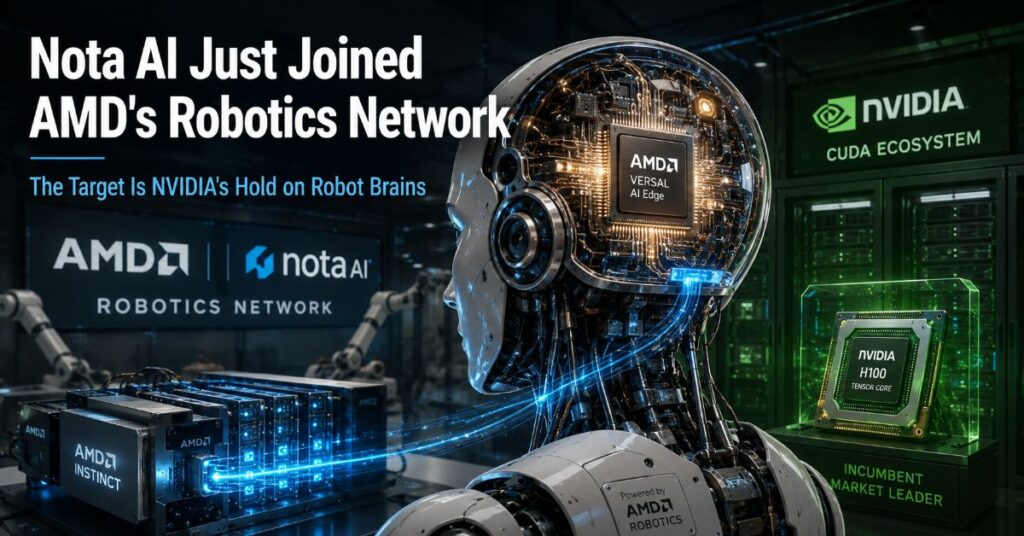
On July 24, 2026, at AMD’s Advancing AI 2026 event at the Moscone Center in San Francisco, Nota AI announced it has officially joined the AMD Robotics Partner Network. The partnership extends Nota AI’s hardware-aware model compression technology into the AMD compute stack for robotics, targeting the class of physical AI workloads — perception, navigation, manipulation, reasoning — that are increasingly required by autonomous industrial, commercial, and humanoid robots but remain computationally demanding relative to what most edge hardware can deliver without optimisation.
Key Developments
- Nota AI, a Seoul-based AI model compression and hardware-aware optimization company, announced on July 24, 2026, that it has joined the AMD Robotics Partner Network at AMD Advancing AI 2026 in San Francisco.
- The AMD Robotics Partner Network is an open ecosystem spanning embedded, edge, and cloud environments using AMD compute, bringing together ODMs, ISVs, sensor providers, and system integrators for end-to-end robotics innovation.
- Nota AI’s integration with AMD platforms is designed to allow autonomous robots to run complex physical AI perception and reasoning models directly on-device, without continuous cloud connectivity, by reducing model size, compute load, and memory usage.
- The announcement coincides with AMD’s debut of the Kria AI System on Module — powered by the Ryzen AI Embedded X100 — a direct competitor to NVIDIA’s Jetson Thor edge AI platform, signalling AMD’s push to own the robotics edge compute ecosystem.
What Was Announced
Nota AI’s official press release via PRNewswire describes the AMD Robotics Partner Network as an open ecosystem enabling partners to build and deploy robotics solutions across embedded, edge, and cloud environments using AMD compute. The network brings together ODMs (original design manufacturers), ISVs (independent software vendors), sensor providers, and system integrators to accelerate end-to-end robotics innovation on an AMD-validated platform. Myungsu Chae, CEO of Nota AI, framed the problem the partnership addresses: ‘For physical AI to deliver real value in industrial environments, AI models must be optimised for the compute and memory constraints of the robots on which they operate.’ Nota AI plans to optimise model size, computational workload, and memory usage specifically for AMD processors used in robotics applications, enabling robots to run complex inference tasks locally rather than offloading to cloud infrastructure.
The Broader AMD Advancing AI 2026 Context
The Nota AI partnership was one of dozens of announcements made across AMD’s two-day Advancing AI 2026 event, which attracted developers, customers, enterprise leaders, and partners to the Moscone Center on July 22–23. The flagship announcement from the event was AMD Helios, described as the world’s most powerful AI rack and AMD’s first rack-scale AI solution. AMD Chair and CEO Dr. Lisa Su delivered the event keynote, covering AMD’s ‘strongest portfolio in its history’ and previewing the roadmap through 2030. The robotics-specific element at AMD Advancing AI 2026 was substantial: AMD debuted the Kria AI System on Module, a new embedded AI compute product powered by the Ryzen AI Embedded X100 processor. The Kria SOM is explicitly positioned as a competitor to NVIDIA’s Jetson Thor — the dominant edge AI computing platform for robotics applications — which NVIDIA has used to build its own robotics ecosystem. ServeTheHome’s live keynote coverage noted that AMD described its approach as ‘Kria for the brain, Versal for the spine,’ mapping out a two-chip architecture for robot intelligence and motion control that competes directly with NVIDIA’s end-to-end Jetson-based robotics stack.
What Nota AI Does
Hardware-Aware Model Compression
Nota AI’s core technology is model compression and hardware-aware optimisation: techniques that reduce the size of AI models — the number of parameters, the precision of numerical representation, and the computational operations per inference — while preserving the accuracy and capability of the original model. The underlying methods include quantisation (reducing parameter numerical precision from 32-bit or 16-bit floating point to 8-bit integer or lower), pruning (removing parameters with low contribution to model outputs), and knowledge distillation (training a smaller model to replicate the outputs of a larger one). What distinguishes hardware-aware optimisation from generic model compression is the additional step of calibrating these techniques to the specific characteristics of a target processor: different chips have different ratios of memory bandwidth to compute throughput, different cache sizes, and different instruction sets that affect which compression strategies produce the largest practical speedup on that hardware. A model compression approach that produces the best benchmark results on a GPU may not produce the best practical performance on an ARM-based edge processor or an FPGA-adjacent embedded platform like AMD’s Kria.
Why Robots Specifically
Robots represent the category of physical AI deployment with the most acute hardware constraint. A data center inference server can dedicate an entire high-end GPU to a single model at significant power draw. A mobile robot in a warehouse operates on a battery with a budget measured in watts, not kilowatts, and must run multiple perception and control models simultaneously — object detection, depth estimation, path planning, manipulation planning, safety monitoring — within that total budget. A surgical robot must make sub-millisecond control decisions with zero tolerance for the latency of a cloud API round-trip. A humanoid robot in a factory must process camera, LIDAR, touch, and force sensor data and produce motion control commands in real time on hardware that fits inside a human-scale enclosure. Each of these constraints is fundamentally different from the requirements of cloud inference, and the model optimisation approaches required are correspondingly different.
The Physical AI Market: Why AMD Is Building a Partner Ecosystem
AMD’s investment in a dedicated Robotics Partner Network reflects a competitive calculation about where AI hardware revenue is going over the next five years. NVIDIA has built a commanding position in physical AI and robotics through its Jetson edge AI product line, its Isaac robotics platform, the GR00T robot foundation model, and an extensive ecosystem of software tools and partners built around those products. Competing with NVIDIA’s robotics position requires not just better hardware specifications — which AMD can argue for in some configurations — but an equivalent ecosystem of software, optimisation tools, and validated partner solutions that robot builders can use to create production systems without starting from scratch. Nota AI’s model compression technology is exactly the kind of enabling layer that robot hardware is useless without: an AMD Kria processor with excellent raw performance specifications still requires someone to make the AI models run efficiently on it. The Robotics Partner Network is AMD’s mechanism for building that enabling layer as an ecosystem rather than attempting to develop it entirely in-house. The context of AMD’s broader competition with NVIDIA across the AI infrastructure stack, documented in our analysis of NVIDIA’s South Korea AI infrastructure deals, extends directly into the edge AI and robotics layer: every domain where NVIDIA has built an ecosystem advantage is a domain where AMD needs to build or acquire equivalent capability, and the robotics edge is one of the highest-growth segments in that competition.
What Nota AI Brings to the Partnership
Nota AI’s specific contribution to the AMD robotics ecosystem is the ability to take a state-of-the-art perception or reasoning model — the kind of model trained in a cloud environment on large GPU clusters using full floating-point precision — and produce an optimised version that can run on AMD’s Kria, Versal, or Ryzen AI Embedded processors at a fraction of the original compute cost. That capability is what converts a powerful foundation model into a deployable robot component. Without optimisation, most current physical AI models are too large and too computationally expensive to run on the processor classes that fit inside a robot chassis at an acceptable power budget. With hardware-aware optimisation calibrated to AMD’s specific processor characteristics, the same model can run in real time on the robot itself. The company currently operates in markets including video monitoring and edge AI deployment, and the AMD partnership extends those capabilities into the robotics application layer.
The Edge vs Cloud Debate for Physical AI
The question of whether robots should process AI workloads at the edge or in the cloud is not settled, but it is shifting meaningfully toward edge-first architectures for a specific class of applications. Consumer robots and lightweight industrial automation systems can tolerate the latency and connectivity dependency of cloud inference for some tasks. Safety-critical applications — a robot operating near humans, a surgical assistant making force-control decisions, an autonomous vehicle navigating a dynamic environment — cannot. The regulatory landscape is also pushing toward on-device processing: EU regulations on autonomous systems and robotics increasingly require that critical decision-making functions operate without dependence on external connectivity, both for safety reasons and for data sovereignty reasons related to what sensor data leaves the device. The combination of regulatory pressure, latency requirements, and the availability of model optimisation tools like Nota AI’s is moving the physical AI architecture debate toward embedded inference for the highest-stakes applications. That is the specific deployment model the Nota AI-AMD partnership is built for, and it sits within the broader trend of agentic AI operating on edge and mobile devices that has been building across consumer and industrial categories simultaneously.
What Happens Next
Nota AI has not specified a product release timeline for AMD-optimised model compression tools, but the AMD Advancing AI 2026 announcement establishes the partnership structure and the technical integration target. The practical next step is the release of Nota AI’s NetsPresso or equivalent compression toolchain with AMD platform support, allowing robot developers building on Kria or Ryzen AI Embedded to use Nota AI’s optimisation pipeline as a standard step in their model deployment workflow. For AMD’s Kria SOM specifically, production availability timelines following the AMD Advancing AI 2026 debut will determine how quickly the ecosystem around it — including Nota AI’s compression tools — translates into shipping robotic systems. AMD has confirmed that the Kria dev kit will be available alongside the SOM itself, following the same pattern NVIDIA has used to build developer adoption of its Jetson platform.
Why It Matters
The Nota AI-AMD partnership matters because it is a building block in AMD’s attempt to create a viable alternative to NVIDIA’s dominance in robotics edge AI. NVIDIA’s Jetson platform and its associated ecosystem currently represent the path of least resistance for most robot developers building physical AI systems — the hardware is well-understood, the software tools exist, the community is large, and the model library is pre-optimised. For AMD to compete in this market, it needs each of these dimensions, and the AMD Robotics Partner Network is the mechanism through which it is assembling them. Nota AI’s model compression expertise is one piece; the Kria hardware is another; the broader partner ecosystem of sensor providers, system integrators, and ODMs brings the third. Whether that assembly produces a robotics compute ecosystem that convinces production robot developers to choose AMD over NVIDIA is a question that will play out over the next two to three product cycles — beginning with the commercial availability of Kria SOM systems and the Nota AI tools that optimise models for them.
Sources
Nota AI official press release via PRNewswire, July 24, 2026. AMD Advancing AI 2026 Newsroom press kit (newsroom.amd.com), July 22-23, 2026. AMD EventBrowse 2026 event overview. ServeTheHome AMD Advancing AI 2026 keynote live coverage, July 23, 2026.
