
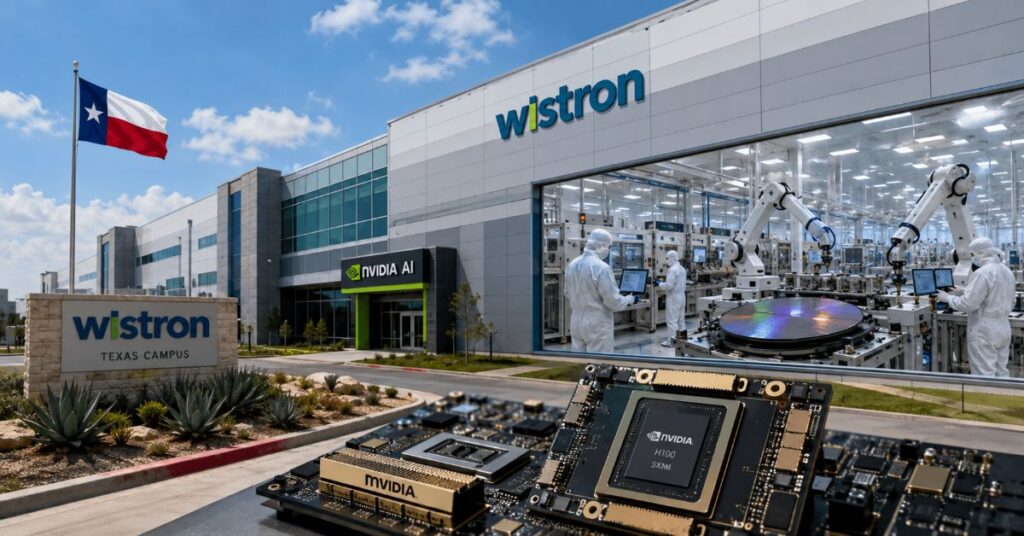
Taiwanese contract manufacturer Wistron has opened its first U.S. factory, a $700 million facility in Fort Worth, Texas, where Nvidia’s most advanced AI chip has now entered mass production on American soil for the first time.
Key Developments
- Wistron opened its $700 million D1 AI smart facility in Fort Worth, Texas, on July 21, 2026, its first manufacturing site in the United States
- The plant is the first location where Nvidia’s GB300 Grace Blackwell Ultra Superchip has been mass-produced on American soil
- Wistron shares jumped 9.7% after the opening, with the facility scaling toward tens of thousands of computing boards per month
- D1 will later add production of Nvidia’s next-generation Vera Rubin Superchip, alongside more than 500 jobs already created on site
What Happened
Wistron officially inaugurated its D1 AI smart facility in Fort Worth on July 21, 2026, with Wistron Chairman Simon Lin and Nvidia founder and CEO Jensen Huang leading the opening ceremony. The 324,000-square-foot plant is the first site where the GB300 Grace Blackwell Ultra Superchip — the current flagship of Nvidia’s AI data center lineup — has been built and mass-produced inside the United States.
Investors responded quickly: Wistron’s Taipei-listed shares climbed 9.7% the day after the opening, a sign of confidence in the company’s foothold within Nvidia’s expanding U.S. manufacturing base. Wistron says the D1 facility is scaling up this year to produce tens of thousands of AI computing boards per month.
The facility has already created more than 500 jobs in the Fort Worth area, with Nvidia projecting headcount will reach roughly 1,000 by the end of 2026. Local officials have pointed to the plant as validation of Texas’s push to position itself as a hub for advanced electronics manufacturing, following years of courting semiconductor and hardware companies with tax incentives and expedited permitting.
The opening ceremony itself doubled as a showcase moment for Nvidia, with Huang using the event to physically sign the first GB300 board produced on U.S. soil — a symbolic gesture the company has used at other manufacturing milestones to underline the shift from AI as a purely software story to one increasingly measured in factories, jobs and capital investment.
How the Plant Works
D1 currently runs two manufacturing cells. One assembles and tests the GB300 Grace Blackwell Ultra Superchip, a platform Huang has described as the core of what he called the most powerful AI supercomputer in the world. The second cell is being prepared to build Nvidia’s next-generation Vera Rubin Superchip, the intended successor to Blackwell — a transition the site has been tracking alongside
the broader push toward Nvidia’s Vera Rubin production ramp that chipmakers have been racing to complete this year.
Production at D1 centers on what the industry calls L6-level assembly and testing — integrating chip modules, memory, networking and cooling components into complete server boards ready for installation in data centers. Those boards are built to plug into Nvidia’s DSX infrastructure, a reference architecture the company uses to standardize how AI factories are designed and operated at scale.
Before construction began, Wistron modeled the entire facility as a digital twin using Nvidia’s own Omniverse simulation platform, incorporating the Nemotron and Cosmos AI models alongside the Metropolis library. Engineers used the simulation to test assembly-line layouts and train workers virtually before any physical equipment went live — a detail Nvidia has highlighted as evidence its own AI tools helped design the factory that now builds its chips.
That reliance on digital-twin planning also reflects how much more complex GB300 assembly is compared with earlier generations of AI hardware. Huang has described a single GB300 system as containing roughly one-and-a-half million individual parts, weighing about two tons, and costing around four million dollars — figures that explain why standing up a domestic assembly line from scratch, rather than simply importing finished boards, has taken years of coordinated planning between Nvidia and its manufacturing partners.
Ramping a facility like D1 from a standing start to tens of thousands of boards a month is less a traditional factory ramp than a logistics challenge running against a hard deadline, since every board depends on components arriving from multiple countries in the right sequence and volume.
Backstory
The Fort Worth plant fits into a broader onshoring push that has gathered pace since 2025, when Nvidia committed roughly half a trillion dollars toward American manufacturing and AI infrastructure investment over four years. Nvidia’s manufacturing partners, including Wistron, TSMC and Foxconn, have expanded operations across dozens of U.S. states as demand for AI computing hardware has accelerated.
That demand has also strained the power grid feeding many of these new sites, a pressure this publication has tracked in the growing data center energy debate, and one that regional utilities are still working to accommodate.
Wistron itself is one of Taiwan’s largest electronics contract manufacturers, historically known for building laptops and enterprise hardware before pivoting toward AI server production in recent years. Fort Worth marks the company’s first manufacturing base on U.S. soil — part of a wider trend of Taiwanese electronics firms relocating parts of their production closer to American customers.
The move also comes as Taiwanese manufacturers face pressure to diversify their production footprint away from a region where cross-strait tensions periodically raise concerns about supply-chain resilience. Building a flagship AI hardware plant in Texas gives Wistron a hedge against those risks while also putting it physically closer to the U.S. cloud providers and enterprises that are Nvidia’s largest customers for GB300-based systems.
Across the country, Nvidia’s manufacturing partner network has now grown to cover 43 states, according to the company, with Wistron, TSMC and Foxconn each running distinct pieces of the AI hardware supply chain domestically. Nvidia and its partners project that this expanded footprint will add roughly $485 billion to U.S. GDP in 2026 alone, underscoring how central chip manufacturing has become to the broader economic case for the AI boom.
Reactions
Wistron Chairman Simon Lin called the Fort Worth operation “not typical manufacturing,” describing it instead as new, comprehensive and high-tech, and said the site would become one of the company’s most important locations as it builds out AI infrastructure in the U.S. over the next several years.
Jensen Huang used the ceremony to sign the first GB300 Grace Blackwell Ultra Superchip produced at the site and framed the plant as evidence that the AI buildout has become a physical undertaking as much as a digital one, telling attendees that electricity comes in and tokens get generated inside these factories.
Nvidia has noted that D1 currently accounts for only around 5% of its total GB300 manufacturing output, according to Taiwan’s Economic Daily News — a reminder of how much additional capacity the company still believes it needs to meet demand that Huang said is doubling every year.
Financial analysts covering Wistron framed the stock’s jump less as a reaction to Fort Worth’s current output, which remains a small share of total production, and more as a signal that Wistron has secured a durable, long-term role inside Nvidia’s U.S. supply chain — one that should grow in importance as D1 and its planned successor come online.
The Dispute
Not every observer reads the Fort Worth opening as a clean win for U.S. manufacturing. Some industry analysts note that while final assembly and testing now happen domestically, many of the underlying components — including the advanced logic chips themselves, produced by TSMC in Taiwan — still originate overseas, meaning the plant onshores a slice of the value chain rather than the full production process. Others point out that D1 represents just a small fraction of Nvidia’s global GB300 output, raising questions about how quickly, and how completely, the company’s manufacturing base can genuinely shift to the U.S. even as announcements like this one generate headlines and stock gains.
What Happens Next
Wistron has already signaled its next step: a second facility, D2, is planned with roughly twice the production capacity of D1, according to Lin. That expansion would deepen the company’s footprint in Texas as Nvidia pushes its manufacturing partners to keep pace with surging AI infrastructure orders, a dynamic also visible in Nvidia’s recent multi-billion-dollar cloud partnerships. D1 itself is expected to begin producing the Vera Rubin Superchip within the coming quarters as that platform moves toward full-scale release.
The buildout also mirrors moves elsewhere in Nvidia’s supply chain, including its expanding chip partnerships across South Korea, underscoring how much of the current AI hardware race is now playing out through physical plants rather than software releases alone.
Why It Matters
For the AI industry, the Fort Worth opening is a concrete marker of how far the buildout of AI computing power has moved from cloud data centers into the physical world of factories, supply chains and skilled labor. It also signals how central Nvidia’s hardware roadmap has become to U.S. industrial policy, with chip production now treated as critical infrastructure worth hundreds of millions of dollars in private investment and hundreds of new jobs in a single facility. Whether this marks a durable shift in where AI hardware gets built, or a symbolic first step in a much longer supply-chain transition, will depend on how quickly plants like D1 — and the planned D2 that follows it — can scale toward a meaningful share of global output.
Sources
1. NVIDIA Blog — Built in Fort Worth: Wistron Opens Advanced Manufacturing Plant
2. CNBC — Wistron shares surge after opening Texas plant for Nvidia AI servers
