
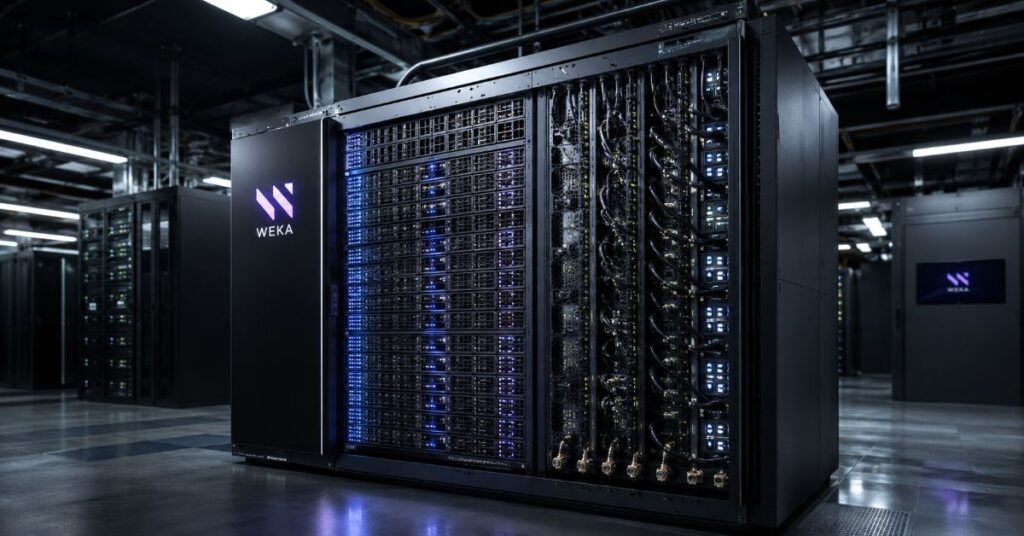
The economics of AI inference have been shifting since the training era ended. When building and training a frontier model was the defining infrastructure challenge, the metrics that mattered were GPU flops, training throughput, and checkpoint storage. Now that production inference — serving hundreds of billions of tokens per day to live users, AI agents, and retrieval systems — is the dominant workload, the metrics that matter are different: tokens per rack, tokens per watt, cost per inference at sustained load, and the storage bandwidth available to feed model weights to GPUs fast enough that those GPUs are not waiting. WEKA’s WEKApod 3, announced July 22, 2026, is designed specifically for that scorecard. It is the first single-rack storage system to deliver more than one exabyte of effective capacity, and its performance density numbers are unlike anything previously announced in the AI infrastructure market.
WEKA, the AI data and memory infrastructure company headquartered in Campbell, California, unveiled three new WEKApod configurations simultaneously: Nitro, Prime, and Prime Max. All three are purpose-built hardware platforms designed to run WEKA’s NeuralMesh 6 software, also announced today, in a combined hardware-software system that WEKA is positioning as an AI inference infrastructure platform rather than a storage appliance.
Key Developments
- WEKA unveiled WEKApod Nitro, Prime, and Prime Max on July 22, 2026, the third generation of its AI storage appliances, purpose-built for long-context, agentic, and retrieval-augmented inference workloads running on NeuralMesh 6 software.
- WEKApod Prime Max delivers 1.1 exabytes of effective capacity in a single 56U rack using Micron 245.76 TB 6600 ION drives, making it the first single-rack system to break the exabyte barrier.
- The WEKApod 3 generation achieves 267% higher effective capacity density and 114% higher performance density than market alternatives in a single rack, using a PCIe Gen 6 internal fabric and a cable-based, backplane-free drive interconnect.
- WEKApod Nitro, Prime, and Prime Max are available to order now for delivery in Fall 2026 with NeuralMesh 6 pre-installed. NeuralMesh 6
What WEKA Announced
The official WEKA press release via PRNewswire describes the WEKApod 3 generation as achieving 267 percent higher effective capacity density and 114 percent higher performance density than market alternatives in a single rack. The headline figure is the WEKApod Prime Max: in a single 56U rack, it delivers 1.1 exabytes of effective capacity, achieved by combining NeuralMesh’s high-performance object storage and always-on data reduction with Micron’s 245.76 TB 6600 ION drives. That makes it the first single-rack storage system to break the exabyte barrier. WEKApod Nitro, the highest-performance configuration in the family, delivers 15.8 petabytes in a 2U footprint, preserving the maximum amount of rack space for compute while delivering the bandwidth that inference GPU clusters require. WEKApod Prime sits between the two, targeting the midpoint between density and footprint for inference deployments that need both. All three are available to order today through WEKA’s worldwide distributor and VAR network, with delivery beginning Fall 2026 and NeuralMesh 6 pre-installed.
The Technology: Why This Is an Inference Problem, Not a Storage Problem
The GPU Starvation Problem
The dominant failure mode in AI inference infrastructure today is not model accuracy or software quality. It is GPU utilisation. A cluster of expensive, power-hungry GPU accelerators that spends a significant fraction of its time waiting for data — waiting for model weights to arrive from storage, waiting for KV cache to be read, waiting for context data to be retrieved from a vector database — produces tokens slowly and at high cost per token. The storage layer that feeds a GPU inference cluster is the bottleneck. Traditional enterprise storage systems, even high-performance ones, were not designed for the access patterns that inference workloads generate: extremely high throughput at low latency for large, irregular reads from model checkpoints and KV caches, combined with extremely dense storage requirements as model parameter counts and context windows expand. WEKApod 3 is WEKA’s answer to that combination of requirements.
The PCIe Gen 6 Internal Fabric
At the hardware level, WEKApod 3 uses a PCIe Generation 6 internal fabric — the same generation of interconnect used inside NVIDIA’s most advanced GPU servers — combined with a cable-based, backplane-free drive interconnect design that eliminates the signal integrity constraints that backplane-based systems face as drive counts increase. NVIDIA ConnectX Supernics provide the high-speed network connectivity that allows WEKApod units to present a unified storage namespace to the GPU cluster they serve. The result is a system that can deliver storage bandwidth at rates that keep modern GPU inference clusters consistently busy rather than waiting for data.
NeuralMesh 6: The Software Layer
WEKApod 3 is designed to run NeuralMesh 6, WEKA’s updated software platform also announced July 22. NeuralMesh 6 introduces native multi-tenancy — allowing multiple AI cloud customers or enterprise workloads to share the same physical storage infrastructure with full data isolation — alongside a combined file-and-object protocol stack, metadata-driven data mobility, always-on data reduction with contractual guarantees, Kubernetes-native operations, and integrated observability. The always-on data reduction with contractual guarantees is the detail that produces the 1.1 exabyte effective capacity from a system with 441.5 petabytes of raw drive capacity: WEKA is contractually guaranteeing the data reduction ratio its software achieves, rather than presenting it as a best-case figure. NeuralMesh 6 will also be available separately for deployment on customer-selected hardware; WEKApod provides the turnkey path. Current WEKA customers can upgrade to NeuralMesh 6 at no additional cost through standard channels.
Why Inference Infrastructure Economics Matter Right Now
Liran Zvibel, WEKA’s co-founder and CEO, framed the competitive moment precisely: ‘AI infrastructure built for traditional workloads cannot power the inference era. The constraints are different: rack space, energy, supply chain, and operational density now determine whether AI deployments produce margin or destroy it. We built WEKApod to operate inside those constraints.’ Steve McDowell, chief analyst at NAND Research, supported that framing: ‘Inference at production scale is a different infrastructure problem than training, with tokens per rack, tokens per watt, and cost per inference at sustained load becoming the metrics that matter.’ The economic pressure that produces those metrics is direct: AI cloud operators charge for inference tokens, and the number of tokens they can generate per dollar of infrastructure per day determines their margin. A storage system that improves GPU utilisation by reducing wait time, reduces rack space by achieving higher density, and reduces power by requiring fewer units to achieve the same throughput directly improves that margin calculation. The broader context for this pressure is documented in our analysis of how data center energy consumption is being driven by AI workloads — the infrastructure economics WEKA is competing in are the same ones forcing data center operators globally to scrutinise every dimension of power, space, and cooling cost.
The Inference Workload Shift
The WEKApod 3 timing reflects a structural shift in what AI infrastructure is actually being asked to do. For much of 2023 and 2024, the dominant AI infrastructure investment thesis was about training: building the largest possible clusters to train increasingly capable frontier models required the most GPU flops per dollar and the fastest checkpoint storage available. That era has not ended, but a new and much larger-volume problem has emerged alongside it: serving those trained models to users and agents at scale, at low latency, at the lowest possible cost per token. Long-context inference — serving models with context windows of hundreds of thousands or millions of tokens, as the leading frontier models now support — is particularly demanding on storage bandwidth. Every token of context must be read into GPU memory on each forward pass, and at million-token context lengths, the bandwidth required to maintain high GPU utilisation across a large inference cluster is orders of magnitude higher than short-context serving. That is the specific problem WEKA’s three-configuration lineup is designed to address at different points of the density-performance trade-off. The energy and resource footprint of AI at scale is simultaneously driving demand for exactly this kind of density improvement: an operator who can fit 267% more effective capacity into the same rack space uses fewer racks, less floor space, and less power to support the same inference workload.
Reactions
Jeremy Werner, Senior Vice President and General Manager of Micron’s Core Data Center Business Unit, confirmed that the WEKApod architecture using Micron’s 245 TB SSDs delivers 15.8 petabytes in a 2U footprint, describing the combination as preserving power and space for additional compute. The Micron partnership is central to WEKApod Prime Max’s exabyte-scale density: Micron’s 6600 ION drives are among the highest-capacity enterprise SSDs available, and WEKA’s supply chain control — which Zvibel referenced directly as a competitive advantage in reliability and pricing — depends on confirmed relationships with drive suppliers at that density level. StorageReview, one of the publications that received advance briefings on the system, noted that WEKApod 3 is poised to ‘shatter existing rack-level data storage benchmark records,’ and that independent benchmark confirmation of WEKA’s performance claims at scale would be the next meaningful data point for enterprise buyers evaluating the system.
What Happens Next
WEKApod Nitro, Prime, and Prime Max are available to order immediately through WEKA’s distributor and VAR network, with shipments beginning Fall 2026. NeuralMesh 6 is expected to be generally available in the second half of 2026. WEKA has not specified whether an independent performance benchmark from a third-party testing organization will precede shipping, but the nature of the claims being made — 267% capacity density advantage and single-rack exabyte capacity — will receive independent scrutiny once customer and reviewer systems are available. For AI cloud operators and large enterprise AI teams building or refreshing inference infrastructure in Q4 2026 and into 2027, WEKApod 3’s availability timing is well-positioned for procurement cycles that need to be locked before end-of-year budget deadlines.
Why It Matters
The WEKApod 3 launch matters because it establishes a new benchmark in the AI inference infrastructure market at the exact moment that benchmark matters most commercially. As more companies move from AI experimentation into production inference at scale, the economics of that inference — cost per token, utilisation per GPU, power per rack — are moving from engineering details to CFO-level line items. A storage system that genuinely delivers 267% higher effective capacity density than alternatives, if that claim holds at scale under real workload conditions, reshapes those economics meaningfully. It also signals a maturation of the AI infrastructure stack: the emergence of purpose-built, inference-specific storage hardware is a sign that the market is large enough and specific enough to justify hardware designed for it, rather than adapting existing enterprise storage products to a workload they were not built for.
Sources
WEKA official press release via PRNewswire, July 22, 2026. HPCwire, July 21, 2026. StorageReview, July 22, 2026. Blocks and Files, July 21, 2026. WEKA.io product page (weka.io/product/wekapod/).
