
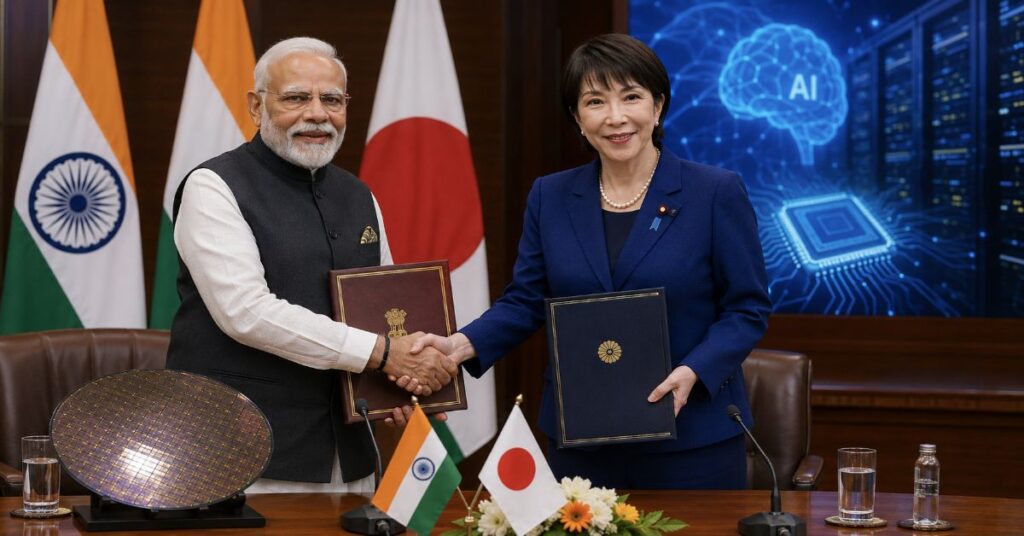
Japan brings precision hardware and industrial engineering. India brings scale, software, and a technology workforce expanding faster than any other country on earth. On July 2, the two governments decided to combine those assets formally, signing what is arguably the most detailed bilateral AI cooperation framework concluded by any two Indo-Pacific nations to date.
The 16th India-Japan Annual Summit in New Delhi produced three policy documents that, read together, sketch an ambitious attempt to build an alternative to the AI supply chains that currently run through and depend heavily on US and Chinese technology ecosystems. Prime Minister Narendra Modi and his Japanese counterpart Sanae Takaichi, on her first official visit to India since taking office, signed a Joint Declaration on Economic Security, a Joint Statement on AI Cooperation, and a Joint Statement on Energy Resilience, alongside more than a dozen sector-specific agreements.
KEY DEVELOPMENTS
- India and Japan signed three key policy documents at the 16th India-Japan Annual Summit on July 2, 2026: a Joint Declaration on Economic Security, a Joint Statement on AI Cooperation, and a Joint Statement on Energy Resilience.
- The AI cooperation roadmap covers the entire technology stack, including semiconductors, GPUs, compute, multilingual open-source LLMs, AI governance, and cybersecurity, with IIT Bombay, Japan’s NII, Sarvam AI, and Preferred Networks named as initial collaborators.
- The economic security declaration targets five priority sectors: semiconductors, critical minerals, ICT, clean energy, and pharmaceuticals, and explicitly flags concerns over economic coercion and concentrated supply chains.
- India and Japan also confirmed their first joint defence co-development project, the naval radio antenna UNICORN, alongside a target of relocating 500 skilled Indian AI professionals to Japan by 2030.
What the Agreements Actually Cover
The AI Joint Statement goes further than most bilateral technology accords. Rather than committing to “cooperate on artificial intelligence” in general terms, India and Japan outlined collaboration across the entire AI technology stack: secure digital infrastructure, semiconductors and GPUs, compute resources, multilingual and open-source AI models, AI governance frameworks, cybersecurity, and AI applications for public services. That level of specificity is unusual. Four concrete collaboration agreements were named at signing: IIT Bombay’s BharatGen Technology Foundation and Japan’s National Institute of Informatics will collaborate on multilingual scientific large language models; Sarvam AI and Japan’s Preferred Networks will work jointly on foundational AI models; the IndiaAI Mission and Japan’s Ministry of Economy, Trade, and Industry (METI) signed an MoU covering AI startups and innovation support; and both governments confirmed a target, first set earlier, of bringing 500 skilled Indian AI professionals to Japan by 2030. Full details of the agreements were reported by Reuters and confirmed in the Indian Ministry of External Affairs’ official readout following the summit.
The economic security declaration is the structural frame around which all the sector agreements sit. It identifies five priority sectors for project-based collaboration: semiconductors, critical minerals, information and communications technology, clean energy, and pharmaceuticals. The declaration explicitly names concerns over “economic coercion, arbitrary export restrictions, and non-market practices that disrupt global supply chains” — language that points clearly toward US-China trade tensions without naming either party, and that signals both countries view supply chain concentration as a strategic risk worth spending political capital to address.
The Semiconductor Piece: More Than a Funding Pledge
What Japan Brings
Japan is home to several of the world’s most critical semiconductor equipment and materials companies: Tokyo Electron, Shin-Etsu Chemical, and Sumco, among others, supply inputs that are embedded in virtually every advanced chip regardless of where it is ultimately fabbed. Japan’s government has also committed roughly $13 billion in domestic semiconductor subsidies to attract TSMC, Samsung, and others to build domestic fabs. That hardware and materials expertise is one of the assets India most lacks.
What India Brings
India’s Semiconductor Mission 2.0, referenced explicitly in the summit declaration, is the government’s attempt to build a domestic chip manufacturing base from near zero. The declaration specifically encourages greater Japanese company participation in that mission, suggesting Tokyo sees India’s emerging manufacturing ecosystem as a genuine hedging opportunity rather than a development-finance project. Combined with India’s established software and semiconductor design talent, which has made Bengaluru a meaningful hub for the back-end design work of companies like Qualcomm, Intel, and Arm, the complementarity is real. What has historically been missing is exactly what this summit attempts to supply: a formal government-level framework to turn complementary strengths into joint commercial activity. The context mirrors patterns seen elsewhere in the region, as reported in our analysis of Nvidia’s South Korea deals across SK Hynix, telecom, and Naver — another bilateral pairing of hardware and AI deployment capacity aimed at reducing dependence on a single supplier chain.
The AI Partnership in Geopolitical Context
The timing of this summit is not incidental. It follows a period in which US export controls on advanced AI models — including Anthropic’s Fable 5 and Mythos 5 suspension in June — have made clear that Washington is willing to impose unilateral restrictions on frontier AI technology for national security reasons, including restrictions that affect allied countries. For Japan and India, both members of the Quad alongside the United States and Australia, this creates a delicate positioning challenge. The partnership announced this week is not an alternative to the US technology relationship; it explicitly reinforces it by building out two Quad members’ independent AI capabilities. But it also reduces the degree to which either country’s AI development roadmap depends on US model access, semiconductor availability, or policy continuity. The BharatGen multilingual LLM project, for instance, is focused on developing open-source models in Indian and Japanese languages — a technical gap that current US frontier models do not serve well, and that neither country can easily fill by importing proprietary English-first models. Our earlier coverage of the 2026 LLM landscape and where multilingual models stand documents the gap these agreements are designed to close: frontier AI performance in Asian languages significantly lags English-language benchmarks, and no US lab has committed the development resources to close it at the pace India and Japan’s domestic deployment needs would require.
Defence, Energy, and What Else Was Signed
Beyond AI and semiconductors, the summit produced its first confirmed joint defence co-development project: the naval radio antenna UNICORN, a unified complex radio antenna system designed for improved stealth characteristics on Indian Navy vessels. The project had been under negotiation since a 2024 memorandum of implementation, and its confirmation here represents a meaningful step in the broader deepening of India-Japan defence ties that has accelerated since 2020. Energy security agreements covered strategic petroleum reserve cooperation, maritime energy transport, hydrogen and ammonia projects including a clean ammonia project in Odisha, and collaboration on nuclear energy and battery supply chains. A Track 1.5 Economic Security Dialogue — involving governments, industry, and experts — was established to provide a standing forum for the more sensitive supply chain discussions that do not easily fit into formal diplomatic channels.
What Happens Next
The practical next step is converting the signed documents into funded projects with timelines. Both governments have a reasonably strong track record on this dimension: the UNICORN project proves that announced co-development frameworks can reach implementation. The AI cooperation agreements are more ambitious and therefore more exposed to the usual obstacles: institutional friction between academic partners, differences in data governance standards, and the challenge of building joint research momentum across two countries whose AI policy frameworks are themselves still evolving. The 500 Indian AI professional target for Japan by 2030 is the single most trackable commitment in the package; whether that pipeline materialises will be an early signal of whether the workforce dimension of the partnership is progressing alongside the capital and research elements.
Why It Matters
This summit matters less as a bilateral trade announcement and more as a signal about the emerging architecture of Indo-Pacific technology competition. India and Japan are not building an alternative to the global AI supply chain; they are building deeper capacity within their portion of it, reducing single-point-of-failure dependencies, and establishing the institutional relationships that would allow both countries to respond more quickly and more independently to the next disruption, whether that is a US export control action, a Chinese supply chain incident, or a geopolitical shock that forces rapid diversification. The specific technical commitments — joint LLMs, semiconductor co-development, GPU resource sharing — are the means. The strategic end is a partnership capable of operating with meaningful technological autonomy within, not outside, the broader US-aligned technology ecosystem.
Sources
Reuters, July 2, 2026. India Ministry of External Affairs official readout of the 16th India-Japan Annual Summit. ANI and Business Standard summit coverage. Tribune India reporting on the 16-point roadmap.
