
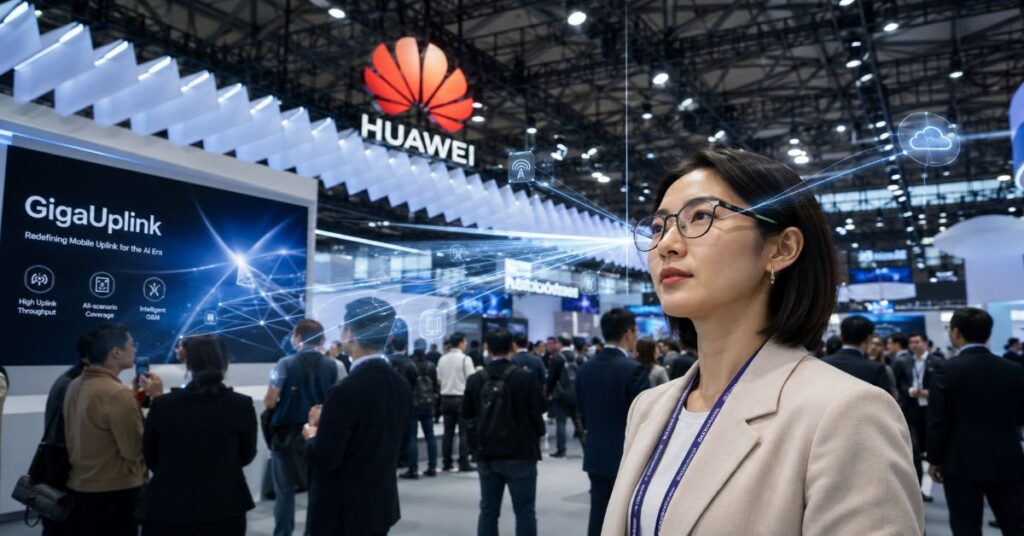
For twenty years, mobile network engineers optimised for one direction: down. Data flew from servers to screens, and the pipe going the other way was an afterthought. AI glasses have just made that twenty-year assumption wrong.
At the Mobile AI Industry Summit during MWC Shanghai 2026, tech leaders from across the carrier ecosystem reached what Huawei is calling an explicit industry consensus: enhancing uplink capacity is now the single most critical technical upgrade the mobile industry must make. To deliver on that consensus, Huawei officially launched GigaUplink, a solution that integrates upgraded multi-antenna hardware with intelligent spectrum allocation algorithms to boost upload speeds fivefold and dramatically increase uplink coverage. The system is designed specifically for the real-time multimodal AI devices — smart glasses, AI wearables, and embodied AI systems — that are imposing an entirely new and much more demanding set of requirements on network infrastructure.
The launch is distinct from the broader token-monetization and AI-centric network strategy Huawei showcased earlier in the week at MWC Shanghai: GigaUplink is the specific radio-layer solution targeting the immediate bottleneck these new devices are creating, and it addresses a problem that will affect every carrier serving AI wearable users within the next two to three years, regardless of which business model they use to bill for it.
Key Developments
- Huawei launched GigaUplink at MWC Shanghai 2026 — a multi-antenna, intelligent-algorithm solution targeting a fivefold increase in mobile uplink capacity for AI-driven devices.
- AI glasses requiring real-time translation and multimodal interaction need a minimum of 20 Mbps sustained uplink; the industry target Huawei is working toward is 1 Gbps peak uplink with 20 Mbps as a universal baseline.
- The GigaUplink architecture integrates hardware upgrades (multi-antenna configurations) with three intelligent spectrum and coordination algorithms that dynamically reallocate radio resources in real time.
- The global 5G-A user base has crossed 100 million, with China’s three major carriers running commercial high-uplink deployments and 20+ countries already designating U6 GHz spectrum for IMT use.
What Happened
According to Huawei’s MWC Shanghai announcements, the industry consensus reached at the Mobile AI Industry Summit establishes 1 Gbps peak uplink capacity and 20 Mbps as a universal uplink baseline as the new benchmarks that networks must plan around. The 20 Mbps figure is not aspirational: AI glasses currently available on the commercial market, including devices running on real-time multimodal AI for translation and visual assistance, require that sustained uplink speed to function without degradation. As more users run more AI wearables simultaneously in dense environments — stadiums, transit hubs, urban commercial districts — the uplink demands of those devices aggregate in exactly the kind of concentrated scenarios where today’s networks are least able to deliver.
According to TechWireAsia’s hands-on coverage of the launch, GigaUplink’s architecture achieves its fivefold uplink improvement by combining upgraded multi-antenna configurations at base stations with three intelligent collaboration algorithms: one that dynamically allocates spectrum between uplink and downlink traffic in real time based on observed device demand, one that coordinates beam management across antennas to direct uplink capacity precisely toward concentrations of AI-device traffic, and one that enables carrier aggregation across multiple bands specifically to extend uplink coverage into edge-of-cell areas where AI wearable users would otherwise experience degraded performance.
The Mechanism: Why Uplink Is the New Bottleneck
The asymmetry between download and upload capacity in mobile networks is not an accident; it reflects two decades of consumer behaviour. In the 4G and early 5G era, the dominant data services — video streaming, social media browsing, app downloads, cloud storage sync — all consumed dramatically more downlink bandwidth than they produced uplink traffic. A user streaming 4K video on a mobile device might consume 25 Mbps of downlink but barely 1-2 Mbps of uplink. That ratio shaped how carriers allocated spectrum, configured antennas, and planned network capacity: the downlink pipe was sized to handle the service; the uplink was sized to handle control signals and small text transmissions.
AI wearables invert that equation. The shift to always-on AI devices — smart glasses, wearable assistants, embodied AI — is part of a broader move toward agentic AI experiences running directly on mobile hardware that requires continuous, high-quality uplink streams rather than occasional file uploads. When thousands of such devices operate simultaneously in a dense area, the aggregate uplink demand can exceed what the network’s current spectrum allocation and antenna configuration is designed to serve. GigaUplink’s intelligent algorithms address this by making the uplink-downlink spectrum allocation dynamic rather than fixed, letting the network redistribute capacity toward uplink in real time as AI wearable density increases in a given area.
The Backstory
GigaUplink is not an entirely new concept at MWC Shanghai — Huawei first introduced the framework at MWC Barcelona in March 2026 and has been positioning it as part of its broader 5G-A AI-centric network strategy since early in the year. What MWC Shanghai 2026 adds is a more concrete product specification tied to real carrier deployments, and the explicit industry consensus statement from the Mobile AI Industry Summit that elevates uplink from a Huawei product pitch to a formally acknowledged collective priority. China’s three state-owned carriers — China Mobile, China Telecom, and China Unicom — are already running commercial high-uplink networks in multiple cities, giving Huawei real-world performance data to anchor its specifications rather than theoretical projections alone.
The U6 GHz spectrum dimension is critical to understanding why this matters globally, not just in China. The Upper-6 GHz band — immediately below the 6 GHz band used for Wi-Fi and above the mid-band 5G deployments now covering most major cities — provides the wider channel bandwidths that are necessary to reach 1 Gbps peak uplink targets. More than 20 countries have already designated U6 GHz for International Mobile Telecommunications use, covering nearly 80 percent of the global population, which means the spectrum policy infrastructure for GigaUplink-class deployments exists outside China even if the commercial deployments have not yet followed.
Reactions
David Wang, Huawei’s Deputy Chairman and Rotating Chairman, framed the uplink shift as a structural consequence of AI’s growth that carriers cannot choose to ignore: “With each generation, we have pushed the limits of spectral efficiency and performance. This has consistently expanded the boundaries of communications, helping carriers translate network capabilities into commercial value.” Wang projected that the number of AI agents operating globally will exceed 100 billion by 2030 and could reach trillions by 2040, each generating uplink traffic that current networks were not designed to serve. The GSMA formalized its own GigaUplink initiative at MWC Barcelona 2026, establishing 20 Mbps universal uplink as a target metric for the industry, which gives Huawei’s commercial deployment claims a layer of independent standards-body validation.
The Dispute: Huawei’s Global Reach Is the Structural Constraint
GigaUplink’s technical case is strong, but its geographic reach is structurally limited by the same geopolitical constraints that have shaped every Huawei product launch since 2019. The carriers best positioned to deploy GigaUplink at scale are Huawei’s existing network equipment customers — concentrated primarily in China, parts of Southeast Asia, the Middle East, and Africa. In the US, Australia, Canada, the UK, and Sweden, Huawei’s equipment has been explicitly excluded from new deployments, and existing Huawei equipment is in the process of being removed from carrier networks in several of those countries. For the AI wearable uplink problem to be solved in those markets, carriers will need to implement equivalent solutions using Nokia, Ericsson, or alternative vendors — which exist in principle but have not yet delivered equivalent deployed results at scale.
That gap creates an interesting competitive dynamic. The sweeping Nvidia AI infrastructure partnerships across South Korean carriers and chipmakers show that the Five Eyes carrier ecosystem is actively investing in AI-native network infrastructure — but that investment is going into compute layers and GPU-accelerated inference, not specifically into the uplink radio hardware that GigaUplink targets. Autonomous network optimization and uplink capacity expansion are different technical problems, and Huawei’s advantage in the specific uplink-hardware dimension means that the carriers who can use its equipment will be able to support AI wearable growth faster than those who cannot.
What Happens Next
Commercial high-uplink deployments are already live in China, and Huawei has cited Middle East carriers as the next major deployment market for GigaUplink-equipped networks. The technology’s performance in those real-world deployments — specifically whether the fivefold uplink improvement holds under dense AI-device loads rather than in controlled test conditions — will be the critical data point that either validates or qualifies the MWC Shanghai claims. Global standardization of the uplink performance targets the GSMA announced at MWC Barcelona, including the 20 Mbps universal baseline, will also create new benchmarking requirements for all carrier networks over the next two to three years, which means even carriers that cannot deploy Huawei equipment will need to match the performance target through alternative means.
Why It Matters
GigaUplink is not primarily a Huawei product story; it is an infrastructure story about what the next generation of AI devices requires from the networks they depend on. The performance requirements that AI wearables are imposing on mobile networks — sustained, high-throughput uplink at low latency, across dense concurrent user deployments — are materially different from anything the current generation of 5G networks was designed to serve. Solving that problem at the radio layer is a prerequisite for the kind of always-on AI assistant experience that device makers are targeting, and it adds yet another dimension to the already severe pressure AI is placing on energy and infrastructure capacity globally. How fast that uplink gap closes — and which equipment vendors close it first — will be one of the decisive infrastructure questions of the next phase of AI deployment.
Sources
Huawei (huawei.com newsroom); TechWireAsia; TheFastMode; CXO Insight Middle East; WebWire.
