
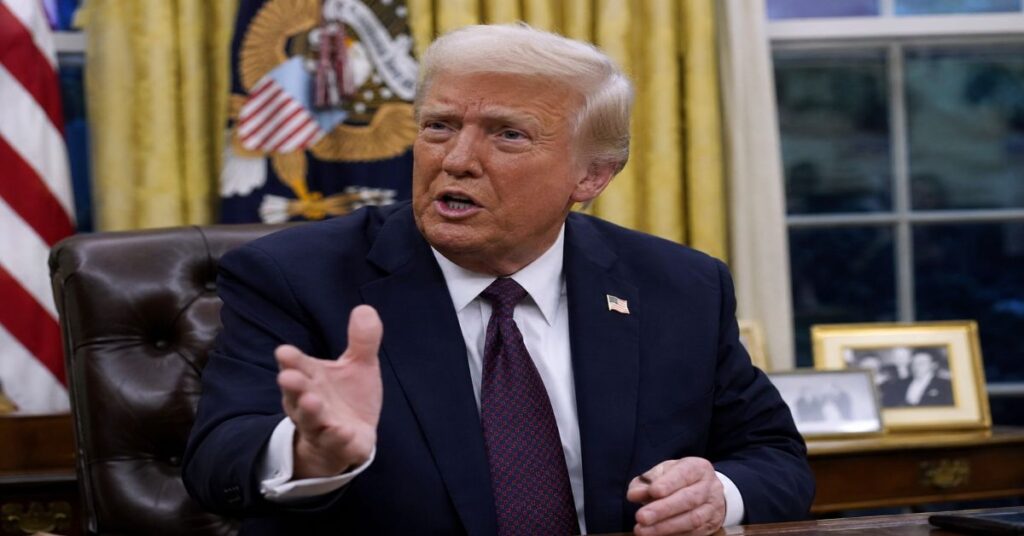
A week ago, the Trump administration treated Anthropic’s most powerful AI model as enough of a national security problem to cut off the entire world’s access to it. This week, after a lunch in the French Alps, the president was calling the company’s CEO “nice” and “smart.”
President Trump told Axios in an interview published Friday that he no longer views Anthropic, or chief executive Dario Amodei, as a threat to national security — a sharp, public softening just eight days after the Commerce Department ordered the company to block foreign nationals from accessing its most advanced models, Fable 5 and Mythos 5. Asked directly whether he saw Anthropic or Amodei as a threat, Trump said: “Well, not now, but a week ago, maybe.”
The shift followed a G7 summit lunch in Évian-les-Bains, France, where Trump met Amodei in person for the first time since the dispute escalated. The underlying export-control order, however, has not been rescinded — leaving Anthropic with a friendlier political tone from the White House, but the same restrictions still legally in force.
Key Developments
- Trump told Axios on June 19, 2026 that he no longer views Anthropic as a national security threat, after meeting CEO Dario Amodei at the G7 summit in Évian-les-Bains two days earlier.
- The Commerce Department’s June 12 directive requiring foreign nationals to seek US approval before accessing Fable 5 and Mythos 5 remains formally in force.
- Trump said the alarm that triggered the restriction came from “a competitor and a part owner” of Anthropic — a description matching Amazon, which has invested $8 billion in the company.
- The comments land weeks after Anthropic confidentially filed for an IPO at a valuation Fortune reported at roughly $965 billion.
What Happened
According to Axios’s own report on the interview, reporter Marc Caputo asked Trump directly whether he viewed Anthropic or Amodei as a national security threat during a wide-ranging White House interview for “The Axios Show.” Trump’s answer — “Well, not now, but a week ago, maybe” — was paired with warmer personal language about Amodei, whom Trump described as having responded “very quickly” and “very responsibly” once the administration raised its concerns. “People get put in prison immediately for that. You can’t play games with that,” Trump said, framing Amodei’s cooperation as the deciding factor in his changed view.
Trump also addressed, but did not rule out, the possibility of invoking emergency powers under the Defense Production Act if AI labs broadly did not “get in line” with the administration’s expectations. “I have the power to use a lot of things,” he said, “but I’m not sure I have to do that.” Asked about easing the current restrictions specifically, Trump told Axios, “I would, but I’m not sure I have to do that” — a statement of openness rather than a commitment to act.
Anthropic responded with a measured statement rather than declaring victory: “We are grateful to the administration for their ongoing partnership in working to get this matter resolved as quickly as possible,” the company said. “We remain committed to working alongside them towards our shared goals of protecting critical infrastructure and making sure the US leads in AI.” CNBC’s own report on the interview noted that senior Anthropic technical staff had separately been scheduled to meet with Trump administration officials earlier in the week specifically to discuss the foreign-access dispute, suggesting the diplomatic groundwork for Trump’s softened tone was already underway before the G7 lunch took place.
The Mechanism: What Actually Triggered the Restriction
Trump’s interview supplied a detail that had not been clearly established publicly before: the identity of who alarmed the administration enough to trigger the export-control order in the first place. “It was a competitor and a part owner that turned Anthropic in. They didn’t like what they were doing. They were very concerned,” Trump said. That description — a company that is simultaneously a competitor and an investor — points squarely at Amazon, which has invested roughly $8 billion in Anthropic while also operating competing AI models through AWS Bedrock.
Per Axios’s reporting, Amazon security researchers discovered a vulnerability in Mythos and reported it to the Trump administration, which then escalated the matter to Anthropic leadership — a process Anthropic reportedly felt dismissed it at first. Anthropic has said no tester has been able to demonstrate a “universal jailbreak” capable of broadly bypassing the model’s safeguards, and that while perfect jailbreak resistance is not achievable, some minor vulnerabilities are an expected and acceptable residual risk rather than evidence the model is unsafe to operate under controlled access.
The Backstory
The dispute between Anthropic and the Trump administration did not begin with the June 12 export-control directive; it traces back to March 2026, when the Pentagon designated Anthropic a supply-chain risk after the company declined to strip guardrails restricting the use of its models for mass surveillance and fully autonomous weapons systems from products used by the US military. A federal judge issued a temporary restraining order in late March blocking elements of that designation, but the Pentagon’s underlying 180-day timeline to remove Anthropic’s Claude models from Department of War systems has continued moving forward regardless.
That standoff escalated sharply this month. Anthropic released Fable 5 and Mythos 5 on June 9, describing Fable 5 as exceeding the capability of any model the company had previously made generally available, with Mythos 5 reserved for a vetted group of cyberdefenders and infrastructure providers under Project Glasswing. Three days later, the Commerce Department issued its directive requiring foreign nationals to obtain US government approval before accessing either model — a restriction so broad and unexpected that Anthropic opted to suspend access for all users worldwide, foreign and domestic alike, rather than attempt to build citizenship-verification infrastructure at the API level on short notice.
The timing could hardly have been worse commercially. Anthropic’s annual recurring revenue had reportedly climbed to roughly $47 billion by early June, up from about $9 billion at the end of 2025, and the company had only recently filed confidentially for an initial public offering — a process that OpenAI’s own parallel consolidation ahead of its planned IPO suggests is becoming a defining competitive battleground for both companies in the second half of 2026. An export-control order disabling Anthropic’s flagship models worldwide, with no clear resolution timeline, was about as direct a threat to that IPO’s valuation as a regulatory action could pose.
Amodei has been working multiple channels simultaneously to manage the fallout. At the G7 summit, he and Google DeepMind chief executive Demis Hassabis jointly pitched G7 leaders on a US-led coalition framework for coordinating frontier AI trade and safety standards among democracies, explicitly positioning China outside that arrangement — a pitch that, according to the Financial Times, included Amodei urging leaders to “resist the temptation to splinter” their individual regulatory approaches. That diplomatic framing, delivered just before the Trump meeting, appears to have set up Amodei’s direct access to the president at a moment when Trump was already primed to see Anthropic as a cooperative partner rather than an adversary.
Reactions
Trump repeatedly framed the episode through the lens of the broader US-China AI competition rather than as a narrow dispute about one company’s model. “I was with President Xi. We talked about it. We’re beating China by a lot,” he told Axios, adding that the “good far outweighs the bad” when it comes to AI development generally, and that the administration intends to “find the bad” and stop it rather than restrain the industry broadly.
The international response to the underlying export-control whiplash has been less forgiving than Trump’s. Canadian Prime Minister Mark Carney, speaking to reporters in Dublin en route to the G7, pointed to the Anthropic restrictions as evidence that US allies need to “build out and diversify” their own AI capabilities rather than depend entirely on American providers — a sentiment that lines up with Canada’s own recently announced effort to help middle powers develop AI alternatives, and one several governments have echoed in the days since.
The Dispute: Warm Words, Unchanged Law
The gap between Trump’s rhetorical shift and the actual regulatory state of play is the central tension in this story, and it is one Trump’s own answers do not resolve. The Commerce Department’s June 12 directive requiring federal approval for foreign nationals to access Fable 5 and Mythos 5 has not been formally rescinded. The Pentagon’s March supply-chain risk designation, barring federal agencies from using Anthropic’s technology, also remains in place. Trump’s comments amount to a public statement of changed personal opinion, not a policy reversal — and the Commerce Department operates with considerable independence on export-control matters that a single presidential interview cannot shortcut.
There is also an unresolved question about what, exactly, changed between the original alarm and this week’s about-face. Trump’s explanation centers on Amodei’s personal responsiveness and the impression he made over a G7 lunch — not on any new technical finding that the underlying vulnerability Amazon flagged has actually been resolved. If the security concern that triggered the directive in the first place was real and substantive, a changed presidential impression of the CEO’s demeanor is a strange basis on which to signal openness to lifting it; if the concern was always more about diplomatic friction than a concrete technical threat, that raises its own questions about how the original restriction was decided in the first place.
What Happens Next
Whether Trump’s softened tone translates into an actual rollback of the Commerce Department directive is now the central thing to watch, and it is not a question a single interview can answer on its own — reversing a formal export-control order requires bureaucratic process that moves independently of presidential messaging. Anthropic’s IPO timeline gives the situation a natural pressure point: the longer the export controls stay formally in place, the harder it becomes for the company to credibly price its offering near the roughly $965 billion valuation reported ahead of the restriction, making the speed of any formal policy change a direct, measurable stake for the company’s public-market debut.
Why It Matters
This episode is a live case study in how unpredictable US AI policy has become even within a single administration’s own week-to-week posture — a company can go from being treated as enough of a threat to justify a worldwide access shutdown to being publicly praised by the president as “very responsible,” without the underlying legal restriction changing at all. For Anthropic’s international partners and customers, several of whom were relying on Mythos for active cybersecurity defense work before the export controls hit, that volatility is the real story: warmer words from the Oval Office do not restore access, and allies and enterprises alike are left making their own AI-sourcing decisions based on the actual state of the restriction rather than its political weather.
Sources
Axios; CNBC; Bloomberg (via Yahoo Finance); WION; ZeroHedge; Cryptopolitan.
