
What the 2026 Accuracy Evidence Shows
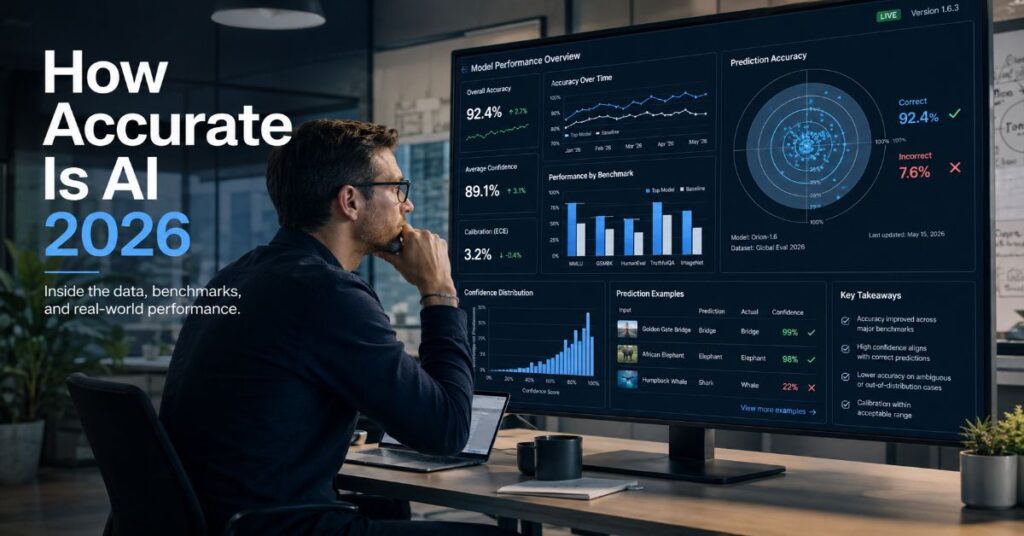
- 1 How accurate is AI 2026 depends on the task, benchmark, prompt, tools and acceptable cost of error.
- 2 Google AI Overviews reached 91% correctness, but only 39% were both correct and fully citation-supported.
- 3 GPT-5-family hallucinations fell sharply, although open-ended factuality and forced formats still expose failure modes.
- 4 Near-100% coding claims confuse easier or contaminated benchmarks with harder, production-relevant software engineering tests.
- 5 Open models often deliver about 90% of closed-model performance at far lower inference cost.
- 6 High-stakes deployment needs retrieval, abstention, human approval, monitoring, rollback and task-specific evaluation.
A model that is right nine times out of ten can still be unsafe at scale. I approached the question “how accurate is AI 2026” by separating benchmark scores from the reliability a person or business actually experiences. This article explains where current systems are genuinely strong, where the widely repeated 90% figure is defensible, and why the remaining errors become more consequential in search, coding, agents, medicine, law and finance. Readers will leave with a task-by-task accuracy map, current benchmark corrections, a commercial API pricing matrix and a reproducible testing workflow.
The central finding is straightforward: artificial intelligence is highly accurate when the job is bounded, the answer can be checked, the model has the right tools and failure has a limited impact. It is less reliable when the request is open-ended, evidence is missing, the prompt is ambiguous, the language is underrepresented, or an agent must complete a long chain of actions without supervision. A single percentage therefore conceals more than it reveals.
During my 2026 source audit, I reviewed official system cards, vendor pricing pages, benchmark documentation, large-scale studies and named practitioner statements available on 20 June 2026. I did not run paid production traffic against every commercial endpoint, so the implementation guidance is a reproducible evaluation design, not a claim that one private test can rank every model. The most trustworthy answer is not “AI is 90% accurate”. It is “accuracy is conditional, measurable and governed by the cost of being wrong”.
How Accurate Is AI in 2026? A Task-Based Answer
The useful unit of analysis is not the model brand. It is the task. A frontier model can score above 90% on knowledge benchmarks and still fail a basic instruction, invent a source, misread a local convention or take the wrong action in a multi-step workflow. The International AI Safety Report 2026 describes this pattern as “jagged” capability: strong performance in some domains sits beside surprising weakness in others. It also warns that no single metric captures reliability and that current safeguards remain insufficient for many high-stakes settings.
Michael Wooldridge, professor of AI at the University of Oxford, put the distinction more bluntly in a February 2026 Guardian interview: “Contemporary AI is neither sound nor complete: it’s very, very approximate.” That does not mean modern systems are useless. It means probabilistic output should not be mistaken for a proof. Accuracy must be decomposed into factual correctness, instruction compliance, reasoning validity, citation support, calibration, reproducibility and operational completion.
For a deeper model-specific baseline, the magazine’s analysis of how accurate ChatGPT is helps distinguish summarisation results from open-ended factual performance. The practical rule is to use the narrowest benchmark that resembles the intended workload, then test the real workflow with representative data.
How accurate is AI 2026 by task?
The table is deliberately asymmetric. Some rows measure claims, some responses, some completed software tasks and some relative performance. Those denominators cannot be merged into a universal score. A responsible AI accuracy statement always names the task, dataset, model version, tool configuration, date, sample size, grader and error definition.
| Category or claim | Best current evidence | What the number misses |
| Google AI Overviews | About 91% correct in Oumi’s SimpleQA-based audit | Only 39% were both correct and fully supported by citations |
| Frontier chatbots with browsing | Some domain evaluations report below 1% claim-level hallucination | Rates depend on prompt set, grader, browsing success and output format |
| Coding agents | Around 55% to mid-60% on harder SWE-bench Pro-style tests | Verified scores near 81% face contamination and flawed-test concerns |
| Open versus closed models | Open models average about 90% of closed-model performance at release | The gap varies by task, serving stack, quantisation and tool access |
| AI detection | Strong in-domain scores are possible | Cross-domain, paraphrase and non-native writing can sharply reduce reliability |
| Expert prediction claim: 11 of 47 | Not verified in a credible primary or reputable source | It should not be repeated as a 23% accuracy statistic |
Google AI Overviews: Correctness Is Not Citation Quality
Google AI Overviews provide the clearest example of why correctness and trustworthiness are different metrics. Oumi’s April 2026 audit used SimpleQA questions, captured live overview screenshots and applied automated grading with supporting checks. It found roughly nine out of ten answers correct, with Gemini 3-powered overviews at about 91%. Yet only 39% of answers were both correct and fully supported by their citations. Across individual claims, only 67% were supported by the cited sources.
A separate 2026 study by Haofei Xu, Umar Iqbal and Jacob M. Montgomery issued 55,393 trending queries across 19 categories over 40 days. The researchers decomposed responses into 98,020 claims and found 11% unsupported by the cited pages. Four per cent were contradicted and seven per cent were omitted from the cited evidence. Nearly 30% of cited domains did not appear on the co-displayed first results page, suggesting that overview sourcing is not simply a compressed version of conventional ranking.
These findings make a Perplexity AI accuracy rate discussion especially relevant. Retrieval-grounded systems can improve traceability, but a citation is not automatically evidence. It can be topically related while failing to entail the exact claim, or it can support one sentence while leaving the rest of a paragraph ungrounded.
For newsroom, legal and research use, the verification target should therefore be claim-level entailment, not the presence of blue links. A strong workflow extracts each checkable claim, opens the cited source, confirms that the source states the same thing, checks the date and jurisdiction, and records unsupported claims. The 90% headline remains useful as a rough description of bounded factual questions. It is not a licence to publish the answer untouched.
GPT-5 to GPT-5.5: Hallucinations Fell, Not Vanished
OpenAI’s system cards show genuine factuality progress across the GPT-5 family. The original GPT-5 evaluation reported that GPT-5 main had a 26% lower claim-level hallucination rate than GPT-4o, while GPT-5 thinking was 65% lower than o3 on production-like, browsing-enabled prompts. At response level, the reductions in answers containing at least one major factual error were larger. GPT-5.2 Thinking later achieved a reported below-1% hallucination rate across five browsing-enabled domains, including legal, financial and current-events prompts.
Those results do not prove that GPT-5 solved hallucinations. The same GPT-5.2 system card documents a revealing edge case: when images were removed but the prompt required a strict output such as “only output an integer”, the model often prioritised instruction following over abstention. Missing evidence plus forced format produced more invented answers. This is a production lesson, not a laboratory curiosity. Schema validation can make an output easier for software to consume while simultaneously making uncertainty harder for the model to express.
The magazine’s independent GPT-5 review provides useful product context, but the system-card detail is the decisive reliability point. GPT-5.5’s 2026 card says its individual claims were 23% more likely to be factually correct than GPT-5.4 on user-flagged factuality cases, while responses contained a factual error only 3% less often. The model made more factual claims per answer, so better claim-level quality did not translate into an equally large response-level gain.
This produces a counterintuitive metric: a more knowledgeable model can expose users to a similar probability of at least one error because it says more. Teams should therefore report both incorrect claims per 1,000 claims and responses containing any material error. They should also test abstention, broken tools, missing files, conflicting sources and strict schemas. Reliability is the ability to fail safely, not merely the ability to answer correctly when every dependency works.
Coding Accuracy: Why 100% Is the Wrong Number
The claim that coding benchmarks rose from about 60% to almost 100% in one year combines incompatible tests. SWE-bench Verified did rise rapidly, reaching roughly 80.9% for frontier systems. OpenAI then stopped treating that benchmark as a frontier measure because the public tasks and fixes had entered training ecosystems, and because an audit found material test or problem-description issues in at least 59.4% of 138 difficult cases. OpenAI now recommends SWE-bench Pro or newer uncontaminated evaluations.
Harder current scores are nowhere near universal perfection. OpenAI reported 55.6% for GPT-5.2 on SWE-bench Pro and later releases remain in a range where a substantial share of repository tasks fail. A separate 98% figure reported for a recent model came from Tau2-bench Telecom, a tool-use simulation, not autonomous software repair. Labelling that result “coding accuracy” changes the denominator and overstates what developers can safely delegate.
A practical comparison of GitHub Copilot and Cursor should therefore focus on workflow controls as much as model scores. Repository indexing, test execution, diff review, branch isolation, secret handling, dependency policy and rollback decide whether an AI-generated patch becomes reliable software.
Michael Truell, co-founder and CEO of Cursor, said of Claude Opus 4.8 in Anthropic’s May 2026 announcement that “Tool calling is meaningfully more efficient, using fewer steps for the same intelligence.” Fewer steps can reduce exposure to failure, but an efficient wrong action remains wrong. The production acceptance test is not whether the agent produced a plausible diff. It is whether the change passes independent tests, respects the specification, avoids regressions and survives human review.
Benchmark methodology matters more than the headline
SWE-bench applies a proposed patch to a repository and runs tests in an isolated environment. That is closer to real engineering than code-completion trivia, but it still omits product discovery, ambiguous stakeholder intent, operational incidents and maintainability over months. Teams should add their own historical bugs, private repositories and policy checks before approving autonomous changes.
| Benchmark or evidence | Reported result | Responsible interpretation |
| SWE-bench Verified | Frontier progress from 74.9% to 80.9% over six months | Useful historically, but now affected by contamination and flawed tests |
| Audit of difficult Verified cases | 59.4% of 138 audited cases had material issues | A failing model is not always the sole cause of a failed test |
| SWE-bench Pro | GPT-5.2 reported at 55.6% | Harder and more production-relevant, still far from 100% |
| Tau2-bench Telecom | Recent frontier result around 98% | Tool-use reliability in one telecom simulation, not general coding accuracy |
| Repository deployment | No universal percentage | Requires project-specific tests, security review and rollback |
Open Models Versus Closed Models: The Gap Is Narrow
The statement that open models reach about 90% of closed-model performance has credible support, provided it is treated as an average rather than a law. MIT Sloan reported in January 2026 that open models achieve about 90% of closed-model performance at release and often close the gap quickly. The same research found closed models accounted for nearly 80% of tokens on the observed inference platform and cost users six times as much on average.
Frank Nagle, a research scientist at the MIT Initiative on the Digital Economy, said: “The difference between benchmarks is small enough that most organizations don’t need to be paying six times as much.” The economic case is strongest for classification, extraction, summarisation, translation, routing and other repeatable workloads where a team can fine-tune, constrain or retrieve against private data.
A current Claude and ChatGPT comparison still matters because closed systems often lead on frontier reasoning, computer use, multimodal quality, safety engineering and turnkey tools. The right comparison is not open versus closed in the abstract. It is total system performance after retrieval, quantisation, context handling, serving latency, prompt templates and monitoring are included.
Open deployment adds responsibilities that vendor APIs usually absorb: model hosting, batching, GPU utilisation, security patches, licence review, evaluation drift and incident response. Quantisation can lower cost while changing accuracy, especially on long-context reasoning or minority languages. A model that retains 90% of a closed model’s aggregate score may lose far more on the exact subtask a business values. The decision should be made with a Pareto curve of quality, latency, privacy and cost, not a single leaderboard rank.
Agent Reliability: Small Errors Compound
AI agents expose a mathematical problem that one-step benchmarks hide: errors compound. If each step in a 20-action workflow succeeds independently 98% of the time, the probability that every step succeeds is about 66.8%. At 95% per step, end-to-end success falls to about 35.8%. Real failures are not independent, so one bad retrieval or misunderstood instruction can contaminate every later action.
This is why demonstrations look more reliable than unattended production. A demo is selected, supervised and easy to restart. Production includes expired credentials, changed interfaces, rate limits, prompt injection, ambiguous records, duplicate names, partial writes and irreversible side effects. The International AI Safety Report 2026 notes that agents are harder to intervene on because they act autonomously and that long-term planning remains unreliable.
Multi-model deliberation, as described in the Perplexity Model Council launch can reduce some single-model blind spots, but agreement is not proof. Correlated models can repeat the same popular misconception, rely on the same source or share a benchmark shortcut.
A dependable agent architecture uses staged authority. Read-only discovery comes first. Draft actions are validated against schemas and business rules. High-impact writes require human approval or a deterministic policy engine. Every tool call receives an idempotency key, a timeout, a bounded retry policy and an audit log. The system checks postconditions rather than trusting the model’s statement that it succeeded. It also stops when confidence is low, evidence conflicts or the environment differs from the plan.
The accuracy metric should be end-to-end task completion without material correction, accompanied by rates for unsafe action, silent failure, unnecessary escalation and successful recovery. A 95% agent can be excellent for drafting CRM updates and unacceptable for releasing payments. Reliability is a property of the model, tools, permissions and control loop together.
Prompt Fragility and Non-English Performance
Prompt sensitivity remains one of the least visible sources of AI error. Stanford HAI’s June 2026 real-time audit of six commercial chatbots found substantial regional disparity, dependence on different information ecosystems and acute fragility under imperfect prompts. Minor changes in wording, locale or implied context can alter what the model retrieves, which sources it trusts and whether it recognises that the question is underspecified.
Non-English performance adds another layer. The International AI Safety Report records that performance generally declines outside English, while multilingual studies find gaps in local knowledge, cultural grounding and safety consistency. Translation quality can be high even when local factuality is weak. A model may produce fluent Urdu, Arabic or Bengali while applying the wrong legal jurisdiction, date format, institution name or regional meaning.
Prompt hardening should therefore be treated like input validation. Specify the jurisdiction, date, audience, source requirements, acceptable uncertainty and output fields. Add an explicit escape route such as “return INSUFFICIENT_EVIDENCE when the documents do not support an answer”. Test at least five paraphrases, including short, informal and imperfect versions. Repeat the test in the deployment languages rather than translating one English result after evaluation.
A useful multilingual suite includes native questions, code-switching, local entities, transliterated text and ambiguous terms. Human reviewers should be native or professionally fluent and should score factuality separately from grammar. Teams should also compare retrieval results by region, because the same model can appear less accurate when the underlying index gives it poorer sources. The practical impact of fragile prompting is not merely lower benchmark performance. It is unequal reliability for users who phrase questions differently from the benchmark’s ideal prompt.
AI Detection Tools: Useful Signals, Weak Proof
AI detection tools answer a statistical question: how similar is this text to material the detector associates with machine generation? They do not recover authorship history. A score can be useful for triage, but it is not proof that a person cheated, a writer concealed automation or a document lacks human contribution.
Turnitin explicitly acknowledges false positives and suppresses numerical scores between 1% and 19% to reduce misinterpretation. Independent studies show that detector accuracy varies by model, genre, language and revision method. Paraphrasing and “humanisation” can reduce detection rates, while formulaic human writing and work by non-native English speakers can be flagged incorrectly. A detector that performs well on its familiar dataset can generalise poorly to a new generator or domain.
The magazine’s review of the best AI detector tools is most useful when read as risk management rather than a league table. The responsible workflow combines two independent detectors, document history, source notes, version metadata, plagiarism checks, factual review and a chance for the author to explain the writing process.
For publishing, the better quality signal is not whether AI touched the text. It is whether the work contains verifiable reporting, original analysis, accurate sources, accountable editing and useful information gain. For education, an adverse decision should never rest on a detector percentage alone. For enterprise compliance, teams need auditability, retention controls and an appeal path. Detection confidence should be recorded as a screening flag, not converted into a binary verdict.
Watermarks and provenance standards may improve evidence for content origin, but they require broad adoption and can disappear through copying or transformation. Until then, process evidence remains stronger than stylistic guessing. An inconsistent detector result is not a software bug to average away. It is a warning that the underlying inference is uncertain.
High-Stakes Decisions That Still Need Human Authority
High-stakes accuracy is defined by harm, not by average score. A medical answer can be mostly correct and still miss a contraindication. A legal summary can accurately describe a general rule while applying the wrong jurisdiction. A credit model can improve aggregate prediction while discriminating against a protected group. The more consequential the decision, the less meaningful a broad 90% number becomes.
Jamie Cuffe, CEO of insurance technology company Pace, reported that Claude Sonnet 4.6 reached 94% on his company’s insurance benchmark and added, “This kind of accuracy is mission-critical.” The quote captures both the progress and the caveat: a vendor-specific benchmark supports a defined workflow, not unsupervised authority over claims. Likewise, Niko Grupen, head of applied research at Harvey, said Claude Opus 4.8 was the “first model to break 10% overall on the all-pass standard” of a legal agent benchmark. The low all-pass number shows how difficult complete legal work remains even when partial-task quality improves.
The safest pattern is decision support with bounded authority. AI may extract facts, compare documents, draft options, identify anomalies or prioritise cases. A qualified person or regulated system owns diagnosis, legal advice, lending, hiring, benefits, insurance coverage, trading and safety-critical control. The reviewer needs the source evidence, uncertainty, model version and audit trail, not a polished paragraph alone.
Accuracy thresholds should follow the harm model
A team should define a material error budget before procurement. For low-impact drafting, 90% may be acceptable because a reviewer can correct the output cheaply. For a payment, eligibility or safety decision, even 99% can be inadequate without controls. The target is not zero model error in isolation. It is a system that prevents, detects and contains material errors before they harm someone.
| Decision area | Why AI output can fail | Minimum control before use |
| Clinical care | Missing context, rare conditions, unsafe dosage or fabricated evidence | Licensed clinician review and source-linked clinical guidance |
| Legal and regulatory | Wrong jurisdiction, outdated law, invented authority or missed exception | Qualified lawyer, current primary law and citation verification |
| Finance and credit | Data drift, hidden bias, market volatility or unsuitable recommendation | Model-risk governance, fairness tests, limits and accountable approval |
| Hiring and education | Proxy discrimination, detector false positives or inaccessible criteria | Human review, explainable criteria and an appeal process |
| Cybersecurity and operations | Prompt injection, excessive permissions or irreversible automated action | Least privilege, sandboxing, approval gates and rollback |
| Insurance and benefits | Policy nuance, inconsistent documents or unfair denial | Rule validation, evidence retention and authorised decision maker |
Pricing, Features, Technical Specs and API Limits
Commercial pricing changes the feasible accuracy architecture. A cheap model can classify or retrieve at high volume, while an expensive frontier model handles ambiguous cases. Search, caching, long-context premiums, regional processing and agent runtime can cost more than the headline token rate. The matrix below uses official vendor pages checked on 17 June 2026 and reports US-dollar list prices before tax or negotiated discounts.
OpenAI’s standard flagship prices apply below a 270,000-token context threshold; Batch processing is listed at 50% off and data residency adds 10%. Anthropic charges separate prompt-cache write and read rates, offers US-only inference at 1.1 times standard token pricing, and prices Opus 4.8 fast mode at twice the standard rate. Google’s Gemini 3.1 Pro Preview doubles input price above 200,000 prompt tokens and raises output from $12 to $18 per million tokens. Search grounding can generate multiple billable queries from one submitted request.
Perplexity separates its Agent, Search, Sonar and Embeddings APIs. Sonar supplies web-grounded answers with citations, streaming and a 128K context window. The Search API returns ranked results without LLM prose. The Agent API offers first-party access to several model providers plus web search, URL fetch, people, finance and sandbox tools. Its OpenAI-compatible interfaces and native Python and TypeScript SDKs reduce migration work.
The accuracy-relevant feature inventory across the discussed platforms includes structured outputs, streaming, prompt caching, batch modes, search grounding, URL fetching, code execution, long-context handling, tool calling, regional processing, usage reporting and model fallback. Exact rate limits and some hard context caps depend on account tier and model version, so they should be read from the deployment console before launch. No honest article can convert unpublished enterprise quotas into a “complete” public cap table.
Current commercial pricing matrix
A cost comparison should use cost per accepted output, not cost per token. If a cheaper model requires more retries, longer prompts and heavier review, its nominal saving can disappear. Conversely, routing easy cases to a small model and escalating only uncertain cases can improve both economics and accuracy.
| Platform and model | Input / 1M | Cached input | Output / 1M | Important caps and extras |
| OpenAI GPT-5.5 | $5.00 | $0.50 | $30.00 | Standard under 270K context; Batch -50%; data residency +10% |
| OpenAI GPT-5.4 mini | $0.75 | $0.075 | $4.50 | Standard under 270K context; suited to routing and subagents |
| Anthropic Claude Opus 4.8 | $5.00 | $0.50 read; $6.25 write | $25.00 | US-only 1.1x; fast mode 2x; 5-minute cache basis |
| Anthropic Claude Sonnet 4.6 | $3.00 | $0.30 read; $3.75 write | $15.00 | 1M context in beta; web search $10/1K; Batch -50% |
| Google Gemini 3.1 Pro Preview | $2.00 <=200K; $4.00 >200K | $0.20 / $0.40 | $12.00 <=200K; $18.00 >200K | 5,000 grounded prompts monthly, then $14/1K search queries |
| Google Gemini 3.1 Flash-Lite | $0.25 text | $0.025 | $1.50 | Batch/Flex $0.125 input and $0.75 output |
| Perplexity Sonar | $1.00 | Not separately listed | $1.00 | 128K context; request fee $5/$8/$12 per 1K for low/medium/high |
| Perplexity Search API | No token charge | Not applicable | No token charge | $5 per 1K requests; ranked raw results |
A Reproducible AI Accuracy Testing Workflow
A credible evaluation starts with the decision the system will support. Define the user population, languages, data freshness, harm level, latency target and the action allowed after the answer. Then build a versioned test set from real historical work. Include normal cases, rare cases, ambiguous requests, adversarial instructions, missing evidence, conflicting sources, broken tools and examples where the correct behaviour is abstention.
Create a gold record for each case with the accepted answer, supporting evidence, allowed alternatives and severity-weighted error labels. Separate objective fields from judgment calls. For extraction, use exact-match or field-level F1. For factual answers, score atomic claims and citation entailment. For agents, score end-to-end completion, side effects, recovery and postcondition checks. For creative work, use paired human preference with a rubric rather than pretending there is one correct sentence.
A citation-first search workflow is particularly effective for factual systems. Retrieve evidence first, restrict generation to the retrieved set, require claim-level citations and reject outputs whose citations do not support the claims.
Run each case across multiple prompt variants and at least three repeated trials. Lock model identifiers, temperature, tool settings, system prompts and retrieval snapshots. Record token use, latency, tool errors and model refusals. Blind human reviewers to the model name. Calculate confidence intervals and slice results by language, topic, user group and difficulty. A high aggregate score can conceal a severe failure cluster.
Before release, use shadow mode against live traffic. Compare the proposed answer with the current human process without allowing the model to act. Set approval thresholds, automatic abstention rules and rollback triggers. After release, monitor drift, unsupported citations, corrections, escalations and near misses. Re-run the suite after every model, prompt, retrieval, tool or policy change. The benchmark is part of the product, not a one-off procurement spreadsheet.
Step 1: Define the accuracy contract
Write one sentence that states what must be correct, how quickly, for whom and at what harm threshold. Replace “the assistant should be accurate” with a measurable contract such as: “For UK policy questions, at least 98% of material claims must be supported by current primary sources, with zero fabricated citations in the release set.”
Step 2: Add abstention and recovery tests
Measure whether the system recognises missing information, asks for clarification and recovers after a failed tool call. These cases often predict production reliability better than another hundred easy questions.
Why Expert AI Predictions Fail
Expert predictions fail because AI progress is not a smooth extrapolation. Capability can jump after a training or tooling change, then stall when a benchmark saturates. Product teams alter model routing, interfaces, prices and safety policies. Organisations adapt their processes. Regulation, compute supply, data access and user trust change what gets deployed. A prediction about “AI performance” may quietly mix laboratory capability, product availability, adoption and economic impact.
The specific claim that only 11 of 47 AI predictions for 2026 came true, producing a 23% accuracy rate, could not be verified in a credible primary report or reputable publication during this review. It should not be used as a factual statistic without the original list, scoring rules, forecast dates and evaluator. This limitation is important because retrospective scoring can be manipulated by redefining what counts as “true”, partially true or resolved by a deadline.
Good forecasting uses probabilities and resolution criteria. A forecast should name the model, benchmark, date, deployment context and threshold. “Agents will be reliable” is not resolvable. “By 31 December 2026, a publicly available agent will complete at least 70% of a specified benchmark under a fixed budget” is. Forecasters should publish base rates, update probabilities as evidence changes and score with a proper rule such as Brier score.
AI agents in 2025 and early 2026 did not transform every workplace as quickly as promotional narratives implied, but that does not make all agent progress illusory. The correct lesson is that capability demonstrations are not deployment forecasts. Integration friction, permissions, exception handling, trust and organisational redesign usually determine adoption. Predictions fail when they treat a benchmark curve as a direct timetable for social and economic change.
Takeaways
- Replace universal accuracy claims with task-specific metrics, model versions, dates, datasets and error definitions.
- Treat 91% factual correctness and 39% fully supported correctness as different Google AI Overview measures.
- Measure both claim-level errors and responses containing any material error; they can move in different directions.
- Do not describe SWE-bench or agent-tool scores as near-100% general coding accuracy.
- Use open models for bounded workloads only after testing quantisation, retrieval, language and serving effects.
- Design agents with staged permissions, postcondition checks, idempotency, audit logs, approval gates and rollback.
- Use AI detectors as triage signals, never as standalone evidence of authorship or misconduct.
- Set stricter controls as potential harm rises, even when the average benchmark score looks excellent.
Conclusion
The best answer to how accurate is AI in 2026 is conditional rather than dramatic. Current systems can be exceptionally accurate on well-defined factual retrieval, extraction, coding and tool-use tasks, especially when they have good evidence and automated checks. The same systems remain vulnerable to unsupported claims, brittle prompts, minority-language gaps, benchmark contamination, tool failure and long chains of autonomous action.
The 90% figure is therefore neither meaningless nor sufficient. It can describe performance on a bounded test, but it says little about citation support, severity of error, calibration or the chance that a 20-step agent finishes safely. The remaining ten per cent is often concentrated in the cases that are rare, ambiguous and expensive to get wrong.
Progress through GPT-5.5, Claude 4.8, Gemini 3.1 and retrieval-grounded APIs shows that factuality and operational performance are improving. No accepted benchmark proves artificial general intelligence, and even ARC’s creators describe their tests as capability measures rather than a single AGI litmus test. Open questions remain around robust abstention, multilingual equity, agent monitoring and evaluation after models enter complex organisations. For now, the reliable strategy is to verify evidence, constrain authority and measure the exact work being done.
Frequently Asked Questions
How accurate is AI in 2026?
AI can exceed 90% on several bounded factual and knowledge tasks, but there is no universal accuracy rate. Results vary by model, prompt, language, tools, dataset and error definition. Open-ended reasoning, unsupported citations and long agent workflows remain less reliable than structured extraction or retrieval.
Is ChatGPT 100% accurate in 2026?
No. GPT-5-family system cards report major reductions in hallucination, and some browsing-enabled domain tests fall below 1% claim-level hallucination. Those controlled results do not mean every answer is correct. Missing evidence, strict output formats, broken tools and open-ended questions can still produce factual errors.
Are Google AI Overviews reliable?
They are often correct, but citation support is weaker than the headline accuracy rate. One 2026 audit reported about 91% correctness, while only 39% of answers were both correct and fully supported by citations. Important claims should be checked against the linked primary source.
Which AI model is the most accurate?
There is no single winner across every task. Frontier closed models often lead on complex reasoning and tool use, while open models can approach their performance on bounded workloads at lower cost. Choose with a representative internal evaluation rather than a general leaderboard.
Can AI be trusted for medical or legal decisions?
AI can support research, extraction, drafting and anomaly detection, but it should not hold final authority over diagnosis, treatment, legal advice or regulated decisions. Qualified review, current primary sources, an audit trail and a clear appeal or correction path remain essential.
Why do AI detection tools disagree?
Detectors use different training data, thresholds and linguistic signals. Their results change with genre, language, paraphrasing and the generating model. They estimate statistical similarity to AI-written text; they do not prove authorship. Use them alongside process and document-history evidence.
Does better prompting improve AI accuracy?
Usually, but prompting cannot guarantee truth. Clear jurisdiction, dates, evidence requirements, output fields and an explicit abstention option reduce ambiguity. The prompt must still be tested with paraphrases, imperfect wording, non-English inputs, missing documents and failed tools.
Has any AI system passed an AGI benchmark?
There is no universally accepted test that establishes AGI. ARC-AGI measures specific generalisation capabilities, and its organisers explicitly avoid presenting it as a single AGI litmus test. Current systems show broad progress but still have jagged, unreliable performance across ordinary and high-stakes tasks.
References
Anthropic. (2026, February 17). Introducing Claude Sonnet 4.6. https://www.anthropic.com/news/claude-sonnet-4-6
Anthropic. (2026). Introducing Claude Opus 4.8. https://www.anthropic.com/news/claude-opus-4-8
International AI Safety Report. (2026). International AI Safety Report 2026. https://internationalaisafetyreport.org/publication/international-ai-safety-report-2026
OpenAI. (2025). GPT-5 system card. https://cdn.openai.com/gpt-5-system-card.pdf
OpenAI. (2026). GPT-5.5 system card. https://deploymentsafety.openai.com/gpt-5-5
OpenAI. (2026). API pricing. https://openai.com/api/pricing/
Oumi. (2026, April 14). Oumi’s study finds 50% of AI Overviews untrustworthy. https://oumi.ai/blog/oumis-study-finds-50-of-ai-overviews
Stanford Institute for Human-Centered Artificial Intelligence. (2026, June 3). Reading today’s headlines through AI: A real-time audit of six commercial chatbots. https://hai.stanford.edu/news/reading-todays-headlines-through-ai-a-real-time-audit-of-six-commercial-chatbots
Xu, H., Iqbal, U., & Montgomery, J. M. (2026). Measuring Google AI Overviews: Activation, source quality, claim fidelity, and publisher impact. arXiv. https://doi.org/10.48550/arXiv.2605.14021
