
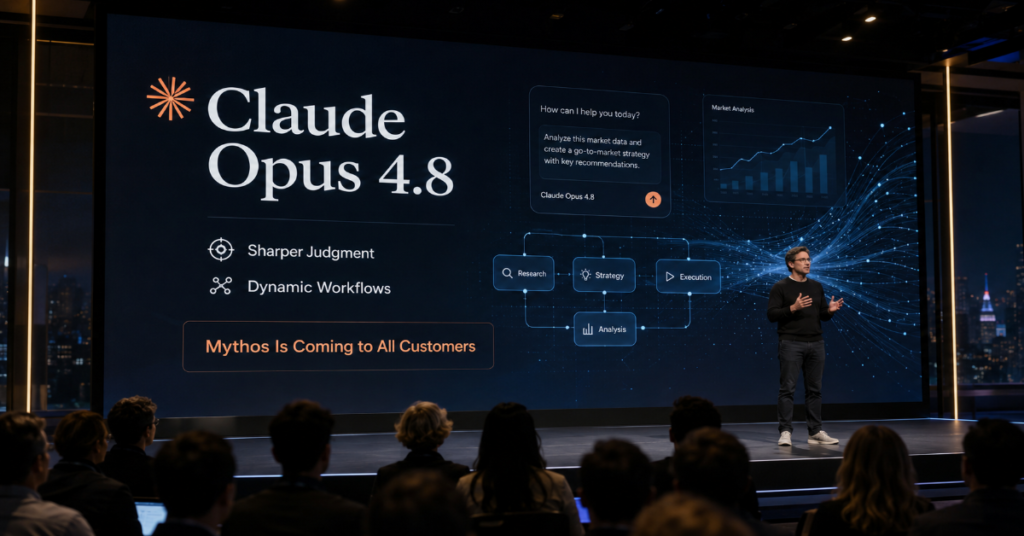
Claude Opus 4.8 launched on May 28, 2026, and it is a meaningfully better model than its predecessor in the domains where enterprise buyers have been applying the most pressure — but the headline capability numbers are almost a secondary story to a single sentence buried in Anthropic’s official release: the company expects to bring Mythos-class models to all customers in the coming weeks. Claude Opus 4.8 is available today to all users on Claude.ai, the Claude API, Amazon Bedrock, Google Cloud Vertex AI, and GitHub Copilot at unchanged pricing from Opus 4.7. The model arrived just 41 days after Opus 4.7 — Anthropic’s fastest flagship model update cycle since the company launched Claude 3 in March 2024, and a direct response to competitive pressure from OpenAI’s GPT-5.5 and Google’s Gemini 3.5 Flash releases in April and May. According to Anthropic’s official release, Axios’s analysis, and 9to5Mac’s technical breakdown reviewed in our research, Opus 4.8 outperforms both GPT-5.5 and Gemini 3.1 Pro on agentic coding, agentic computer use, multidisciplinary reasoning, knowledge work, and agentic financial analysis. TechCrunch noted that the fast update cycle may trace partly to a lukewarm reception to Opus 4.7 from some users who found the previous release underwhelming — and to the observation that the same six-week window saw significant new releases for OpenAI’s Codex and Google’s Gemini Flash, raising competitive stakes.
What Actually Changed in Opus 4.8 — The Four Improvements That Matter
The most significant capability change in Opus 4.8 is the honesty improvement. Anthropic’s evaluations show the model is approximately four times less likely than Opus 4.7 to allow flaws in code it has written to pass unremarked. This is not a minor quality-of-life improvement for enterprise coding deployments — it is a structural change in how reliably the model flags its own uncertainty. In agentic workflows, where Claude Code executes multi-step tasks autonomously over extended periods, a model that silently passes flawed code is worse than a model that stops to flag uncertainty, because the flawed output compounds through subsequent steps. Early testers described Opus 4.8 as more reliable and sharper in its judgment when performing agentic tasks, and less likely to make unsupported claims. Alignment assessments show the model hits new highs on prosocial traits including supporting user autonomy and acting in the user’s best interest — performing at a level comparable to Claude Mythos Preview on those specific measures.
The second significant change is Fast Mode. Opus 4.8 includes a configurable fast mode that operates at 2.5 times the speed of the standard model while costing three times less than previous equivalent configurations. This creates a practical tiering that enterprise buyers have been asking for: standard mode for complex reasoning tasks that benefit from extended thinking time, fast mode for high-volume tasks where speed and cost matter more than maximum reasoning depth. Effort level controls are now configurable — users can specify low, medium, high (default), extra-high, or max effort, allowing workflow orchestrators to tune the model’s compute investment on a per-task basis rather than applying uniform defaults across all completions. For enterprise deployments running thousands of Claude API calls per hour, the ability to route routine tasks to fast mode while reserving high-effort mode for genuinely complex reasoning is a meaningful cost optimisation.
“Opus 4.8 is around four times less likely than its predecessor to allow flaws in code it has written to pass unremarked. Early testers have found Opus 4.8 to be more reliable and sharper in its judgment when it is performing agentic tasks.” — Anthropic, official Claude Opus 4.8 release announcement, May 28, 2026
Claude Opus 4.8 vs Opus 4.7 vs GPT-5.5 — Key Benchmark Comparison
| Benchmark | Opus 4.8 | Opus 4.7 | GPT-5.5 | Gemini 3.1 Pro |
| Agentic coding | Leads — Anthropic claims top position | Second — was competitive | Behind Opus 4.8 | Behind Opus 4.8 |
| Agentic financial analysis | Leads | Below 4.8 | Behind | Behind |
| Agentic computer use | Leads | Below 4.8 | Behind | Behind |
| Multidisciplinary reasoning | Leads | Below 4.8 | Competitive | Competitive |
| Code flaw detection | 4x better than 4.7 | Baseline | Not directly compared | Not directly compared |
| Prosocial alignment | Near Mythos level | Below Mythos | Not published at this level | Not published |
| Fast Mode speed | 2.5x faster than standard | N/A | Not available | Not available |
| Pricing (input/output) | $5/$25 per M tokens — unchanged | Same | Higher at equivalent quality | Varies by tier |
Dynamic Workflows — The Architecture That Changes Enterprise AI
The most consequential announcement in the Opus 4.8 release is not the model itself but a new product architecture shipping simultaneously in research preview: Dynamic Workflows. Dynamic Workflows allows Claude Code running on Opus 4.8 to plan work, spin up hundreds of parallel subagents within a single session, and verify outputs before returning results to the user. Anthropic’s official documentation provides a specific example of what this unlocks: Claude Code with Opus 4.8 can now carry out codebase-scale migrations across hundreds of thousands of lines of code from kickoff to merge, with the existing test suite as its verification bar. This is not an incremental improvement to agentic capability. It is a categorical shift in the scale of software engineering task that a single Claude session can autonomously execute.
Previous Claude Code deployments could run multi-step agentic tasks within a single agent thread. Dynamic Workflows introduces a coordinator-worker architecture where a primary agent plans the overall task, spawns hundreds of parallel worker subagents to execute components of the work simultaneously, and then collects, verifies, and synthesises their outputs before presenting the result. For large-scale software engineering tasks — migrating a 200,000-line codebase from one framework to another, refactoring an entire API surface, or applying a security patch across every service in a distributed system — the sequential single-agent approach was the primary bottleneck. Dynamic Workflows eliminates that bottleneck by parallelising the work while maintaining a coordinating agent that ensures the outputs are coherent, consistent, and verified against the test suite before they are surfaced to the human developer. Dynamic Workflows is available in research preview for Claude Code users on Enterprise, Team, and Max plans.
“For example, Claude Code alongside Opus 4.8 can now carry out codebase-scale migrations across hundreds of thousands of lines of code from kickoff to merge, with the existing test suite as its bar.” — Anthropic, official Dynamic Workflows announcement, May 28, 2026
Mythos for All — What Coming Weeks Actually Means
The sentence that is generating the most discussion in the AI developer community is not about Opus 4.8 itself: it is about Mythos. Anthropic stated in the official release that it is working on models that have the same capabilities as Opus 4.8 at a lower cost, and a new class of model that is even more intelligent than Opus — and that it expects to bring Mythos-class models to all customers in the coming weeks. Claude Mythos Preview, announced April 7, 2026, is Anthropic’s most advanced model — the one that autonomously found thousands of zero-day vulnerabilities across every major operating system and browser, leading to Project Glasswing. It has been restricted since April to the Project Glasswing coalition of AWS, Apple, Microsoft, Google, and approximately 40 additional critical infrastructure organisations, specifically because its cybersecurity offensive capabilities made unrestricted public release too dangerous to deploy without established governance frameworks.
The coming weeks timeline suggests Anthropic believes it has developed sufficient safeguards — training, deployment constraints, use-policy enforcement, and monitoring infrastructure — to extend Mythos-class capability access beyond the Project Glasswing coalition. TechCrunch noted that the Mythos preview period may soon end, once necessary safeguards are complete. For enterprise customers currently using Opus 4.8, this means the model they have available in coming weeks could be materially more capable than what shipped on May 28. For the competitive landscape, Mythos-class capability at general availability represents an advance that neither GPT-5.5 nor Gemini 3.5 can currently match on the specific capability dimensions where Mythos leads. The IPO context matters here: Anthropic’s public S-1 prospectus — expected in August 2026 — will describe a model that is already in general availability, not one that is restricted to 40 organisations.
Key Takeaways
• Claude Opus 4.8 launched May 28, 2026 — just 41 days after Opus 4.7, Anthropic’s fastest flagship update cycle. Available on Claude.ai, API, Amazon Bedrock, Google Cloud Vertex AI, and GitHub Copilot at unchanged pricing ($5/$25 per million input/output tokens).
• Key improvements: 4x better code flaw detection than Opus 4.7; Fast Mode at 2.5x speed and 3x lower cost than previous configurations; configurable effort levels (low through max); prosocial alignment scores at near-Mythos level; leads GPT-5.5 and Gemini 3.1 Pro on agentic coding, financial analysis, computer use, and reasoning benchmarks.
• Dynamic Workflows (research preview on Enterprise, Team, Max plans) enables Claude Code with Opus 4.8 to plan, execute hundreds of parallel subagents simultaneously, and verify outputs — supporting codebase-scale migrations across 100,000+ lines of code in a single coordinated session.
• Anthropic confirmed Mythos-class models are coming to all customers in the coming weeks — ending the Project Glasswing-only restriction that has limited Mythos access since April 7, 2026. Safeguards must be completed before general availability.
• The fast update cycle (41 days vs typical 2-3 months) reflects competitive pressure from GPT-5.5 and Gemini 3.5 Flash, plus user feedback that Opus 4.7 underdelivered relative to expectations — Anthropic is accelerating its release cadence to match OpenAI’s sub-60-day model update pace.
• Anthropic is simultaneously developing a model cheaper than Opus 4.8 and a model more capable than Opus — suggesting a full Claude 5 family is in active development alongside the Mythos general availability work.
Conclusion
Claude Opus 4.8 is a meaningful update that addresses the specific failure modes that most frustrated enterprise Opus 4.7 users: unreliable code flaw detection, limited agentic parallelism, and a lack of configurable effort controls. The four-times improvement in code flaw detection alone changes the calculus for production agentic coding deployments. But the genuine significance of May 28 is not Opus 4.8 — it is the confirmation that Mythos is coming to all customers and that Dynamic Workflows changes the ceiling on what a single Claude session can execute. Mythos at general availability represents a capability advance over any currently available consumer or enterprise AI model on the specific dimensions where frontier AI is most consequential. The coming weeks timeline is Anthropic’s commitment that the safety work is nearly complete. When Mythos ships to all customers, the competitive landscape changes again.
Frequently Asked Questions
What is Claude Opus 4.8?
Claude Opus 4.8 is Anthropic’s latest flagship AI model, launched May 28, 2026, as an upgrade to Opus 4.7. It delivers improvements in agentic coding, multidisciplinary reasoning, agentic computer use, knowledge work, and agentic financial analysis. The model is four times less likely than Opus 4.7 to miss code flaws, features a 2.5x faster Fast Mode at 3x lower cost, and includes configurable effort levels. Pricing is unchanged at $5/$25 per million input/output tokens.
What are Dynamic Workflows in Claude Code?
Dynamic Workflows is a new feature for Claude Code, available in research preview for Enterprise, Team, and Max plan users. It allows a primary Claude agent to plan a complex task, spawn hundreds of parallel subagents to execute components simultaneously, and verify the combined outputs before returning results. This enables codebase-scale migrations across hundreds of thousands of lines of code in a single coordinated Claude Code session.
When will Claude Mythos be available to everyone?
Anthropic stated in the May 28, 2026 release that it expects to bring Mythos-class models to all customers in the coming weeks. Mythos has been restricted since April 7, 2026 to the Project Glasswing coalition (AWS, Apple, Microsoft, Google, and approximately 40 additional organisations) due to its advanced cybersecurity offensive capabilities. Anthropic is completing safeguards required for broader release.
How does Claude Opus 4.8 compare to GPT-5.5?
According to Anthropic’s benchmarks, Claude Opus 4.8 leads GPT-5.5 on agentic coding, agentic financial analysis, agentic computer use, and multidisciplinary reasoning. GPT-5.5 has a 88.7% SWE-bench Verified score; Opus 4.8’s equivalent figures were not separately published at this benchmark. Pricing is comparable. The most significant differentiator Anthropic claims is code flaw detection (4x improvement) and the upcoming Mythos-class general availability, which has no GPT-5.5 equivalent.
Why did Anthropic release Opus 4.8 so quickly after 4.7?
Anthropic released Opus 4.8 just 41 days after Opus 4.7 — its fastest flagship update cycle. TechCrunch reported the speed may reflect a lukewarm reception to Opus 4.7 from some users, plus competitive pressure from significant new releases by OpenAI (Codex updates, GPT-5.5 Instant default) and Google (Gemini 3.5 Flash) during the same six-week window. Anthropic’s $10.9 billion Q2 revenue projection and IPO preparation also create incentives to maintain a rapid innovation cadence.
References
Anthropic. (2026, May 28). Introducing Claude Opus 4.8 and Dynamic Workflows. https://www.anthropic.com/news/claude-opus-4-8
MacRumors. (2026, May 28). Anthropic launches Claude Opus 4.8 with gains in coding and honesty. https://www.macrumors.com/2026/05/28/anthropic-claude-opus-4-8/
TechCrunch. (2026, May 28). Anthropic releases Opus 4.8 with new dynamic workflow tool. https://techcrunch.com/2026/05/28/anthropic-releases-opus-4-8-with-new-dynamic-workflow-tool/
9to5Mac. (2026, May 28). Anthropic upgrades Claude with new Opus 4.8 model, details here. https://9to5mac.com/2026/05/28/anthropic-upgrades-claude-with-new-opus-4-8-model-heres-whats-new/
Axios. (2026, May 28). Anthropic releases Opus 4.8 with new dynamic workflow tool. https://www.axios.com/2026/05/28/anthropic-opus-release-mythos
Help Net Security. (2026, May 29). Anthropic launches Claude Opus 4.8, prepares Mythos-class models for all customers. https://www.helpnetsecurity.com/2026/05/29/anthropic-claude-opus-4-8/
WaveSpeed. (2026, May 28). Claude Opus 4.8: Release date, pricing, benchmarks, and builder notes. https://wavespeed.ai/blog/posts/opus-4-8/
