
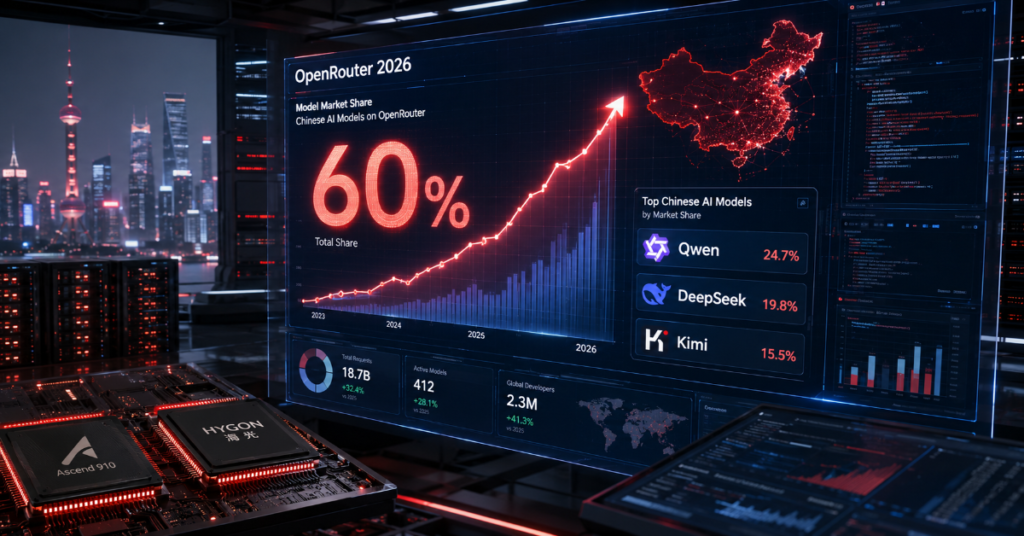
Chinese AI models now account for more than 60 percent of all usage on OpenRouter — the world’s most widely used third-party AI model routing platform — up from approximately one percent in 2024. This is the data point that Databricks CEO Ali Ghodsi disclosed this week, and it is not a niche developer statistic. OpenRouter processes requests from hundreds of thousands of developers and businesses routing AI queries across dozens of models. The shift from one percent to sixty percent in two years is one of the most compressed technology adoption curves ever documented for an enterprise software category. On May 20, 2026, CNBC published a detailed investigative analysis arguing that this competitive dynamic — combined with a nine-times cost differential between Anthropic’s Claude and the cheapest Chinese frontier alternatives — represents the primary structural threat to the $800 billion-plus IPO valuations that OpenAI and Anthropic are both targeting in the second half of 2026. The combination of these two stories is the most important investor-facing AI development of the week, and it arrives on the same day that both companies’ IPO processes entered their most visible public phase.
The Cost Numbers That CNBC Published
CNBC’s investigation, published May 20, is built around a specific benchmark methodology: running ten standard AI evaluation tasks through each model and measuring the total compute cost. The results, sourced from AI benchmarking firm Artificial Analysis, are stark. Anthropic’s Claude costs $4,811 to complete the ten-evaluation set. OpenAI’s ChatGPT (GPT-5.4) costs $3,357. DeepSeek V3.2 costs $1,071. Kimi K2.6 costs $948. Zhipu’s GLM-5.1 costs $544 for the same set of tasks. The ratio between the most expensive Western frontier model (Claude at $4,811) and the cheapest capable Chinese model (GLM at $544) is approximately 8.8 times. Put differently, a developer or enterprise that can achieve equivalent task completion using Zhipu’s GLM instead of Anthropic’s Claude saves 89 percent of their per-query compute cost.
The enterprise adoption data makes the cost differential operational rather than theoretical. According to the latest 2026 data reviewed from Databricks’ internal analysis and Ghodsi’s public statements, enterprises are increasingly adopting what he calls the ‘advisor model’: using cheap open-source or Chinese models as the default layer for the majority of queries and calling OpenAI or Anthropic only for tasks that require capabilities those models cannot provide. In this architecture, the frontier Western models become specialist consultants rather than general-purpose workhorses — expensive to call, valuable when needed, but not the primary compute layer for high-volume enterprise workflows.
“Firms use cheap open-source or Chinese models as the default layer and call OpenAI or Anthropic only for tasks those models cannot solve. In that architecture, every frontier model improvement is immediately challenged by cheaper alternatives that are good enough for most use cases.” — Ali Ghodsi, CEO, Databricks, May 2026
AI Model Cost Comparison — Standard Benchmark Set (10 Evaluations)
| Model | Provider | Cost (10-eval set) | vs Claude | GPQA Score (est.) | OpenRouter Share |
| Claude Opus 4.7 | Anthropic (US) | $4,811 | Baseline | 94.2% | Declining — est. 15% in May 2026 |
| GPT-5.4 | OpenAI (US) | $3,357 | 30% cheaper | ~92% | Declining — est. 20% in May 2026 |
| DeepSeek V3.2 | DeepSeek (China) | $1,071 | 78% cheaper | ~88% (est.) | Part of 60% Chinese share |
| Kimi K2.6 | Moonshot AI (China) | $948 | 80% cheaper | 90.5% | Part of 60% Chinese share |
| GLM-5.1 | Zhipu AI (China) | $544 | 89% cheaper | ~87% (est.) | Part of 60% Chinese share |
| Gemini 3.5 Flash | Google (US) | Lower than Claude | Competitive | Benchmark leader scientific | Growing — Google products push |
Anthropic’s Own Admission — Only Several Months Ahead
The most surprising element of the CNBC investigation is not the cost differential from third-party benchmarking — it is Anthropic’s own acknowledgement of the competitive position. The company released a policy paper in May 2026 stating that US models are only ‘several months ahead’ of Chinese ones and that Beijing is ‘winning in global adoption on cost.’ This is a remarkable disclosure for a company that is simultaneously raising at a $900 billion valuation and projecting its first quarterly profit. It is the kind of candour that is unusual in corporate communications from a company approaching an IPO — and it is either a sign of Anthropic’s intellectual honesty about competitive dynamics or a calculated regulatory message designed to persuade policymakers that frontier AI support is necessary to maintain US advantage.
The ‘several months’ framing is important. If Chinese models are several months behind US frontier capabilities today, and they are improving at a pace that has taken them from one percent to sixty percent of OpenRouter usage in two years, the capability gap narrows to near-parity within the IPO window. An OpenAI or Anthropic IPO in September or October 2026 at a $1 trillion implied valuation requires investors to believe that the pricing premium for the marginal capability advantage is durable. If the gap is ‘several months’ at IPO and narrows to ‘a few weeks’ by the first public earnings report, the pricing power assumption embedded in the valuation collapses faster than the revenue growth rate can compensate for it.
“US AI models are only several months ahead of Chinese ones. Beijing is winning in global adoption on cost. The window to establish durable US frontier advantage is narrowing.” — Anthropic, policy paper released May 2026, cited in CNBC investigation
OpenAI’s Counter-Argument — The Vertical Wall of Demand
OpenAI pushed back on the CNBC narrative, with a person familiar with the company’s thinking arguing that every frontier model release — including GPT-5.5 — had driven what they described as a ‘vertical wall’ of enterprise demand. Their argument: at the true frontier, quality matters enough to justify the price premium. The organisations asking the most demanding questions — the most complex legal analyses, the most sophisticated code generation, the deepest scientific reasoning — will pay for the model that delivers the best answer. Those organisations represent a disproportionate share of enterprise AI value even if they are a small share of query volume.
The tension in OpenAI’s argument is the OpenRouter data itself. A marketplace where Chinese models went from one to sixty percent of usage in two years is not a marketplace where frontier quality is sustaining pricing power across the board. It is a marketplace where quality-sensitive use cases are captured by Western frontier models while quality-insensitive or cost-sensitive use cases migrate to cheaper alternatives at an accelerating rate. If the sixty percent figure continues growing — toward seventy or eighty percent of total OpenRouter queries — the absolute revenue that OpenAI and Anthropic generate from the remaining quality-sensitive segment must grow fast enough to offset the declining market share for their pricing premium to be justified at a trillion-dollar IPO valuation. The Anthropic Q2 revenue trajectory suggests it is, currently. Whether it will still be the case in 2027 and 2028 — when both companies’ IPO lock-up periods expire and institutional investors make their long-term hold decisions — is the genuine uncertainty at the heart of the AI IPO valuation story.
| Valuation Risk Factor | OpenAI | Anthropic | Chinese Model Competitive Response |
| Current implied revenue multiple | ~34x ($25B ARR vs $852B val.) | ~21x ($43.6B ARR vs $900B val.) | DeepSeek V3.2 at $0.28/M tokens vs Claude at ~$15/M — 50x cost advantage |
| Capability gap to Chinese frontier | GPT-5.4 leads on some benchmarks | Claude leads enterprise adoption — 70% win rate | Kimi K2.6: 90.5% GPQA; 4 Chinese models launched in 12 days in April 2026 |
| Pricing power sustainability | Depends on sustained frontier lead | Depends on enterprise stickiness + profitability | OpenRouter share growing — 60% Chinese in May 2026 vs 1% in 2024 |
| IPO valuation risk scenario | High if multiple compressed to 15x = $375B market cap | Moderate — profitability provides floor | If Chinese models reach 90% GPQA parity, cost premium loses justification |
| Counter-argument | Vertical wall of frontier demand | Enterprise switching costs + Claude Code stickiness | OpenRouter skews developer/price-sensitive — not enterprise core revenue |
“Every frontier model release, including GPT-5.5, has driven a vertical wall of enterprise demand. At the true frontier, quality matters enough to justify the price premium — the story is not about cost, it is about capability.” — Person familiar with OpenAI’s thinking, cited in CNBC investigation, May 20, 2026
Key Takeaways
• Chinese AI models grew from approximately 1% to over 60% of OpenRouter usage between 2024 and May 2026 — one of the fastest technology adoption shifts ever documented in enterprise software, representing a fundamental change in how developers route AI queries.
• CNBC’s May 20 investigation, citing Artificial Analysis benchmarking data, found Anthropic’s Claude costs $4,811 per standard 10-evaluation set versus $544 for Zhipu’s GLM — an 8.8x cost differential that is driving the ‘advisor model’ pattern of enterprise adoption where cheap models handle most queries and frontier models handle only specialist tasks.
• Anthropic itself acknowledged in a May 2026 policy paper that US AI models are only ‘several months ahead’ of Chinese frontier models and that China is ‘winning in global adoption on cost’ — a candid disclosure that directly complicates the pricing power assumptions embedded in both companies’ $800 billion-plus IPO valuations.
• The Databricks ‘advisor model’ enterprise pattern — using cheap open-source or Chinese models for most queries and calling Western frontier models only for specialist tasks — structurally reduces the total addressable market paying premium prices, even as absolute frontier demand grows.
• OpenAI counters that frontier quality creates a ‘vertical wall’ of demand from the most valuable enterprise use cases — arguing that the quality-sensitive segment paying premium prices grows in absolute value even if it shrinks as a share of total queries.
• The timing creates maximum investor uncertainty: both IPO processes are entering their most visible public phase at the exact moment when the competitive dynamics most challenging to their valuation narratives are most clearly documented in public data.
Conclusion
The convergence of three data points on the same week — OpenRouter’s 60% Chinese model share, the CNBC cost benchmarking showing an 8.8x differential, and Anthropic’s own admission of ‘several months’ lead — creates the clearest public picture of the AI competitive landscape that investors have ever had. It is not a picture that obviously supports $800 billion to $1 trillion valuations for companies whose primary product advantage is frontier model quality. It is a picture that requires believing one of three things: that frontier model quality will sustain a durable pricing premium even as Chinese model quality approaches parity; that enterprise switching costs and integration depth create a moat that protects revenue even when cheaper alternatives are available; or that both companies will find new revenue categories — infrastructure, services, deployment, vertical applications — that grow faster than the per-query cost compression that Chinese competition is driving. Anthropic’s Q2 profitability projection, its million-dollar enterprise customer doubling, and Claude Code’s deep workflow integration are the strongest available evidence for the switching-cost and new-category arguments. Whether they are strong enough to sustain a trillion-dollar valuation through the public market’s quarterly judgment cycle is the most consequential unanswered question in technology investing in 2026.
Frequently Asked Questions
What is OpenRouter and why does its data matter?
OpenRouter is the most widely used third-party AI model routing platform for developers — it allows developers to access dozens of AI models through a single API, routing queries to whichever model is specified. Because it is model-agnostic and widely used, its usage data is one of the cleanest available signals of where developer demand is actually going across the AI model landscape, unfiltered by any single vendor’s reporting.
Why are Chinese AI models so much cheaper than Claude?
Several factors: Chinese AI labs operate with lower labour costs, receive significant state subsidy and infrastructure support, and have optimised their models specifically for cost efficiency — particularly DeepSeek, which demonstrated in early 2025 that frontier-class capabilities could be achieved at a fraction of Western training costs. They also price aggressively to gain market share on Western developer platforms, with DeepSeek V3.2 at $0.28 per million tokens versus Claude at approximately $15 per million tokens for comparable tasks.
Is Claude actually only 9x more expensive than Chinese alternatives?
Based on Artificial Analysis’s ten-evaluation benchmark set: Claude Opus 4.7 costs $4,811 versus Zhipu GLM-5.1 at $544 — an 8.8x differential. This comparison reflects compute costs for a specific set of standard evaluations and will vary by task type. For tasks where Claude’s superior reasoning is necessary, the quality difference justifies the cost. For tasks where GLM’s quality is adequate, the cost differential is the dominant factor.
Does the Chinese model cost advantage threaten the OpenAI and Anthropic IPOs?
CNBC’s May 20 investigation argues yes — that the pricing gap and OpenRouter’s 60% Chinese share erode the pricing power assumptions embedded in $800 billion-plus valuations. OpenAI argues that frontier quality creates durable demand from the most valuable enterprise use cases. Anthropic’s Q2 profitability data suggests its enterprise revenue is growing faster than cost compression so far. The true test will be in the public S-1 financials and the first one or two post-IPO quarterly earnings reports.
What is the advisor model in enterprise AI?
The advisor model is the enterprise AI architecture described by Databricks CEO Ali Ghodsi: organisations use cheap open-source or Chinese AI models as the default layer for the majority of their queries, and call expensive Western frontier models (Claude, GPT) only for tasks that cheaper models cannot handle to adequate quality. This pattern reduces the share of total queries going to premium-priced frontier models, even as demand for those models for specialist tasks continues to grow.
References
CNBC. (2026, May 20). Cheap AI could derail OpenAI and Anthropic IPOs. https://www.cnbc.com/2026/05/20/cheap-ai-could-derail-openai-and-anthropic-ipos.html
Build Fast with AI. (2026, May 21). AI news today — May 22, 2026: 12 biggest stories. https://www.buildfastwithai.com/blogs/ai-news-today-may-22-2026
Artificial Analysis. (2026, May). AI model cost and performance benchmarking — May 2026. https://artificialanalysis.ai
Ghodsi, A. (2026, May). [Public statements on OpenRouter Chinese model adoption]. Databricks CEO commentary.
OpenRouter. (2026, May). Usage statistics — model distribution data. https://openrouter.ai
Anthropic. (2026, May). Policy paper on US-China AI competitive dynamics. https://www.anthropic.com/policy
Benaich, N. (2026, May). State of AI — May 2026. Air Street Capital. https://nathanbenaich.substack.com/p/state-of-ai-may-2026
