
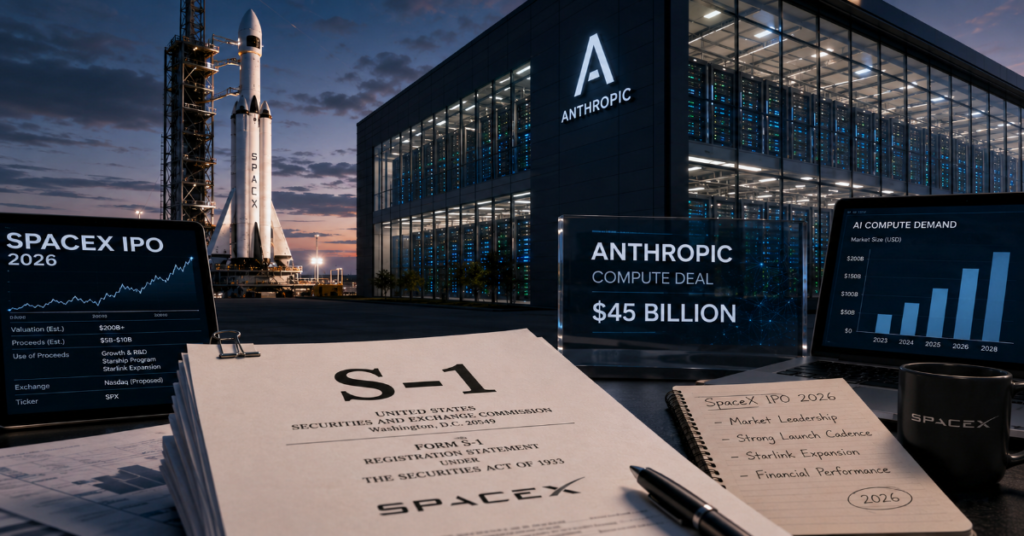
The SpaceX IPO prospectus, filed with the SEC on May 20, 2026, targeting a Nasdaq listing under the ticker SPCX at a reported $1.75 trillion valuation, contained a bombshell that had nothing to do with rockets. Buried in the related-party transactions section — the part of a prospectus that most investors skip — is a disclosure that Anthropic has agreed to pay SpaceX $1.25 billion every month for compute access through May 2029. Over the full term of the contract, that is approximately $45 billion. At the current monthly rate, it is $15 billion per year — nearly matching SpaceX’s entire 2025 standalone revenue before the xAI merger. The disclosure, confirmed simultaneously by Anthropic president Daniela Amodei on X and by Build Fast with AI’s May 22 roundup, is the single most important data point about frontier AI infrastructure costs ever disclosed in a public document. It reveals why Anthropic’s compute efficiency ratio matters so much, why the GB200 upgrade at Colossus 2 is strategically critical, and why Anthropic’s move to first-ever profitability in Q2 2026 is even more remarkable than the headline number suggests.
What Colossus Is and Why Anthropic Is Paying $15 Billion Per Year for It
Colossus 1 is the Memphis, Tennessee data centre that xAI — the Musk-founded AI company now merged into SpaceX as SpaceXAI — built in 2024 at a cost exceeding $1 billion. The facility contains more than 220,000 NVIDIA GPUs including H100s, H200s, and GB200 Blackwell Ultra chips, delivering approximately 300 megawatts of compute power at peak — enough to run some of the largest AI training runs in history simultaneously. When xAI merged into SpaceX in February 2026 and was formally dissolved as a separate company in May, Colossus 1 became a SpaceX asset. The decision to lease its excess capacity to Anthropic — the company whose Claude models directly compete with Grok, the AI product xAI built at Colossus — is one of the more ironic commercial decisions in recent technology history.
The $1.25 billion monthly price tag reflects the genuine scarcity of compute at this scale. NVIDIA GB200 and H200 GPUs are in short supply globally; the lead time for large cluster purchases from NVIDIA is measured in months. An organisation that wants to train or run inference on frontier models at the scale Anthropic requires either builds its own infrastructure — a multi-year, multi-billion-dollar project — or rents from an entity that already has it. Amazon Web Services, Google Cloud, Microsoft Azure, and now SpaceX’s Colossus are the primary options at the capacity level Anthropic needs. The SpaceX deal is notable because Colossus offers something the hyperscalers cannot: the GB200 Blackwell Ultra generation at a scale and in a physical concentration that enables the kinds of large training runs that frontier model development requires. According to the latest 2026 documentation reviewed from Anthropic president Daniela Amodei’s X post and Build Fast with AI’s analysis, Colossus 2 — SpaceX’s second Memphis facility, online since January 2026 — is scaling GB200 capacity through June, which is why the $1.25 billion monthly rate is expected to provide even more compute value per dollar in H2 2026 than it does today.
“We’re expanding our partnership with SpaceX, and will be scaling up on GB200 capacity in Colossus 2 throughout June.” — Daniela Amodei, Co-founder and President, Anthropic, post on X, May 21, 2026
SpaceX IPO Prospectus — Key Financial Disclosures
| Financial Item | SpaceX S-1 Data | Context |
| Target IPO valuation | $1.75 trillion | Would be largest IPO in history at this valuation |
| Listing exchange / ticker | Nasdaq / SPCX | Elon Musk retains 85.1% of combined voting power (Class B: 10 votes/share) |
| Starlink subscribers | 10.3 million in 164 countries (March 31, 2026) | Connectivity segment: $1.19B operating profit in Q1 2026 |
| Space segment Q1 result | $662M operating loss | Starship R&D and launch infrastructure investment |
| SpaceXAI segment Q1 revenue | $818 million | Primarily Grok/AI products — $1.25B/month Anthropic compute deal ramping |
| SpaceXAI Q1 operating loss | $2.47 billion | Loss rate of $3 for every $1 of revenue — xAI merger effect |
| Total Q1 revenue | $4.69 billion | Combination of Connectivity, Space, and AI segments |
| Total Q1 net loss | $4.28 billion | xAI acquisition turned profitable SpaceX into loss-making entity |
| Anthropic compute contract | $1.25B/month through May 2029 | $45B total — largest AI compute contract ever disclosed |
| Full year 2025 revenue | $18.7 billion (combined inc. xAI/X) | Net loss $4.9 billion — xAI merger effect on FY figures |
The Compute Cost Context — What $1.25 Billion Per Month Tells Us
Anthropic’s $1.25 billion monthly compute spend at Colossus alone is the clearest public data point ever available on the true infrastructure cost of frontier AI at scale. It contextualises a series of previously opaque financial dynamics. Anthropic’s Q1 2026 compute cost ratio of 71 cents per dollar of revenue — on $4.8 billion in revenue — implies approximately $3.4 billion in total compute spending in Q1. At $1.25 billion per month, the SpaceX deal alone accounts for $3.75 billion per quarter, suggesting that Colossus is not just one provider among many but potentially the single largest compute source in Anthropic’s infrastructure. The remaining compute (AWS, Google Cloud, Broadcom, Microsoft, Fluidstack) is additional.
The Q2 projection of a 56-cent compute ratio on $10.9 billion in revenue implies approximately $6.1 billion in total Q2 compute spending. If the SpaceX deal remains at $1.25 billion per month, that is $3.75 billion of the $6.1 billion — 61 percent of Q2 compute spend coming from a single vendor. This concentration is not an accident — it reflects the physical reality that Colossus 1 and Colossus 2 together represent one of the largest coherent GPU clusters in the world, and large coherent clusters are what frontier model training and serving at Anthropic’s scale requires. Breaking that compute into smaller chunks distributed across multiple clouds introduces networking latency and orchestration complexity that reduces training efficiency. The 90-day termination clause on both sides gives both Anthropic and SpaceX exit flexibility — but the operational reality of migrating a $1.25 billion-per-month training workload in 90 days is a theoretical flexibility, not a practical one.
“SpaceX’s IPO filing contains the single most revealing public disclosure about frontier AI infrastructure costs ever published. Anthropic is paying $1.25 billion per month — $45 billion total through 2029 — for access to the Colossus compute cluster.” — Build Fast with AI, May 22, 2026
The SpaceX Valuation Story — Three Very Different Businesses
SpaceX’s $1.75 trillion target valuation is built on three businesses with very different financial profiles. The Connectivity segment — Starlink internet service — is the cash cow: $1.19 billion in Q1 2026 operating profit from 10.3 million subscribers in 164 countries. Starlink is a capital-intensive business to build but, at scale, generates operating leverage as each new subscriber adds revenue without proportional infrastructure cost. The Space segment — rocket launches, Starship development, and government contracts — generates revenue but posted a $662 million Q1 operating loss, driven by the ongoing R&D investment in Starship, which aims to reduce the per-kilogram cost of orbital launch by a factor of 10.
The AI segment (SpaceXAI — formerly xAI — including Grok and X) is the most interesting and the most problematic for the valuation story. In Q1, SpaceXAI posted $818 million in revenue and a $2.47 billion operating loss — a loss rate of approximately three dollars for every one dollar of revenue. The majority of that loss is the infrastructure and R&D cost of running Grok and xAI’s model development, which has not yet reached the revenue scale that Anthropic’s and OpenAI’s competing products have achieved. The xAI merger was supposed to add AI revenue to SpaceX’s balance sheet; in Q1, it added an operating loss that turned a profitable SpaceX into a loss-making entity. The investment thesis for the AI segment is the same as for the Space segment: the losses are investment in a position, not structural. The Anthropic compute deal — $1.25 billion per month in contractual revenue ramping through Q2 and Q3 — is the primary mechanism by which the AI segment moves toward breakeven.
Key Takeaways
• SpaceX filed its IPO prospectus on May 20, 2026, targeting a $1.75 trillion Nasdaq listing under ticker SPCX. Elon Musk retains 85.1% of combined voting power through a dual-class share structure. He will not sell any shares in the offering.
• The prospectus revealed Anthropic pays SpaceX $1.25 billion per month for compute access at Colossus 1 and Colossus 2 (Memphis, Tennessee) through May 2029 — $45 billion total. This is the largest AI compute contract ever disclosed in a public document.
• Anthropic is simultaneously expanding to Colossus 2 for GB200 (Blackwell Ultra) GPU access, with scaling through June 2026 confirmed by Anthropic president Daniela Amodei on X — meaning the $1.25 billion monthly rate provides increasing compute value as GB200 capacity ramps.
• SpaceX’s Q1 2026 financials show three very different business profiles: Connectivity (Starlink) generated $1.19 billion operating profit; Space segment posted a $662 million operating loss from Starship R&D; SpaceXAI posted $818 million revenue and a $2.47 billion operating loss.
• The xAI merger in February 2026 converted a profitable SpaceX into a loss-making entity at the consolidated level. The Anthropic $1.25 billion per month compute contract is the primary mechanism for moving the AI segment toward breakeven in Q2 and Q3 2026.
• Either party can terminate the Anthropic-SpaceX compute contract with 90 days’ notice — but migrating $1.25 billion per month in frontier training workloads in 90 days represents a theoretical rather than practical exit option for Anthropic given its current infrastructure dependency.
Conclusion
The SpaceX S-1’s disclosure of Anthropic’s $1.25 billion monthly compute commitment is the most important AI infrastructure data point of 2026 — more revealing than any benchmark release or model announcement. It answers the question that has been lurking behind every Anthropic financial projection: what does it actually cost to train and run frontier AI at the scale required to generate $43.6 billion in annualised revenue and approach operating profitability? The answer, at minimum, is $15 billion per year in compute spending from a single provider, with additional commitments to Amazon, Google, and others on top. The Q2 improvement in compute efficiency — from 71 cents to 56 cents per dollar of revenue — is therefore not a marginal operational tweak. It is a $1.6 billion margin improvement at Q2 revenue scale, achieved while simultaneously scaling to more expensive GB200 infrastructure. If Anthropic can continue improving compute efficiency as it gains access to more advanced GPU generations through Colossus 2, the profitability trajectory becomes self-reinforcing: more revenue, more compute leverage, more margin, more resources for the next model generation. The SpaceX filing did not intend to be an Anthropic financial disclosure. It is, inadvertently, the most useful one that exists.
Frequently Asked Questions
How much is Anthropic paying SpaceX for compute?
Anthropic is paying SpaceX $1.25 billion per month for GPU compute access at the Colossus 1 and Colossus 2 data centres in Memphis, Tennessee. The contract runs through May 2029, totalling approximately $45 billion. The monthly rate is $15 billion per year — disclosed in SpaceX’s IPO prospectus filed May 20, 2026.
What is SpaceX’s IPO valuation?
SpaceX filed its IPO prospectus targeting a $1.75 trillion valuation and a Nasdaq listing under ticker SPCX. If achieved, this would be the largest IPO in history by implied market capitalisation. Elon Musk retains 85.1% of voting power and is not selling shares in the offering.
What is Colossus and why does Anthropic use it?
Colossus 1 and Colossus 2 are SpaceX-owned data centres in Memphis, Tennessee, built originally by xAI before the SpaceX merger. Colossus 1 contains 220,000-plus NVIDIA GPUs delivering 300 megawatts of compute. Colossus 2 is being scaled with GB200 Blackwell Ultra GPUs through June 2026. Anthropic rents this compute for training its Claude models because building equivalent infrastructure from scratch would take two or more years.
Is the SpaceX AI segment profitable?
No. SpaceXAI (formerly xAI, now the AI division of SpaceX) posted $818 million in revenue and a $2.47 billion operating loss in Q1 2026 — a loss rate of approximately $3 for every $1 of revenue. The Anthropic compute contract, which ramps to full $1.25 billion monthly rate in Q2 and Q3 2026, is expected to add approximately $2.5 billion in quarterly AI revenue and move the segment toward breakeven.
Why can either party exit the Anthropic-SpaceX compute deal with 90 days’ notice?
Both sides wanted contractual exit flexibility. SpaceX may need the compute capacity for its own AI development if SpaceXAI’s Grok models reach training scale. Anthropic wants the ability to diversify to other compute sources if better options become available. In practice, migrating $1.25 billion per month in frontier training workloads in 90 days is operationally very difficult, making the clause a theoretical exit option rather than a practical one for Anthropic’s current workloads.
References
SEC EDGAR. (2026, May 20). SpaceX IPO prospectus — S-1 filing. https://www.sec.gov/cgi-bin/browse-edgar?action=getcompany&company=SpaceX
Build Fast with AI. (2026, May 21). AI news today — May 22, 2026: 12 biggest stories. https://www.buildfastwithai.com/blogs/ai-news-today-may-22-2026
Amodei, D. (2026, May 21). [Post on X — Colossus 2 expansion confirmation]. https://x.com/danielaamodei
Reuters. (2026, May 20). SpaceX files IPO prospectus at $1.75 trillion target valuation. Reuters Technology.
Bloomberg. (2026, May 20). SpaceX S-1 reveals $45 billion Anthropic compute contract. Bloomberg Technology.
CNBC. (2026, May 21). SpaceX IPO filing: Starlink, Starship, xAI and the Anthropic deal explained. https://www.cnbc.com/2026/05/21/spacex-ipo-filing-explained/
The Information. (2026, May 21). SpaceX S-1 bombshell: Anthropic paying $1.25 billion monthly for Colossus compute. https://www.theinformation.com/articles/spacex-s1-anthropic-compute-deal
