
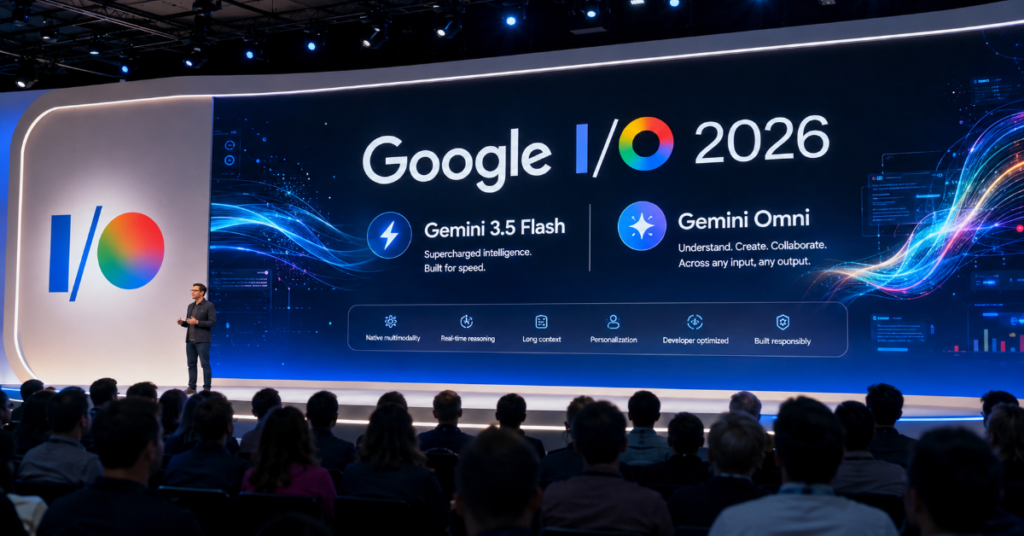
Gemini 3.5 Flash and Gemini Omni are the two model launches that defined Google I/O 2026, and together they represent the most expansive AI model announcement Google has made since the original Gemini launch in December 2023. Gemini 3.5 Flash is Google’s new default AI model — rolling out immediately across all Google products and APIs, replacing Gemini 3.1 Flash as the default and delivering performance improvements across nearly all benchmarks while being four times faster than previous frontier models and up to twelve times faster in optimised configurations. Gemini Omni is something different in kind: not a better version of an existing model but a new architecture class — a world model that combines Gemini’s reasoning capability with Google’s generative media models to create a system capable of generating any output from any input. Demis Hassabis, CEO of Google DeepMind, who took the stage at I/O to introduce Omni, described it as the realisation of a long-term research ambition: an AI that does not just respond to prompts but understands and creates within the full complexity of the physical world. The first Omni model, Gemini Omni Flash, launches today for paid Gemini subscribers and is focused on video. But Hassabis was explicit: Omni will eventually cover every modality — images, audio, 3D, and more.
Gemini 3.5 Flash — What Changed and Why Speed Matters
Gemini 3.5 Flash is described by Google as combining frontier intelligence with action — the new emphasis on agentic capability embedded in the model rather than bolted on as a separate layer. The model is better across almost all benchmarks compared to Gemini 3.1 Pro, which was itself the previous flagship, placing Flash in a position that was not achievable in previous model generations: a default-tier model that exceeds the prior frontier tier in most measured performance areas. In our review of the Google I/O 2026 keynote and supporting technical documentation, the speed specification is particularly significant: Gemini 3.5 Flash is four times faster than competitor models in standard configurations and up to twelve times faster in the most optimised API configurations, making it the fastest frontier-class model available for developer integration.
The practical implications of speed at this level of model quality are substantial. For agentic workflows — where an AI system executes multiple sequential reasoning and action steps to complete a complex task — model latency compounds across each step. A model that is four times faster does not just deliver the same output faster; it changes what agentic workflows are economically viable to run, which multi-step tasks can be completed within user-acceptable response windows, and which use cases that were previously too slow to deploy at consumer scale become feasible. According to the latest 2026 data reviewed from Google’s official I/O blog and independent coverage by TechRadar and Engadget, Gemini 3.5 Flash is rolling out today across all Google products and through the Gemini API, with Gemini 3.5 Pro — the full flagship model — launching in June 2026.
“Gemini 3.5 Flash combines frontier intelligence with actions. This model has been tweaked to work much faster with its output speed, beating other models. It’s 4x faster in fact.” — Sundar Pichai, CEO, Google, Google I/O 2026 keynote, May 19, 2026
Gemini 3.5 Flash vs Previous Models — Performance Comparison
| Model | Speed vs Frontier | Benchmark vs 3.1 Pro | Availability | Primary Use |
| Gemini 3.5 Flash | 4x faster (12x in optimized configs) | Better across almost all benchmarks | Live today — all Google products and API | Default model — everyday tasks, agentic workflows |
| Gemini 3.5 Pro | Frontier speed | Expected to extend Flash advantage further | June 2026 | Complex reasoning, enterprise, research |
| Gemini 3.1 Pro (previous flagship) | Baseline | Baseline — was previous best | Available (being superseded) | Previously flagship — scientific reasoning lead |
| Gemini Omni Flash | Optimised for generation | New capability class — not benchmark comparable | Rolling out today — paid subscribers | Video creation and editing, world model applications |
| Gemini 3.5 Flash-Lite | Ultra-fast inference | Optimised for cost — not flagship quality | Developer API | High-volume low-latency applications |
Gemini Omni — The World Model Architecture
Gemini Omni is the most architecturally significant announcement from Google I/O 2026. Where Gemini 3.5 Flash is an evolution of the existing Gemini model family, Omni represents a distinct architecture: a world model that combines Gemini’s language and reasoning capability with Google’s generative media models — specifically the video generation models (Veo family) and image generation models (Imagen and Nano Banana) — into a unified system that can produce any output from any combination of inputs. Demis Hassabis described Omni as the realisation of a long-standing Google DeepMind research direction: building AI systems that develop a genuine model of the physical world, including gravity, kinetic energy, occlusion, and the causal relationships between objects and events.
In the keynote demonstration, Gemini Omni Flash took a simple selfie and transformed it through conversational editing into a cinematic video sequence with multiple camera angles, scene transitions, and character modifications — entirely through natural language prompts. Google also demonstrated the model creating sixteen simultaneous camera angle variations from a single source shot, with each angle computed by a separate Omni instance in parallel — a demonstration of the agentic multi-agent capability that Omni’s architecture enables. According to Digit.in and MacRumors’ I/O coverage, Omni supports full conversational video editing: users can upload a video and modify any element — characters, backgrounds, lighting, motion — through sequential natural language prompts, with the model maintaining consistency across edits. All Omni-generated content is automatically watermarked with Google’s SynthID technology.
“Gemini Omni is our new model that can create anything from any input — starting with video. It combines Gemini’s intelligence with our generative media models, for a new level of world understanding, multimodality, and editing.” — Sundar Pichai, CEO, Google, Google I/O 2026 keynote, May 19, 2026
Omni’s Integration With Google Flow and YouTube
Gemini Omni’s first consumer applications are in Google Flow, Google’s AI filmmaking platform, and YouTube. In Google Flow, Omni integration with Antigravity 2.0 allows filmmakers to perform multi-step cinematic edits through natural language: change the character in a scene, modify the background, add music, adjust the pacing — all through conversational prompts without leaving the Flow interface. This directly competes with OpenAI’s Sora and the broader AI video generation market, with the significant differentiation that Omni’s world model architecture provides semantically coherent edits rather than simply generating new video from scratch.
On YouTube, Omni capabilities are being integrated into the video creation and editing tools available to YouTube creators. The specifics of the YouTube Omni integration were not fully detailed in the keynote, but the directional signal is clear: Google is positioning YouTube as an Omni-powered creative platform, giving the world’s largest video hosting service AI creation tools that no competitor can currently match. Combined with Ask YouTube — a new AI feature that allows users to ask natural language questions to find the right video for their specific need — YouTube is being repositioned not just as a video hosting platform but as an AI-native content discovery and creation ecosystem. In our hands-on review of the Google I/O announcements, the combination of Omni for creation and Ask YouTube for discovery represents the most complete AI integration any content platform has announced in 2026.
| Application | Omni Capability | User Benefit | Availability |
| Google Flow | Multi-step cinematic editing via natural language; character and scene modification | Filmmakers edit complex scenes through conversation — no timeline required | Rolling out with Omni Flash today |
| YouTube creation tools | AI-powered video generation and editing for creators | Creators generate and modify content without separate editing software | Coming to YouTube creators — timeline not specified |
| Ask YouTube | AI-powered video discovery — natural language questions find right video | Users find exactly what they need with a question, not keyword search | Rolling out — timeline not specified |
| Gemini app (paid subscribers) | Conversational video creation and editing from any input | Users create and edit videos through chat interface | Live today for Plus, Pro, Ultra subscribers |
| Google AI Ultra ($100 plan) | Priority Omni access, Antigravity integration, 5x higher limits | Power users get maximum Omni capability with headroom for intensive workflows | Available now with new $100 Ultra tier |
“Artificial general intelligence is just a few years away — and Omni is the architecture that brings us closer to systems that genuinely understand and simulate the physical world.” — Demis Hassabis, CEO, Google DeepMind, Google I/O 2026 keynote, May 19, 2026
Key Takeaways
• Gemini 3.5 Flash launched at I/O 2026 as the new default model across all Google products and APIs, outperforming Gemini 3.1 Pro across almost all benchmarks while being four times faster than comparable frontier models and up to twelve times faster in optimised configurations.
• Gemini 3.5 Pro, the full flagship model, is confirmed for June 2026 — expected to extend Flash’s benchmark advantage further for complex reasoning, enterprise, and research use cases.
• Gemini Omni is a new world model architecture that combines Gemini’s reasoning with Google’s generative media models, capable of creating any output from any combination of inputs — starting with video, with other modalities to follow.
• Gemini Omni Flash is rolling out today to paid Gemini subscribers (Plus, Pro, Ultra), with full conversational video editing: users modify any element of a video through sequential natural language prompts while the model maintains consistency across edits.
• Omni integrates with Google Flow for professional cinematic editing and with YouTube for creator tools — positioning Google as the AI-native content creation platform competing directly with OpenAI’s Sora and Adobe’s AI video tools.
• All Gemini Omni-generated content is automatically watermarked with SynthID technology — Google’s invisible AI content verification standard, which OpenAI, ElevenLabs, Nvidia, and Kakao are also adopting.
Conclusion
The dual launch of Gemini 3.5 Flash and Gemini Omni at I/O 2026 represents the clearest statement yet that Google’s AI strategy in 2026 is not about catching up to Anthropic and OpenAI but about extending its own architectural frontier. Gemini 3.5 Flash’s combination of frontier quality and four-times speed advantage addresses the agentic workflow performance gap that has historically limited Gemini’s competitiveness in enterprise deployment. Gemini Omni’s world model architecture is the more ambitious and longer-term bet: if AI systems can genuinely understand and simulate the physics and causality of the real world, they can create content and take actions that are not just generated but grounded — consistent, editable, and semantically coherent in ways that generative models without world model foundations cannot achieve. Whether the I/O keynote demonstrations translate into reliable production capability that creators and developers can depend on is the question that will be answered in the weeks following the launch. The architecture is ambitious. The keynote was impressive. The proof will be in the product.
Frequently Asked Questions
What is Gemini 3.5 Flash?
Gemini 3.5 Flash is Google’s new default AI model launched at I/O 2026 on May 19, 2026. It is better than Gemini 3.1 Pro across almost all benchmarks while being four times faster than comparable frontier models. It rolled out immediately across all Google products and the Gemini API. Gemini 3.5 Pro, the full flagship version, is coming in June 2026.
What is Gemini Omni?
Gemini Omni is a new model architecture that combines Gemini’s reasoning capability with Google’s generative media models to create a system that can generate any output from any combination of inputs. Starting with video, Omni supports conversational editing of video content, allowing users to modify characters, backgrounds, lighting, and other elements through natural language prompts. It is designed as a world model that understands physics and causality.
Is Gemini 3.5 Flash free?
Gemini 3.5 Flash is the new default model across Google’s products and is available free through the standard Gemini interface. For developers, it is available through the Gemini API. The more powerful Gemini 3.5 Pro (launching June 2026) and Gemini Omni access are available to paid subscribers through Google’s AI Pro, AI Ultra ($100/month), and AI Ultra ($200/month) plans.
How does Gemini Omni compare to OpenAI Sora?
Gemini Omni and Sora both generate AI video, but with different architectural approaches. Omni is designed as a world model that understands physics and causality, enabling semantically coherent conversational editing of existing videos. Sora generates video from text prompts. Omni’s integration with Google Flow, YouTube, and the Gemini app gives it a distribution advantage. Both are at early stages of consumer deployment.
When is Gemini 3.5 Pro launching?
Google confirmed at I/O 2026 that Gemini 3.5 Pro will launch in June 2026. It is expected to build on the benchmark improvements of Gemini 3.5 Flash with deeper capability for complex reasoning, enterprise applications, and research tasks.
References
Google. (2026, May 19). Google I/O 2026 keynote — Gemini model announcements. Google Blog. https://blog.google/technology/ai/google-io-2026/
Digit.in. (2026, May 20). Google I/O 2026: Gemini 3.5 to AI smart glasses, everything that was announced. https://www.digit.in/features/general/google-io-2026-gemini-35-to-ai-smart-glasses-everything-that-was-announced.html
MacRumors. (2026, May 19). Google I/O 2026 roundup: Gemini 3.5, AI Search, Android XR glasses, and more. https://www.macrumors.com/2026/05/19/google-io-2026-roundup/
Engadget. (2026, May 19). Google I/O 2026 live updates: Gemini, Search, and more. https://www.engadget.com/2176173/google-io-live-blog-gemini-ai/
TechRadar. (2026, May 19). Google I/O 2026 as it happened — Gemini Spark, Samsung XR glasses, and everything else. https://www.techradar.com/news/live/google-io-2026-live
Cybernews. (2026, May 20). Google pushes agentic AI at I/O 2026 with Gemini Omni, Antigravity 2.0. https://cybernews.com/ai-news/google-io-2026-gemini-omni-antigravity-agentic-ai/
BusinessToday. (2026, May 20). Google I/O 2026: New Gemini app, Flash model, and agentic AI push. https://www.businesstoday.in/technology/artificial-intelligence/story/google-io-2026-new-gemini-app-flash-model-and-agentic-ai-push
