
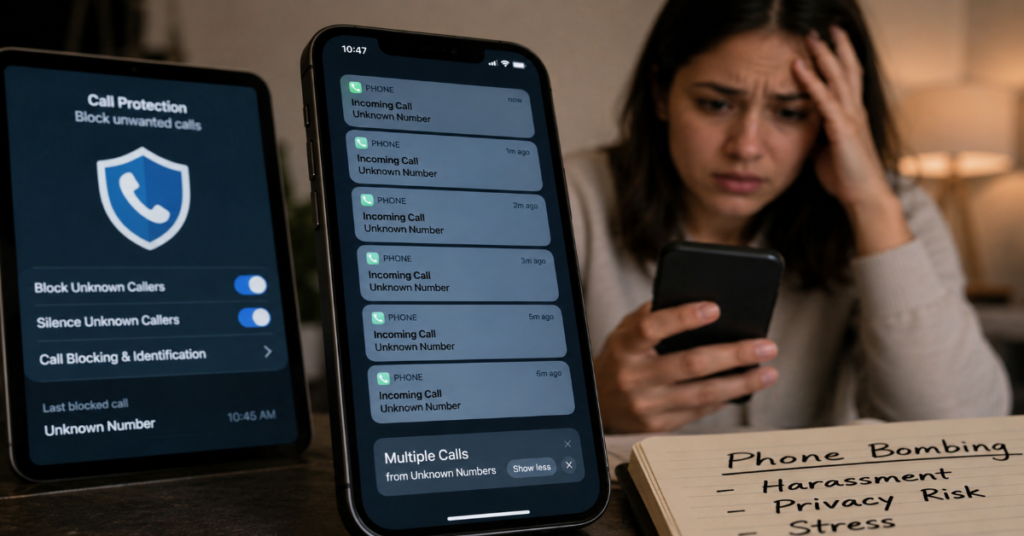
Call Bomber In is a search phrase many people use when they are trying to understand call-bombing websites, prank-call tools or services that send repeated automated calls to a phone number. The important point is simple: a call bomber is not a harmless toy when used on someone else. It can overwhelm a person’s phone, disrupt work, create anxiety and interfere with emergency communication.
These tools are usually promoted as “prank” services. Some websites ask users to enter a target number and press a button to trigger repeated calls or SMS messages. Others appear as Android APKs outside official app stores. The packaging may look casual, but the behavior resembles spam automation and harassment.
This article does not explain how to attack a number. Instead, it explains what the phrase means, why these services are dangerous, what victims can do, how regulators are responding to spam calls and what phone users should expect in 2027.
The issue sits at the intersection of consumer telecom safety, cybersecurity and online harassment. India’s telecom regulator has pushed carriers to act against spam and fraudulent calls, including blacklisting unregistered senders for up to two years in some cases. In Pakistan, cybercrime enforcement falls under the broader framework of the Prevention of Electronic Crimes Act, 2016, which applies to electronic systems and digital communications.
What Does Call Bomber In Mean?
The phrase Call Bomber In most often points to “call bomber” or “call bomb” services connected with India-focused search behavior, domain names or prank-call pages. It may also be typed by users who have seen a website ending in “.in” or are looking for information about call flooding.
A call bomber is a tool designed to send repeated calls to a phone number in a short period. Some versions also send SMS messages. A user enters a number, starts the process and the target receives a burst of calls from different sources or repeated automated triggers.
That is why the term should be treated carefully. The same mechanism that someone may describe as a joke can become harassment when used without consent.
How Call-Bombing Tools Usually Present Themselves
Most call-bombing pages follow a familiar pattern:
| Feature | How it usually appears | Safety concern |
| Phone number field | User enters a target mobile number | Can be abused against people without consent |
| “Prank” wording | Site claims the tool is for fun | Downplays harm and legal risk |
| Call plus SMS option | Repeated calls and messages | Can overwhelm the target’s device |
| APK download | App offered outside official stores | May contain malware or intrusive permissions |
| No clear ownership | Anonymous domain or developer | Hard to verify accountability |
| Terms checkbox | User agrees to vague terms | Does not make misuse legal |
The most dangerous part is the false sense of harmlessness. A phone number is a personal communication channel. Flooding it can block real calls, disturb sleep, affect work and create fear for the victim.
Why Call Bombing Is Not Just a Prank
Call bombing creates three kinds of harm.
First, it disrupts communication. A person receiving dozens of calls may miss calls from family, clients, doctors, banks or emergency contacts.
Second, it creates psychological pressure. Repeated ringing can feel like stalking, especially when the victim does not know who is behind it.
Third, it can become part of a wider abuse pattern. Call bombing may be combined with doxxing, impersonation, SMS spam, fake sign-ups or social media harassment.
That is why Call Bomber In should be understood as a safety and cyber-abuse topic, not a simple prank keyword.
Legal and Regulatory Context
Laws vary by country, but the risk pattern is consistent: flooding someone’s phone without consent can trigger harassment, spam, telecom misuse or cybercrime complaints.
In India, the Telecom Regulatory Authority of India has taken stronger action against spam communication. Reuters reported in August 2024 that TRAI directed telecom providers to stop promotional calls from unregistered senders and blacklist violators for up to two years. TRAI also operates as India’s telecom regulator and publishes consumer-protection guidance through its official website.
In Pakistan, the Federal Investigation Agency is the national law enforcement body that handles complex crimes and cybercrime-related enforcement through its official structure. Pakistan’s PECA law provides a cybercrime framework for electronic systems and digital networks.
In the United States, the FCC advises consumers to report illegal unwanted calls and texts, including suspected spoofing or robocall abuse. The FTC also recommends call blocking and call labeling as core defenses against unwanted calls.
Practical Steps If Your Number Is Being Bombed
If your phone is being flooded, avoid responding emotionally. Treat it like an incident.
| Step | What to do | Why it matters |
| 1 | Take screenshots of call logs and SMS messages | Creates evidence |
| 2 | Note dates, times and caller patterns | Helps carrier or police review |
| 3 | Do not call unknown numbers back | Reduces scam and verification risk |
| 4 | Turn on spam filtering | Limits repeated disruption |
| 5 | Block repeat sources | Reduces immediate noise |
| 6 | Contact your mobile carrier | Carrier may trace or restrict abuse patterns |
| 7 | Report serious harassment | Creates an official record |
On Android, use the Phone app’s caller ID, spam detection and call-screening features where available. Google and Android device makers have expanded anti-scam protections, including warnings and friction around risky actions during suspicious calls.
On iPhone, silence unknown callers, block repeated numbers and report junk messages where supported by your carrier.
What Not to Do
Do not install random “anti bomber” APK files from unknown websites. Many of these apps request intrusive permissions and may expose your contacts, call logs or device identifiers.
Do not retaliate with another bombing tool. That can escalate the situation and may create legal exposure for you.
Do not post your number publicly while asking for help. Share evidence only with your carrier, platform support or law enforcement.
Do not assume every call is from the same person. Attackers may use spoofed numbers, automated triggers or third-party forms.
Security Risks of Using Call Bomber Apps
People searching for Call Bomber In may be tempted to test these apps. That is risky even before any legal issue begins.
Unknown APKs may request permissions for contacts, SMS, call logs, device storage or accessibility. Once granted, those permissions can be abused for credential theft, surveillance or spam.
A call-bombing site may also collect the user’s IP address, device details and entered phone numbers. That creates privacy exposure for both the user and the target.
There is another risk: fake bomber sites may be bait. They can push ads, malware, phishing pages or subscription traps. The person trying to run the prank may become the victim.
Real-World Impact
Call bombing is part of a wider spam-call ecosystem. Regulators and carriers are not only fighting nuisance calls. They are fighting fraud, phishing, impersonation and automated abuse.
India’s spam-call problem has pushed TRAI toward blacklisting and stricter sender controls. In 2025, reports also noted TRAI’s SMS header classification system that uses suffixes such as P, S, T and G to help users identify promotional, service, transactional and government messages.
The cultural problem is that many users still see phone flooding as a prank. That framing hides the real cost: lost productivity, fear, blocked communication and extra work for carriers.
Safer Legal Testing Options
There are legal ways to test phone security, but they require consent and controlled conditions.
A business can test call handling by using an approved QA system, a contact-center testing tool or a telecom provider’s test environment. A developer can test SMS delivery through sandbox APIs offered by legitimate communication platforms. A person can test spam-filter settings by asking a trusted contact to call under agreed conditions.
The rule is simple: only test numbers you own or have written permission to test.
The Future of Call Bombing in 2027
By 2027, call bombing is likely to become harder to run at scale but not disappear.
Three trends matter.
First, carriers are moving toward stronger sender verification, spam scoring and bulk-traffic filtering. India’s TRAI actions against unregistered senders show the direction of travel.
Second, device-level protection will keep improving. Google has already added more anti-scam protections to Android, including features that make it harder for scammers to manipulate users during calls.
Third, AI-generated voice abuse will remain a concern. The FCC declared AI-generated voices in robocalls illegal under the Telephone Consumer Protection Act in 2024, showing how regulators are adapting older telecom laws to newer abuse methods.
The uncertain part is enforcement. Small anonymous websites, cross-border infrastructure and spoofed caller IDs make attribution difficult. That means user reporting, carrier cooperation and regulator pressure will remain essential.
Key Takeaways
- Call Bomber In is best understood as a search term around call-flooding tools, not a safe prank topic.
- A call bomber can disrupt communication, create harassment and expose both the user and victim to security risks.
- Unknown APKs and websites can collect sensitive data or deliver malware.
- Victims should document evidence before blocking everything.
- Carriers can sometimes help when call patterns are repeated or clearly abusive.
- Reporting matters because individual blocking does not stop the broader spam ecosystem.
- Legal testing requires consent, ownership of the number or an approved test environment.
Conclusion
Call-bombing tools sit in a gray-looking space that becomes much clearer when harm is considered. A phone number is not just a string of digits. It is a personal access point for family, work, banking, healthcare and emergency communication.
That is why Call Bomber In should not be treated as a harmless prank search. The safer and more responsible approach is to understand the risk, avoid misuse, protect your number and report repeated abuse through official channels.
For victims, the best response is calm documentation, spam filtering, carrier support and escalation when harassment continues. For curious users, the safest rule is even simpler: never run call-flooding tools against a number without clear permission.
FAQ
What is Call Bomber In?
Call Bomber In usually refers to call-bombing websites, apps or search results connected with repeated automated calls to a phone number. These tools may be marketed as prank services, but using them without consent can create harassment and legal risk.
Is using a call bomber legal?
It depends on jurisdiction and context, but using any tool to flood someone’s number without consent can create legal problems. It may be treated as harassment, spam, telecom misuse or cybercrime.
How do I stop someone from bombing my phone number?
Save evidence, enable spam filtering, block repeat numbers, contact your mobile carrier and report serious harassment to the relevant cybercrime or telecom authority. Do not retaliate with similar tools.
Are call bomber apps safe to install?
No unknown APK should be treated as safe. Many unofficial apps can request sensitive permissions, collect data or expose your device to malware.
Can I test my own number legally?
Testing your own number may be legal if it does not violate carrier rules or disrupt networks. For serious testing, use approved telecom testing tools, sandbox APIs or your carrier’s guidance.
Why do call bombers use multiple numbers?
Some tools rely on automated forms, call triggers, spoofing or third-party systems. This can make the calls appear to come from different sources, which complicates blocking and attribution.
Should I change my number after call bombing?
Usually, start with filtering, blocking, evidence collection and carrier support. Changing your number should be a last resort if the harassment is severe, persistent and unresolved.
Methodology
This article was drafted from the provided editorial brief, then shaped into a safety-focused explainer that avoids operational misuse. The analysis used official and reputable sources, including TRAI, the FCC, the FTC, Reuters, Pakistan’s PECA text and reporting on Android anti-scam protections.
References
Federal Communications Commission. (2026). Stop unwanted robocalls and texts. FCC.
Federal Trade Commission. (2026). How to block unwanted calls. FTC Consumer Advice.
National Assembly of Pakistan. (2016). Prevention of Electronic Crimes Act, 2016.
Reuters. (2024). India telecom watchdog directs carriers to stop spam calls, blacklist callers.
Telecom Regulatory Authority of India. (2026). Official website.
The Verge. (2025). Android launches new protections against phone call scammers.
Associated Press. (2024). AI-generated voices in robocalls can deceive voters. The FCC just made them illegal.
