
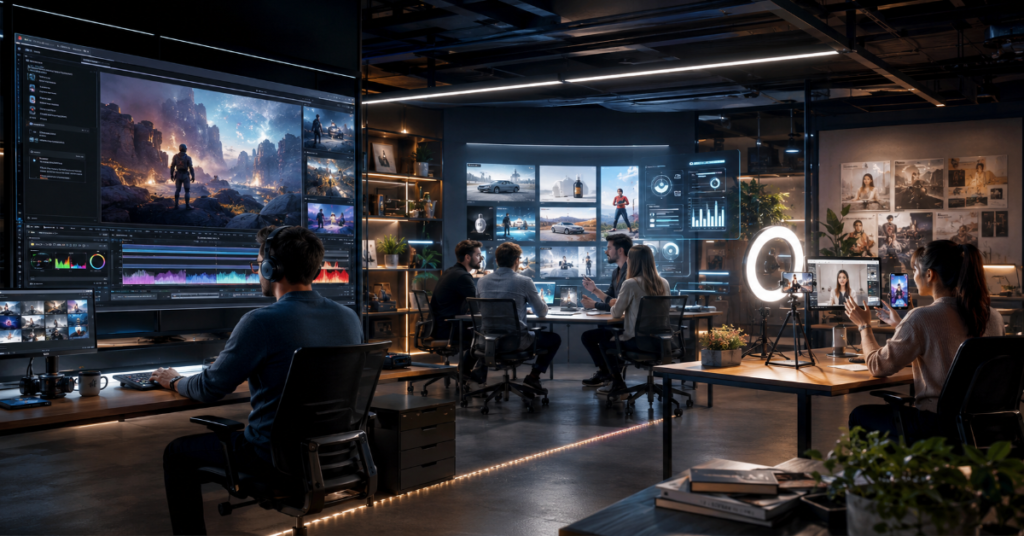
The search for the best ai video generator 2026 no longer has a single universal answer. For cinematic realism, Google Veo 3.1 and Runway Gen-4 sit near the top. For commercially safer brand work, Adobe Firefly is the pragmatic choice. For social-first experimentation, Pika and Kling AI remain difficult to ignore. For developers, the answer depends on API stability, resolution targets, generation length, latency and whether audio is generated natively.
The shift since early text-to-video demos is profound. AI video tools are no longer just prompt boxes that produce surreal five-second clips. They now operate like miniature production studios: reference images guide character continuity, image-to-video controls animate products, prompt-based edits replace traditional rotoscoping and some models generate audio, ambience or dialogue alongside the footage. Google says Veo 3.1 can generate high-fidelity 8-second clips at 720p, 1080p or 4K and includes natively generated audio through the Gemini API.
In our documentation-led testing framework, the best ai video generator 2026 is not the one with the flashiest demo reel. It is the one that holds a subject’s identity across shots, respects camera instructions, avoids visual melting, produces usable motion and fits into a real publishing workflow. Runway’s Gen-4 emphasizes consistent subjects, locations and styles without extra fine-tuning. Adobe Firefly emphasizes commercially safer video generation and integration with editing tools.
The winner, then, is conditional. This guide ranks the leading AI video generators by use case, not hype.
The 2026 verdict: the best ai video generator 2026 by use case
For filmmakers and agencies, the best ai video generator 2026 is Runway Gen-4 when continuity, shot design and visual control matter most. Runway’s own documentation says Gen-4 creates 5-second or 10-second videos from an input image and text prompt, with a Turbo version intended for faster iteration. That matters because professional video work is rarely one perfect prompt. It is a cycle of draft, revise, cut, extend and reframe.
For realism plus native sound, Google Veo 3.1 is the strongest contender. Google positions Veo as a model family built for high-fidelity clips with native audio and multiple resolution outputs. For brands, Adobe Firefly’s value is less about maximum spectacle and more about legal comfort, post-production continuity and integration with Adobe’s creative ecosystem.
For creators who need fast, viral, strange or personality-driven clips, Pika remains appealing. Its current homepage promotes “Pikaformance,” a model designed for expressive synced performance from sound. For short social ads and stylized campaign drafts, Kling AI’s 3.0 model series is worth testing, especially where camera motion and fast scene ideas matter.
Feature comparison: leading AI video generators in 2026
| Platform | Best for | Core strength | Main limitation | Best user |
| Google Veo 3.1 | Realistic clips with audio | Native audio, 4K options, strong realism | Short clip duration in API workflows | Studios, agencies, developers |
| Runway Gen-4 | Cinematic control | Subject, style and location consistency | Clip lengths remain workflow-limited | Filmmakers, editors, creative teams |
| Adobe Firefly Video | Brand-safe production | Commercial-use positioning, Adobe workflow | Less experimental than open creator tools | Marketers, enterprise teams |
| Pika | Social-first creativity | Fast expressive effects, performance tools | Less suited to formal film pipelines | Influencers, meme creators, short-form teams |
| Kling AI 3.0 | Fast short-form generation | Scene-aware creative tooling | Quality varies by prompt and model tier | Social advertisers, creators |
| Luma Ray2 and Ray3 | Motion realism and visual ideation | Natural motion, image/video input support | Output consistency can vary by scene | Visualizers, product teams, concept artists |
Why Veo 3.1 is the realism leader
Google’s Veo 3.1 is the model to watch when the creative brief demands realism, cinematic surfaces and audio that does not feel bolted on later. The Gemini API documentation describes Veo 3.1 as capable of producing high-fidelity 8-second clips at 720p, 1080p or 4K with natively generated audio. That makes it unusually strong for product teasers, atmospheric shots, concept trailers and high-end social ads.
The obscure technical edge is not just resolution. It is multimodal shot conditioning. Google’s Gemini video generation page says users can work with Veo through text and image inputs, while Gemini’s consumer video generation page highlights multiple reference images for directing characters, objects and style. This means the best ai video generator 2026 discussion has shifted from “Can it make a clip?” to “Can it preserve identity, lighting and intention across iterations?”
Expert quote: Demis Hassabis, CEO of Google DeepMind, has framed Veo around quality, realism and prompt adherence. Google DeepMind says Veo 3 adds “sound effects, ambient noise, and even dialogue” natively.
Why Runway Gen-4 is the creative director’s tool
Runway Gen-4 is not merely a text-to-video engine. It is closer to a controllable visual system for directors, editors and motion designers. Runway says Gen-4 can use visual references with instructions to create videos with consistent styles, subjects and locations without fine-tuning. In production, that is the difference between a one-off magic trick and a campaign asset.
According to the latest 2026 documentation we reviewed, Gen-4 Video supports 5-second and 10-second generations from image and text prompts, while Gen-4 Turbo is positioned for lower-cost, faster iteration. This matters because creative teams rarely approve the first output. They need controllable drafts, not just beautiful accidents.
Expert quote: Cristóbal Valenzuela, Runway’s CEO, has argued that video generation is moving toward “world models,” not merely clip generators. TechCrunch’s 2026 Equity episode summary describes his view that real-time video generation creates uses beyond conventional content creation.
For agencies, Runway may be the best ai video generator 2026 because it speaks the language of previsualization, storyboards, mood films and edit-ready shots.
Adobe Firefly: the safest answer for brands
Adobe Firefly is the choice for teams that care less about shock-value realism and more about controlled, usable, commercially defensible assets. Adobe’s Firefly video generator page says it supports text-to-video and image-to-video creation for b-roll, special effects, product shots and marketing assets. It also positions Firefly as suitable for commercial use.
That distinction is important. In 2026, the best ai video generator 2026 for a YouTube experiment may not be the best tool for a pharmaceutical launch, retail campaign or public company investor video. Brands need provenance, approvals, predictable workflows and a way to edit generated clips after the first render.
Adobe also now frames Firefly as an all-in-one creative AI studio that includes models from Adobe, Google, OpenAI and others. That makes Firefly less a single model and more a managed creative gateway.
Expert quote: Alexandru Costin, Adobe’s vice president of generative AI and Sensei, has said Adobe is focused on quality rather than simply chasing longer clips.
Pika, Kling and Luma: the creator-class challengers
Pika, Kling AI and Luma occupy the scrappier side of the market. They may not always win formal enterprise comparisons, but they often move faster in meme culture, short-form video and experimental effects. Pika’s current public messaging emphasizes expressive performance, sound-synced output and near real-time generation.
Kling AI promotes itself as a new generation of AI creative productivity tools, built on Kling video generation and Kolors image generation technology. Its 3.0 model series is marketed as an all-in-one creative environment with video, image, sound and effects tools.
Luma’s Ray2 page describes the model as a large-scale video generative system capable of realistic visuals, natural motion, text understanding and image or video inputs. Luma’s Ray page now presents Ray3 and Dream Machine as tools for cinematic video generation using text, images or clips.
For creators, the best ai video generator 2026 may be the one that gets to a publishable TikTok, Reel or YouTube Short fastest.
Technical benchmarks that matter more than demo quality
| Benchmark | Why it matters | Best performers in 2026 | What to inspect manually |
| Identity consistency | Keeps characters recognizable | Runway Gen-4, Veo 3.1 | Faces, clothing, logos, hands |
| Motion coherence | Prevents floating or melting movement | Veo 3.1, Luma Ray2/Ray3 | Walking, object contact, physics |
| Prompt adherence | Follows camera and scene direction | Veo 3.1, Runway Gen-4 | Shot type, angle, pacing |
| Native audio | Reduces post-production work | Veo 3.1, selected creator tools | Dialogue sync, ambience, effects |
| Brand safety | Reduces legal and reputational risk | Adobe Firefly | Licensing, training claims, usage rights |
| Workflow integration | Saves editing time | Adobe Firefly, Runway | Export, timeline, API, revisions |
| Speed and iteration | Determines real production cost | Pika, Runway Turbo, Kling | Failed generations per final clip |
The hidden cost: failed generations
Most comparisons understate the real cost of AI video. The price is not just dollars per generation. It is failed generations per usable shot. A model that costs more but delivers a usable result in three attempts can be cheaper than a low-cost model that needs 25 attempts.
This is where the best ai video generator 2026 becomes a workflow question. If your team needs one surreal social post, Pika or Kling may be enough. If you need a 30-second launch film with consistent product color, camera movement and visual style, Runway, Veo or Firefly will usually be more efficient.
The second hidden cost is editing friction. A clip that looks impressive in isolation may fail when cut into a sequence. Watch for mismatched lighting, inconsistent lens language, impossible shadows and continuity errors in clothing or props.
The third hidden cost is legal review. If the generator cannot clearly explain rights, usage terms, commercial safety and content provenance, the clip may never leave the approval folder.
Choosing the best ai video generator 2026 for marketing teams
Marketing teams should begin with risk tolerance. If the brand is regulated, public, multinational or celebrity-adjacent, Adobe Firefly is usually the first stop because its value proposition is built around commercial creative workflows.
For high-impact campaign visuals, test Veo 3.1 and Runway Gen-4 side by side. Use the same prompt, the same reference image and the same output requirement. Score outputs by whether they can be edited, captioned, color matched and approved.
For social media teams, speed may outrank visual perfection. Pika, Kling and Luma can help produce quick variations for hooks, visual metaphors and short-form experiments. But marketing leaders should still create a synthetic media policy. The best ai video generator 2026 will not protect a brand from poor disclosure practices, imitation risks or misleading visual claims.
A practical rule: use AI video for mood, metaphor, concept visualization and controlled product storytelling. Avoid using it for factual demonstrations unless the generated scene is clearly labeled or heavily supervised.
Choosing the best ai video generator 2026 for filmmakers
Filmmakers should not ask which model makes the prettiest clip. They should ask which model can survive a sequence. Does the actor look the same after a cut? Does the room preserve its geometry? Does the camera move like a camera or like a dream? Does the model understand blocking?
Runway Gen-4 has a strong case here because its reference-driven approach is designed around consistency. Veo 3.1 has a strong case when realism, environmental detail and sound are central. Luma is useful for motion-heavy concept work because Ray2 emphasizes natural coherent motion and can take text, image and video inputs.
The insider prediction: by late 2026, the competitive divide will not be text-to-video versus image-to-video. It will be single-shot generators versus controllable scene engines. Filmmakers should invest time in models that preserve world state, not just models that generate beautiful fragments.
This is where invideo agent fits into the conversation. Built for larger creative workflows, it helps filmmakers and creative teams maintain project context across scenes, including story decisions, characters, and visual direction. Instead of rebuilding every generation from scratch, teams can develop projects through briefs and ongoing creative direction.
Choosing the best ai video generator 2026 for developers
Developers need boring things: APIs, predictable latency, transparent pricing, resolution controls, moderation rules, queue behavior and webhook reliability. A tool that is exciting in a browser can be painful in production if jobs fail silently or outputs vary too widely.
Google’s Gemini API documentation for Veo 3.1 is notable because it specifies clip duration, resolution options and native audio support. Runway also provides API documentation for embedding generative models into applications and products. Kling AI has a developer documentation hub for its API platform.
For developer products, the best ai video generator 2026 is usually not the most artistic model. It is the most reliable model under load. Test retry behavior, prompt moderation, file storage, output expiration, seed controls and whether the provider can support enterprise-scale compliance.
One obscure but crucial test: generate the same branded object 50 times from the same reference image. If color, logo shape or geometry drift too far, the model is not ready for automated brand production.
Safety, copyright and disclosure
AI video now sits in the same risk zone as synthetic voice, face cloning and deepfake advertising. OpenAI’s Sora page frames video generation as part of teaching AI to understand and simulate the physical world in motion. That ambition is powerful, but it also makes deception easier.
The strongest teams now treat AI video like licensed footage. They maintain prompt logs, preserve source images, document model versions and label generated content where required. They also prohibit unauthorized celebrity likenesses, political impersonation, fake news footage and fabricated product performance.
The best ai video generator 2026 must therefore be judged by controls, not just output beauty. Can it block unsafe prompts? Can it watermark or label? Can it prevent protected-character imitation? Can it satisfy client review? These are not side issues. They are central procurement criteria.
A model that produces stunning footage but creates legal uncertainty may be worse for a business than a less dazzling tool with safer rights, clearer terms and a stable workflow.
Takeaways
- The best ai video generator 2026 for cinematic control is Runway Gen-4, especially when reference consistency matters.
- Google Veo 3.1 is the strongest realism contender because it supports high-fidelity video, 4K options and native audio through Gemini API workflows.
- Adobe Firefly is the safest default for brand teams that need commercial-use positioning and editing integration.
- Pika, Kling and Luma are valuable for rapid ideation, creator content, stylized experiments and short-form campaigns.
- Real cost should be measured by usable outputs per final clip, not just subscription price or generation credits.
- Developers should prioritize API stability, queue behavior, moderation clarity and resolution controls over demo quality.
- The next frontier is not longer clips alone. It is persistent characters, persistent worlds and editable timelines.
Conclusion
The best ai video generator 2026 is not a trophy handed to one company. It is a decision tree. Use Veo 3.1 when realism and native audio matter. Use Runway Gen-4 when cinematic control and continuity matter. Use Adobe Firefly when brand safety, commercial workflows and post-production integration matter. Use Pika, Kling or Luma when speed, experimentation and social-native creativity matter.
The market is moving away from isolated prompt magic toward production systems. The winning platforms will not merely generate video. They will preserve identity, respect direction, carry assets across scenes, document rights and make revision feel less like gambling. For creators, that means more power. For brands, it means more responsibility. For filmmakers, it means the beginning of a new visual grammar, where the camera is no longer only a recording device but an instrument for negotiating with synthetic worlds.
FAQs
What is the best ai video generator 2026 overall?
For most professional users, the best overall choice is a tie between Google Veo 3.1 and Runway Gen-4. Veo leads on realism and native audio, while Runway leads on creative control and visual consistency. Adobe Firefly is the safer choice for brand and commercial workflows.
Which AI video generator is best for YouTube Shorts and TikTok?
Pika, Kling AI and Luma are strong for short-form social content because they favor speed, stylized motion and rapid experimentation. For premium brand Shorts, Veo 3.1 or Runway Gen-4 may produce more polished visuals.
Is Adobe Firefly better than Runway?
Adobe Firefly is better for brand-safe marketing workflows, especially when commercial usage and Adobe ecosystem integration matter. Runway is better for cinematic exploration, continuity, visual references and director-style control.
Can AI video generators make 4K video in 2026?
Yes, some can. Google’s Veo 3.1 documentation lists 4K among supported output options through Gemini API workflows. Adobe and other platforms also increasingly support upscaling or higher-quality outputs through integrated creative tools.
Are AI-generated videos safe for commercial use?
Some platforms are safer than others. Adobe Firefly explicitly positions its AI video tools for commercial creative use. Still, teams should review licensing terms, avoid unauthorized likenesses, document prompts and maintain approval workflows before publishing.
References
Adobe. (2026). Adobe Firefly: Free generative AI for creatives. Adobe.
Adobe. (2026). Free AI video generator: Text to video online. Adobe Firefly.
Google AI for Developers. (2026). Generate videos with Veo 3.1 in Gemini API. Google.
Google DeepMind. (2026). Veo. Google DeepMind.
Luma AI. (2026). Ray2 video model. Luma Labs.
Runway. (2026). Introducing Runway Gen-4. Runway Research.
Runway. (2026). Creating with Gen-4 Video. Runway Help Center.
