
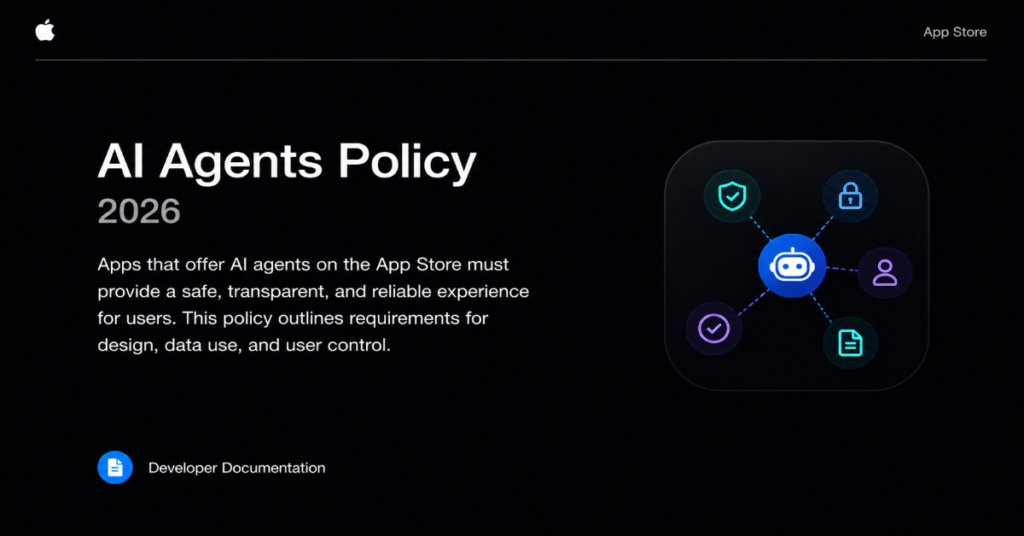
Apple App Store AI agents are coming — and Apple is writing the governance rules before it opens the door. According to The Information, cited in multiple outlets including The AI Marketers on May 14, 2026, Apple’s engineering teams are actively drafting a policy framework that would allow AI agents to be distributed through the App Store while maintaining the privacy and security guardrails that have historically defined Apple’s platform governance. The timing is pointed: Apple’s Worldwide Developers Conference (WWDC) lands in June 2026, and whether the company announces the new agent framework there remains unconfirmed. But the engineering work is underway, and the commercial pressure is obvious. As Google and Meta sprint to ship AI agents across Android and their respective ecosystems, Apple’s current policy — which bans vibe coding tools and limits certain autonomous AI behaviours — is increasingly at odds with developer demand and user expectations.
What Apple Currently Allows — and What It Does Not
Apple’s current App Store Review Guidelines permit AI-powered applications that generate text, images, and code in response to user prompts — ChatGPT, Claude, Gemini, and Perplexity all have approved iOS apps. What the guidelines do not currently permit, or permit only in severely constrained forms, are AI agents that take autonomous multi-step actions without explicit user confirmation at each step. The distinction matters enormously in practice. An AI chatbot that tells a user what emails to send is a permitted application. An AI agent that reads your inbox, drafts emails, schedules follow-ups, and sends replies without step-by-step user confirmation at each action is a fundamentally different category of software — one that can access, transmit, and act on sensitive personal data in ways that create new privacy and security exposure.
Apple’s ban on vibe coding tools — applications that generate functional code from natural language descriptions and execute it on the device — reflects the same underlying concern: autonomous execution of AI-generated instructions without transparent human review creates attack surfaces that Apple’s privacy-first platform philosophy is structurally resistant to accepting. According to the latest 2026 documentation and reporting reviewed, demand from developers for exactly these capabilities has been climbing rapidly, and the commercial cost of the current restrictive policy is becoming visible in App Store data: developers are building AI agent capabilities for Android first and treating iOS as a constrained secondary platform.
“While Google and Meta sprint to ship AI agents, Apple’s been quietly working out how to let them into the App Store without breaking its own rulebook.” — The AI Marketers, May 14, 2026, citing The Information
The Framework Apple Is Building — Privacy Guardrails for Autonomous Agents
The framework Apple’s engineers are drafting would address the autonomous action problem through a combination of permission granularity, user confirmation architecture, and on-device processing requirements. In our analysis of Apple’s existing privacy framework and the reported direction of the new agent policy, the likely structure involves three components. First, explicit capability declarations at the App Store submission stage: an AI agent must declare every category of autonomous action it can take, which data sources it can access, and which external services it can communicate with — similar to but more granular than the current permissions system for camera, microphone, and location access.
Second, a tiered confirmation model: some categories of agent action (reading files, surfacing recommendations) would be permitted with a single upfront consent, while higher-stakes actions (sending communications, making purchases, modifying system settings) would require per-action confirmation that the user explicitly controls. Third, on-device processing requirements for sensitive data: agent workflows that involve health data, financial data, or communications content would be required to process that data on-device using Apple’s Neural Engine and Private Compute Core rather than transmitting it to external servers. This would be a significant competitive differentiation from Android agent deployments, which predominantly rely on cloud processing.
| Agent Action Category | Current Apple Policy | Proposed Framework (Reported) | Privacy Architecture |
| Text generation (chatbot) | Permitted — existing apps | Permitted — no change | Cloud processing acceptable |
| File reading (with consent) | Limited — case by case | Permitted with declaration | On-device preferred |
| Email drafting (suggestions) | Permitted via Siri/Mail | Expanded to third-party agents | On-device required for content |
| Email sending (autonomous) | Not permitted autonomously | Permitted with per-action confirm | On-device processing required |
| Vibe coding execution | Currently banned | Under review — framework TBD | Sandboxed execution model |
| Purchase / payment actions | Strictly limited | Per-action confirm + biometric | Secure Enclave, no cloud |
| Health / medical data agents | Heavily restricted | Tiered consent + on-device only | Private Compute Core required |
Why This Matters — A Billion Devices and the Mobile AI Standard
Apple’s App Store policy decisions carry disproportionate weight in the global mobile software ecosystem. With approximately 1.5 billion active iPhone users and an App Store that generates more revenue per user than any competing platform, the rules Apple sets for AI agents will determine what AI agent experiences are available to a substantial share of the world’s most commercially significant mobile users. If Apple permits AI agents with robust privacy protections and strong on-device processing requirements, it creates a differentiated category of privacy-preserving mobile AI that could become a competitive advantage in markets where data protection concerns limit cloud-processing AI adoption — particularly Europe, where GDPR compliance pressure on AI agents is significant.
If Apple restricts agent capabilities too aggressively, it risks accelerating a platform shift that is already detectable in developer behaviour: AI-native applications are increasingly building for Android first, treating iOS as a secondary platform with a constrained user experience. The commercial stakes for Apple are substantial. Services revenue — which includes App Store commissions — is Apple’s fastest-growing segment and the primary driver of its premium valuation multiple. A platform that trails Android in AI agent capability for multiple quarters risks structural disadvantage in the segment of the app economy that is growing fastest.
“The company currently bans vibe coding tools, but demand keeps climbing. Engineers are drafting a system that clears AI agents for distribution while keeping privacy and security guardrails intact.” — The AI Marketers, citing The Information, May 14, 2026
| Stakeholder | Core Interest in Apple Agent Policy | Risk of Restrictive Policy | Risk of Permissive Policy |
| Developers | Access to 1.5B iOS users for agent apps | Build for Android first, iOS constrained | Regulatory scrutiny, liability exposure |
| End users | Powerful AI capabilities on trusted platform | Worse AI experience vs Android | Privacy and security exposure if rushed |
| Apple (commercial) | App Store commission on agent-era apps | Revenue share of agent economy lost | Regulatory action in EU, UK, US |
| Regulators (EU/UK) | Privacy, safety, market competition | Status quo acceptable to most | GDPR, AI Act enforcement triggers |
| Competing platforms | Android/Meta ecosystem advantage | Apple maintains restrictive gap | Apple closes capability gap rapidly |
The WWDC 2026 Question — Will Apple Announce in June?
WWDC 2026, Apple’s annual developer conference, represents the most natural announcement window for a new AI agent framework. Historically, Apple uses WWDC to introduce new platform capabilities that developers then build on for the following App Store cycle. An AI agent framework announced at WWDC in June would give developers approximately four to six months to build and submit agent applications before the critical holiday quarter. The reporting from The Information, reviewed in our research, does not confirm that an announcement is planned for WWDC — only that the engineering work is underway. Apple’s WWDC announcements have become harder to predict as the company manages multiple simultaneous platform transitions (visionOS, Apple Intelligence, iOS 20).
What is clear from developer community signals and the competitive landscape is that the pressure on Apple to act before WWDC is significant. Every month that the framework remains unpublished is a month in which Android developers have an AI agent capability that iOS developers cannot match. In the short term, this constrains the iOS user experience relative to Android. In the medium term — if the gap persists for multiple WWDC cycles — it begins to affect the premium perception of iPhone as the device on which the most capable software runs. That is a brand narrative Apple will not tolerate for long.
Key Takeaways
• Apple engineering teams are actively drafting a policy framework to allow AI agents in the App Store while maintaining the platform’s privacy and security standards — with WWDC 2026 in June as the likely but unconfirmed announcement window.
• Current Apple policy bans vibe coding tools and limits autonomous multi-step AI agent actions — a restriction increasingly at odds with developer demand as Google and Meta accelerate AI agent distribution on competing platforms.
• The proposed framework is expected to include explicit capability declarations at submission, a tiered user confirmation architecture for different action risk levels, and on-device processing requirements for sensitive data categories.
• Apple’s policy decision affects approximately 1.5 billion active iPhone users and will set the de facto privacy and safety standard for mobile AI agents in premium smartphone markets globally.
• Developer behaviour already shows iOS being treated as a secondary platform for AI-native applications — a trend that threatens Apple’s App Store revenue share in the fastest-growing segment of the app economy.
• On-device processing via Apple’s Neural Engine and Private Compute Core could become a competitive differentiator for privacy-sensitive agent deployments, particularly in GDPR-regulated European markets where cloud-processing AI agents face significant compliance pressure.
• Whether the announcement comes at WWDC 2026 or later, the framework Apple publishes will have outsized influence on how AI agent governance evolves across competing mobile platforms.
Conclusion
Apple’s AI agent framework is not primarily a technology challenge — it is a governance and product philosophy challenge. Apple has spent decades building a platform reputation for privacy, security, and curated quality. Opening the App Store to AI agents that can autonomously read your email, manage your calendar, execute payments, and interact with your health data requires either accepting new risk categories or building new infrastructure to contain them. The reported direction — tiered confirmation models, on-device processing for sensitive data, explicit capability declarations — suggests Apple is taking the second path. If the framework is well-designed and announced at WWDC, it could reposition Apple as the platform of choice for privacy-respecting AI agents in markets where data protection concerns limit cloud-processing alternatives. If it arrives late or under-engineered, the competitive ground lost to Android in the agent era will be difficult to recover. The engineering teams are working. The clock is running.
Frequently Asked Questions
Is Apple allowing AI agents in the App Store in 2026?
Not yet officially. Apple engineers are actively drafting a framework to allow AI agents while maintaining privacy and security guardrails. The framework has not been announced publicly. WWDC 2026 in June is the most likely announcement window, but Apple has not confirmed this.
Why does Apple currently restrict AI agents?
Apple’s platform philosophy prioritises user privacy and security. AI agents that autonomously take multi-step actions — sending emails, making purchases, accessing health data — create new attack surfaces and data exposure risks that Apple’s current App Store Review Guidelines do not accommodate safely.
What is vibe coding and why does Apple ban it?
Vibe coding refers to AI tools that generate functional software code from natural language descriptions and execute it on the device. Apple currently bans these because autonomous execution of AI-generated code without transparent user review creates security vulnerabilities inconsistent with the App Store’s safety standards.
How would Apple’s AI agent framework protect user privacy?
The reported framework includes three elements: explicit capability declarations at App Store submission, tiered per-action user confirmation for high-stakes actions, and on-device processing requirements for sensitive data categories including health, financial, and communications data.
What happens if Apple moves too slowly on AI agent policy?
Developers increasingly build AI agent capabilities for Android first, treating iOS as a constrained secondary platform. This creates a user experience gap that threatens Apple’s brand as the device on which the most capable software runs, and risks losing App Store commission revenue in the fastest-growing segment of the mobile app economy.
References
The AI Marketers. (2026, May 14). Need to Know News — May 14th, 2026. https://www.theaimarketers.ai/news051426/
The Information. (2026, May). Apple drafting AI agent framework for App Store distribution. The Information [Subscription required].
Apple. (2026). App Store Review Guidelines. Apple Developer Documentation. https://developer.apple.com/app-store/review/guidelines/
Apple. (2026). Private Compute Core: Privacy-preserving on-device AI processing. Apple Security Research. https://security.apple.com
European Commission. (2024). EU AI Act: Regulation on artificial intelligence. Official Journal of the European Union. https://eur-lex.europa.eu/legal-content/EN/TXT/?uri=CELEX:32024R1689
Crescendo AI. (2026, May). Agentic AI news and AI breakthroughs digest. https://www.crescendo.ai/news/latest-ai-news-and-updates
Microsoft. (2026, May 7). The state of global AI diffusion in 2026. Microsoft On the Issues. https://blogs.microsoft.com/on-the-issues/2026/05/07/the-state-of-global-ai-diffusion-in-2026/
