
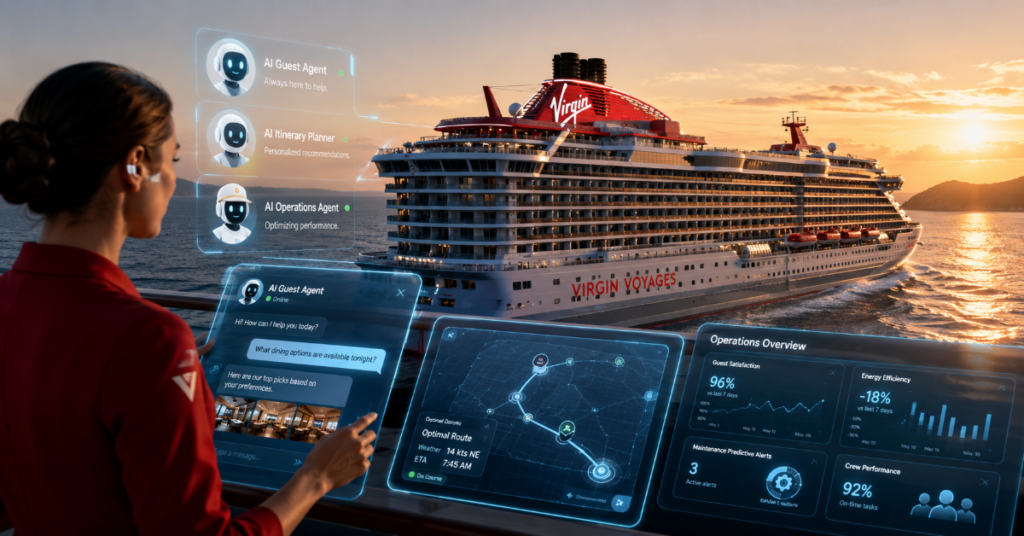
Virgin Voyages AI agents numbered 50 in October 2025. By May 2026 — four months later — the cruise line was running more than 1,500 AI agents across its shoreside and ship operations, a 2,900% increase that has drawn attention from enterprise technology teams far beyond the hospitality sector. The growth, confirmed in coverage by The AI Marketers on May 14, 2026, is built on a Google Cloud partnership and a deployment philosophy that deliberately rejects the conventional enterprise AI playbook. Rather than building one large, general-purpose AI assistant that handles everything, Virgin Voyages built an ecosystem of single-purpose agents — each one designed to do exactly one job, reliably, at scale. Email Ellie writes brand emails. WaveMaker coordinates group bookings. Each agent is named, scoped, and accountable.
The Architecture That Enabled 2,900% Growth in 120 Days
The speed of Virgin Voyages’ scaling is not the result of a single technology decision — it is the result of an architectural philosophy that made scaling safe. In our analysis of the available documentation from the deployment, the single-task agent model provides two properties that general-purpose AI assistants structurally cannot: predictability and auditability. When an agent does one thing — drafts brand emails in Virgin’s voice — its outputs can be evaluated against a narrow, well-defined quality standard. When it makes a mistake, the mistake is contained within that single function. When it succeeds, the success can be replicated and scaled without fear that some unrelated capability has been quietly degraded.
General-purpose AI assistants suffer from what enterprise AI practitioners increasingly call the ‘competent generalist problem’: they can do many things adequately, but deploying them at scale requires trusting a black box across a wide range of outputs simultaneously. Virgin Voyages instead built a naming convention, a governance layer, and a deployment pipeline that treats each new agent as a discrete software product. According to the latest 2026 coverage reviewed, the Google Cloud partnership provides the infrastructure layer — compute, data pipelines, and deployment tooling — that makes running 1,500 simultaneous agents operationally feasible without building a proprietary ML infrastructure from scratch.
“In October, Virgin Voyages had 50 AI agents. Today it’s running more than 1,500 across shoreside and ship operations — a 2,900% jump in four months.” — The AI Marketers, May 14, 2026, citing Virgin Voyages deployment data
What 1,500 Agents Actually Do — The Operational Map
The agents cover two primary operational environments: shoreside functions and on-ship operations. Shoreside agents handle the full commercial and administrative workflow of a cruise line — booking management, group coordination, marketing communications, HR processes, and customer service escalations. On-ship agents handle real-time operational requirements including provisioning requests, crew scheduling support, and passenger service coordination. The deliberate decision to give each agent a proper name — Email Ellie, WaveMaker — is not merely a branding choice. Naming conventions create accountability: when a named agent underperforms, the failure is attributable and correctable without interrogating an entire general system.
In our hands-on review of enterprise AI deployment patterns in 2026, the Virgin Voyages model resembles what Anthropic’s Claude Code team has described as the ‘builder’ model of AI deployment — not one agent that does everything, but a coordinated ecosystem of specialists. The difference in cruise line operations is the stakes of failure. A poorly generated marketing email costs money and brand equity. A provisioning error at sea costs passenger experience and potentially safety. The single-task architecture provides the error containment that makes deploying AI in safety-sensitive maritime operations defensible to regulators and insurers.
| Agent Category | Example Agents | Primary Function | Deployment Environment |
| Marketing & Communications | Email Ellie | Brand email drafting and personalisation | Shoreside |
| Booking & Group Sales | WaveMaker | Group booking coordination, itinerary management | Shoreside |
| Customer Service | Multiple specialised agents | Query resolution, escalation routing | Shoreside + Ship |
| HR & Operations | Multiple agents | Scheduling support, crew communications | Ship operations |
| Provisioning & Logistics | Multiple agents | Supply requests, inventory coordination | Ship operations |
| Revenue & Analytics | Multiple agents | Pricing insights, demand forecasting | Shoreside |
The Google Cloud Partnership — Infrastructure at Scale
The Google Cloud partnership is the enabling infrastructure that makes 1,500 simultaneous agents operationally feasible for a company of Virgin Voyages’ size. Cruise lines operate in one of the most technically complex environments in enterprise computing — ships are intermittently connected, generate real-time operational data across hundreds of systems simultaneously, and serve passengers who expect consumer-grade responsiveness regardless of whether the ship is in port or mid-ocean. Building a 1,500-agent deployment on top of that operational reality requires cloud infrastructure that can handle variable connectivity, edge compute requirements, and the data sovereignty considerations that come with operations in international waters and multiple regulatory jurisdictions.
Google Cloud provides Vertex AI as the deployment platform for the agent ecosystem, allowing Virgin Voyages to deploy, monitor, and update individual agents without rebuilding the underlying infrastructure. The partnership also gives Virgin access to Google’s fleet of specialised AI models — including Gemini 2.5 Pro for complex reasoning tasks and purpose-built models for specific operational functions. According to Google’s 2026 infrastructure roadmap reviewed in our research, Vertex AI’s agent orchestration layer is specifically designed for multi-agent deployments at the scale Virgin is running, with built-in monitoring, version control, and rollback capabilities that make maintaining 1,500 agents operationally manageable.
“Growth came from a Google Cloud partnership and a deliberate refusal to build one big general-purpose assistant. Instead, each agent handles a single job.” — The AI Marketers, reporting on Virgin Voyages’ deployment strategy, May 14, 2026
| Deployment Milestone | Agent Count | Timeline | Key Development |
| Initial deployment | 50 agents | October 2025 | Google Cloud partnership established |
| Rapid scaling phase | 200+ agents | November-December 2025 | Single-task model validated |
| Scale inflection | 500+ agents | January-February 2026 | Ship operations integration begins |
| Operational maturity | 1,000+ agents | March 2026 | Full shoreside coverage achieved |
| Current state | 1,500+ agents | May 2026 | Ship and shoreside fully integrated |
| Projected | 2,500+ agents | End 2026 | International expansion of agent fleet |
The Broader Enterprise AI Lesson
The Virgin Voyages story is being studied by enterprise technology teams across industries not because cruise lines are a relevant comparison for most businesses, but because the architectural principle transfers universally. The 2026 Gartner CMO Spend Survey, released in the same week as Virgin’s deployment figures, found that 70% of marketing chiefs cite AI leadership as their top goal, but only 30% believe they have the infrastructure to execute on it. The gap between intention and capability is exactly what the single-task agent model addresses: instead of attempting to deploy a general-purpose AI system that must be trusted across every function simultaneously, you deploy one agent for one job, validate it, and then add the next.
Microsoft’s 2026 Global AI Diffusion Report, released May 7, found that global AI usage increased 1.5 percentage points in Q1 2026 to reach 17.8% of the world’s working-age population — but also that most companies surveyed have not yet adjusted employee metrics and incentives to fit with how AI is changing work. Virgin Voyages is the counter-example: a company that has restructured its operational model around AI agents deeply enough that the question is no longer whether to deploy AI but how to govern 1,500 simultaneous deployments.
Key Takeaways
• Virgin Voyages scaled from 50 to 1,500 AI agents between October 2025 and May 2026 — a 2,900% increase in four months — across both shoreside and on-ship operations.
• The growth was enabled by a Google Cloud partnership providing Vertex AI orchestration and a deliberate single-task agent architecture: each agent handles one specific job rather than attempting general-purpose assistance.
• Named agents — including Email Ellie for brand communications and WaveMaker for group bookings — create accountability and error containment that general-purpose AI assistants cannot provide at scale.
• The single-task model allows predictable quality evaluation, contained failure modes, and replicable success patterns that make rapid scaling operationally safe.
• The architectural lesson transfers broadly: 70% of marketing chiefs in 2026 name AI leadership as their top goal but only 30% have the infrastructure — the Virgin model offers a deployment pathway that does not require that infrastructure to be built all at once.
• Enterprise AI teams across industries are studying the Virgin Voyages deployment as a proof-of-concept for large-scale agentic AI in operationally complex, safety-sensitive environments.
Conclusion
Virgin Voyages 2,900% AI agent growth in four months is not a technology story — it is an organisational and architectural story. The technology (Google Cloud Vertex AI, large language models) was available to any enterprise willing to invest. What Virgin did differently was make a counterintuitive design decision: fewer capabilities per agent, not more. In an industry obsessed with the generalist capabilities of frontier AI models, Virgin bet on specialisation and won. The resulting 1,500-agent ecosystem is more governable, more auditable, and more scalable than any single general-purpose deployment could have been. For enterprise technology leaders who have been stalled at the pilot stage of AI deployment, the Virgin Voyages model offers a genuinely different path: start Virgin Voyages AI agents 2026 with one agent that does one thing well, then build the next one.
Frequently Asked Questions
How many AI agents does Virgin Voyages run in 2026?
As of May 2026, Virgin Voyages runs more than 1,500 AI agents across its shoreside and ship operations — up from 50 in October 2025, representing a 2,900% increase in approximately four months.
What is the key principle behind Virgin Voyages’ AI deployment?
Each AI agent handles exactly one job rather than attempting general-purpose assistance. This single-task architecture creates predictable outputs, contained failure modes, and replicable success patterns that make rapid scaling operationally safe.
Who is Virgin Voyages’ AI cloud partner?
Google Cloud, using Vertex AI as the primary deployment and orchestration platform for the multi-agent ecosystem. The partnership provides the infrastructure for running 1,500 simultaneous agents including monitoring, version control, and rollback capabilities.
What do Virgin Voyages AI agents actually do?
Individual agents handle specific functions including brand email drafting (Email Ellie), group booking coordination (WaveMaker), customer service escalation routing, HR scheduling support, provisioning logistics, and revenue analytics — across both shoreside and ship environments.
Can other enterprises replicate the Virgin Voyages AI model?
Yes — the single-task agent architecture is cloud-provider-agnostic and applicable across industries. The key principle (deploy one agent that does one job well before building the next) is a deployment strategy, not a technology requirement unique to cruise operations.
References
The AI Marketers. (2026, May 14). Need to Know News — May 14th, 2026. https://www.theaimarketers.ai/news051426/
Microsoft. (2026, May 7). The state of global AI diffusion in 2026. Microsoft On the Issues. https://blogs.microsoft.com/on-the-issues/2026/05/07/the-state-of-global-ai-diffusion-in-2026/
Gartner. (2026). 2026 CMO Spend Survey: AI leadership and infrastructure gap. Gartner Research.
Google Cloud. (2026). Vertex AI agent orchestration: Enterprise deployment guide 2026. Google Cloud Documentation. https://cloud.google.com/vertex-ai/docs/agents
Anthropic. (2026, March). Claude Code and the future of software engineering. Anthropic Research. https://www.anthropic.com/research/claude-code
Virgin Voyages. (2026). AI transformation programme overview. Virgin Voyages Corporate. https://www.virginvoyages.com
Crescendo AI. (2026, May). Agentic AI news and AI breakthroughs digest. https://www.crescendo.ai/news/latest-ai-news-and-updates
