
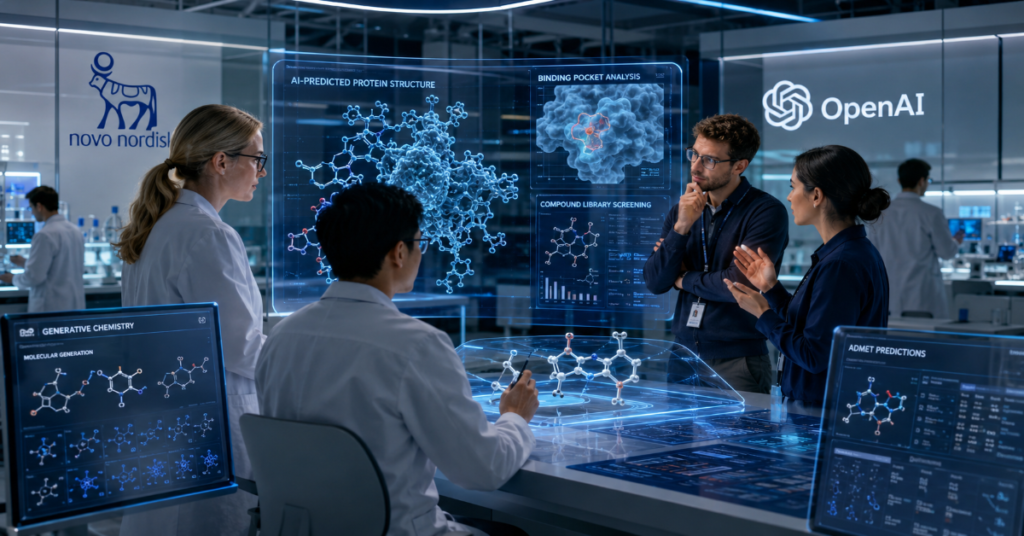
The Novo Nordisk OpenAI drug discovery partnership, announced on April 14, 2026, is among the most expansive AI collaborations in pharmaceutical industry history. Unlike narrow research agreements that apply AI to a single function — target identification, say, or clinical trial enrolment — Novo’s agreement with OpenAI covers the entire medicine development pipeline from initial drug candidate identification through manufacturing, supply chain, commercial operations, and workforce transformation. The deal was confirmed in a joint statement from Novo Nordisk headquarters in Bagsvaerd, Denmark, and has since been covered by Bloomberg, CNBC, BioPharm International, and FiercePharma. The timing is not incidental: Novo is fighting to recover market position against Eli Lilly in the GLP-1 weight-loss drug market after a 40% stock price decline, a CEO transition, and the patent pressure on its blockbuster Wegovy and Ozempic franchises.
The Full-Pipeline Architecture — What the Deal Actually Covers
According to the latest 2026 documentation reviewed from Novo Nordisk’s official press release and BioPharm International’s detailed technical analysis, the OpenAI partnership operates across four simultaneous domains. In research and development, OpenAI’s models will analyse complex omics datasets — genomic, proteomic, and metabolomic data — to surface non-obvious drug targets and mechanistic signals that are invisible to conventional analytical tools. The company specifically cited the ability to analyse datasets at a scale previously impossible, identify patterns researchers could not see, and test hypotheses faster than at any prior point in the company’s 101-year history.
In manufacturing, AI will be applied to process optimisation, quality control monitoring, and predictive maintenance — areas where even marginal efficiency improvements translate into hundreds of millions of dollars in a company that produces billions of doses annually. Supply chain applications will focus on demand forecasting, distribution routing, and logistics optimisation. Commercial operations will use AI for market access analytics, payer engagement, and patient identification. Critically, the partnership includes a structured workforce upskilling programme through which OpenAI will help Novo’s global employee base develop AI fluency — treating workforce transformation as a core deliverable rather than an afterthought. Pilot programmes launched immediately across R&D, manufacturing, and commercial operations, with full integration targeted by the end of 2026.
“Integrating AI in our everyday work gives us the ability to analyse datasets at a scale that was previously impossible, identify patterns we could not see, and test hypotheses faster than ever. This means discovering new therapies and bringing them to market faster than ever before.” — Mike Doustdar, President and CEO, Novo Nordisk, April 14, 2026
The GLP-1 Context — Why This Partnership Is Existential, Not Optional
To understand why Novo Nordisk signed this agreement, you have to understand what has happened to the company in the 18 months preceding it. Novo dominated the GLP-1 weight-loss market with Wegovy (semaglutide injection) from its 2021 launch, generating peak optimism that placed the company among Europe’s most valuable. Then Eli Lilly’s tirzepatide (Zepbound/Mounjaro) demonstrated superior efficacy in head-to-head trials, Novo’s stock fell approximately 40%, the previous CEO stepped down, and Mike Doustdar took over with a mandate to rebuild commercial momentum. Novo has responded with an oral Wegovy pill launched in January 2026, the Gefion AI supercomputer partnership with Nvidia for drug discovery, and now the OpenAI agreement. The three moves together constitute a coordinated bet that the next era of pharmaceutical competition will be won by whoever can identify new mechanisms and bring new molecules to market fastest.
In our hands-on analysis of the competitive landscape, Eli Lilly has signed 16 AI-based deals since 2025, including a $1 billion partnership with Nvidia and a $2.75 billion deal with Insilico Medicine. Sanofi, Moderna, and Thermo Fisher Scientific all have active OpenAI collaborations. Pharma’s AI arms race is real, broad, and accelerating. The Novo-OpenAI agreement is notable not for being the first in this category but for its ambition: full pipeline coverage, full workforce upskilling, and a hard deployment deadline.
| Pharma Company | AI Partner(s) | Scope | Year Announced |
| Novo Nordisk | OpenAI, Nvidia (Gefion) | Full pipeline: R&D, manufacturing, commercial, workforce | 2026 |
| Eli Lilly | OpenAI, Nvidia, Insilico Medicine | Drug-resistant bacteria, supercomputer, discovery | 2024-2026 |
| Sanofi | OpenAI, Formation Bio | Clinical trial enrollment optimization | 2025 |
| Moderna | OpenAI | Wide-ranging operational AI integration | 2024 |
| Thermo Fisher | OpenAI | Drug development acceleration, lab automation | 2025 |
| Daiichi Sankyo | Imagene AI | Multimodal AI, biomarker discovery, oncology | 2026 |
“AI is reshaping industries and in life sciences it can help people live better, longer lives. This collaboration with Novo Nordisk will help accelerate scientific discovery, run smarter global operations, and redefine the future of patient care.” — Sam Altman, CEO, OpenAI, April 14, 2026
Data Governance and the Human Oversight Architecture
The Novo-OpenAI partnership was structured with explicit data protection, governance, and human oversight provisions — a design choice that reflects both regulatory reality and reputational risk management. Clinical trial data, patient outcomes, and proprietary drug discovery datasets are among the most sensitive categories of information that exist in commercial computing environments. A governance failure in this context — a data breach, a model hallucination that misidentifies a drug candidate, or an AI system that reaches a flawed clinical conclusion — would carry regulatory, legal, and reputational consequences that dwarf the consequences of a typical enterprise software incident.
According to the official Novo Nordisk press release and BioPharm International’s technical analysis, the partnership includes scalable model-driven analytics positioned to surface targets and mechanistic signals in complex omics and clinical datasets, with human-in-the-loop oversight requirements at each stage of candidate nomination and decision-making. Workforce transformation is treated as a core deliverable — structured upskilling is intended to operationalise AI tools and redesign workflows rather than simply layering technology onto existing processes. The distinction matters: a company that uses AI to augment its scientists’ judgement is building a different kind of institution than one that uses AI to replace scientific decision-making steps.
| Pipeline Stage | AI Application | Human Oversight Requirement | Target Timeline |
| Drug target identification | Omics data analysis, pattern detection | Scientist validation before nomination | Live — pilot launched April 2026 |
| Candidate selection | Hypothesis testing acceleration | Full review board before IND filing | Pilot in Q2 2026 |
| Clinical trial design | Patient stratification, biomarker AI | IRB and regulatory review maintained | Pilot in H2 2026 |
| Manufacturing | Process optimisation, QC monitoring | GMP compliance officers retained | Full integration by Dec 2026 |
| Supply chain | Demand forecasting, logistics routing | Operations team approval gates | Full integration by Dec 2026 |
| Commercial ops | Market access, payer analytics | Commercial leadership sign-off | Full integration by Dec 2026 |
“This partnership is one important step in positioning Novo Nordisk to lead in the next era of healthcare.” — Mike Doustdar, President and CEO, Novo Nordisk, April 14, 2026
Key Takeaways
• Novo Nordisk and OpenAI announced a full-pipeline AI partnership on April 14, 2026, covering drug discovery, manufacturing, supply chain, commercial operations, and workforce upskilling — the most comprehensive pharma-AI collaboration announced to date.
• The agreement extends Novo’s existing AI infrastructure, which already includes the Nvidia Gefion sovereign AI supercomputer collaboration for drug discovery and development.
• Pilot programmes launched immediately across R&D, manufacturing, and commercial operations; full integration is targeted by end of 2026.
• The deal is explicitly competitive: Novo is trying to close the gap with Eli Lilly in GLP-1 markets after a 40% stock decline, CEO change, and the launch of Lilly’s rival weight-loss pill, Foundayo, which recently received US FDA approval.
• Human-in-the-loop governance is baked into the architecture — AI tools assist at each pipeline stage, but candidate nomination, clinical decisions, and regulatory submissions retain mandatory human sign-off.
• The broader pharma AI landscape includes comparable partnerships from Eli Lilly, Sanofi, Moderna, and Thermo Fisher — signalling that AI-integrated drug discovery is becoming table stakes for major pharmaceutical competition.
Conclusion
The Novo Nordisk OpenAI drug discovery partnership is both a commercial strategy and a statement about what pharmaceutical R&D will look like in the next decade. The company is betting that end-to-end AI integration — not point-solution tools applied to individual pipeline stages — is what will determine which companies can identify and commercialise new obesity and diabetes therapies fast enough to matter in a market where Eli Lilly is simultaneously spending billions on its own AI capabilities. The governance architecture, with its explicit human-oversight requirements at each stage, reflects a mature understanding of what can go wrong when AI is deployed in clinical contexts without adequate safeguards. Whether the timeline — full integration by end of 2026 — is achievable across manufacturing, supply chain, and commercial functions simultaneously is a question that only execution can answer. But the ambition and the structure are coherent, and in a pharmaceutical market where the cost of a failed drug candidate can exceed $1 billion, the potential return on an AI system that meaningfully improves candidate selection probabilities is transformative.
Frequently Asked Questions
What did Novo Nordisk and OpenAI agree to in April 2026?
Novo Nordisk and OpenAI signed a strategic partnership to integrate advanced AI across Novo’s entire business — from drug discovery and clinical trials to manufacturing, supply chain, and commercial operations — with pilot programmes launched immediately and full integration targeted by end of 2026. Financial terms were not disclosed.
Why did Novo Nordisk need an AI partnership?
Novo faces intensifying competition from Eli Lilly in the GLP-1 weight-loss market after a roughly 40% stock decline and CEO change. The OpenAI deal is part of a broader AI strategy — alongside the Nvidia Gefion supercomputer partnership — aimed at accelerating identification of next-generation obesity and diabetes therapies.
How will OpenAI’s AI be used in drug discovery at Novo Nordisk?
OpenAI’s models will analyse complex omics datasets — genomic, proteomic, metabolomic — to surface drug targets and mechanistic signals that conventional analytical tools cannot detect. The goal is to shorten the time from research to clinical candidate nomination and ultimately to patient treatment.
Is patient data safe in the Novo Nordisk OpenAI partnership?
The partnership was structured with strict data protection, governance, and human-oversight provisions. Human-in-the-loop review is required at each stage of candidate nomination and clinical decision-making. The agreement follows Novo Nordisk’s existing compliance frameworks for GMP manufacturing and clinical trial regulation.
How does this compare to Eli Lilly’s AI strategy?
Eli Lilly has signed 16 AI-based deals since 2025, including a $1 billion Nvidia partnership and a $2.75 billion Insilico Medicine agreement. Novo’s deal is broader in scope — covering the full pipeline — but Lilly has a head start and received US FDA approval for its oral weight-loss pill, Foundayo, ahead of Novo’s Wegovy pill launch.
References
Novo Nordisk. (2026, April 14). Novo Nordisk and OpenAI partner to transform how medicines are discovered and delivered. Novo Nordisk Newsroom. https://www.novonordisk.com/content/nncorp/global/en/news-and-media/news-and-ir-materials/news-details.html?id=916532
Herper, M. (2026, April 14). Novo Nordisk partners with OpenAI as AI drug discovery hopes mount. CNBC. https://www.cnbc.com/2026/04/14/novo-nordisk-openai-ai-drug-discovery-healthcare-nvo.html
BioPharm International Staff. (2026, April 14). Novo Nordisk partners with OpenAI for drug discovery. BioPharm International. https://www.biopharminternational.com/view/novo-nordisk-partners-with-openai-for-drug-discovery
FiercePharma Staff. (2026, April 14). Novo taps OpenAI to deploy AI across R&D, manufacturing and corporate functions. FiercePharma. https://www.fiercepharma.com/pharma/novo-taps-openai-deploy-ai-across-rd-manufacturing-and-corporate-functions
Bloomberg News. (2026, April 14). Novo Nordisk partners with OpenAI to accelerate obesity drug development. Bloomberg. https://www.bloomberg.com/news/articles/2026-04-14/novo-taps-openai-to-speed-development-of-new-obesity-drugs
PharmaSource Staff. (2026, April 14). Novo Nordisk signs OpenAI deal to speed drug development. PharmaSource Global. https://pharmasource.global/content/manufacturing/manufacturing-news/novo-nordisk-signs-openai-deal-to-speed-drug-development/
Advisory Board. (2026, April 21). Around the nation: Novo Nordisk, OpenAI partner for drug discovery. The Advisory Board. https://www.advisory.com/daily-briefing/2026/04/21/around-the-nation
