
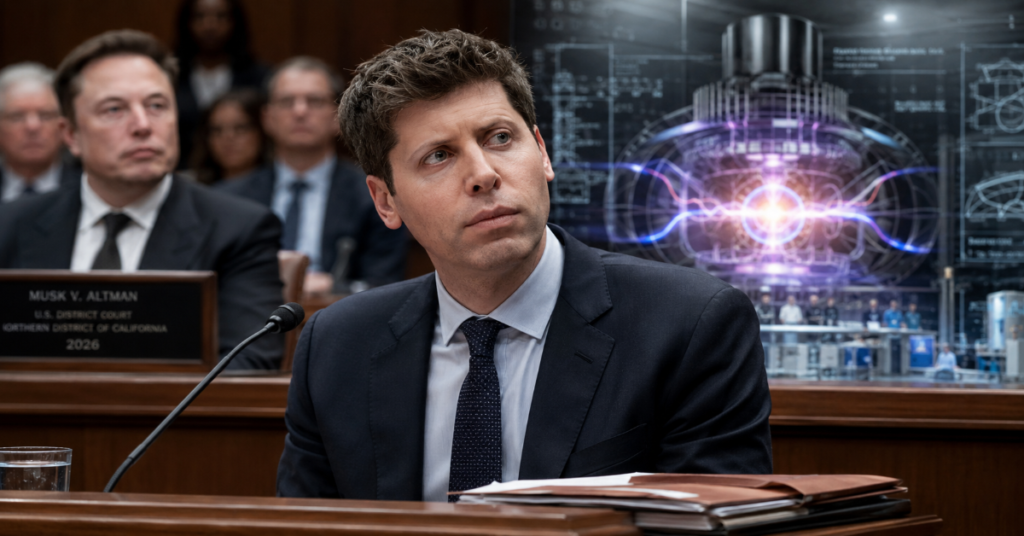
Sam Altman faced some of the most pointed scrutiny of his career this week as he testified in the Musk v. Altman trial in Oakland, confirming under cross-examination that he owns approximately one third of Helion Energy — a nuclear fusion startup valued at roughly $5 billion — at a time when OpenAI was actively exploring its own investment in the company. The stake, valued at approximately $1.65 billion as of late 2025 according to financial disclosures filed in the case, has now drawn parallel investigations from the House Oversight Sam Altman Helion conflict of interest Musk trial 2026 Committee, a group of Republican state attorneys general calling on the SEC to act, and growing scrutiny from institutional investors who are watching OpenAI’s governance ahead of its anticipated IPO.
Helion, founded in 2013 and based in Everett, Washington, is one of the most prominent fusion energy startups in the world, having raised more than $1 billion from investors. Altman personally invested $375 million in a 2021 $500 million funding round and served as Helion’s board chairman from 2015 until March 2026. He left the board two months before his appearance on the stand — a departure that has itself drawn scrutiny from Musk’s legal team, which characterised the timing as suspicious.
What Altman Said on the Stand
Testifying under cross-examination by Musk’s attorney Steven Molo, Altman confirmed the ownership figures and his role as board chairman but maintained that he had consistently recused himself from OpenAI’s dealings with Helion. When asked by Molo what recusal meant in practice, Altman said it covered ‘the decision to proceed and the final approval of terms.’ He acknowledged that ‘a huge percentage’ of his time at OpenAI is spent on securing energy and compute resources — precisely the domain where Helion operates — and that he was performing this work while simultaneously chairing Helion’s board.
Altman also confirmed he was aware of a second OpenAI-Helion agreement signed in March 2026, but said he was not familiar with its details. His original 2024 agreement gave OpenAI the option to purchase power from Helion’s first commercial plant. Helion separately has a 2024 agreement to sell power to Microsoft — OpenAI’s largest investor and a defendant in the Musk case — starting in 2028. The overlapping relationships between Altman, OpenAI, Microsoft, and Helion are at the centre of Musk’s legal narrative that Altman has used his position at OpenAI to benefit his personal portfolio.
Financial disclosures in the case show that Altman has a total stake of more than $2 billion in companies that do business with OpenAI — a figure that Musk’s legal team used to construct a broader argument about systemic conflict of interest. Altman has denied that any deals were approved without appropriate process, and OpenAI has stated that the company’s board conducts independent review of related-party transactions.
Congress and Regulators Respond
The Helion testimony landed simultaneously with escalating political pressure. The House Oversight Committee, chaired by Representative James Comer of Kentucky, sent Altman a letter on May 8 requesting documents related to OpenAI’s handling of potential conflicts of interest. The letter specifically cited the Helion relationship and expressed concern that ‘funds donated for charitable purposes are not diverted for unintended uses, such as artificially increasing the market value of other companies in which an executive or board member may hold an interest.’
Separately, a group of Republican state attorneys general called on the Securities and Exchange Commission to scrutinise the Helion relationship ahead of OpenAI’s planned IPO, as reported by the Wall Street Journal. The AGs argued that investors considering the IPO would be materially affected by undisclosed or inadequately disclosed conflicts between Altman’s personal investment portfolio and OpenAI’s procurement decisions. The SEC has not publicly responded to the request.
What the Musk Case Is Actually About
The Musk v. Altman trial, which began in late April 2026, centres on Musk’s claim that Altman and co-founder Greg Brockman abandoned OpenAI’s original nonprofit mission when the company restructured as a for-profit entity. Musk is seeking $150 billion in damages payable to the nonprofit, as well as the removal of Altman and Brockman from their roles. He first filed the lawsuit in 2024.
On the stand, Altman testified that after Musk failed to obtain a controlling stake in a for-profit subsidiary of OpenAI, Musk began pushing for the company to become a division of Tesla — a framing Altman characterised as reflecting Musk’s long-standing preference to only work on companies he fully controlled. The Helion conflict-of-interest allegations are a subsidiary thread within this broader narrative about who controls OpenAI and in whose interests the company’s decisions are made.
Frequently Asked Questions
What is Helion Energy and what does it have to do with OpenAI?
Helion is a nuclear fusion startup based in Everett, Washington, developing technology to generate electricity from fusion — the process that powers the sun. No company has yet demonstrated commercially viable fusion power, but Helion has raised more than $1 billion and broke ground on its first plant in Malaga, Washington. Altman has been one of the company’s largest backers, investing $375 million personally. OpenAI signed a 2024 agreement giving it the option to purchase power from Helion’s first plant, and a second agreement was signed in March 2026. The conflict of interest concern is that Altman, as OpenAI’s CEO, approved or oversaw these agreements while simultaneously holding a $1.65 billion personal stake in Helion.
Has Altman admitted wrongdoing?
No. Altman has testified that he consistently recused himself from OpenAI’s decisions involving Helion, and OpenAI states that related-party transactions are reviewed by an independent board process. The dispute is not over whether recusal occurred, but over whether recusal is sufficient given the scale of the financial interest and the centrality of energy procurement to OpenAI’s core operations. Musk’s legal team argues that no recusal mechanism can adequately firewall a founder whose personal wealth is directly linked to a company’s vendor relationships at this Sam Altman Helion conflict of interest Musk trial 2026 scale.
