
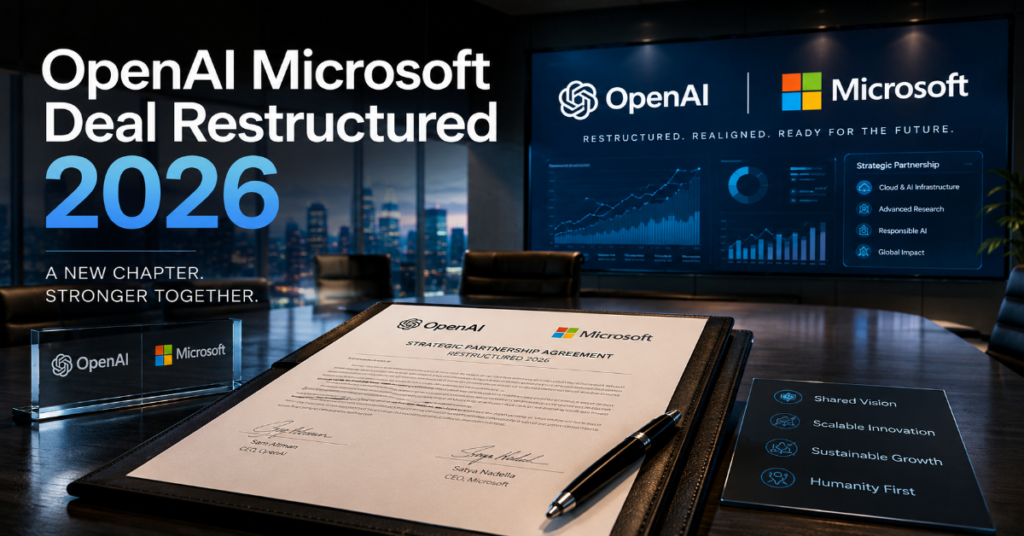
OpenAI and Microsoft announced a sweeping overhaul of their long-standing AI partnership on April 27, 2026 — one of the most significant restructurings in the short history of the AI industry. The revised agreement caps Microsoft’s total revenue share at $38 billion through 2030, ends Microsoft’s exclusive licence to OpenAI’s models and technology, and allows OpenAI to serve its products across any cloud provider for the first time. OpenAI Microsoft deal restructured 2026 saves OpenAI an estimated $97 billion through 2030 compared with the previous uncapped revenue-sharing arrangement, and removes structural constraints that had been limiting the company’s ability to reach enterprise customers who do not operate on Microsoft Azure.
AI Magazine confirmed on May 13 that The Information had reported the $38 billion cap figure — a specific number that crystallises the scale of what OpenAI has achieved in the renegotiation. Microsoft’s investment in OpenAI, made over multiple tranches since 2019 and totalling approximately $13 billion, is now valued at roughly $135 billion, representing approximately 27% of the company on a diluted basis.
What Changed — The Three Key Terms
The revised partnership rests on three structural changes that together shift significant commercial power from Microsoft to OpenAI. First, revenue share payments are now subject to a hard cap of $38 billion total through 2030. These payments continue independently of OpenAI’s technology progress — removing the former linkage between payment terms and AGI milestones. Second, the Microsoft licence to OpenAI’s intellectual property for models and products continues through 2032, but is no longer exclusive. Previously, Microsoft held exclusive access, meaning competitors using Azure gained the benefit but rivals on AWS or Google Cloud were locked out. Now, OpenAI can serve any customer on any cloud. Third, the famous ‘AGI clause’ — a provision that required Microsoft to determine its response when OpenAI declared it had reached artificial general intelligence — has been removed entirely, simplifying what had become one of the partnership’s most complex and disputed provisions.
Microsoft’s official blog described the change as a mutual evolution driven by the ‘rapid pace of innovation.’ The joint statement reads: ‘Today, we are announcing an amended agreement to simplify our partnership and the way we work together, grounded in flexibility, certainty, and a focus on delivering the benefits of AI broadly.’ Both companies were careful to emphasise that Azure remains OpenAI’s primary cloud partner and that OpenAI products will ship first on Azure, unless Microsoft cannot or chooses not to support the necessary capabilities. The partnership is not ending — it is being put on a different structural footing.
Why This Happened — The Competitive Context
The restructuring reflects pressure from multiple directions that had been building for months. OpenAI’s own revenue chief, Denise Dresser, wrote in an internal memo that the previous partnership had ‘limited our ability to meet enterprises where they are’ — a direct reference to the reality that many large enterprise customers run primarily on AWS or Google Cloud, not Azure. With the old exclusive arrangement, those customers could not access OpenAI models through their preferred cloud provider.
The deal also followed OpenAI’s $50 billion Amazon investment partnership, announced in February 2026, under which Amazon agreed to invest up to $50 billion in OpenAI and OpenAI expanded its AWS agreement by $100 billion over eight years. That deal was structurally incompatible with genuine Azure exclusivity. The Microsoft restructuring formalized what Amazon’s entry had already begun to break: OpenAI’s single-cloud dependency. AWS CEO Andy Jassy confirmed the day of the Microsoft announcement that AWS would offer OpenAI models through Amazon Bedrock in the coming weeks.
What It Means for the IPO
The financial structure of the new deal matters significantly for OpenAI’s anticipated IPO, reported to be targeting Q4 2026. A $38 billion revenue cap, in place of an uncapped obligation, makes OpenAI’s financials substantially cleaner for public market investors. The estimated $97 billion in savings through 2030 changes the long-term profitability narrative significantly — the company still targets breakeven around 2029, but the path is now less burdened by structural payments to its largest investor. Multiple analysts have noted that the restructuring gives OpenAI ‘a much stronger long-term pitch’ for a public offering, as it demonstrates the company’s ability to renegotiate terms from a position of commercial strength.
Frequently Asked Questions
Did Microsoft and OpenAI break up?
No — the relationship continues, with Microsoft remaining OpenAI’s primary cloud partner and largest investor. What changed is the exclusivity structure and the revenue share cap. OpenAI products still ship first on Azure, and Microsoft’s $135 billion stake in OpenAI (approximately 27% diluted) makes the companies deeply financially intertwined. The restructuring makes the partnership more balanced and commercially flexible for both sides.
How much does Microsoft still make from OpenAI?
Under the new OpenAI Microsoft deal restructured 2026, Microsoft will receive a 20% revenue share from OpenAI through 2030, subject to the hard cap of $38 billion total. Microsoft also holds approximately 27% equity in OpenAI valued at roughly $135 billion. The combination of revenue share and equity makes Microsoft one of the primary financial beneficiaries of OpenAI’s commercial success — the restructuring affects the payment structure, not the overall financial relationship.
