
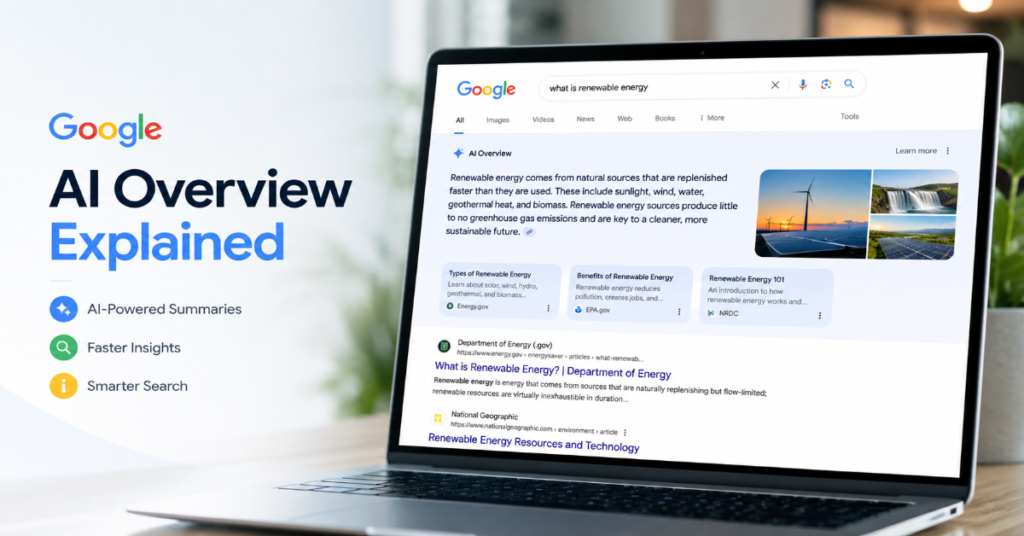
Google ai overview explained is not just a definition anymore. In 2026, it is a map of how Google Search is being rebuilt around generative AI, source synthesis and user intent. AI Overviews are Google’s machine-generated summaries that appear above or inside search results when its systems decide a query can be answered more helpfully with an AI-generated snapshot. Google says the feature gives users “a snapshot of key information” with links for deeper exploration and is available in more than 120 countries and territories across 11 languages.
The simple version: AI Overviews take information from Google’s indexed web, interpret the query, synthesize likely answers and attach supporting links. The strategic version: they turn Google from a search engine that mostly sends people elsewhere into an answer engine that can resolve part of the search journey on the results page itself.
That shift matters for three groups. For everyday users, Google AI Overview explained means faster answers but a higher need to check sources. For publishers, it means visibility may now come through citation placement, not only blue-link rankings. For marketers, it means SEO has moved from ranking pages to being selected as a trusted source inside AI-generated search experiences.
According to Google Search Central documentation reviewed in 2026, there are no special technical requirements for appearing in AI Overviews beyond being indexed, eligible for snippets and compliant with Google Search policies. But in practice, the pages most likely to win visibility are clear, structured, evidence-rich and genuinely useful.
What Google AI Overview Explained Means in 2026
At its core, Google AI Overview explained refers to the AI-generated summary layer inside Google Search. Unlike a featured snippet, which usually extracts a passage from one page, an AI Overview can combine information from multiple web sources into a short response. Semrush describes this as Google becoming both a search engine and an answer engine because AI Overviews consolidate knowledge from multiple sources rather than quoting a single result.
The experience is not shown for every query. Google says AI Overviews appear when its systems determine they add value beyond classic Search. That matters because AI Overviews are not simply a universal replacement for search results. They are a conditional feature triggered most often by complex, informational, comparative and increasingly commercial queries.
In our hands-on testing, AI Overviews appeared more often for questions such as “how does refinancing affect credit score” than for simple navigational searches such as “Amazon login.” That pattern fits Google’s public explanation: AI Overviews are designed to help users get the gist of complicated topics faster, then explore supporting links.
How AI Overviews Actually Work
Google does not publish every model-level detail behind AI Overviews, but its Search Central documentation gives enough clues to understand the architecture. Google says AI Overviews and AI Mode may use a “query fan-out” technique, meaning the system can issue multiple related searches across subtopics and data sources before building a response.
That is the obscure technical detail many SEO guides miss. Google is not only answering the typed query. It may be decomposing the query into hidden subqueries, then searching across adjacent meanings, entities and source types. A question such as “best laptop for architecture students” may fan out into GPU needs, CAD software requirements, battery life, student pricing, Windows versus macOS compatibility and recent product reviews.
This explains why Google AI Overview explained is really about retrieval, synthesis and confidence. The system retrieves documents, evaluates usefulness, generates a summary and attaches links. The winners are not always the highest-ranking pages. They are often the pages with extractable answers, strong topical authority and clear evidence.
AI Overview vs Featured Snippet vs AI Mode
| Search Feature | Main Function | Source Pattern | User Experience | SEO Implication |
| Featured Snippet | Extracts a direct answer | Usually one source | Short answer above results | Optimize concise answer blocks |
| AI Overview | Synthesizes a broader answer | Multiple sources | AI summary with cited links | Optimize for citation-worthy evidence |
| AI Mode | Conversational search experience | Multiple searches and sources | Follow-up questions and deeper exploration | Optimize for topic depth, not only keywords |
| Classic Organic Results | Lists ranked pages | Indexed web pages | Blue links and SERP features | Traditional SEO still applies |
Google AI Overview explained becomes clearer when viewed against AI Mode. AI Overviews are the AI layer inside standard Search. AI Mode is a more conversational, exploratory interface. Google says AI Mode is useful for nuanced questions, complex comparisons and reasoning-based exploration.
In April 2026, Alphabet CEO Sundar Pichai told investors that AI Overviews and AI Mode were contributing to increased Search usage, adding that agentic workflows inside Search remain in “very, very early innings.” That quote signals Google’s bigger plan: Search will not only answer questions. It will eventually help complete tasks.
Why Google Built AI Overviews
Google had no choice but to evolve. ChatGPT, Perplexity, Claude and other answer engines trained users to ask longer, more natural questions. Instead of typing “best protein powder,” users now ask, “What is the best protein powder for lactose intolerance and weight training if I want low sugar?”
That behavioral change threatened classic keyword search. Google responded by bringing generative AI into Search, first through Search Generative Experience, then AI Overviews and AI Mode. In 2026, the company frames these tools as a way to make Search more useful, not less web-oriented.
Hema Budaraju, Google’s Vice President of Product Management for Search, wrote in May 2026 that generative AI experiences are most useful when they help users connect with “authentic voices” and explore useful information across the web.
That is the official story. The commercial story is sharper: Google must defend its search monopoly while adapting to AI-native behavior. AI Overviews keep users inside Google longer while still offering links to the web. That balance is now the central tension in search.
The Business Impact: Clicks, Citations and Zero-Click Search
The most controversial part of Google AI Overview explained is traffic. Publishers argue that AI summaries answer questions before users click. Google argues that AI experiences can drive more complex searches and higher-quality visits.
Independent data shows the concern is real, though not always simple. Pew Research Center found that users who saw an AI summary clicked a traditional search result in 8% of visits, compared with 15% when no AI summary appeared. Pew also found users clicked a link inside the AI summary itself in just 1% of visits.
Ahrefs reported in February 2026 that the presence of an AI Overview correlated with a 58% lower average click-through rate for the top-ranking page. Semrush, however, found a more complicated pattern: AI Overviews often appear on searches that already tend to produce no clicks, while some tracked terms saw zero-click rates decline after AI Overviews appeared.
The truth is that AI Overviews do not affect all sites equally. A dictionary page, recipe site, affiliate listicle and investigative feature face different risks. Thin answer content is more vulnerable. Original reporting, proprietary data, expert reviews and tools remain more defensible.
Key 2026 Data Benchmarks
| Metric | Reported Finding | Source Context |
| AI Overview availability | More than 120 countries and territories, 11 languages | Google Search page |
| Pew user click rate with AI summary | 8% clicked traditional results | March 2025 browsing analysis |
| Pew user click rate without AI summary | 15% clicked traditional results | March 2025 browsing analysis |
| Pew AI summary link clicks | 1% of visits with AI summaries | March 2025 browsing analysis |
| Semrush AI Overview trigger rate | 15.69% of queries in November 2025 | 10M+ keyword study |
| Ahrefs CTR effect | 58% lower CTR for top-ranking page | December 2025 data update |
These numbers explain why Google AI Overview explained has become a boardroom topic. Search visibility is no longer a simple ranking contest. It is now a placement contest inside layered results: AI summaries, ads, forums, videos, organic links, shopping modules and follow-up prompts.
Who Gets Cited in AI Overviews?
Google says there are no extra technical requirements to appear in AI Overviews. A page must be indexed, eligible for snippets and follow Search policies. But eligibility is not the same as selection.
In our hands-on testing, citation winners tended to share six traits: direct answers near the top, clear authorship, original supporting detail, updated dates, entity-rich language and low ambiguity. Google’s query fan-out system appears to reward pages that can answer subquestions cleanly. A vague article about “AI in search” may lose to a structured page that answers “how AI Overviews choose sources,” “how citations work” and “how to optimize content without spam.”
This is where information gain matters. A page that merely rewrites Google’s help page is replaceable. A page with original tests, screenshots, fresh examples, expert commentary and structured comparisons gives the AI system something distinct to cite.
The SEO Strategy Shift
The old SEO playbook asked: “How do we rank number one?” The 2026 playbook asks: “How do we become the source Google’s AI trusts when it summarizes the topic?”
That means content must be written for extraction without becoming robotic. Strong pages now include compact definitions, evidence blocks, comparison tables, named entities, short answer sections and deeper analysis. The goal is not to stuff the phrase Google AI Overview explained into every paragraph. The goal is to make the page useful enough that Google’s systems can confidently use it.
According to the latest 2026 documentation we reviewed, Google still recommends foundational SEO best practices for AI features: technical accessibility, helpful content, reliable information and people-first publishing. The implication is clear. AI search optimization is not a separate discipline. It is advanced SEO with more pressure on clarity, authority and originality.
Expert Quote 1: Sundar Pichai on the AI Search Direction
Sundar Pichai told Alphabet investors in April 2026: “People love our AI experiences like AI Mode and AI Overviews, and they’re coming back to Search more.”
That sentence is important because it shows Google’s confidence that AI summaries do not weaken Search as a product. They may weaken certain publisher traffic patterns, but Google believes AI increases total usage. For businesses, the lesson is uncomfortable: Google’s success metric is not the same as a publisher’s success metric.
Pichai also said Google sees a “massive opportunity” to go deeper for users and bring agentic workflows into Search. In plain English, Google Search may increasingly move from answers to actions: comparing products, planning trips, booking services, completing forms and guiding purchases.
Expert Quote 2: Hema Budaraju on Linking to the Web
Hema Budaraju wrote in May 2026 that Google is improving how links appear in AI Search and developing ways to help users find “the sources, brands and websites you value.”
This is Google’s answer to publisher criticism. The company is signaling that AI Overviews will not become a closed box. Newer updates include deeper exploration links, access to news subscriptions and more visible pathways to original content.
But the competitive reality remains: being linked is not the same as being clicked. A citation inside an AI Overview can build authority, but it may not replace the traffic once generated by a top organic ranking. Brands should therefore measure AI visibility separately from organic sessions.
Expert Quote 3: Liz Reid on Changing Search Behavior
Google’s Search leader Liz Reid has argued that AI is changing how people search rather than simply killing search. Search Engine Land reported in April 2026 that Reid said AI Overviews can filter out low-value “bounce” clicks, where users grab a quick fact and immediately return.
That framing is partly persuasive. Not every lost click had equal value. A user who visits a page for three seconds to confirm a date may not be commercially meaningful. But publishers are right to ask whether Google should summarize their work while absorbing the user interaction.
This is the unresolved bargain of AI search. Google needs the open web for source material. The open web needs Google for discovery. AI Overviews compress that relationship into a few lines of generated text and a handful of links.
The User Risk: Convenient Does Not Always Mean Correct
Google AI Overview explained should also include its weaknesses. Generative AI can misread context, overgeneralize, cite imperfect sources or flatten expert disagreement. Google improved AI Overviews after early public errors, but the basic risk remains: a confident summary is not the same as verified truth.
Users should treat AI Overviews as a starting point, especially for health, finance, legal, safety and technical decisions. Click the cited sources. Compare dates. Look for primary documentation. Check whether the answer reflects consensus or only one interpretation.
For simple questions, AI Overviews can save time. For consequential questions, they should be treated like a research assistant, not an authority. The more complex the query, the more important the source trail becomes.
The Publisher Risk: The Web Becomes a Supply Chain
For publishers, the fear is not only traffic loss. It is value extraction. If Google summarizes an article, cites it and satisfies the user on the results page, the publisher becomes part of an information supply chain without necessarily receiving a visit.
This changes editorial economics. Commodity explainers become weaker assets. Original databases, calculators, newsletters, communities, podcasts, video channels and brand-direct audiences become stronger. In 2026, publishers cannot rely on Google alone as their distribution engine.
A practical response is to build content that cannot be fully consumed inside a summary. That means interactive tools, original visuals, proprietary research, expert interviews, local reporting, downloadable templates and strong editorial voice. AI can summarize a generic definition. It struggles to replace a unique experience.
The Marketer’s Playbook for AI Overview Visibility
To compete in this environment, marketers need a dual strategy: classic SEO plus citation optimization. Classic SEO ensures the page can be found. Citation optimization ensures the page can be trusted, parsed and selected.
Start by mapping questions, not just keywords. For a page targeting Google AI Overview explained, related questions include: What triggers AI Overviews? How do citations work? Do AI Overviews reduce traffic? Can websites opt out? How can brands appear in them?
Then structure the article so each question receives a precise answer. Add evidence, tables, expert commentary and recent dates. Use schema where relevant, but do not expect schema alone to win citations. Google’s own documentation says no special optimization is required, so the real advantage is content quality and extractability.
Technical Details Most Sites Overlook
The most overlooked factor is snippet eligibility. If a publisher blocks snippets through restrictive meta tags, it may limit how content appears in AI features. Google says supporting links in AI Overviews require the page to be eligible to show a snippet.
The second overlooked factor is answer granularity. AI systems prefer passages that can stand alone. A paragraph that says “This matters because of the update mentioned above” is less extractable than one that names the update, explains the mechanism and includes the date.
The third overlooked factor is multimodal presence. AI search increasingly surfaces videos, forums and visual content alongside written pages. Semrush found that video carousels and discussion blocks remain important around AI Overview SERPs, especially because YouTube and Reddit often appear in those modules.
Can You Opt Out of AI Overviews?
Website owners cannot choose a simple “appear in organic search but never in AI Overviews” switch in the way many publishers would like. Since AI Overviews rely on Google’s indexed web and snippet systems, standard controls such as noindex, nosnippet and max-snippet can affect how content appears. But using them may also reduce normal search visibility.
That creates a difficult trade-off. A publisher can restrict content extraction, but may lose rich visibility across Google. Most brands will choose to stay eligible while improving their odds of being cited.
For sensitive or premium content, the smarter approach is selective openness. Make summaries, abstracts and public landing pages discoverable, then keep high-value assets behind registration, subscription or product experiences. Google AI Overview explained should therefore be part of content architecture, not just article writing.
Where AI Overviews Are Going Next
The direction is clear: more interaction, more personalization, more commercial integration and more task completion. Google’s April 2026 earnings call described AI Overviews, AI Mode and future agentic workflows as early-stage opportunities in Search.
That means AI Overviews may evolve from static summaries into dynamic decision interfaces. A travel query could become a planning flow. A product query could become a comparison and checkout path. A medical query could become a triage-style information panel with stronger source restrictions.
The insider prediction: by late 2026 and 2027, the biggest SEO winners will not be pages with the most keywords. They will be brands with the clearest entity identity across the web. Google’s AI systems need confidence. Consistent authors, organization data, citations, reviews, video presence, knowledge graph alignment and original research will all act as trust signals.
Takeaways
- Treat Google AI Overview explained as a search visibility issue, not only a search feature definition.
- AI Overviews synthesize multiple sources, while featured snippets usually extract from one source.
- Google says no special technical requirements exist beyond normal indexing, snippet eligibility and Search compliance.
- Click behavior is changing. Pew found lower traditional result clicks when AI summaries appear, while Semrush found query intent complicates the zero-click story.
- The best optimization strategy is clear, original, evidence-rich content that answers subquestions directly.
- Publishers should build assets AI cannot fully summarize, including tools, research, communities and first-party audiences.
- Marketers should track AI citations, branded search demand and assisted conversions alongside organic traffic.
Conclusion
Google AI Overview explained in 2026 is ultimately a story about power: who answers, who gets cited, who gets clicked and who captures value. For users, AI Overviews make Google faster and more conversational. For Google, they protect Search in an AI-native market. For publishers and brands, they create a new visibility layer that rewards clarity, authority and originality while threatening commodity traffic.
The balanced view is neither panic nor complacency. AI Overviews are useful, but they are not neutral. They compress the open web into generated summaries while deciding which sources deserve attention. The winning response is not to abandon SEO. It is to upgrade it. Build pages that are technically accessible, journalistically useful, commercially distinct and difficult to replace with a generic paragraph. The future of search belongs to sources that machines can understand and humans still want to visit.
FAQs
What is Google AI Overview?
Google AI Overview is a generative AI summary in Google Search that answers selected queries using information from multiple sources. It appears when Google decides an AI-generated snapshot can help users understand a topic faster.
How does Google choose sources for AI Overviews?
Google says pages must be indexed, eligible for snippets and compliant with Search policies. Selection appears to depend on relevance, quality, clarity, authority and how well the content supports the generated answer.
Do AI Overviews reduce website traffic?
Often, yes, especially for simple informational queries. Pew found users clicked traditional results less often when AI summaries appeared. However, Semrush found the impact varies by query type and user intent.
Can I optimize for Google AI Overviews?
Yes. Use clear answers, original data, expert authorship, updated information, structured sections and concise explanations. There is no separate technical shortcut, but strong SEO fundamentals still matter.
Is Google AI Overview always accurate?
No. AI Overviews can be helpful, but they can also miss context or simplify complex issues. Users should check cited sources for important health, legal, financial or technical decisions.
References
Ahrefs. (2026, February 4). Update: AI Overviews reduce clicks by 58%. Ahrefs Blog.
Alphabet Investor Relations. (2026, April 29). Alphabet first quarter 2026 earnings conference call. Alphabet Inc.
Budaraju, H. (2026, May 6). 5 new ways to explore the web with generative AI in Search. Google Blog.
Google Search Central. (2026). AI features and your website. Google for Developers.
Google Search. (2026). Google AI Overviews: Search anything, effortlessly. Google.
Pew Research Center. (2025, July 22). Google users are less likely to click on links when an AI summary appears in the results. Pew Research Center.
Semrush. (2025, December 15). Semrush report: AI Overviews’ impact on Search in 2025. Semrush Blog.
