
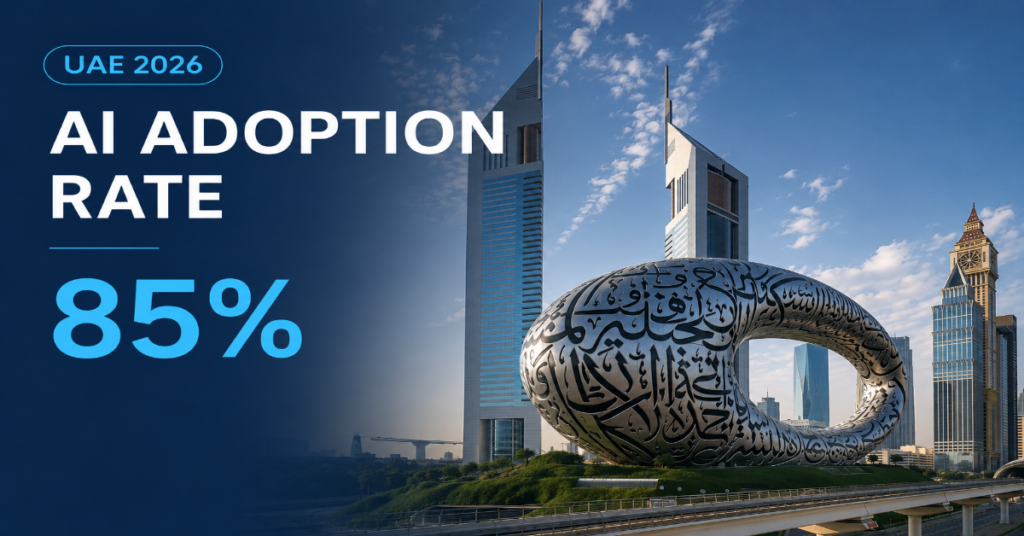
The United Arab Emirates has maintained its position at the top of Microsoft’s National AI Leaderboard with a generative AI adoption rate of 70.1% among working-age adults — the highest measured rate of any country on earth and more than double the global average of 17.8%, according to Microsoft’s Q1 2026 Global AI Diffusion Report published May 7. The figure places the UAE dramatically ahead of the United States (31.3%, ranked 21st), Switzerland (37.8%), and all other measured economies.
How the UAE Got Here
The UAE leadership in AI Adoption Rate 2026 reflects a decade of deliberate government strategy. The country appointed the world’s first Minister of Artificial Intelligence in 2017 and has since embedded AI adoption targets into its national development framework, the UAE Centennial 2071 Plan. Government services in Dubai and Abu Dhabi have been systematically redesigned around AI interfaces, creating widespread citizen exposure to AI tools in contexts — tax filing, visa applications, healthcare scheduling — that drive habitual use.
The UAE AI Adoption Rate 2026 has also positioned itself as a neutral ground for AI infrastructure investment. Microsoft, Google, Amazon, and Alibaba have all established significant data centre presences in the country, giving UAE residents access to frontier AI tools with low latency and competitive pricing relative to regional alternatives.
The Geopolitical Significance
The UAE’s AI leadership has a geopolitical dimension that extends beyond the impressive adoption statistic. The country has attracted AI investment from both US and Chinese technology companies simultaneously — a position that most nations have had to choose between as AI infrastructure has become an arena of US-China strategic competition. The UAE’s ability to maintain relationships with both OpenAI and Alibaba’s Qwen team, while hosting US cloud infrastructure and Chinese semiconductor partnerships, makes it a useful case study for other nations navigating the AI geopolitical landscape.
