
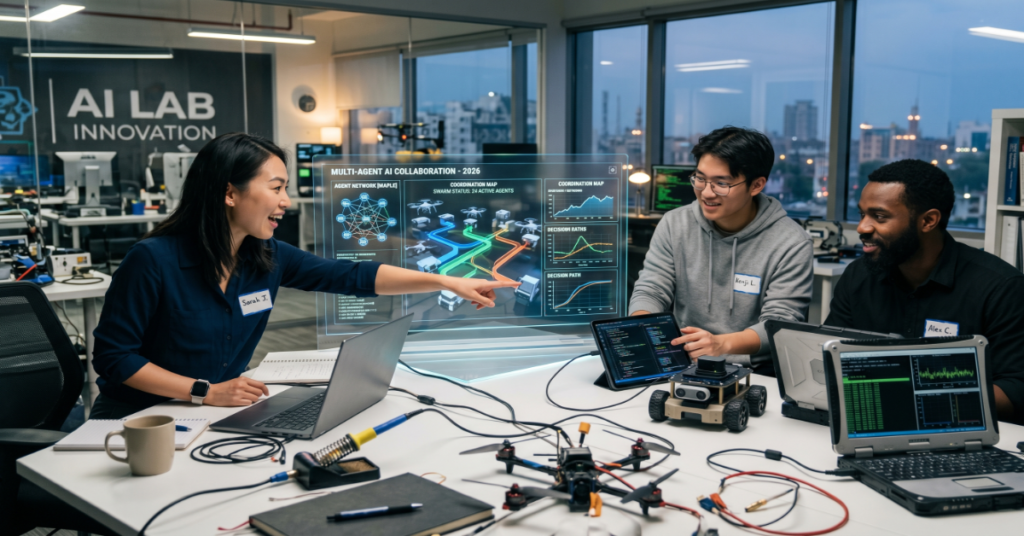
The first generation of AI agents — systems that could browse the web, write code, or execute a sequence of tasks in response to a single instruction — could only act alone. The next wave can cooperate. MIT Technology Review’s 2026 list of the most important trends in artificial intelligence identifies multi-agent collaboration — teams of AI systems that divide tasks, communicate, verify each other’s work, and combine outputs to achieve goals that no single agent could accomplish alone — as one of the most significant developments reshaping what AI can actually do.
From Solo Agent to AI Team
The shift from single-agent to multi-agent architectures is already visible in production deployments. Perplexity Computer, launched in February 2026, orchestrates 20 different AI models in parallel to execute complex research and analysis tasks. Anthropic’s Claude Opus 4.6 introduced agent teams for parallel coding workflows — multiple Claude instances that can work on different parts of a codebase simultaneously, verify each other’s outputs, and merge results. OpenAI’s Codex agent and Microsoft’s Copilot Workspace both implement similar patterns for software development tasks.
The practical implication is that AI systems can now tackle tasks that are too large, too complex, or too multi-domain for any single model’s context window or capability set. A multi-agent system can run parallel literature searches while simultaneously drafting report sections, with a third agent verifying factual claims against sources — a workflow that compresses hours of human research into minutes.
The Risk: Coordination Without Oversight
Multi-agent architectures also introduce risks that single-agent systems do not. When AI agents communicate and coordinate autonomously, human oversight becomes significantly harder to maintain — by definition, the value of multi-agent systems comes partly from their ability to execute complex multi-step workflows without requiring human approval at every step.
Establishing appropriate checkpoints, audit trails, and human review processes for multi-agent outputs is one of the most active areas of AI safety research in 2026, and one that MIT identifies as an area where governance has not kept pace with capability.
