
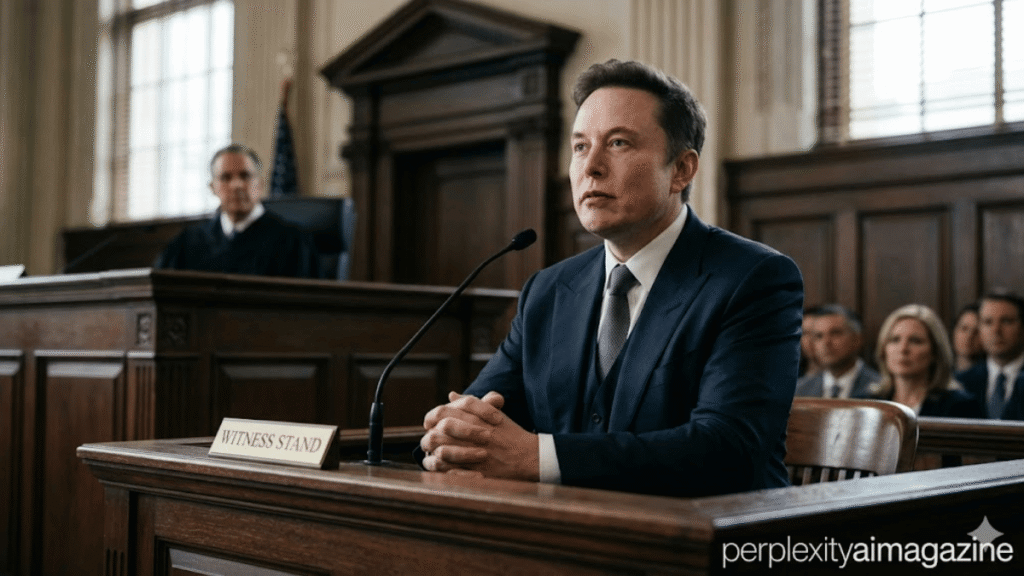
The landmark Musk vs. Openai trial entered its second day on Wednesday in Oakland, California, with jurors and the public digesting hours of dramatic testimony from Elon Musk himself — the first witness called in what legal experts are calling the most consequential courtroom battle in the history of artificial intelligence. At stake is not only the Musk OpenAI trial’s central question of whether the company’s for-profit conversion betrayed a charitable trust, but potentially the entire trajectory of one of the world’s most powerful AI companies.
Musk took the stand on Tuesday and faced nearly two hours of direct examination from his lead attorney, Steven Molo. He testified that he co-founded OpenAI in 2015 with a singular purpose: to develop artificial intelligence as an open-source, nonprofit enterprise that would serve humanity rather than enrich any individual. “I came up with the idea, the name, recruited the key people, taught them everything I know, provided all the initial funding,” Musk told the jury. He said he would never have contributed his resources — which he estimates amounted to at least $44 million — had he believed the company’s founders intended to eventually profit from it.
Molo entered into evidence OpenAI’s founding charter from 2015, which stated the company was “not organized for the private gain of any person” and would seek to create “open source technology for the public benefit.” Musk described the document as unambiguous: “It was specifically meant to be for a charity that did not benefit any individual person,” he said. Musk also warned the jury about broader AI risks, saying he had “extreme concerns” about the technology and did not want a “Terminator outcome.” – Openai trial.
OpenAI’s attorneys, led by William Savitt, offered a sharply different account in their opening statement. Savitt told the jury the Musk OpenAI trial exists not because anyone stole a charity, but because Musk “didn’t get his way.” According to OpenAI’s version of events, Musk himself advocated for a for-profit structure as early as 2017 but was denied full operational control of the company and chose to leave. Savitt pointed to a September 2020 post Musk made on X, then Twitter, writing that “OpenAI is essentially captured by Microsoft” — evidence, OpenAI’s lawyers say, that Musk had acknowledged the for-profit relationship years before filing suit.
“We are here because Mr. Musk turned out to be very wrong about OpenAI,” Savitt said. “We’re here now because Mr. Musk competes with OpenAI.” Indeed, Musk went on to found xAI, his own artificial intelligence company, after departing OpenAI’s board in 2018. Critics and OpenAI alike have cast the litigation as a competitive maneuver — Savitt told jurors that “after he launched his own competitor, then he launched lawsuits.”
The remedies Musk is seeking are sweeping: a court order reverting OpenAI to a nonprofit structure, the removal of Sam Altman and Greg Brockman as officers of the for-profit subsidiary, and approximately $130 billion in damages to be returned to OpenAI’s nonprofit foundation. Microsoft, which has invested over $13 billion in OpenAI since 2019, is also named as a defendant, with Musk’s lawyers alleging it aided and abetted the alleged breach of charitable trust.
The trial threatens to cloud OpenAI’s plans for an initial public offering expected later this year. CEO Sam Altman, who was present in the Oakland courthouse on Tuesday, declined public comment as testimony got underway. Cross-examination of Musk and additional witnesses are expected to continue through the rest of the week, with the jury’s advisory verdict potentially weeks away.
