
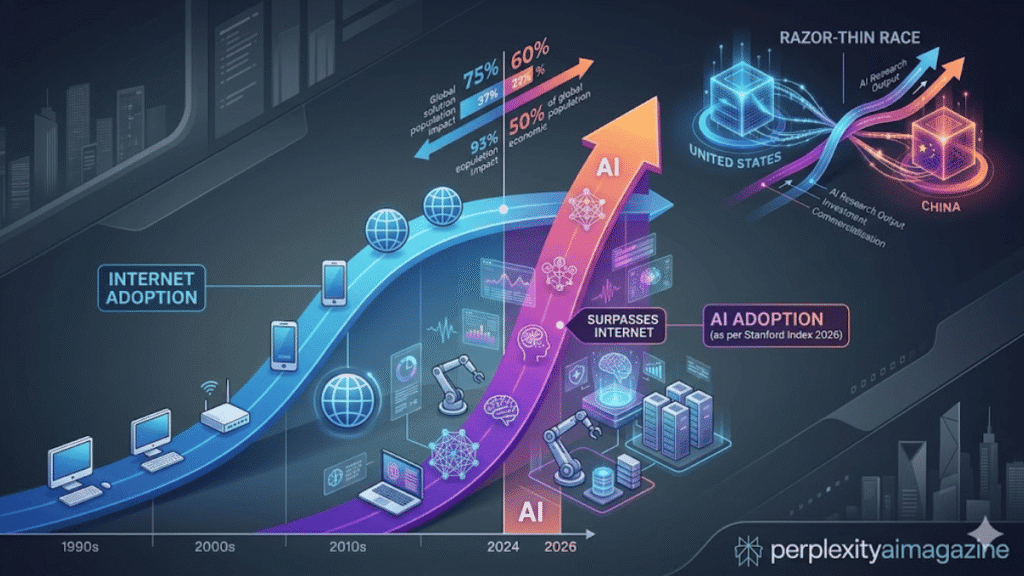
The most comprehensive annual audit of artificial intelligence’s global trajectory landed this month with a finding that cuts through much of the ambient noise about slowdowns, bubbles, and diminishing returns: AI adoption is outpacing the personal computer and the internet, the top models are continuing to improve despite predictions of a plateau, and the race between the United States and China has narrowed to margins so thin that performance rankings have become nearly meaningless as differentiators. The Stanford AI Index 2026, published by the university’s Institute for Human-Centered Artificial Intelligence, serves as the field’s annual report card — and this year’s edition arrives at an inflection point.
The Stanford AI Index 2026 documents a pace of public adoption unlike anything recorded for previous transformative technologies. People are picking up AI tools and integrating them into daily workflows faster than they adopted smartphones, social media platforms, or home broadband. AI companies are generating revenue faster than any previous technology boom in recorded history — and they are spending at a scale commensurate with that ambition. AI data centers globally can now draw 29.6 gigawatts of power, a level sufficient to run the entire state of New York at peak demand.
The US-China model competition, which the Stanford AI Index 2026 tracks using Arena — a community-driven ranking platform that has users compare model outputs directly — shows the two countries are nearly neck and neck for the first time. In early 2023, OpenAI held a commanding lead. By late 2024, Google and Anthropic had narrowed the gap from the American side. In February 2025, DeepSeek’s R1 model briefly matched the leading US model. As of March 2026, Anthropic leads the Arena rankings, trailed closely by xAI, Google, and OpenAI — with Chinese models from DeepSeek and Alibaba lagging only modestly. The margin separating these top competitors has become so narrow that the Stanford AI Index concludes the industry is now competing primarily on cost, reliability, and real-world usefulness rather than raw benchmark performance.
That shift has significant strategic implications. For enterprise buyers, the era in which a single dominant model’s capability advantage justified premium pricing or lock-in is effectively over. The Stanford AI Index 2026 notes that the benchmarks historically used to evaluate AI performance — including many that drove headlines and investment decisions — are struggling to keep pace with the actual capabilities of deployed systems. The same is true of AI governance frameworks and regulatory structures, which the report describes as running to catch up with a field that is, in the report’s words, “sprinting.”
The infrastructure costs underpinning this sprint are staggering. AI companies are spending hundreds of billions of dollars on data centers and specialized chips. Cloud providers — Amazon, Microsoft, and Google — are collectively on track to spend roughly $600 billion on AI infrastructure in 2026. The Stanford AI Index 2026 notes that these expenditures are unlike any previous technology investment cycle in their speed and concentration, and that the financial sustainability of the current buildout remains an open question even as revenues accelerate.
On the policy front, the index identifies regulatory lag as one of the defining challenges of the current moment. The benchmarks used to evaluate model safety, the legal frameworks governing AI liability, and the labor market structures affected by automation are all, the report concludes, insufficiently equipped to address a technology moving at this velocity. The Stanford AI Index 2026 stops short of predicting an AI development slowdown but acknowledges that the infrastructure, regulatory, and societal systems that surround AI may impose practical limits before the models themselves do.
Click Here to Read More About AI Related News!
