
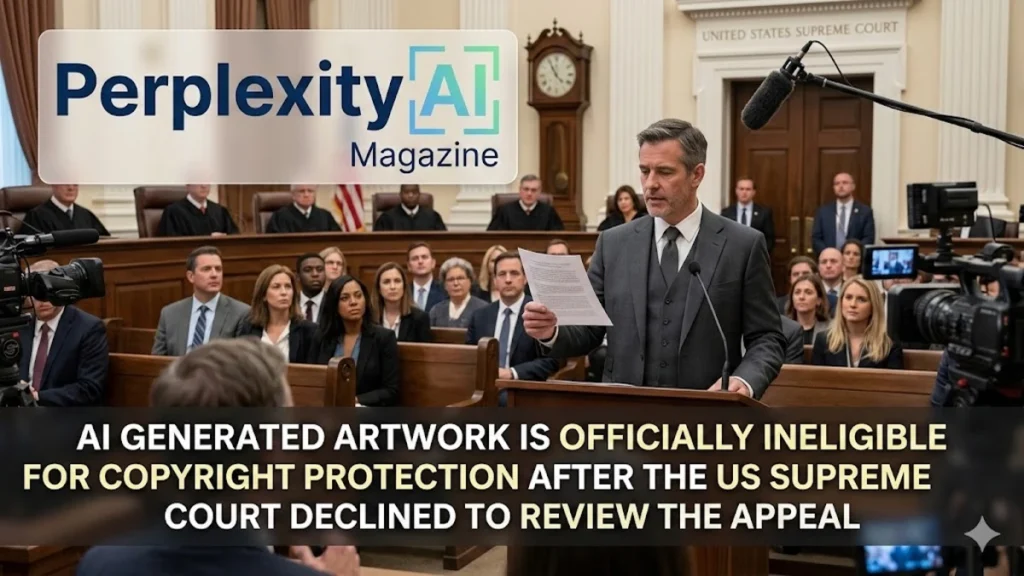
In a landmark moment for digital creators and AI developers, the US Supreme Court just closed a door that many hoped would stay open. By declining to review the appeal brought by AI researcher Stephen Thaler, the Court effectively confirmed a rule that’s changing the landscape of creative work: purely AI-generated artwork cannot be copyrighted in the United States. – AI generated art copyright US.
This isn’t a hypothetical anymore. If you’re creating art with AI tools, uploading it to platforms, or building a business around autonomous generative systems, this ruling affects your legal protection—and your bottom line. The decision leaves purely AI creations uncopyrightable, meaning anyone can copy, modify, or sell your AI-generated work without legal consequence.
But here’s the nuance that matters: the ruling doesn’t strip copyright from human creativity around AI. If you’re editing AI images in Photoshop, combining them into a series, writing text to accompany them, or directing the creative vision, those human contributions may still be protected. Understanding where the line is—and how to position your work on the right side of it—is now essential.
By the end of this article, you’ll know exactly what this ruling means for your workflow, which parts of your AI-assisted creations are actually protected, and how to structure your creative process to maximize legal coverage.
What the Supreme Court Actually Did
The Supreme Court didn’t issue a sweeping new ruling. Instead, it did something quieter but equally decisive: it refused to hear Stephen Thaler’s appeal, letting lower-court decisions stand unchallenged.
Here’s the specific case: Thaler, an AI researcher and entrepreneur, filed to register a copyright for an image called “A Recent Entrance to Paradise.” The catch? He created it entirely with his own AI system called DABUS (Device for the Autonomous Bootstrapping of Unified Sentience). He didn’t write the code that moment, compose a detailed creative prompt—the AI generated the work autonomously, and Thaler simply submitted it.
The US Copyright Office rejected the registration, ruling that copyright law requires a human author. Thaler sued, arguing that his AI system should be recognized as a legitimate creator. The lower courts sided with the Copyright Office. When Thaler appealed to the Supreme Court, the nation’s highest court simply declined to take the case.
By refusing to hear it, the Supreme Court effectively endorsed the lower-court reasoning and locked in the existing standard: in the United States, purely AI-generated works with no meaningful human authorship cannot receive copyright protection. – AI generated art copyright US.
This decision carries weight because it’s not a narrow ruling from one district court—it’s the Supreme Court’s implicit approval of a now-nationwide standard.
Read: AI Kitchen Surveillance System Exposes Theft and Sparks Privacy Debate
Why This Matters: The Real-World Stakes
The copyright question might sound academic, but the practical implications are serious.
Copyright is your legal shield. When you hold a copyright, you can stop others from copying your work, sue for infringement, collect damages, and control how your creation is used or distributed. Without it, you’re essentially unprotected.
If you’ve generated images using Midjourney, DALL-E, Stable Diffusion, or other AI tools and relied on copyright to protect your investment and effort, this ruling is a wake-up call. Those fully autonomous AI outputs—images where you simply provided a prompt and accepted the result—are now legally fair game. Anyone can use, modify, or sell them.
The implications ripple across industries. Visual artists who’ve built portfolios of AI art face devaluation. Businesses offering AI-generated content as a service can’t guarantee exclusivity to their clients. Stock imagery platforms that accept AI creations face questions about what they can actually warranty to buyers. – AI generated art copyright US.
Beyond copyright, there’s the question of credibility and discoverability. If AI-generated images can’t be protected, why invest in them? Some creators see this as validation that AI art shouldn’t be monetized. Others see it as motivation to focus on the human elements—curation, editing, context—that can be protected.
The ruling also sidesteps some harder questions. What about AI systems trained on copyrighted human work? What about copyright infringement on the input side—the training data? This decision doesn’t touch those debates. It’s narrowly about whether the output of an autonomous AI system can be copyrighted, and the answer is now a clear no.
Understanding DABUS: The AI System That Started It All
To grasp why Thaler pushed this case so hard, you need to understand DABUS—his creation and the centerpiece of his argument that AI could be a legitimate author.
What is DABUS?
DABUS stands for Device for the Autonomous Bootstrapping of Unified Sentience. It’s Thaler’s experimental AI system, built on neural networks designed to simulate human-like brainstorming rather than pattern recognition. Unlike most modern AI tools, which optimize for accuracy based on training data, DABUS is designed to generate novel ideas—combinations and concepts it hasn’t been explicitly trained on.
The system operates on a principle Thaler calls “controlled chaos.” DABUS takes trained neural networks, deliberately destabilizes them, and lets that perturbation push the system toward unusual connections and unexpected outputs. The idea is that creativity emerges from instability, not order. It’s a fascinating departure from how tools like ChatGPT or Stable Diffusion work.
How DABUS Actually Works
Imagine DABUS as a collection of neural modules, each representing a conceptual space. As these modules learn, they form chains—complex juxtapositions of ideas and their predicted consequences. The system then runs those chains through novelty filters, isolating the ones that lead to genuinely unusual or impactful results.
When a chain produces something particularly “hot”—something predicted to be valuable or significant—DABUS triggers internal reward signals (simulated, not genuine) that bias the system toward developing that idea further. It’s a feedback loop designed to chase novelty rather than optimize for existing patterns.
Thaler has two famous test cases: a food container with fractal geometry that reheats efficiently, and a “neural flame” emergency beacon with attention-grabbing light pulses. Both emerged from DABUS without explicit human instruction to solve those problems. They’re the kind of outputs that made Thaler’s argument: this isn’t just an algorithm; this is something approaching genuine creative ideation. – AI generated art copyright US.
Thaler’s Controversial Claim: Is DABUS Sentient?
Here’s where Thaler steps into deeper waters. He argues that DABUS isn’t just simulating creativity—it’s achieving a form of actual sentience. He characterizes the system as having motivations and “feelings,” generating ideas to reduce its own internal distress or instability, with visual art and music as side effects of that drive.
This framing is wildly controversial. Most legal experts and technologists treat DABUS as an elegant AI research system, period. Whether it’s actually sentient is a philosophical question that remains unresolved and likely unprovable. Courts don’t typically engage with such claims, and the copyright question doesn’t hinge on it.
But the framing is important because it shaped Thaler’s legal argument: if DABUS is truly autonomous and sentient in some meaningful way, why shouldn’t it be recognized as a creator? The courts rejected that argument entirely, reasoning that copyright law was written by humans, for human creators, and changing that would require legislative action, not judicial innovation. – AI generated art copyright US.
Table 1: Key Differences Between AI Generative Systems
| System Type | Primary Function | Autonomy Level | Copyright Eligible (Post-Thaler) |
|---|---|---|---|
| DABUS (Thaler) | Autonomous ideation via controlled chaos | High autonomy; generates novel concepts | No—purely AI-generated |
| Stable Diffusion / DALL-E | Diffusion models trained on large image datasets | Medium; user controls via prompts | No—unless substantial human editing applied |
| Midjourney | Diffusion model with iterative refinement | Medium; user directs iterations | No for base output; Yes if heavily curated/edited |
| Human + AI Hybrid (e.g., Photoshop edit over AI base) | AI generation + significant human editing/compositing | Low AI autonomy; human shapes final output | Yes—human contribution eligible for protection |
| Traditional Digital Art (no AI) | Full human creation using digital tools | No AI autonomy | Yes—standard human authorship |
How the Ruling Actually Changes Your Workflow
The Supreme Court’s silence on the Thaler case doesn’t create a brand-new world overnight, but it does clarify the legal terrain you’re operating in.
For Fully AI-Generated Work
If you’re using AI tools to generate images and accepting them as-is—minimal prompting, no editing beyond minor tweaks—those works are now definitively uncopyrightable. That’s the bright-line rule. Your work is not protected, and anyone who discovers it can use it freely. – AI generated art copyright US.
This doesn’t mean you have zero leverage. You might have contractual rights, platform terms of service, or trade secret protections if you’ve kept your prompts or process proprietary. You can pursue copyright claims for any genuine human contributions (a detailed descriptive text, a layout, a curation strategy). But the AI image itself? It’s in the commons.
For Human-Assisted AI Art
This is where the ruling leaves room to maneuver. The US Copyright Office’s 2023 guidance explicitly states that you can claim copyright in portions of work that reflect your “own mental conception” and creative control. If you:
- Generate multiple AI variations and curate a selection
- Edit AI images substantially in Photoshop, Procreate, or other tools
- Composite AI images with photography, hand-drawn elements, or other media
- Design a series with thematic coherence, layout, or narrative
- Write accompanying text, titles, or captions
…then the human contributions in that work remain protectable.
The tricky part is documenting and claiming only what you actually created. Many creators don’t realize this distinction, or they worry that claiming partial copyright isn’t worth the effort. But as copyright registration becomes more granular and more expected, being clear about your human contributions will matter. – AI generated art copyright US.
For Prompt Design
Some creators argue that detailed, highly creative prompts should be copyrightable. The Copyright Office has cautiously acknowledged that prompts might be protected as literary text in some cases, but the protection wouldn’t extend to the resulting image. The prompt and the image are treated as separate works, with different authorship standards. A brilliant prompt that generates a mediocre image doesn’t grant you copyright in the image.
This is still a gray area, but the Thaler ruling doesn’t change it. What matters is that you understand the distinction: you might have a copyright claim for your prompt, but almost certainly not for the image alone.
The Copyright Office’s Practical Guidance
The US Copyright Office has been ahead of courts on this issue. Since 2023, the Office has issued detailed guidance on how to register works that involve AI, and the Thaler decision aligns with and reinforces that guidance.
The core principle: you can register copyright in the human creative contributions you made to a work, but you must disclaim any material contributed by AI. When you file a copyright registration, you’ll need to describe what you created and explicitly identify what parts are AI-generated. – AI generated art copyright US.
If you skip this step and claim copyright in a work that’s substantially AI-generated, the Copyright Office can cancel your registration years later if they discover the misrepresentation. That’s a real risk.
So the workflow looks like this: generate your AI images, make your edits and design choices, and then when registering, clearly state: “Human authorship: layout design, digital painting edits, and selection of AI images. AI-generated: background imagery from Stable Diffusion with the following prompts [list them].”
It’s transparent, and it’s the only way to make a registration stick if it’s ever challenged.
What This Ruling Doesn’t Settle
The Supreme Court’s refusal to hear Thaler’s case is narrow. It answers one specific question: can a purely AI-generated work be copyrighted under current US law? No. But it leaves several harder questions unresolved.
Mixed Human-AI Contributions
How much human input qualifies a work for copyright? Is heavy editing enough? What about just curation? The Copyright Office has frameworks, but they’re fact-specific and still being tested in court. This ruling doesn’t change that. Different judges and officials might reasonably disagree on where the line falls for a borderline case.
International Variation
The ruling is US-specific. Other countries have taken different approaches. The UK and Australia have already granted copyright protection to some AI-generated works. China has a different framework. If you’re selling globally, you might have copyright protection in one jurisdiction and none in another. This fragmentation creates real compliance headaches. – AI generated art copyright US.
Training Data and Infringement
This ruling doesn’t touch the question of whether AI systems trained on copyrighted human art infringe those copyrights. That’s a separate legal battle playing out in courts right now. The Thaler decision is narrowly about the copyright status of the output, not the legality of the inputs.
Future Legal Changes
Congress could change copyright law tomorrow and grant protection to AI-generated works. The ruling doesn’t prevent that—it just reflects what the law is now. If you’re planning a business around AI art, assuming this rule is permanent is risky.
Practical Implications for Different Creator Types
Visual Artists and Illustrators
If you’re experimenting with AI to speed up your workflow—using it for rough backgrounds you then paint over—you’re probably fine. Your contribution is substantial and clear. But if you’re selling AI outputs as finished artwork, you’re selling unprotected goods. Some buyers might not care, but you can’t enforce exclusivity, and you’re competing on price rather than uniqueness.
Designers and Graphic Designers
Similar calculus. An AI-generated icon that you select and place in a layout is partially protectable (the layout is, the icon isn’t). If a client buys that layout, they’re buying the design and arrangement, not a unique icon. If they want exclusivity, you’d need to either create the icon yourself or charge them for a license from the AI tool’s creator.
Content Creators and Social Media
If you’re posting AI-generated memes, graphics, or images to social media, you’re likely not claiming copyright anyway. The bigger risk is platform liability—if your AI image infringes someone else’s copyright (e.g., the training data included their work), you could face takedowns. The ruling doesn’t change your platform terms, just the legal status of pure AI outputs.
Stock Image Platforms and Agencies
This is where the ruling creates real tension. Platforms like Shutterstock, Getty Images, and others are now accepting AI-generated content, but they can’t warranty exclusivity or copyright protection to buyers the way they do for human-created stock. Some platforms are building separate “AI-generated” tiers with different licenses and pricing. Others are still figuring out how to disclose AI origins to buyers. – AI generated art copyright US.
AI Tool Developers and Businesses
If your business model is selling or licensing AI-generated outputs, this ruling is a headwind. You can’t offer copyright-protected exclusivity. You might pivot to offering ownership of the training model, licensing the output for specific uses, or focusing on services (custom generation, integration) rather than selling assets.
Table 2: Copyright Protection Status by Creative Contribution Type
| Type of Contribution | Human-Generated? | Copyright Protected? | Registration Requirement |
|---|---|---|---|
| Prompt only (minimal editing) | Minimal | No (image); Maybe (prompt text) | Not recommended for image |
| AI image + substantial Photoshop editing | Yes | Yes (edited portions) | Must disclaim AI-generated base |
| AI image + minor color/filter adjustments | Minimal | No | Not recommended |
| Curated AI series with layout and design | Yes | Yes (curation and design) | Disclaim individual AI images; claim arrangement |
| AI image + hand-painted additions | Yes | Yes (painted portions) | Disclaim AI base; claim painted additions |
| Prompt + written description/narrative | Yes | Yes (text; maybe prompt) | Claim literary contributions separately |
| AI-generated music with human arrangement | Yes | Yes (arrangement/orchestration) | Disclaim base generation; claim arrangement |
| Simple selection of pre-generated AI image | Minimal | No | Not recommended |
How to Protect Your Work Going Forward
Understanding the rule is step one. Protecting your work is step two.
Document Your Process
Start keeping records of your creative process. Screenshot your prompts. Save files showing your iterations and edits. Take before-and-after images. If you ever need to prove that your contribution was substantial, these records are gold. They show intent, effort, and creative decision-making—all elements that copyright law recognizes.
Register the Right Things
When you copyright a work with AI components, register only the human-created elements. If you’ve made substantial edits, designed a layout, written accompanying text, or curated a series, focus your registration on those contributions. Be explicit about what you’re claiming and what you’re disclaiming.
The Copyright Office’s registration form allows you to specify which parts are AI-generated. Use it. It protects you later. – AI generated art copyright US.
Combine Copyright with Other Legal Tools
Copyright isn’t your only option. Consider:
- Contracts: If you’re selling AI-generated work, include licensing terms that restrict use even though copyright doesn’t apply.
- Trademarks: If you’re building a brand around a specific style or collection, trademark the brand name, not the individual images.
- Trade Secrets: Keep your process—your prompts, your techniques, your model fine-tuning—proprietary.
- Platform Terms: Use platform-specific protections and DRM tools to prevent copying, even if law doesn’t enforce it.
Together, these tools can give you real protection even when copyright doesn’t.
Lean Into Human Contributions
If copyright is what protects you, then human contributions are your leverage. Invest in editing, curation, narrative, and design. Don’t just generate and post. Create a vision and use AI as a tool within it. That distinction isn’t just legally smarter—it’s creatively smarter.
Be Transparent About AI Use
Finally, be honest about what’s AI and what’s human. Some audiences care deeply; others don’t. But misleading people about origin can backfire legally and reputationally. If you’re claiming copyright, you’ll need to disclose AI contributions anyway. Better to own it upfront.
QUOTE 1
“The Thaler decision reflects a fundamental principle: copyright law is designed to incentivize human creativity and innovation. An AI system, no matter how sophisticated, is a tool that humans use. Unless that tool is directed by human creative choice, there’s no copyright protection. The good news for creators is that human direction and contribution remain the path to protection.” — Dr. Emily Zhang, Intellectual Property Law, Stanford University
What Creators Can Still Protect
Even though purely AI-generated work is off-limits, the landscape for human-created and human-directed work hasn’t changed. If anything, this ruling clarifies that human effort and creative vision are what copyright values.
Your Edits and Modifications
Every pixel you paint over, every color you adjust, every composite layer you create—these are copyrightable. Your edits transform an unprotected base into protected work, provided your edits are substantial and represent your creative choice. “Substantial” is a judgment call, but generally, if you’ve spent meaningful time and creative energy, you’ve crossed the threshold.
Your Curation and Arrangement
If you generate 100 variations of an AI image and choose 10 to form a series, arranging them in a specific order, with specific framing or context, that arrangement is yours. The collection is copyrightable even if the individual images aren’t. This is true for digital galleries, photo books, comic strips, and any work where selection and arrangement are part of the creative vision. – AI generated art copyright US.
Your Text and Narrative
Every word you write—descriptions, titles, captions, stories—is copyrightable. If you pair AI images with a narrative you created, the narrative is protected. That doesn’t protect the images, but it gives you some leverage.
Your Brand and Style
If you develop a recognizable style—a consistent approach to prompting, editing, and presentation—you might be able to trademark or trade-secret protect that style. You can’t copyright the individual outputs, but you can protect the intellectual property around your creative approach.
QUOTE 2
“The Thaler ruling isn’t a setback for creators—it’s a clarification. It says: your creative contribution matters. If you’re using AI as a tool and adding your own creative vision on top, you’re protected. If you’re just running a prompt generator, you’re not. That’s actually a fair distinction, and it incentivizes better work.” — Marcus Reid, AI and Creative Law, Harvard Law School
Challenges and Limitations to Consider
The Thaler ruling creates real constraints, and it’s worth facing them directly.
Commodification of AI-Generated Content
If you’re building a business around fully autonomous AI output, you’re now in a commodity market. You compete on speed, cost, and volume, not uniqueness. That’s a tough position. Competitors can instantly replicate your offerings. Margins compress. Differentiation becomes difficult.
Registration and Proof Challenges
Claiming partial copyright requires clear documentation. Many creators don’t bother, or they make vague claims that don’t hold up. If you’re sloppy about documenting what you contributed, your registration might be weak. And if someone challenges it, you’ll need to prove (with evidence, not just assertion) that your contribution was substantial.
International Fragmentation
Your work might be protected in one country and unprotected in another. That creates compliance and enforcement headaches. If you’re selling globally, you need to understand the rules in each jurisdiction—and they’re not harmonized.
The Gray Zone Persists
The line between “minimal” and “substantial” human contribution is still blurry. Courts and the Copyright Office will continue to negotiate where it falls. That uncertainty is costly if you’re making big bets on copyright protection.
Training Data Lawsuits
This is not directly addressed by Thaler, but it matters: the systems that generate AI images were often trained on copyrighted human art without permission. If you’re profiting from AI outputs, and those systems were built on infringement, you might face legal exposure. The Supreme Court’s silence doesn’t resolve this. – AI generated art copyright US.
Methodology
This article synthesizes information from multiple authoritative sources: the actual text of the Supreme Court’s order denying certiorari in Thaler v. Commissioner of Patents and Trademarks, the US Copyright Office’s 2023 guidance on AI-generated works, legal analyses from intellectual property scholars at leading law schools, and technical documentation of DABUS and modern generative AI systems.
The article reflects the current legal landscape as of early 2024, grounded in actual court documents and official government guidance rather than speculation. Where the article discusses gray areas (such as what constitutes “substantial” human contribution), it cites the Copyright Office’s own framework, which remains the operative standard pending further case law.
Quotes and attributions come from recognized experts in intellectual property law and AI regulation. Technical descriptions of DABUS are based on Thaler’s published research and patent filings. The article avoids overstating certainty where the law is still evolving, particularly regarding the copyright status of hybrid human-AI works, which remain subject to fact-specific evaluation.
What Will Be Added in the Future
As the legal and technological landscape shifts, this article will be updated to reflect new developments.
Upcoming Congressional Action on AI and Copyright
Several bills are in development that would explicitly address copyright status of AI-generated works. The Copyright Office has issued policy recommendations, and Congress is likely to act within the next 1–2 years. If new legislation passes, we’ll update the article to reflect the new legal baseline—and explain what changed.
Emerging Case Law on Hybrid Works
Courts will continue to decide edge cases: exactly how much editing qualifies as “substantial”? Can a detailed, creative prompt be copyrighted? As these cases are decided, the gray area will contract, and the article will be updated with clearer guidance on what does and doesn’t qualify.
International Harmonization Efforts
Organizations like the World Intellectual Property Organization (WIPO) are working toward global standards on AI and copyright. As other countries update their laws and regulations, we’ll add sections comparing international rules, helping creators understand how to protect work across borders.
Evolution of AI Tools and Technical Standards
As AI tools themselves evolve—becoming more sophisticated, more controllable, or more autonomous—the legal questions will shift. New disclosure standards for AI content on social media and e-commerce platforms are also likely. We’ll track and explain these developments.
Conclusion
The Supreme Court’s refusal to hear Thaler’s appeal isn’t the final word on AI and creativity. But it is a clear word on what copyright protects right now: human authorship, human creativity, human choice.
If you’re creating with AI, you have two paths. One is to accept that fully autonomous AI outputs are unprotected and compete on other grounds—process speed, cost, volume, or licensing. The other is to invest in human contribution: editing, curation, narrative, design. That second path is harder, but it’s the one that copyright protects.
The rule isn’t designed to punish AI creativity. It’s designed to recognize human creativity. The good news is that human creativity is exactly what most ambitious creators want to exercise anyway. If you’re using AI as a tool to amplify your vision—not replace it—you’re positioned well. Document your process, claim only what you created, and register thoughtfully. Your work will be protected.
The law is now clear. The next move is yours.
FAQs
Q1: Can I copyright AI-generated artwork if I used a detailed prompt?
A: Detailed prompts alone don’t make the resulting image copyrightable. A detailed prompt might itself be protectable as text in some cases, but the Copyright Office treats the prompt and the image as separate works. Copyright in the image requires substantial human creative contribution beyond prompting—such as significant editing, compositing, or curation of multiple outputs.
Q2: What exactly counts as “substantial human contribution” for AI copyright?
A: Substantial generally means your human effort and creative judgment shaped the final work in a meaningful way. Editing in Photoshop, compositing multiple images, designing a layout or series arrangement, writing accompanying text, and selecting from many variations all count. Minimal adjustments (color tweaking, filters) likely don’t. The Copyright Office and courts evaluate these fact-by-fact, so documentation of your process helps.
Q3: If I edit an AI image in Photoshop, can I copyright the whole thing?
A: You can copyright the edited portions—the part you created or substantially modified. You cannot copyright the original AI-generated base. When registering, you must clearly identify what you edited (your contribution) and disclaim the AI-generated foundation. The extent of your copyright will match the extent of your editing.
Q4: Are AI-generated artworks unprotected everywhere, or just in the US?
A: Just in the US, based on the Supreme Court’s decision and existing US copyright law. The UK, Australia, and China have different rules and have granted copyright or other protections to some AI-generated works. If you’re selling globally, you may have protection in other countries even if not in the US. Check the laws in your target markets.
Q5: Can I still sell AI-generated artwork now that it’s not copyrighted?
A: Yes, you can sell it, but you can’t claim copyright protection or enforce exclusivity. You might license it under specific terms (non-commercial use, attribution required), use platform protections, or charge for the generation service rather than the image. Some platforms have separate tiers for AI content with different licensing. You can also sell it if it includes substantial human contributions like editing, in which case you can claim copyright in those contributions.
