
April 24–25, 2026
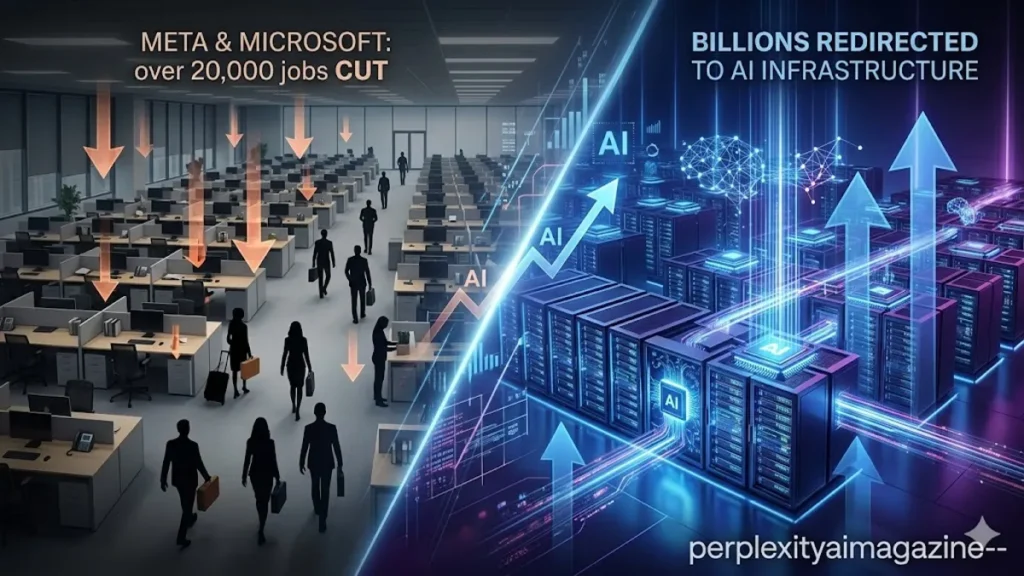
NEW YORK — Two of the world’s most powerful technology companies announced sweeping workforce reductions this week, framing the cuts as necessary steps to fund an accelerating arms race in artificial intelligence infrastructure. – Meta Microsoft AI layoffs.
Meta is laying off approximately 8,000 workers — roughly 10 percent of its global workforce — as it continues to scale up spending on AI infrastructure and highly paid AI-expert hires. The company said the cuts were made in the interest of efficiency and to free capital for new investments. Al Jazeera
Microsoft, meanwhile, is introducing a voluntary separation program — the first of its kind in the company’s 51-year history — against a backdrop of more than 92,000 tech-sector layoffs so far in 2026. GuruFocus
The same companies collectively spending hundreds of billions of dollars annually on AI infrastructure are simultaneously seeking efficiencies from that same AI by reducing headcount. Alphabet, Microsoft, Meta, and Amazon are expected to spend nearly $700 billion combined this year to fuel their AI buildouts. CNBC
Many economists and industry experts now fear a labor crisis may already be underway — not arriving sometime in the future — given the speed with which AI is being embedded across corporate America. As of this week, more than 92,000 tech workers have lost their jobs in 2026 alone, bringing the total since 2020 to nearly 900,000, according to Layoffs.fyi. – Meta Microsoft AI layoffs. CNBC
The picture, however, is not straightforward. Meta announced in March that it would shut down its metaverse platform Horizon Worlds by June. Reality Labs, the division that developed the technology, employed 15,000 people as of January 2026. Some analysts argue that attributing job cuts solely to AI is overly simplistic, and that financial restructuring is also a factor. Techxplore
Both companies are scheduled to report quarterly earnings on April 29, where analysts are expected to press executives on the scope of future spending and the longer-term trajectory of workforce transformation.
Click Here to Read More About AI Related News!
