
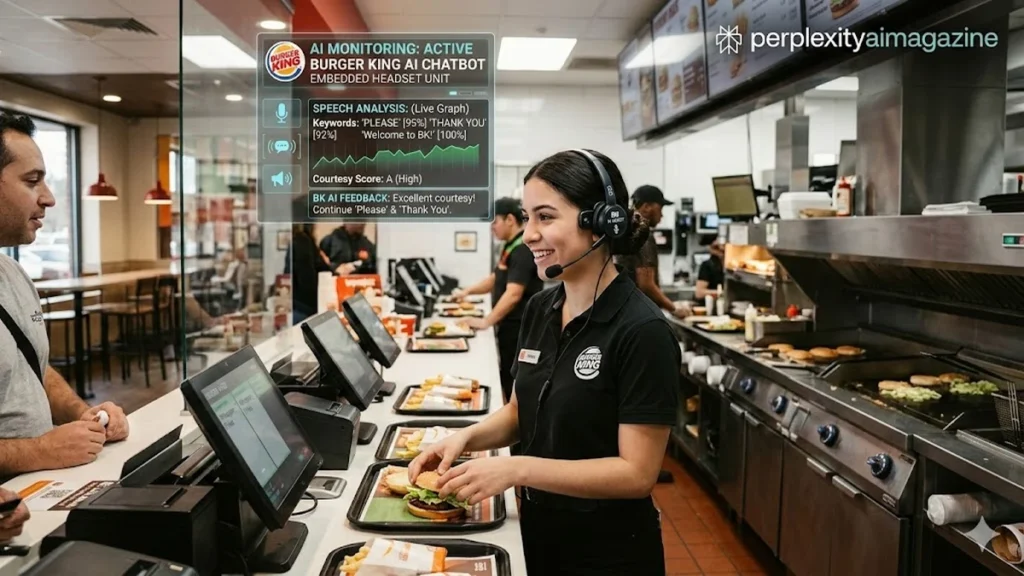
I have covered workplace technology long enough to recognize when a pilot program signals something far larger than an operational tweak. Burger King’s new AI-powered system, BK Assistant, does exactly that. The company has begun testing an artificial intelligence chatbot named “Patty” in employee headsets at roughly 500 U.S. locations. Built with OpenAI technology, Patty listens to drive-thru conversations and detects politeness phrases such as “please,” “thank you” and “welcome.” Managers receive aggregated data showing hospitality trends at the store level, not individual scorecards, the company says. – Burger King AI.
For customers and workers alike, the central question is clear: Is this a coaching tool or a new form of digital surveillance? Burger King describes Patty as a hospitality booster and operational assistant. Beyond tracking courtesy language, it can recite menu recipes, flag low inventory, notify staff of restroom needs and automatically remove unavailable items from digital menus. A nationwide rollout is planned by the end of 2026.
Yet the launch has sparked immediate backlash online, where critics compare it to dystopian fiction and warn about creeping corporate surveillance. The debate arrives at a moment when artificial intelligence is rapidly reshaping service industries, and when trust between employers and hourly workers remains fragile.
How Patty Works
Patty operates through voice recognition embedded in employee headsets worn during drive-thru shifts. Using OpenAI-powered speech recognition, the system detects a limited set of preprogrammed phrases associated with hospitality. These include “welcome to Burger King,” “please” and “thank you.” The technology converts detections into store-level counts rather than producing full conversation transcripts, according to the company.
Managers receive trend reports showing how frequently politeness markers occur across shifts. Burger King emphasizes that Patty is not designed to evaluate individual workers. Instead, the aggregated data helps managers coach teams and improve overall service tone. – Burger King AI.
In addition to language monitoring, Patty acts as a real-time assistant. Employees can ask it for recipe instructions, including ingredient breakdowns for menu staples like the Whopper. The system can alert staff when inventory runs low, flag restroom maintenance needs and automatically remove out-of-stock items from ordering screens.
Read: AI Nuclear War Simulation Study Reveals Escalation Risks
Rollout Timeline and Scope
Burger King began pilot testing Patty in February 2026 at fewer than 500 U.S. restaurants. Executives describe the program as an early-stage trial designed to refine accuracy and gauge operational benefits. A full nationwide rollout is projected by the end of 2026 if results meet internal benchmarks.
The company’s leadership has framed the initiative as a strategic modernization effort following mixed industry experiences with AI in drive-thrus. McDonald’s previously tested AI-powered voice ordering in partnership with IBM but discontinued the pilot in 2024, citing accuracy challenges and shifting toward a Google Cloud partnership.
Unlike customer-facing AI order takers, Patty focuses on employee-side interactions. That distinction sets Burger King apart from competitors experimenting with AI primarily for order automation rather than worker behavior analytics.
AI Use in Fast Food: A Comparison
| Company | AI Application Focus | Employee Monitoring | Status |
|---|---|---|---|
| Burger King | Politeness detection + operations | Yes | Pilot in 500 U.S. locations |
| McDonald’s | Drive-thru order automation | No | Paused IBM pilot |
| Wendy’s | FreshAI order assistant | No | Expanding rollout |
| Taco Bell | Voice ordering AI | No | 100+ locations |
| Panera Bread | Tori drive-thru assistant | No | Pilot phase |
Public Backlash and Cultural Reaction
The public reaction was swift and intense. Social media users likened the system to dystopian television episodes, drawing comparisons to “Black Mirror.” Memes proliferated within hours of the announcement, portraying fast-food workers monitored by invisible digital overseers.
Critics argue that constant listening technology, even if limited to specific phrases, alters the psychological environment of work. Labor advocates question whether employees were fully informed about data handling practices and whether consent mechanisms are robust. – Burger King AI.
Some online commentators have suggested that corporations should prioritize wage increases and staffing improvements over technological oversight. Others counter that hospitality metrics have long existed in the form of secret shoppers and customer surveys, and that AI simply modernizes those tools.
To date, no widespread employee strikes or formal complaints have surfaced. The pilot’s limited scale and early phase may partly explain the absence of organized pushback.
Workplace Surveillance in Context
Workplace monitoring is not new. Retail and warehouse employees have long worked under performance metrics tied to speed and customer satisfaction. What differentiates Patty is its constant audio presence embedded in wearable technology.
Shoshana Zuboff, author of “The Age of Surveillance Capitalism,” has written that digital systems increasingly “render human experience as behavioral data for prediction and control” (Zuboff, 2019). In the fast-food context, politeness becomes quantifiable data.
Privacy scholars warn that even aggregated metrics can create pressure. Daniel Solove, a privacy law expert at George Washington University, has argued that surveillance can chill autonomy even when data collection is partial or anonymized (Solove, 2021).
Burger King insists that Patty’s design avoids individual profiling. Managers view trends rather than personal scores. Still, the perception of being constantly monitored may influence worker morale. – Burger King AI.
Data Handling and Security Risks
Constant audio capture introduces questions about storage, retention and security. Burger King states that Patty does not store full transcripts and focuses only on detecting specific hospitality phrases. However, speech recognition systems inherently process broader audio inputs to function.
If data were breached, biometric voice elements could theoretically be exploited. Voice patterns are increasingly considered biometric identifiers, similar to fingerprints. Security experts note that voice-based systems require robust encryption and strict access controls.
The opacity of AI algorithms adds another layer of concern. Without transparent disclosure of false-positive rates or accuracy benchmarks, employees and regulators must rely on corporate assurances. In drive-thru environments, where background noise, accents and overlapping speech are common, detection accuracy may fluctuate.
General speech-to-text systems often achieve 85 to 95 percent accuracy in noisy settings. Even small error rates could affect aggregated politeness metrics.
Accuracy and Limitations
Burger King has not released public data on Patty’s accuracy. The system currently detects a limited set of phrases rather than conducting comprehensive sentiment analysis. Company representatives have indicated that tone analysis may be added in future iterations. – Burger King AI.
In noisy drive-thru lanes, speech recognition can struggle with car engines, wind and simultaneous conversations. Accents, slang and rapid exchanges may reduce reliability. Overlapping staff voices could also produce detection errors.
Because metrics are aggregated at the store level, the company suggests that minor inaccuracies would not materially affect evaluations. The emphasis remains on coaching rather than scoring.
Potential Technical Constraints
| Challenge | Impact on Detection |
|---|---|
| Background noise | Reduced phrase recognition accuracy |
| Overlapping speech | False positives or missed detections |
| Accents and dialects | Misinterpretation of politeness cues |
| Slang or informal tone | Uncaptured hospitality signals |
| Hardware limitations | Audio distortion or lag |
Ethical and Regulatory Questions
The deployment of AI listening tools intersects with evolving privacy regulations. In Europe, the General Data Protection Regulation mandates purpose limitation and explicit consent for certain forms of monitoring. While Patty operates in the United States, global regulatory frameworks influence corporate practices.
In Illinois, the Biometric Information Privacy Act governs the collection of biometric identifiers, including voiceprints. Although Patty reportedly does not store biometric identifiers, experts say that voice-processing systems must carefully define retention policies.
Ryan Calo, a law professor specializing in technology policy, has noted that workplace surveillance technologies often outpace legal safeguards, leaving regulators to respond after widespread adoption (Calo, 2018).
Burger King maintains that employees are informed of the pilot and that the system complies with applicable labor and privacy laws.
Hospitality as Data
At its core, Patty transforms manners into metrics. Hospitality becomes countable, comparable and improvable through dashboards. For corporate leaders, that offers measurable insight into customer experience.
Historically, fast-food chains have relied on mystery shoppers and customer surveys to gauge service quality. AI monitoring promises real-time feedback rather than delayed reports. That immediacy appeals to executives seeking operational efficiency.
Yet critics argue that hospitality cannot be reduced to word frequency. Tone, warmth and situational context often matter more than scripted phrases. A cashier may omit “please” but convey friendliness through tone. Conversely, a scripted “thank you” may feel robotic.
The tension between authentic service and quantifiable metrics defines much of modern workplace automation.
Broader Industry Landscape
Other chains are experimenting with AI, but not in the same way. Taco Bell, Wendy’s, Panera Bread and KFC have deployed AI to handle drive-thru ordering, improving speed and accuracy. These systems interact directly with customers rather than monitoring staff.
McDonald’s halted its IBM-powered AI order taker pilot in 2024 after technical difficulties and consumer complaints. The company later pivoted toward partnerships emphasizing cloud infrastructure and analytics rather than full automation.
Burger King’s approach remains unique in focusing on employee-side language monitoring through wearable headsets. That distinction places the company at the center of a debate about how far AI should extend into daily workplace interactions.
The Human Factor
So far, direct employee reactions remain largely unreported. The pilot’s limited scale may explain the absence of public testimonials. Media coverage suggests potential discomfort, with some commentators describing the initiative as a “risky bet.”
Employees may interpret aggregated metrics as indirect pressure. Even without individual scoring, store-level performance data can influence managerial decisions. If politeness counts drop, supervisors may increase coaching intensity.
At the same time, some workers may appreciate operational assistance. Real-time recipe recitation and inventory alerts could reduce cognitive load during busy shifts. In high-turnover environments, training support can improve consistency.
The success of Patty may depend less on technical accuracy than on how managers communicate its purpose.
Takeaways
- Burger King is piloting BK Assistant with the AI chatbot Patty in 500 U.S. locations.
- Patty detects politeness phrases in drive-thru interactions and provides operational support.
- The system generates aggregated store-level metrics rather than individual performance scores.
- Public backlash centers on privacy, surveillance and worker autonomy concerns.
- No other major fast-food chain currently monitors employee politeness through AI headsets.
- Accuracy benchmarks and long-term data policies remain undisclosed.
Conclusion
As I examine Burger King’s experiment, I see more than a headset upgrade. Patty represents a turning point in how service work is measured and managed. Artificial intelligence now sits not only at corporate headquarters but directly in the ears of hourly employees.
The company frames the system as a coaching tool designed to boost hospitality and streamline operations. Critics warn that constant listening risks eroding trust and normalizing workplace surveillance. Both interpretations may hold elements of truth.
Technology rarely arrives in isolation. It enters ecosystems shaped by labor conditions, corporate incentives and public expectations. Whether Patty becomes a widely accepted tool or a cautionary tale will depend on transparency, worker engagement and regulatory clarity.
In the end, the debate may not hinge on whether employees say “please” and “thank you,” but on who decides how those words are counted.
FAQs
What is Burger King’s Patty AI chatbot?
Patty is an AI-powered assistant integrated into employee headsets that detects politeness phrases and provides operational support.
Does Patty monitor individual employees?
Burger King says the system generates aggregated store-level data, not individual performance scores.
Is the system recording conversations?
The company states that Patty detects specific phrases and does not store full transcripts.
How accurate is the politeness detection?
No public accuracy metrics have been released. General speech-to-text systems achieve high but imperfect accuracy in noisy settings.
Are other fast-food chains using similar systems?
No. Other chains use AI for drive-thru ordering, not employee politeness monitoring through wearable headsets.
