
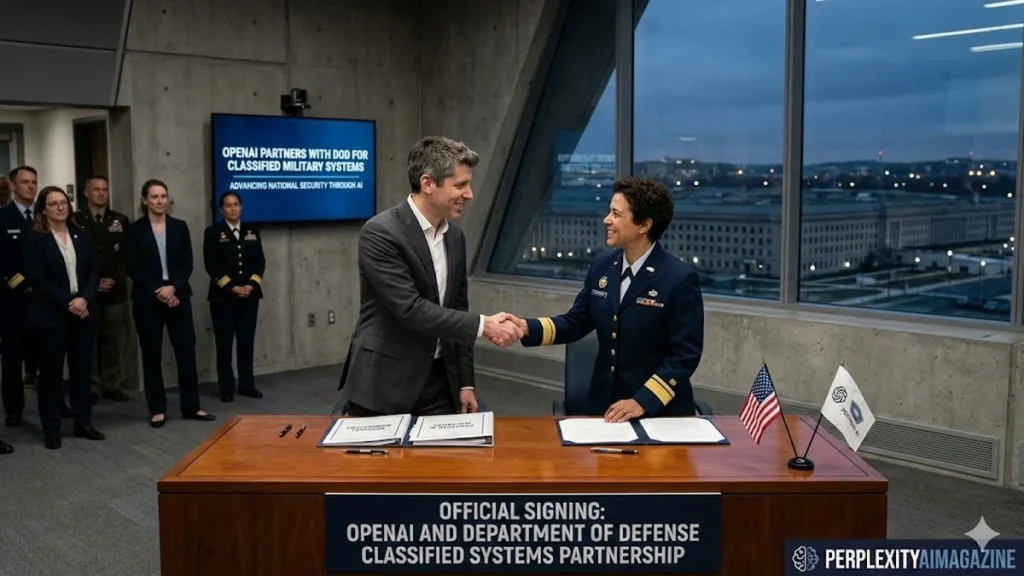
I have reported on defense policy long enough to recognize when a contract signals something larger than a procurement milestone. OpenAI’s Feb. 27, 2026, agreement with the Pentagon does exactly that. The deal authorizes the company’s advanced artificial intelligence systems to operate within classified U.S. Department of Defense networks for intelligence analysis, logistics optimization, cybersecurity, health systems support and strategic planning. It arrived only hours after President Donald Trump ordered federal agencies to halt the use of rival Anthropic’s AI tools following a dispute over operational control and safety restrictions.
For readers seeking clarity, the essential point is straightforward. OpenAI will deploy customized AI systems across classified military environments under explicit safeguards that prohibit domestic mass surveillance and autonomous weapons without human oversight. The Pentagon has agreed to align all deployments with U.S. law and established Defense Department policy. Within days of the announcement, the agreement was amended to add further protections against misuse involving surveillance of Americans.
This agreement builds upon a $200 million pilot contract awarded in June 2025 to develop prototype AI capabilities in warfighting and enterprise domains. Together, these steps mark a structural shift in how artificial intelligence integrates into national defense infrastructure and signal a new era of collaboration between Silicon Valley and the national security state.
The Political Catalyst
The immediate catalyst for the OpenAI agreement was a public clash between the Trump administration and Anthropic. According to administration officials, Anthropic declined Pentagon demands to authorize its models for “all lawful purposes,” citing concerns that the technology could be repurposed for domestic surveillance or unsupervised autonomous weapons systems.
President Trump criticized the company publicly, arguing that elected officials, not private technology firms, determine military doctrine and warfighting strategy. On Feb. 26 and 27, 2026, he directed federal agencies to cease using Anthropic’s AI tools immediately, granting the Pentagon a six-month phaseout window. The order classified Anthropic as a national security supply chain risk.
Defense Secretary Pete Hegseth stated that the department had no intent to conduct unlawful surveillance or deploy unsupervised weapons systems. However, officials insisted that AI vendors must permit use for any lawful purpose under federal authority. Within hours of Anthropic’s removal, OpenAI’s classified agreement was announced, reshaping the federal AI landscape overnight.
OpenAI’s Classified Expansion
The Feb. 27 announcement marked the first confirmation that OpenAI’s frontier models would operate at scale inside classified Defense Department systems. The agreement enables customized versions of ChatGPT and related models to assist intelligence analysts, logistics planners and cybersecurity teams.
Primary applications include intelligence synthesis across vast datasets, strategic scenario modeling, rapid threat assessment and acquisition program analysis. Officials also identified potential improvements in service member health systems, administrative streamlining and proactive cyber defense.
OpenAI leadership framed the expansion as consistent with previously articulated usage principles. The company reiterated prohibitions on domestic mass surveillance and fully autonomous weapons, embedding technical controls to prevent unauthorized repurposing. Human oversight remains mandatory for all force-related decisions.
Read: Block AI Layoffs: Jack Dorsey Cuts 4,000 Jobs in AI Pivot
The June 2025 Prototype Contract
The classified deployment builds directly upon a one-year, $200 million pilot contract awarded in June 2025 by the Pentagon’s Chief Digital and Artificial Intelligence Office. That contract funded prototype “frontier AI capabilities” across warfighting and enterprise domains.
Rather than limiting the technology to combat operations, the pilot focused heavily on administrative modernization. Projects included acquisition data analysis, healthcare system support for service members, logistics forecasting and cybersecurity resilience.
Officials described the pilot as an evaluation phase designed to test the reliability and operational value of large language models in secure environments. The February 2026 agreement represents a transition from experimentation to institutional integration, extending beyond prototypes into embedded classified infrastructure.
Comparison of Major AI Defense Engagements
| Aspect | $200M DoD Pilot (June 2025) | February 2026 Classified Deal |
|---|---|---|
| Scope | Prototype capabilities | Operational deployment |
| Duration | One-year pilot | Multi-year classified integration |
| Environment | Enterprise and limited classified systems | Fully classified DoD networks |
| Focus Areas | Admin, health, cyber, warfighting prototypes | Intelligence, logistics, strategic planning |
| Safeguards | Policy-aligned restrictions | Explicit bans on surveillance and autonomous weapons |
The Anduril Partnership
OpenAI’s defense involvement began prior to the Pentagon’s direct engagement. In late 2024, the company partnered with Anduril Industries, a defense contractor specializing in autonomous surveillance towers and drone defense systems.
That collaboration integrated OpenAI’s models into Anduril’s platforms to counter unmanned aerial threats. Anduril separately secured a $100 million Defense Department contract supporting national security missions aimed at protecting U.S. personnel from aerial attacks.
While the Anduril partnership was platform-specific, focusing narrowly on counter-drone systems, the Pentagon agreement extends AI integration across broader institutional infrastructure. The earlier collaboration served as a technical and operational precursor to full classified deployment.
Comparison of Defense Engagement Phases
| Aspect | Anduril Partnership (Late 2024) | Direct DoD Engagement |
|---|---|---|
| Parties | OpenAI and Anduril | OpenAI and DoD |
| Focus | Drone and UAS defense | Broad military systems |
| Funding | Linked to Anduril’s $100M DoD work | $200M pilot and classified pact |
| Scale | Platform-specific integration | Government-wide deployment |
| Timeline | Ongoing since December 2024 | Announced Feb. 27, 2026 |
Safeguards and Red Lines
The most debated dimension of the agreement centers on safeguards. The contract explicitly prohibits mass domestic surveillance, autonomous weapons without human control and high-stakes automated social scoring systems.
OpenAI deploys what it describes as a multi-layered “safety stack” that includes technical controls designed to detect and block unauthorized repurposing. Human oversight is required for any decision involving force. These safeguards align with existing U.S. law and Defense Department policy.
On March 2, 2026, OpenAI amended the agreement in response to public backlash. The amendment added explicit prohibitions against surveilling U.S. persons, including bans on tracking through commercial data aggregation. Company officials stated that the additional protections exceed prior classified AI agreements in scope and clarity.
Cybersecurity, Intelligence and Operational Use
Within classified networks, AI systems will support intelligence synthesis across large data streams, identify anomalies and assist analysts in prioritizing emerging threats. In cybersecurity contexts, models can model adversary behavior, detect vulnerabilities and accelerate response protocols.
Pentagon officials emphasize that the systems function as advisory tools rather than autonomous decision-makers. Command authority remains with human leaders. AI-generated recommendations are subject to review, interpretation and approval.
The deployment also extends to logistics optimization, healthcare systems support and acquisition program analysis. By accelerating administrative processes, officials argue, AI can improve operational readiness without altering command structures.
Industry and Policy Implications
The removal of Anthropic from federal systems reshapes competitive dynamics across Washington’s AI ecosystem. Federal adoption often signals credibility and commercial validation. OpenAI’s elevation positions it prominently within government markets.
At the same time, the episode highlights enduring tension between private sector ethical frameworks and government authority. Anthropic’s resistance reflected corporate caution regarding potential misuse. The administration’s response underscores its view that lawful authority rests with elected officials.
The episode echoes earlier disputes involving encryption standards, surveillance authorities and defense procurement policy. Artificial intelligence now occupies the center of that debate.
Global Context and Strategic Competition
The agreement unfolds amid intensifying global competition in artificial intelligence. Major powers view AI integration as central to military modernization. Strategic advantage increasingly depends on algorithmic capability, rapid data processing and autonomous system resilience.
By embedding frontier AI models within classified networks, the Pentagon aims to preserve technological superiority. Supporters argue that democratic governance requires leadership in advanced technologies. Critics caution that accelerated military deployment may outpace the development of international norms.
The balance between innovation and restraint remains delicate. The OpenAI agreement reflects an effort to maintain both.
Takeaways
- OpenAI’s Feb. 27, 2026, agreement authorizes AI deployment inside classified Defense Department systems.
- The deal followed an executive order halting Anthropic’s AI tools across federal agencies.
- Safeguards prohibit domestic mass surveillance and autonomous weapons without human oversight.
- The agreement builds on a $200 million pilot contract awarded in June 2025.
- OpenAI’s 2024 partnership with Anduril laid groundwork for defense integration.
- A March 2026 amendment added explicit protections against surveilling U.S. persons.
- The episode highlights tension between corporate AI ethics and federal authority.
Conclusion
From my perspective as a defense reporter, the significance of this agreement extends beyond technology. Artificial intelligence has shifted from experimental pilot programs into the core of classified military infrastructure. The safeguards embedded in the contract signal recognition that public trust depends on restraint, transparency and human oversight.
Yet technology rarely remains static. As AI systems grow more capable, oversight mechanisms will face sustained pressure. Political leadership, institutional discipline and corporate responsibility will shape how these tools evolve within national security operations.
The OpenAI agreement marks a defining moment in the partnership between Silicon Valley and the Pentagon. Whether it strengthens democratic governance or complicates accountability will depend on how rigorously its safeguards are enforced and how carefully its power is exercised.
FAQs
What does the OpenAI-Pentagon deal authorize?
It authorizes OpenAI’s AI systems to operate within classified Defense Department networks for intelligence, logistics, cybersecurity and strategic planning under defined safeguards.
Why were Anthropic’s tools removed?
Anthropic declined to permit unrestricted lawful use of its AI models, prompting an executive order directing federal agencies to stop using its systems.
Does the agreement allow autonomous weapons?
No. The contract explicitly prohibits autonomous weapons without human oversight and mandates human control over force-related decisions.
What changed in March 2026?
An amendment added explicit protections against surveilling U.S. persons, including restrictions on AI-enabled tracking using commercial data.
How does the deal relate to earlier contracts?
It builds on a June 2025 $200 million pilot program and follows OpenAI’s 2024 partnership with Anduril focused on drone defense systems.
